Ask a procurement manager which sewing machine brand is “best” and you’ll usually get a brand name, not a reason. Ask a maintenance mechanic the same question and you’ll get a very different answer, usually built around which brand’s parts are sitting on the shelf and which one keeps calling the service line back. Both perspectives matter, and neither one alone tells the full story of what a machine actually costs a factory over its working life.
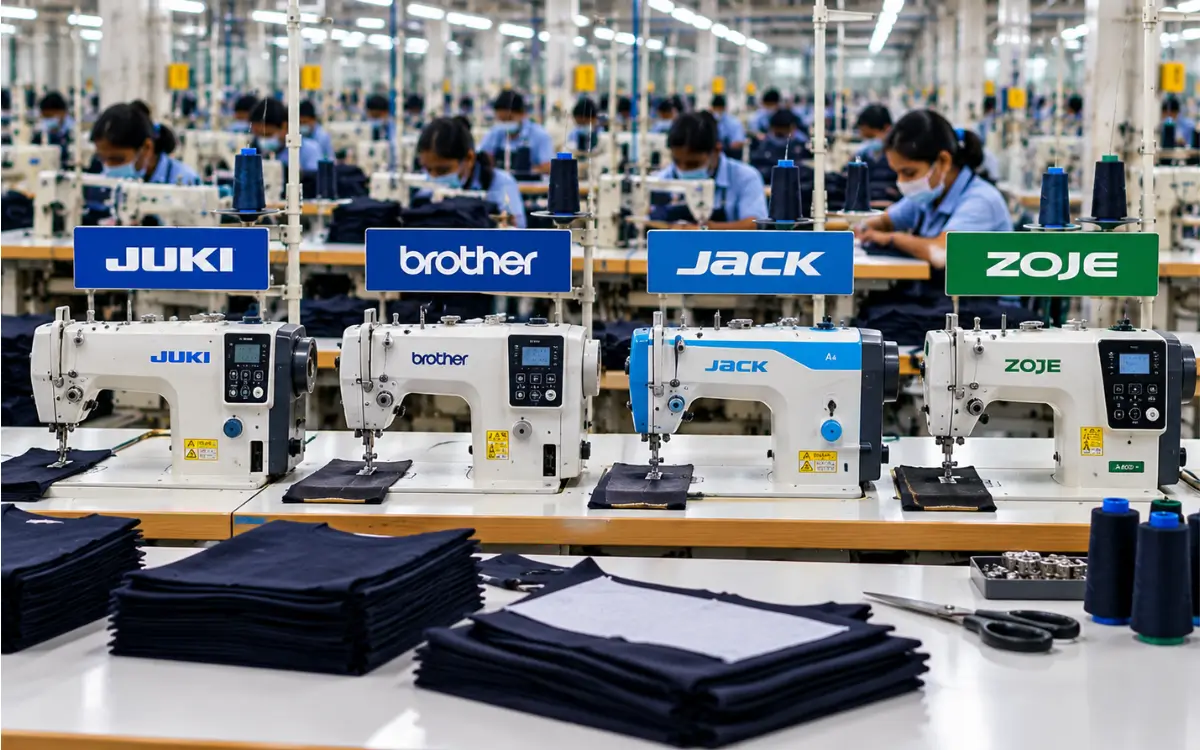
The Four Brands Factories Compare Most
Juki, a Japanese manufacturer, has the longest-established reputation in the industrial sewing machine market and is often treated as the reference point other brands get measured against, particularly on build quality and long-term reliability. Brother, also Japanese, competes closely with Juki on quality while often positioning somewhat more competitively on price, with a strong reputation particularly in electronic and computerized machine categories. Jack, a Chinese manufacturer, has grown rapidly in the mid-market segment, offering a meaningfully lower price point while closing the quality gap with established Japanese brands considerably over the past decade. Zoje, another Chinese manufacturer, occupies similar territory to Jack, competing primarily on price and increasingly on the strength of its direct-drive and computerized machine ranges.
The Distributor Matters as Much as the Brand
It’s worth stating plainly what’s implicit throughout this comparison: in most markets, a factory isn’t buying directly from Juki, Brother, Jack, or Zoje as manufacturers, it’s buying through a local distributor, and that distributor’s own service infrastructure, parts stocking decisions, and business practices often matter more to actual day-to-day experience than the underlying brand’s general market reputation. Two factories buying the same Juki model through two different local distributors can have meaningfully different experiences with parts availability and service response, since the manufacturer’s brand reputation reflects the product itself, not any specific distributor’s operational quality in a given market. This is exactly why the distributor-specific questions covered later in this article, about technician coverage, response time, and actual customer experience, matter as much as, and sometimes more than, the brand name on the machine.
Spare Parts Availability: The Factor That Matters Most Day to Day
A machine’s brand reputation matters far less on a daily basis than whether the local market actually stocks its spare parts. Juki and Brother, given their decades-long presence in major garment manufacturing markets, generally benefit from the deepest and most established local spare parts networks, with parts available through both authorized distributors and a wider secondary market of parts dealers built up over years of machine population in the market. Jack and Zoje have built out their own parts networks considerably as their machine population has grown, though in some markets the network still isn’t as deep or as geographically distributed as the two longer-established Japanese brands.
The practical impact shows up in downtime. A common part sourced from local stock might mean a same-day repair. The same part needing to be ordered internationally can mean days of a machine sitting idle, and that gap in parts availability is often the single biggest real-world difference between brands, more consequential day to day than the modest performance differences between comparable machine models.
Service Response Time
Closely related to parts availability is how quickly a brand’s authorized service network can actually get a technician on-site for issues beyond what an in-house mechanic can resolve. Established brands with a longer market presence generally have a more built-out authorized service network, though this varies considerably by specific market and by how seriously a given distributor invests in service infrastructure versus just moving units. Asking current customers of a given distributor about actual service response time, rather than relying on a brand’s own marketing claims, gives a far more reliable picture than the sales conversation alone.
Resale Value
Machines get resold more often in this industry than buyers outside it might expect, whether through factory downsizing, line reconfiguration, or a factory closing entirely. Established Japanese brands generally hold resale value somewhat better than newer market entrants, partly reflecting buyer confidence in remaining working life and partly reflecting the deeper secondary market and parts availability that makes a used Juki or Brother machine a lower-risk purchase for whoever buys it secondhand. This isn’t a fixed rule across every machine category, and the gap has narrowed as Chinese brands have built a longer track record in the market, but it remains a real consideration for factories thinking about total cost of ownership rather than just purchase price.
Warranty Comparison
Warranty terms vary by distributor as much as by brand, since local distributors typically set their own warranty policy within whatever framework the manufacturer provides. Rather than comparing brands in the abstract, get the actual warranty terms, covered components, and claims process from the specific distributor you’d be buying from, since two distributors selling the same brand in the same market can offer meaningfully different warranty support.
Cost Per Year: The Number That Actually Matters
Purchase price alone is a misleading way to compare these brands, since a cheaper machine with more frequent downtime, shorter working life, or weaker resale value can easily cost more per year of actual service than a pricier machine that runs longer with fewer interruptions.
A more useful comparison divides total cost of ownership, purchase price plus expected maintenance and parts cost over the machine’s working life, minus expected resale value at replacement, by the number of years the machine is expected to remain in productive service. This calculation requires reasonable assumptions about working life and resale value, which vary by brand and by how well the machine is maintained, but even rough assumptions produce a more useful comparison than purchase price alone.
A Worked Cost-Per-Year Example
Here’s how the total cost of ownership comparison plays out with illustrative numbers, which you should replace with real quotations for your own market before making a purchasing decision.
Say Brand X, an established brand with a deep local parts network, costs $1,800 per machine installed, with expected annual maintenance and parts cost of \$90, an expected working life of 10 years, and an estimated resale value of $300 at the end of that period.
Brand Y, a newer entrant with a lower price point, costs $1,200 per machine, but with a thinner local parts network its expected annual maintenance and parts cost runs higher at $160 a year (reflecting more frequent minor repairs and occasional parts sourcing delays), an expected working life of 7 years given generally shorter-lived components in this comparison, and an estimated resale value of $100.
Brand X total cost of ownership: $1,800 (purchase) + ($90 × 10 years) − $300 (resale) = $1,800 + $900 − $300 = $2,400 over 10 years, or $240 per year.
Brand Y total cost of ownership: $1,200 (purchase) + ($160 × 7 years) − $100 (resale) = $1,200 + $1,120 − $100 = $2,220 over 7 years, or about $317 per year.
Despite costing $600 less to purchase, Brand Y works out to roughly $77 more per year of actual service once realistic maintenance cost, working life, and resale value are factored in. This doesn’t mean the cheaper brand is always the wrong choice, a factory with a very tight capital budget and low utilization on that specific machine might still prefer the lower upfront cost despite the higher annual cost of ownership, but it does mean the purchase price comparison alone was actively misleading about which option is actually cheaper over time. Run this same calculation using real quotations and your own honest estimates of maintenance cost and working life for the specific brands and distributors you’re evaluating.
How Factories Actually Decide in Practice
In practice, most Bangladeshi factories land on a mixed fleet rather than standardizing on a single brand across the whole floor. Core, high-utilization operations like standard lockstitch and overlock often lean toward the established, deep-parts-network brands, since downtime risk on high-volume operations is the most expensive place for a parts or service gap to bite. Lower-utilization or specialized machines sometimes get sourced from the more competitively priced brands, where the lower daily utilization makes the parts-availability risk less consequential even if it does occur occasionally.
This mixed approach reflects a reasonable trade-off rather than an unwillingness to commit to one brand. It matches the brand’s specific strengths, parts network depth for high-utilization machines, price competitiveness for lower-utilization ones, to where those strengths actually matter most for the factory’s specific operation.
Questions Worth Asking Before Committing to a Brand
Before finalizing a machinery order with any of these brands, it’s worth asking the local distributor directly: how many technicians cover your factory’s region, what’s the typical response time for an on-site service call, what’s actually in local parts stock versus what needs to be ordered, and what do current customers say about their real experience, not just the distributor’s own claims. These questions matter more to actual day-to-day machine uptime than any specification sheet comparison between the brands themselves.
Frequently Asked Questions
Is Juki always better than Jack or Zoje?
Not necessarily. Juki and Brother generally have deeper spare parts networks and better resale value, but Jack and Zoje have closed much of the quality gap while offering meaningfully lower prices, making the right choice dependent on the specific operation’s utilization.
Does the distributor matter more than the brand?
Often, yes. Two factories buying the same brand through different local distributors can have very different parts availability and service response experiences, since distributor service infrastructure varies independently of the manufacturer’s reputation.
How do I compare total cost of ownership between two machine brands?
Add purchase price to expected maintenance cost over the machine’s working life, then subtract expected resale value, and divide by years of service, as the worked example in this article demonstrates. This often produces a different answer than comparing purchase price alone.
Should every machine on a sewing floor be the same brand?
Not necessarily. Many factories run a mixed fleet, leaning toward deep-parts-network brands for high-utilization core operations and more competitively priced brands for lower-utilization or specialized machines.