Try to sew the cuff of a small sleeve on a normal flat table. The fabric tube will not slide under the needle. You will fight it and the seam will pucker. Now put the same cuff on a machine with a narrow round arm and the tube slips over it like a sock on a leg. The job gets easy. The only change is the shape of the machine bed.
The bed is the base part of the machine where the fabric rests while it is sewn. Different jobs need different beds. This guide explains the main sewing machine bed types, what each is used for, how to choose and how to count machines for a line. For a wider list of machines, see our guide to the sewing machines used in the apparel industry.
What is the bed of a sewing machine
A sewing machine has three main body parts. The base is the bed. The vertical part that holds the head is the pillar. The arm reaches over the bed and carries the needle bar and the presser foot. The bed holds the feed dog, the throat plate and, in most lockstitch machines, the bobbin and hook. If you want to see each part, our article on the parts of a sewing machine and their functions shows them.
The shape of the bed decides how fabric reaches the needle. A wide, flat bed supports big panels. A narrow, rounded bed lets tube-shaped parts slide around it. So the bed type is a main reason you pick one machine over another.
The main sewing machine bed types
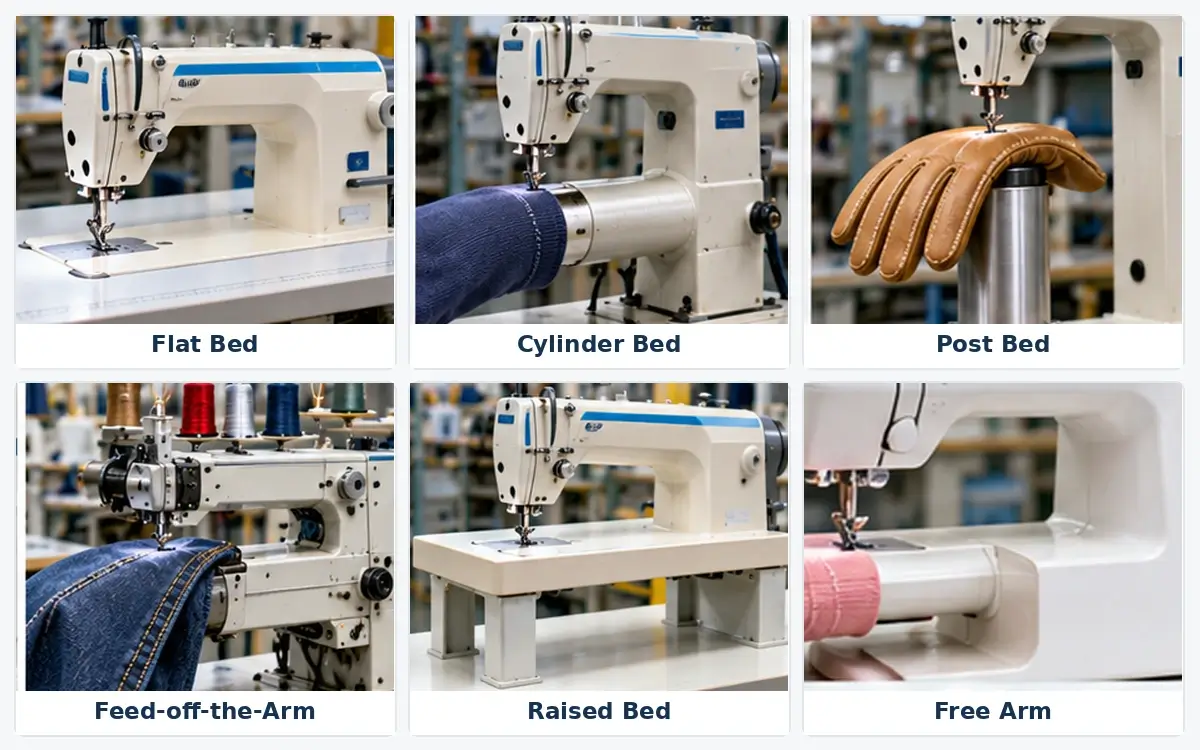
| Bed type | Shape | Best for |
|---|---|---|
| Flat bed | Flat top, level with the table | Seams on open panels, most general sewing |
| Cylinder bed | Narrow round tube sticking out | Cuffs, sleeve hems, bags, shoes, curved parts |
| Post bed | Tall post rising from the bed | Gloves, caps, boots, hard to reach spots |
| Feed-off-the-arm | Arm with the feed to the side | Felled seams, jeans inseam and side seams |
| Raised bed | Bed lifted above the table | Bulky or heavy items, waistbands |
| Free arm (domestic) | Small removable base | Home sewing of cuffs and hems |
Let us look at each one.
1. Flat bed machines
The flat bed is the most common bed in factories. The top of the bed is flat and level with the table. Fabric lies on it and is pushed forward by the feed dog.
Strengths
- Gives wide support for large pieces, so panels do not hang down and pull.
- Easy to handle, so new operators learn it fast.
- Fits the widest range of tasks, from joining shoulders to topstitching.
- Works with many attachments, such as folders and guides.
Limits
- A closed tube, such as a small sleeve or a pant leg, is hard to turn around the needle.
- Awkward for curved or three dimensional parts.
Used for
- Shoulder joins, side seams and hems on open pieces
- Pocket attaching
- Collar and cuff making
- Topstitching on open panels
- Most basic lockstitch work
Most single needle lockstitch machines are flat bed. Our article on the features of a single needle lockstitch machine covers the common model. Overlock, flatlock and many chainstitch machines are also flat bed. To compare them, see lockstitch vs overlock vs flatlock.
2. Cylinder bed machines
A cylinder bed machine has a narrow, round tube in place of a wide flat bed. The tube sticks out toward the operator. The needle sews on top of this tube. Fabric can slide around it, so closed or curved pieces can be sewn without opening them.
Strengths
- Handles tubes, such as sleeve hems, cuffs, trouser hems on children’s wear and bags.
- Good for small, curved parts.
- Lets the operator move the fabric around in many directions.
Limits
- Less support for large flat panels, so they may drag.
- Slower for plain flat seams.
- Needs more skill.
Used for
- Sleeve and leg hems on tube shapes
- Bottom hems on small garments
- Sewing shoe uppers and bags
- Repair work on closed pieces
- Embroidery on caps and tubular items, in some machines
Some cylinder bed machines are lockstitch and some are chainstitch, and many have a walking foot or a compound feed for thick material.
3. Post bed machines
A post bed machine has a vertical post that rises from the bed, like a pole. The needle sits at the top of the post, so the sewing point is well above the table. The operator can pull the item down around the post.
Strengths
- Gives access to deep, hard to reach parts.
- Good for three dimensional items.
- Holds the work high, so it can be turned in many directions.
Limits
- Very specialized.
- Slow for ordinary flat seams.
- Few operators are trained.
Used for
- Gloves, especially finger and thumb areas
- Caps and hats
- Boots and footwear
- Bags with deep parts
- Decorating shaped items
For a glove, this bed is a big help. Our guide on the parts of a glove shows why the fingers are hard to reach on a flat machine.
4. Feed-off-the-arm machines
On a feed-off-the-arm machine, the bed is built like a narrow arm and the feed mechanism sits at the side of the arm. Two needles and a looper system are often used. Fabric is pulled off the arm and out to one side as it is sewn.
Strengths
- Makes strong felled seams in one pass.
- Handles heavy fabric without distortion.
- Keeps long seams straight.
Limits
- Costs more than a flat bed.
- Needs skilled setup.
- Works for few tasks.
Used for
- Jeans inseam and outseam
- Workwear seams
- Shirt side seams in some factories
- Heavy tents and covers
You will meet this bed most in denim production. If denim is your area, our guide on what is denim gives the background.
5. Raised bed machines
On a raised bed machine, the bed is lifted above the table, so the sewing point sits higher and there is room under it. The raised bed makes the work area bigger and easier to manage.
Used for
- Sewing waistbands on trousers
- Bulky seams on heavy fabric
- Attaching items that hang down a lot
A raised bed gives space to guide large or thick pieces. Names and designs differ between makers, so ask the supplier what the model offers.
6. Free arm machines
Home sewing machines often have a free arm. A small removable part of the bed comes off and leaves a narrow arm. It acts like a small cylinder bed for cuffs and hems. Factories rarely use this type, but it is useful to know when you read about domestic machines.
Bed length and width
Some beds are long and some are short. A long bed gives more support. A short bed fits small spaces. The specification sheet will give the bed size in millimeters.
Bed height
The height from table to needle changes with the bed type. A cylinder or post bed raises the work, which changes how the operator sits and how the fabric hangs. Chair and table height should match.
Sewing area clearance (throat space)
The distance between the needle and the pillar is called the throat space. A bigger throat gives more room for large items such as quilts. Check the number in the machine specification.
Feed type
The bed holds the feed dog, but you can also pick the feed system. Plain feed suits light fabric. A needle feed, walking foot or compound feed suits thick or slippery fabric. A cylinder bed with a compound feed is a common pair for bags.
How to choose the bed type
Ask these questions in order.
- Is the part open or closed? Open panels use a flat bed. Closed tubes use a cylinder bed.
- How deep is the item? For deep items such as gloves or caps, think of a post bed.
- Is the seam a felled seam? Jeans and workwear point to a feed-off-the-arm machine.
- How thick is the fabric? Heavy stacks need strong feed and may need a raised bed.
- How big is the volume? A special bed pays off when the quantity is high.
- Who will run it? Special beds need trained operators.
- What does the buyer allow? Check if the buyer sets a stitch or seam type.
Common matches:
| Garment part | Common bed |
|---|---|
| Shoulder join | Flat bed |
| Sleeve cuff hem | Cylinder bed |
| Jeans inseam | Feed-off-the-arm |
| Trouser waistband | Raised or flat bed |
| Glove fingers | Post bed |
| Cap crown | Post bed |
| Bag base | Cylinder bed |
| Collar topstitch | Flat bed |
For more on the sleeve, see the parts of a sleeve.
A worked example: how many machines
Say a line must hem the cuffs on 1,200 children’s jackets a day. The operation takes 0.45 minutes per piece. This is an illustrative time. The line works 8 hours a day, which is 480 minutes, with 85 percent efficiency.
- Work content = 1,200 × 0.45 = 540 minutes
- Available time per machine = 480 × 0.85 = 408 minutes
- Machines needed = 540 ÷ 408 = 1.32, so plan for 2 machines
If the same cuff were sewn on a flat bed, the operator would need to open and handle the tube, and the time might rise to 0.60 minutes. Work content would then be 1,200 × 0.60 = 720 minutes, and machines needed would be 720 ÷ 408 = 1.76, still 2 machines. But the line balance and quality would be worse. Use your own time study for real planning. Our guide on machine requirement calculation in a garment line shows the full method.
Care and setup tips
- Clean lint from the bed and feed dog every day. Lint builds up fast in a narrow cylinder.
- Check the throat plate for scratches. A burr cuts thread and fabric.
- Oil the parts that the maker names, and do not over oil near the fabric path.
- Set the table so the bed is level with the work surface where it should be.
- Change the needle by the schedule. Our guide on the preventive maintenance checklist gives a simple routine.
- Match the needle size and thread to the fabric. A narrow bed leaves little room to hide errors.
Common problems linked to bed type
| Problem | Likely cause | Fix |
|---|---|---|
| Puckering on tubes | Flat bed used for a closed tube | Use a cylinder bed |
| Fabric dragging on a cylinder | Large panel unsupported | Add a table extension |
| Uneven stitches on thick seams | Weak feed | Use a walking foot or compound feed |
| Operator back pain | Wrong chair or work height | Adjust the seat and table |
| Slow output on post bed | Too little skill | Train and use job aids |
| Skipped stitches | Wrong needle, dull needle | Match and change the needle |
Final thoughts
The bed of a sewing machine looks like a small detail, but it shapes how work moves. Use a flat bed for open panels, a cylinder bed for tubes, a post bed for deep items, a feed-off-the-arm machine for felled seams and a raised bed for bulky work. Match the bed to the part, the fabric and the skill of your operators. Count the machines with real time study numbers, and keep the bed clean. The right bed turns a hard job into an easy one.
Frequently asked questions
The bed is the base part of the machine where the fabric rests while it is sewn. It holds the feed dog and the throat plate.
The main types are flat bed, cylinder bed, post bed, feed-off-the-arm and raised bed. Home machines also have free arm beds.
It is used for tube shaped or curved items, such as sleeve hems, cuffs, bags and shoes.
It is used for deep or hard to reach items, such as gloves, caps and boots.
Many jeans factories use a feed-off-the-arm machine for the long felled seams, and flat bed machines for other work.
Neither is better for everything. A flat bed suits open panels. A cylinder bed suits closed tubes and curved parts.
You can, but it gives less support for large panels, so a flat bed is easier.