You raise your arm to reach for a shelf and your shirt pulls across the back. Or you put on a new jacket and the sleeve feels tight just under the armpit. In both cases, the problem sits in the sleeve. The sleeve looks like a plain tube, but it is cut and sewn with great care, because it has to fit a moving arm.
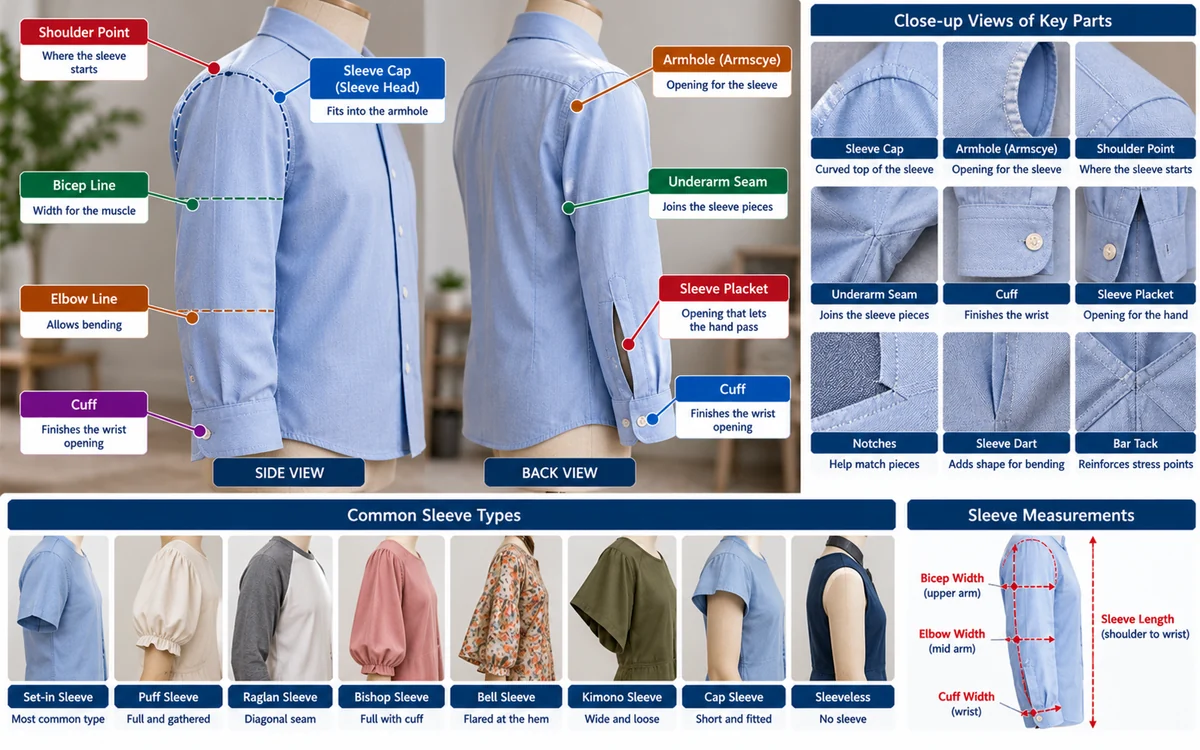
This guide explains the parts of a sleeve in plain words. You will learn the names pattern makers use, how sleeves are joined to the body and what usually goes wrong. If you want to see the sleeve in the context of a whole garment, read our guides on the parts of a shirt and the parts of a t-shirt.
What a sleeve does
A sleeve covers the arm. It must do three jobs at once. It has to look good, it has to fit when the arm is down, and it has to let the arm move up, forward and back. The shape of a sleeve is a balance between these three jobs.
A flat sleeve pattern looks like a wide, bell-shaped piece of fabric. When the sides are sewn together, it becomes a tube with a curved top. That curve is the secret of how a sleeve fits into the armhole.
Parts of a sleeve at a glance
| Part | Location | Job |
|---|---|---|
| Sleeve cap (sleeve head) | Top curve | Fits into the armhole |
| Armhole (armscye) | On the body | Opening for the sleeve |
| Shoulder point | Top of arm | Where the sleeve starts |
| Bicep line | Upper arm | Width for the muscle |
| Elbow line | Mid arm | Allows bending |
| Underarm seam | Inside of arm | Joins the two edges of the sleeve |
| Sleeve hem or cuff | End | Finishes the wrist or arm opening |
| Sleeve placket | Near cuff | Opening that lets the hand pass |
| Notches | Seam edges | Help match pieces |
The sleeve cap
The sleeve cap is the curved top edge of the sleeve. It is also called the sleeve head. It is the most important part of the sleeve, because its shape decides how the sleeve sits on the shoulder.
The cap is a little longer than the armhole it fits into. The extra length is called ease. When the sleeve is sewn in, the operator spreads this ease evenly around the curve, so the sleeve looks smooth. Too little ease makes the sleeve pull and drag. Too much makes it look puffy, with tiny pleats.
A high sleeve cap gives a slim, tailored fit but limits arm lift. A low sleeve cap gives more room but the sleeve may wrinkle at the underarm. Casual shirts and t-shirts use a low cap. Tailored jackets use a higher cap.
The armhole
The armhole, known as the armscye in pattern making, is the opening in the body where the sleeve joins. It is not a plain circle. It is an oval, deeper at the front and back and flatter at the top. Pattern makers shape it to follow the natural line of the arm joint.
The armhole depth is measured from the shoulder point down to the underarm. A deep armhole feels loose and gives more movement. A shallow armhole fits closely and looks smart. Good fit needs the armhole and the sleeve cap to be matched in shape.
Shoulder point and shoulder seam
The shoulder point is where the shoulder ends and the arm begins. On a set-in sleeve, the sleeve cap seam meets this point. If the shoulder seam sits too far toward the neck, the shoulder looks narrow. If it sits too far toward the arm, the garment looks too big.
The bicep, elbow and wrist
The sleeve is wider at the top and narrower at the bottom. Pattern makers measure it at three key places.
- Bicep or upper arm width: The widest part of the sleeve, measured just below the underarm.
- Elbow width: Measured halfway down the sleeve. In fitted sleeves, a dart or a curved seam is added here for bending.
- Cuff or wrist width: The narrowest part, at the bottom edge.
Sleeve length is measured from the shoulder point to the wrist bone, or in some systems from the center back of the neck, across the shoulder, to the wrist. This is called center back sleeve length. It is common in shirt sizing, and it explains why some sleeve sizes are written as 34 or 35, in inches.
The underarm seam and the sleeve seam
The underarm seam is the seam that runs along the inside of the sleeve, from the cuff to the underarm. In most garments, it connects with the side seam of the body. These two seams meet at a point under the arm. That point has to be strong, because it takes a lot of strain when you lift your arm.
Some shirts are sewn with a closed side-and-sleeve seam in one pass. This is common in knit garments. It is faster, but the finishing needs care, because the seams must meet cleanly.
Sleeve types
Sleeves are joined to the body in different ways. The method is what makes each type distinct.
Set-in sleeve
A set-in sleeve is sewn separately into the armhole at the natural shoulder point. It gives the cleanest, most tailored line. Shirts, blazers and most woven garments use it.
Raglan sleeve
A raglan sleeve runs from the neckline diagonally down to the underarm. The sleeve and shoulder are cut as one piece, so there is no shoulder seam on top. Baseball shirts and many sweatshirts use raglan sleeves. They allow free movement and are easy to sew.
Drop shoulder sleeve
In a drop shoulder, the armhole seam sits lower down on the upper arm, not at the shoulder point. The sleeve cap is flat and short. It gives a loose, relaxed look that is common in streetwear and oversized t-shirts.
Kimono sleeve
A kimono sleeve is cut in one piece with the body. There is no armhole seam. The sleeve flows from the shoulder in a straight or slightly angled line. It is easy to sew but limits arm lift in a woven fabric.
Dolman or batwing sleeve
A dolman sleeve is cut deeply into the body and narrows toward the wrist. It has a wide armhole that drapes. It is popular in tops and sweaters.
Cap sleeve
A cap sleeve is a very short sleeve that only covers the top of the shoulder. It does not reach the upper arm.
Puff sleeve
A puff sleeve has extra fabric gathered at the cap or the hem. It gives a rounded, full shape.
Bell sleeve
A bell sleeve fits at the top and flares out toward the wrist, like a bell.
Bishop sleeve
A bishop sleeve is full through the arm and gathered into a cuff at the wrist.
Bracelet and three-quarter sleeves
These describe length rather than shape. A three-quarter sleeve ends between the elbow and wrist. A bracelet sleeve ends just above the wrist.
Cuffs and sleeve ends
How the sleeve ends can change its look and function.
- Plain hem: The edge is turned and stitched. Common on t-shirts.
- Rib cuff: A stretchy band on sweatshirts and jackets.
- Shirt cuff: A stiff band with a button and buttonhole. It can be single or double.
- French cuff: A long band that folds back and fastens with a cufflink.
- Elastic cuff: Elastic is threaded through a channel.
- Velcro cuff: A strap with hook and loop tape. Common on work jackets.
- Slit with buttons: A vent at the end of the sleeve with working buttons.
Sleeve placket
On shirts with button cuffs, a small opening above the cuff, called the sleeve placket, allows the hand to pass through. The placket is usually a narrow strip of fabric that finishes the slit. A neat placket has straight edges and a sharp point on top. Many sewing teams count it as one of the hardest small parts to sew.
Notches and balance marks
Notches are small cuts in the edge of the fabric. They show where pieces should be matched. A double notch usually marks the back of the sleeve. A single notch marks the front. A dot at the top of the sleeve cap marks the point that meets the shoulder seam. Operators who ignore these marks often end up with a twisted sleeve.
How the sleeve is joined to the body
There are two main methods.
Sleeve set flat. The sleeve is sewn to the armhole before the side seams are closed. The body lies flat while the sleeve is attached. This is common in knit garments. It is quick and easy to control.
Sleeve set in the round. The side seam and the underarm seam are sewn first. The sleeve is then attached to the armhole in a circle. This is common in woven shirts and jackets, and it gives a better fit, but it needs more skill.
In a factory, each method becomes an operation on the operation breakdown, with its own machine and time. See our operation breakdown and SMV of a shirt to see how sleeve operations are listed.
Common faults
- Twisted sleeve: The sleeve hangs toward the front or back. It is often a matching problem at the notches.
- Puckered sleeve cap: Too much ease or uneven stitching.
- Tight armhole: The armhole was cut too small or the sleeve cap was too high.
- Uneven sleeve length: One sleeve is longer than the other.
- Pulled underarm: Seams at the underarm are tight or twisted.
- Wavy cuff: The cuff was stretched or the interlining was uneven.
- Open stitching at underarm: Weak stitching in a high-stress area.
- Shade difference: The sleeve fabric comes from a different roll.
For common sewing causes, our guide on sewing defects and root causes is a useful reference.
Quick checks for a good sleeve
- Raise your arm. The garment should not lift more than an inch or two at the hem.
- Look at the sleeve cap. It should be smooth, with no small pleats.
- Check the underarm seam. It should be flat and strong.
- Compare both sleeves. They should be the same length.
- Check the cuff. It should lie flat and fasten easily.
- Look at the sleeve hang. It should fall straight, not twist.
Final thoughts
A sleeve is a small piece of cloth with a big job. The cap fits the armhole, the bicep and elbow give room, the underarm seam holds it together and the cuff finishes it. If you know these parts, you can explain a fit problem with a few words. Check the sleeve cap, the underarm seam and the cuff when you buy or inspect a garment. If those three are right, the sleeve will almost always be right too.
Frequently asked questions
The main parts are the sleeve cap, armhole, underarm seam, bicep, elbow, cuff and sleeve placket. Some sleeves also have darts, gathers or vents.
The sleeve cap is the curved top of the sleeve that fits into the armhole. It is slightly longer than the armhole, so the extra length is eased in.
Armscye is the technical name for the armhole, the opening in the body of a garment where the sleeve is attached.
A set-in sleeve is sewn into the armhole at the shoulder point. A raglan sleeve runs diagonally from the neckline to the underarm, so there is no shoulder seam on top.
A drop shoulder has the armhole seam lower on the upper arm instead of at the shoulder point. It gives a loose, relaxed fit.
It is usually measured from the shoulder point to the wrist bone. In shirts, it is often measured from the center back of the neck, over the shoulder, to the wrist.
Ease is extra fabric in the sleeve cap compared with the armhole. It gives the sleeve a smooth, rounded shape and room to move.