Underwear is the garment you wear closest to your body, for the longest hours. You may not think about it until it itches, rides up or loses its elastic. Comfort in underwear comes from small construction details, such as a soft waistband, a flat seam and a well-made gusset. Learning the parts of underwear helps you buy better, and it helps factories build better.
This guide covers the main parts of men’s and women’s underwear, the common styles and the fabrics used. It also explains how underwear is cut and sewn, and the faults that cause returns. Bangladesh is a major maker of knit underwear, so this topic matters to the industry. For more on that segment, read our overview of the sweater and lingerie subsections of the RMG sector.
What underwear includes
Underwear is a broad term. It covers briefs, boxers, trunks, panties, bikinis, thongs, boy shorts and more. Each style cuts the body differently, but they share many of the same parts.
Parts of underwear at a glance
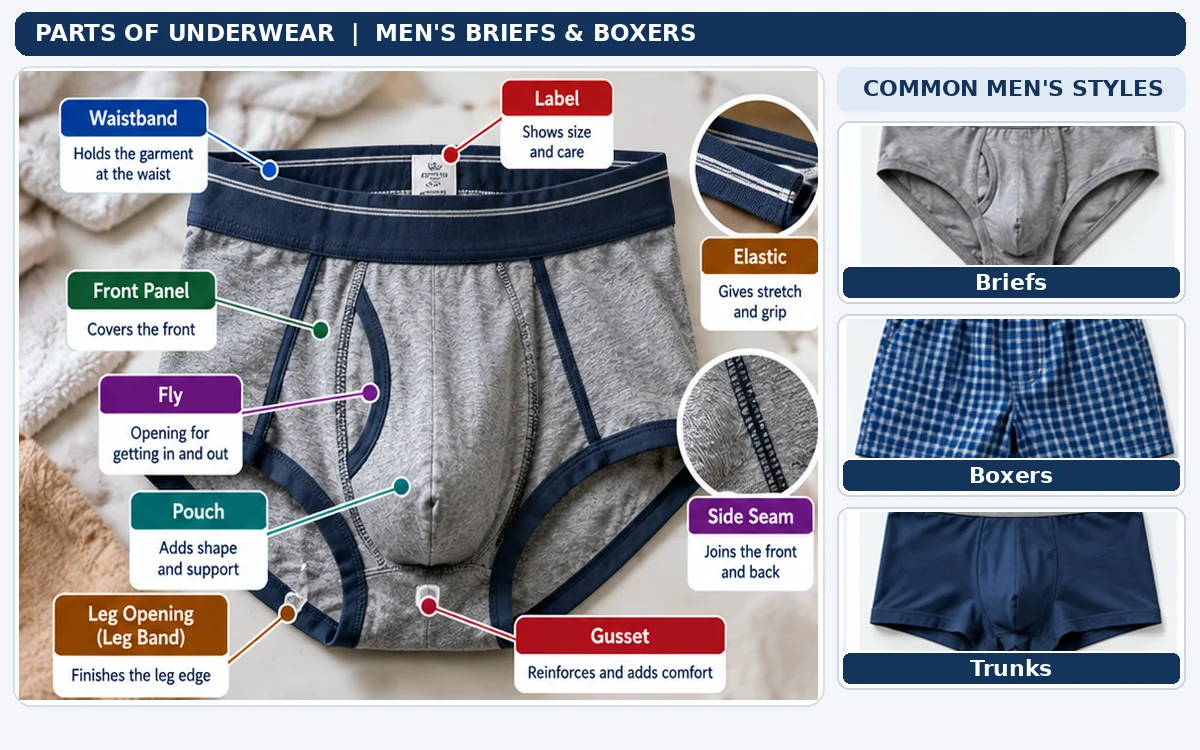
| Part | Location | Job |
|---|---|---|
| Waistband | Top edge | Holds the garment at the waist |
| Elastic | Inside the waistband and leg openings | Gives stretch and grip |
| Front panel | Front body | Covers the front |
| Back panel | Back body | Covers the back |
| Gusset | Crotch | Reinforces and adds comfort |
| Leg opening (leg band) | Around thighs | Finishes the leg edge |
| Side seams | Sides | Join the front and back |
| Fly | Front opening (men’s briefs and boxers) | Allows access |
| Pouch | Front (men’s) | Adds shape and support |
| Label | Inside | Shows size and care |
| Trims | Various | Lace, bows, logo |
Waistband
The waistband is the top edge. It holds the garment at the waist or hips. Waistbands come in several designs.
- Covered elastic waistband: Elastic is wrapped in fabric and sewn into the edge. It is soft and durable. This is common on men’s briefs and boxers.
- Exposed elastic waistband: Elastic is visible on the outside, often printed with a brand name. It is a typical sporty design.
- Fold-over waistband: The fabric is folded over elastic and stitched. It is simple and cheap.
- Lace or plush elastic waistband: A soft, wide band that is gentle on skin. Common in women’s underwear.
- Bonded or laser-cut waistband: No stitching, the edge is bonded flat. It gives a smooth look under clothes.
The waistband must be wide enough to avoid digging in, but not so wide that it rolls. A narrow, hard band can leave marks on the skin.
Elastic
Elastic is a stretchy band made from rubber or spandex yarns, usually covered with nylon or polyester. It is used in the waistband and leg openings. Elastic quality decides how long underwear keeps its shape.
Good elastic stretches and recovers well. Poor elastic loses stretch after a few washes. Heat is a major enemy of elastic. High-heat dryers degrade it quickly.
Elastic width and strength depend on the style. A wide soft elastic is used at the waist. A thinner elastic is used at the legs.
Front and back panels
The front and back panels make up the main body of the garment. For briefs, the front panel curves, with the front rise sitting at or below the waist. For boxers, the panels are wider and more loose. For women’s bikinis, the panels are cut to cover the hips and seat in various levels.
Fabric choices
Most underwear is knitted. Common fabrics include:
- Cotton jersey: Soft, breathable and widely used.
- Cotton and spandex: Gives stretch and fit.
- Modal: A soft cellulose fiber. See our guide on modal fabric.
- Microfiber (polyester and nylon): Smooth, light and quick drying.
- Bamboo viscose: Soft and smooth.
- Lace: Decorative, used on women’s styles.
- Woven cotton (for boxers): Light, loose and cool.
Cotton breathes well but dries slowly. Microfiber dries fast, but some people find it less breathable. Fabric weight is usually light, often around 150 to 200 grams per square meter for jersey, though styles vary.
Gusset
The gusset is a small piece of fabric sewn into the crotch. It reinforces this area, which takes strain, and it adds a layer of breathable material. In women’s underwear, the gusset is nearly always cotton. It is cut as a separate piece and may be doubled.
A gusset gives more comfort by absorbing moisture and by reducing seams in the crotch. It also stops the garment from stretching out of shape. A good gusset lies flat, with no wrinkles.
Leg openings
The leg opening is the edge around each leg. It can be finished in several ways.
- Elastic: A thin band that grips the thigh.
- Plain hem: A turned edge without elastic, used for boxers and loose styles.
- Binding: A strip of fabric wrapped over the edge, often seen on women’s briefs.
- Lace trim: Decorative edges.
- Laser-cut raw edge: Used for no-seam underwear.
The leg opening should hold gently, without cutting into the skin. If the leg band is too tight, it leaves red lines. If too loose, the garment rides up.
Side seams
Side seams join the front and back panels. Many underwear styles have side seams, but some, especially no-seam styles, have none. Side seams should be flat and soft, with no rough edges.
Seams in underwear are often sewn on a flatlock or a cover stitch machine, because these make flat seams that do not rub. A bulky overlock seam can irritate skin. Our guide on lockstitch, overlock and flatlock explains the differences.
No-seam underwear
No-seam underwear is knitted in one piece on a special circular machine, with almost no seams. It has a smooth surface and does not show lines under tight clothes.
Fly and pouch
Fly
Men’s briefs have a Y-shaped front fly, an opening for convenience. It is made from overlapping panels. Boxers have a button fly or an overlap fly. The fly should lie flat with no bulge.
Pouch
The pouch is a shaped panel in men’s briefs and trunks. It adds support and comfort. Some designs use a separate piece sewn in, and others use a molded or contoured shape.
Labels and trims
Underwear labels are often printed directly on the fabric, or heat-transfer labels are used, to avoid scratchy tags. Care labels may be sewn into the side seam or printed inside the waistband. For more on heat-transfer labels, read our guide on heat transfer operation guidelines.
Trims include:
- Bows: Small bows at the waist of women’s styles.
- Lace: On waistbands and legs.
- Brand logos: Woven or printed.
- Hang tags: Attached at the side.
Underwear styles and their parts
| Style | Cut | Features |
|---|---|---|
| Brief | Close fit, high or low rise | Y-front fly, gusset, covered waist |
| Boxer | Loose, longer legs | Button fly, woven cloth |
| Boxer brief | Longer legs, fitted | Knit fabric, pouch |
| Trunk | Short boxer brief | Fitted, short leg |
| Bikini (women’s) | Moderate coverage | Elastic legs, gusset |
| Hipster | Higher legs, mid-rise | Wider side panels |
| Brief (women’s) | Full coverage | High rise, wide leg opening |
| Thong | Minimal back coverage | Narrow back strip |
| Boy short | Longer leg | Soft hem, wide gusset |
How underwear is made
A knit brief or panty follows these steps.
- Fabric preparation. Jersey is relaxed and inspected.
- Cutting. Front, back and gusset pieces are cut.
- Gusset attachment. The gusset is sewn into the front or back.
- Side seams. Front and back are joined at the sides.
- Waistband. Elastic is sewn on.
- Leg openings. Elastic or binding is added.
- Labels. Care labels or heat transfers are applied.
- Finishing. Threads are trimmed and the garment is pressed.
- Inspection and packing. Each piece is checked and folded.
For a timed list of these steps, see our guide to the operation breakdown, SMV and layout of lingerie.
Men’s and women’s underwear compared
The two share the same basic parts, but the shaping differs. Men’s styles focus on the front, with a fly or a pouch to support and give room. Women’s styles focus on the hip and seat, with wider side panels, leg openings cut at different heights and lace or bow trims. Women’s gussets are usually wider, and they are made of cotton. Both types need a soft waistband and flat seams. Children’s underwear follows the same logic in smaller sizes, with extra attention to soft labels and plain, skin-friendly fabric.
Fit and sizing
Underwear size is usually based on waist or hip measurement. Measure around the natural waist for men’s briefs and boxers, and around the fullest part of the hips for women’s styles. Because the fabric is knit and stretchy, each size covers a range. Between sizes, choose the larger one for comfort, since a small pair digs in at the waistband and leg openings. Check the size chart of each brand, because sizing differs from one maker to the next. A pair that fits well should stay in place when you sit, bend and walk, with no red marks left on the skin at the end of the day.
What buyers check in a factory
On an export order, the buyer’s inspector looks at a short list of points. They measure the waist and leg opening at rest and at stretch, and they check that the elastic returns to its size. They run a hand over the gusset and seams to feel for roughness. They check the label position and the print quality, because labels are a common reason for claims. They pull the seams to test strength and look at shade matching across the pair. These checks are written in the buyer’s specification, so factories keep a copy at the inspection table.
Care and washing
Wash new underwear before wearing it to remove loose dye and finishing chemicals. Use warm or cool water, not hot, and avoid strong bleach on elastic. Tumble dry on low or hang to dry. Heat shortens the life of elastic more than anything else. Replace a pair when the waistband no longer holds, the fabric thins or the leg bands stretch out.
Common faults
- Twisted waistband: Elastic is stretched unevenly.
- Rolling waistband: Narrow or stiff elastic.
- Leg band marks: Elastic too tight.
- Gusset wrinkles: Poor sewing.
- Seam irritation: Bulky or rough seams.
- Loss of elasticity: Low quality elastic or high heat.
- Shrinkage: Cotton that was not pre-shrunk.
- Shade variation: Different dye lots.
- Pilling: Short fibers rub together.
- Loose threads: Poor trimming.
How to choose well
- Check the waistband. It should stretch and return.
- Look at the gusset. It should be cotton and flat.
- Feel the seams. They should be smooth.
- Check the fiber. Cotton and modal breathe well. Microfiber suits sports.
- Pick the right size. Tight pairs ride up. Loose pairs bunch.
- Wash before wearing if you have sensitive skin.
Final thoughts
Underwear looks plain, but every part affects comfort. The waistband and leg elastic hold the fit, the gusset gives breathable support and the seams decide whether it irritates. When you buy a pair, check the waistband, the gusset and the seams first. If they are soft and flat, you will probably forget you are wearing them, which is exactly the point.
Frequently asked questions
The main parts are the waistband, elastic, front and back panels, gusset, leg openings and side seams. Men’s styles may also have a fly and a pouch.
The gusset is the small piece of fabric in the crotch. It reinforces the area and adds a breathable layer.
Cotton absorbs moisture and breathes well. This helps keep the area comfortable and clean.
No-seam underwear is knitted in one piece with very few seams. It has a smooth surface and does not show lines under clothing.
It rolls when the elastic is too narrow or stiff, or when the fabric is too light for the band.
It depends on use and care. Many people replace underwear once the elastic loses stretch or the fabric thins.
Cotton is a popular all-round choice. Modal is softer. Microfiber suits exercise.