
Jute fiber is the soft, shiny, golden strand that has carried rice, sugar and cement around the world for more than a century. People call it the golden fiber, and the name fits. Jute is cheap, strong and grows with little help from chemicals. It is also one of the few fibers where Bangladesh sits at the center of the story, because the delta soil and the monsoon rains suit the plant very well.
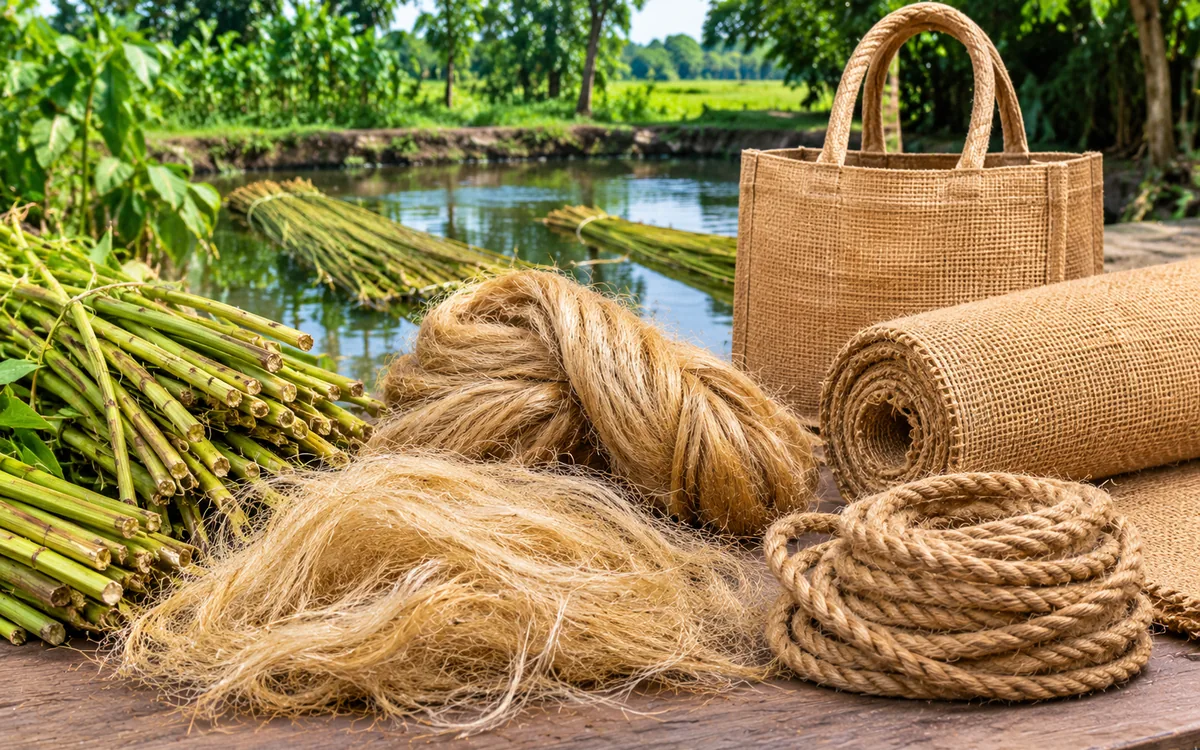
This guide explains what jute fiber is, how the plant grows, how the fiber is pulled out of the stem and what the finished fiber can and cannot do. It covers the main uses, a worked weight calculation for hessian and the pros and cons of the fiber. If you want to see how jute fits among other fibers, read our guides on the classification of textile fiber and the different types of textile fibers.
What is jute fiber
Jute is a natural fiber that comes from the stem of the jute plant. It belongs to the group called bast fibers. Bast fibers sit in the outer layer of a plant stem, just under the bark. Flax, hemp, ramie and kenaf are other bast fibers.
The two main jute species are white jute (Corchorus capsularis) and tossa jute (Corchorus olitorius). White jute is the more common one. Tossa jute gives a softer, stronger and finer fiber, and many mills prefer it for better quality goods.
A single strand is long. Jute fiber bundles can run one to four meters from end to end. The color ranges from pale cream to deep brown, and good grades have a golden shine.
Where jute is grown
Jute needs a warm, humid climate and plenty of water. It does best on the flat, river-fed land of South Asia. The FAO notes that India and Bangladesh together produce most of the world’s jute. Its figures put India at roughly 60 percent and Bangladesh at roughly 30 percent, with small amounts from Nepal and Myanmar. Shares move from year to year with weather and prices, so treat these as a rough guide.
Jute is an annual crop. Farmers sow seed in spring and cut the plants after about 120 days. Because it grows fast and mostly on rain, it needs little fertilizer or pesticide compared with many other crops. That is one reason jute is often described as a low-impact fiber.
How jute fiber is made
Step 1: Growing and harvesting
The plants grow tall, often two to four meters. At harvest, workers cut the stems near the ground. The leaves are shaken off and left in the field. They rot and feed the soil.
Step 2: Retting
Retting is the step that loosens the fiber from the woody core. Farmers bundle the stems and sink them in slow, clean water for two to four weeks. Bacteria in the water break down the gum and pectin that glue the fiber to the stem.
Retting is the most critical step for quality. A few days too short, and the fiber stays harsh and hard to strip. A few days too long, and the fiber weakens and turns dull and dark. Clean, moving water gives lighter, stronger fiber than still, dirty water. Many projects now teach farmers better retting methods and use ribbon retting machines to improve both the color and the strength.
Step 3: Stripping and washing
After retting, workers strip the fiber from the stem by hand. They hold a bundle of stems, beat them gently, then pull the long ribbons of fiber off. They wash the fiber in clean water and hang it in the sun to dry.
Step 4: Grading and baling
Dry fiber is sorted into grades by color, length, strength and cleanliness. Buyers and mills use grade names that differ by country, such as the Bangladesh white and tossa grades. The fiber is pressed into bales and sent to mills.
Step 5: Mill processing
At the mill, the fiber goes through batching, where it is softened with oil and water. Then it is carded to open and align the fibers, drawn to even out the strands, and spun into yarn. Jute spinning uses its own machines, not cotton ones. For the full step list, see our process flow chart of jute spinning.
The yarn is then woven into hessian (burlap), sacking or other cloth, or twisted into twine and rope.
Properties of jute fiber
| Property | What it means |
|---|---|
| Length | Long fibers, often one to four meters in the bundle |
| Color and look | Golden to brown, with a natural shine |
| Strength | High tensile strength, one of the strongest natural plant fibers |
| Stretch | Low elongation, so it does not give much under load |
| Moisture | Absorbs moisture readily and dries fairly fast |
| Breathability | Breathes well, which suits food and grain storage |
| Insulation | Low heat conductivity and good antistatic behavior |
| Composition | Mainly cellulose and lignin, which makes it stiff and woody |
| Biodegradability | Breaks down naturally and can be recycled |
| Feel | Rough and coarse compared with cotton |
The high lignin content is what makes jute coarse. It also makes the fiber sensitive to sunlight and damp. Jute loses strength when it stays wet for long, and it yellows when left in strong sun.
Jute vs other fibers
| Fiber | Strength | Softness | Cost | Typical use |
|---|---|---|---|---|
| Jute | High | Low | Low | Sacks, hessian, carpet backing |
| Cotton | Medium | High | Medium | Clothing, home textiles |
| Flax (linen) | High | Medium | High | Clothing, bedding |
| Hemp | High | Low to medium | Medium | Rope, canvas, clothing |
| Polypropylene | High | Low | Low | Sacks, ropes, geotextiles |
Jute competes mainly with polypropylene in packaging. Polypropylene is lighter and does not rot, but it comes from oil and does not break down easily. Jute is natural and biodegradable, and many buyers now pay attention to that.
Uses of jute fiber
Traditional uses
- Sacks and bags: Sacking is still the largest product group. Jute sacks carry grain, sugar, coffee, cocoa and potatoes.
- Hessian (burlap): A plain-woven jute cloth used for wrapping, bagging, sandbags and plant covers.
- Twine and rope: Jute twine is used in farming, packaging and craft work.
- Carpet backing: Primary and secondary backing for carpets and rugs.
Textile and home uses
- Curtains, chair covers and rugs: The natural look suits home decor.
- Blended yarns: Jute can be blended with cotton, wool or synthetic fibers.
- Fashion bags and shoes: Jute shopping bags, tote bags and the upper of espadrilles.
- Jute canvas: A softer, finer cloth used for bags and covers.
Technical and green uses
- Geotextiles: Jute nets and mats hold soil on slopes and riverbanks, then rot away once plants have rooted.
- Composites: Jute mixed with plastic or resin makes panels, car interior parts and furniture boards.
- Paper and pulp: Jute stems and fiber waste can go into paper pulp.
- Agriculture: Biodegradable pots and mulch mats.
- Jute sticks: The woody stem is used as fuel and fencing in villages.
For related uses of rough natural fibers, see our guide to canvas fabric.
A worked example: hessian weight in GSM
Hessian is often sold by weight in ounces per yard at a fixed width. Say a buyer asks for 10 oz hessian, 40 inches wide. To compare it with metric specs, convert to grams per square meter (GSM).
- Weight of one yard length = 10 oz × 28.35 g = 283.5 g
- Length = 1 yard = 0.9144 m
- Width = 40 inches = 1.016 m
- Area of one yard length = 0.9144 × 1.016 = 0.929 m²
- GSM = 283.5 ÷ 0.929 = about 305 GSM
So 10 oz hessian at 40 inches is close to 305 GSM. A 12 oz hessian of the same width would be about 366 GSM. The same method works for any fabric sold by ounces per yard. Buyers should always confirm the width, because a wider cloth at the same ounce weight is lighter per square meter.
Advantages of jute fiber
- It is cheap and widely available in South Asia.
- It is strong and holds heavy loads.
- It breathes, so grain and produce stay fresher than in plastic.
- It is biodegradable and can be recycled.
- It needs little fertilizer and pesticide.
- It supports farm income for millions of households in Bangladesh and India.
Limitations of jute fiber
- It is coarse and not comfortable against the skin.
- It loses strength when wet for a long time and can rot or grow mold.
- It yellows and weakens in strong sunlight.
- It creases and does not recover well.
- It sheds small dust and fiber particles in processing.
- Retting uses a lot of water and can pollute ponds and canals if done badly.
- Prices change with weather and with the cost of polypropylene.
Mills try to fix the roughness with softening oils, enzyme treatment or blending. Jute that has been treated with enzymes can be spun into finer yarn for fashion cloth.
Quality checks for jute fiber
Mills and buyers check these points when they buy bales or yarn.
- Grade and color: Match the sample, and look for dark spots or stains.
- Fiber length: Longer fibers make stronger yarn.
- Strength: Test breaking load of bundles or yarn.
- Moisture: Jute bales should not be damp. Too much moisture causes heating and rot in storage.
- Root content: The hard, woody root end should be low.
- Cleanliness: Check for sticks, sand and foreign matter.
- Yarn count and evenness: For yarn, check the weight per length and look for thick and thin places. Our guide on yarn count explains the units.
Jute and sustainability
Jute is often called an eco-friendly fiber, and much of that is fair. The plant takes in carbon dioxide as it grows, needs few chemicals and leaves leaves and roots in the soil. The fiber breaks down at end of life. But it is wise to avoid absolute claims. Retting can pollute water if done in dirty ponds, and mill processing uses energy and oil for batching. Brands that talk about jute should talk about the real gains and the real work still needed.
Care of jute products
- Keep jute dry. Store in a ventilated place.
- Brush off dust with a soft brush or vacuum with a light setting.
- Spot clean with a damp cloth and mild soap, then dry quickly.
- Avoid soaking jute rugs, because they may shrink and lose color.
- Keep away from strong sunlight when not in use.
Final thoughts
Jute fiber is simple, strong and honest. It starts as a tall plant in a wet field, becomes a golden bundle after retting and ends up as a sack, a rug or a soil-saving mat. It has clear limits. It is coarse, it dislikes long damp and sun, and its quality depends on careful retting. Still, few fibers match its price, its strength and its natural story. For buyers, check grade, length and moisture. For growers and mills, better retting and clean water give the biggest gains in quality.
Frequently asked questions
Jute fiber is a long, shiny natural fiber taken from the stem of the jute plant. It is used mainly for sacks, hessian, twine, carpet backing and technical textiles.
Most jute comes from India and Bangladesh, where the warm, humid climate and river soil suit the plant. Small amounts come from Nepal and Myanmar.
Farmers cut the plants, soak the stems in slow water for a few weeks, then strip the loosened fiber by hand, wash it and dry it in the sun. This soaking step is called retting.
Yes. Jute has high tensile strength, but it does not stretch much. It loses strength if it stays wet for a long time.
Yes. Jute is a plant fiber and breaks down naturally. Coatings or blends with plastic can change this.
Jute is the fiber. Hessian, also called burlap, is a plain-woven fabric made from jute yarn.
It can, but the fiber is coarse. Fine, enzyme-treated jute is blended with cotton or other fibers for fashion goods.


