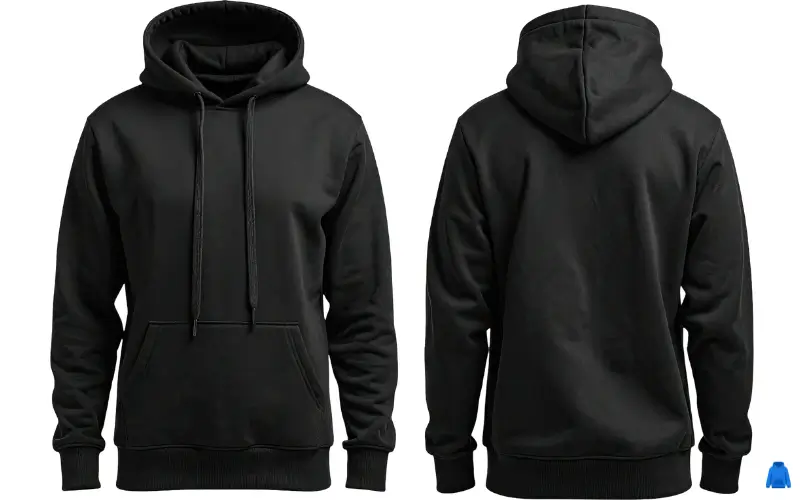
A coat is the garment you rely on when the weather turns. It has to keep out wind, rain and cold while still looking good. To do that, a coat uses more layers and more parts than almost any other garment. If you understand the parts of a coat, you can compare coats fairly, ask smart questions in a shop and know which details justify a higher price.
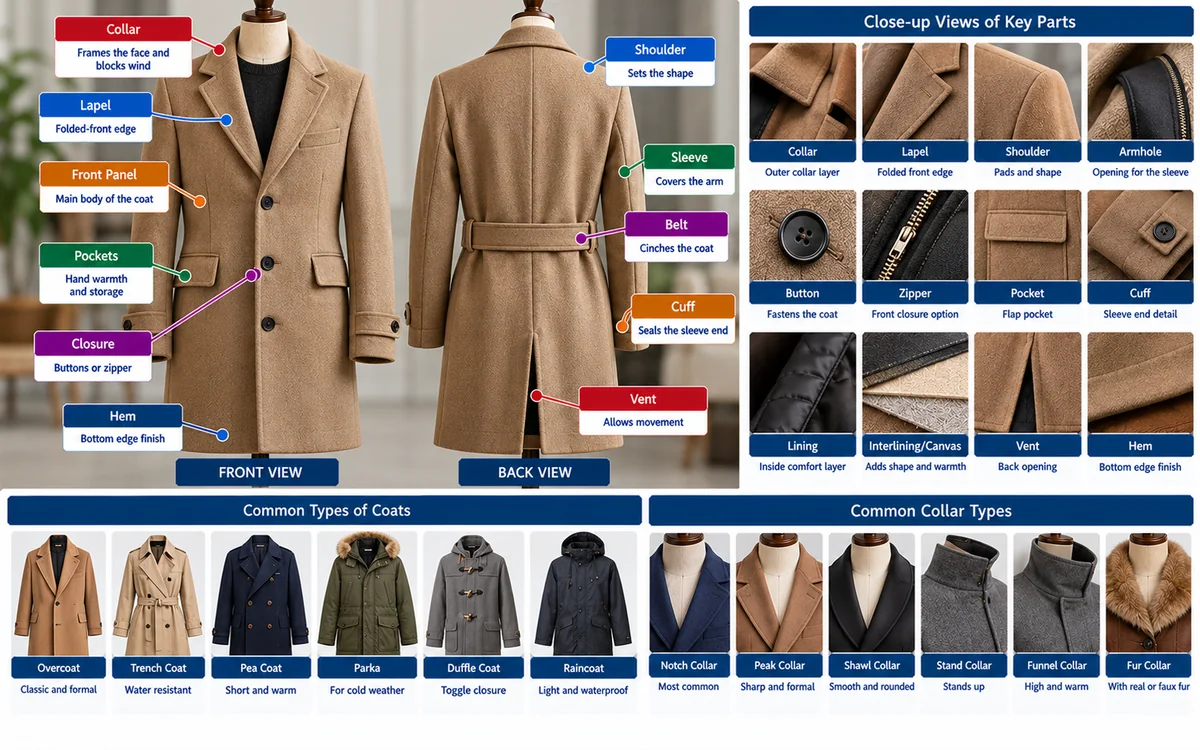
This guide goes from the collar to the hem, then inside to the layers. It explains what each part does, what a coat is made from and what factories check. Many coat parts are shared with jackets, so if you have read our guide on the parts of a jacket, some of this will be familiar. A coat is longer, heavier and built for outdoor weather.
Coat or jacket
A coat is a long outer garment that usually reaches at least the hip and often the knee or lower. A jacket stops at the waist or hip. Coats are made from heavier fabrics and have more layers. Common types include overcoats, trench coats, parkas, pea coats, duffle coats and raincoats.
Parts of a coat at a glance
| Part | Location | Job |
|---|---|---|
| Collar | Neck | Frames the face and blocks wind |
| Lapel | Front | Folded-back front edge |
| Shoulders | Top | Set the shape |
| Sleeves | Arms | Cover the arms |
| Cuffs | Wrists | Seal the sleeve ends |
| Front body | Chest | Main panel |
| Back body | Back | Main panel |
| Closure | Front | Buttons, zip or belt |
| Pockets | Front | Hand warmth and storage |
| Lining | Inside | Comfort and finish |
| Interlining | Between shell and lining | Warmth and shape |
| Vent | Back hem | Allows movement |
| Hem | Bottom | Finishes the edge |
| Belt | Waist | Cinches the coat |
Collar
A coat collar protects the neck from wind and rain. It often stands higher than a shirt collar. Common types include:
- Notch collar: A tailored collar with a small notch where it meets the lapel. Common on overcoats.
- Peak collar: The lapel points upward. More formal.
- Shawl collar: A smooth rounded collar with no notch. Used on robes and some coats.
- Stand collar: A collar that stands up around the neck, with no fold.
- Funnel collar: A high tubular collar. Seen on parkas.
- Storm collar: A high collar that can be closed across the throat.
- Fur collar: A collar with real or faux fur for warmth.
- Hood: A hood replaces the collar on parkas and duffle coats.
On tailored coats, the collar has an upper layer and an under collar. The under collar is often cut from a felt-like fabric, so it can be shaped into a smooth roll. For more about how collars are built, read our guide on the parts of a collar.
Lapel and revers
The lapel is the folded-back flap on the front of a tailored coat. The revers is its inner face. They add width and interest to the chest. A wide lapel suits a long coat. A narrow lapel suits a slim cut. The fold line is called the roll line.
Shoulders and sleeves
The shoulder seam sits at the edge of your shoulder bone. Coats often have a shoulder pad or a thin wadding layer to give shape and to fit over thick clothes.
Coat sleeves are cut a little wider than jacket sleeves, because you wear layers beneath them. They have a set-in or raglan shape. A raglan sleeve runs from the neckline to the underarm and is easier to move in. Our guide on the parts of a sleeve explains the difference.
Armhole
The armhole must be cut with extra room, so you can lift your arms in a thick coat. Overcoats often have an underarm gusset or a deeper cut.
Cuffs
Coat cuffs keep cold air out. Types include:
- Plain hem cuff: A simple turned edge.
- Tab cuff: A strap with a button that tightens the sleeve.
- Inner storm cuff: A knitted sleeve inside the coat sleeve that hugs the wrist. Found in parkas and winter coats.
- Elastic cuff: Elastic around the wrist.
- Velcro cuff: Hook and loop tape for adjustment.
- Turn-back cuff: A deep folded cuff, sometimes seen on duffle coats.
Body
Front and back
The front and back panels make up the body. A long coat has long panels and often a seam at the waist or a belt to shape it. The back may have a center seam, a pleat or a back yoke. Back pleats give room for movement.
Yoke
Some coats, like trench coats, have a shaped panel across the upper back and shoulders. This is called a yoke. A trench coat also has a gun flap, a patch of fabric on the chest, and a storm shield. These were built for soldiers and are now mostly decorative.
Side seams and darts
Side seams join front and back. Tailored coats use darts to shape the waist.
Closure
Coats close in several ways.
- Single-breasted buttons: One row of buttons down the center.
- Double-breasted buttons: Two rows of buttons, with one side overlapping.
- Zipper: A strong zip, often with a storm flap over it.
- Toggles and loops: Duffle coats use wooden toggles and rope loops.
- Snap buttons: Common on rain jackets and parkas.
- Belt: A fabric strap with a buckle, tied at the waist. Common on trench coats and wrap coats.
- Wrap: The coat overlaps and ties without buttons.
Buttons on coats are large and strong. They often use shanks, because coat fabric is thick. For more, see our guide on the parts of a button.
Placket and storm flap
The placket carries buttons and buttonholes. On parkas, a storm flap covers the zipper to keep wind and rain from passing through the teeth.
Pockets
Coat pockets need to be deep and strong.
- Patch pocket: A flat piece sewn on the outside.
- Flap pocket: A pocket with a flap on top.
- Welt pocket: A slit with bound edges.
- Slash pocket: A slanted opening in the seam.
- Hand-warmer pocket: A pocket lined with soft fleece.
- Inside pocket: A pocket in the lining for valuables.
- Zip pocket: A pocket with a zipper.
See our guide on the parts of a pocket for detail.
Lining
The lining is the inner layer of the coat. It makes the coat comfortable, hides the seams and lets the coat slide over other clothing. Common linings are:
- Polyester: Strong and low cost.
- Viscose or rayon: Smooth and breathable.
- Cupro: Silky and breathable.
- Fleece: Warm, used in winter coats.
- Quilted lining: Adds insulation.
- Sherpa or faux fur: Very warm.
Lining must be cut with extra length, called ease, so that it does not pull the coat when you move.
Interlining and insulation
Between the outer fabric and the lining is the interlining. It provides shape or warmth.
- Canvas: A stiff woven cloth in tailored coats. It supports the chest and lapel.
- Fusible interlining: A layer of glue-backed fabric bonded to the shell.
- Wadding or batting: Soft polyester padding for warmth.
- Down: Soft feathers from ducks or geese. Light and very warm.
- Synthetic insulation: Polyester fiber that mimics down but handles wet better.
- Thermal lining: A reflective layer that holds heat.
Warmth depends on how much air the insulation traps. Down is rated by fill power, a measure of how much space an ounce of down fills. A higher fill power means more warmth for less weight. Always check the coat’s label for the fill details.
Shell fabrics
The outer layer of a coat is chosen for weather and style.
| Fabric | Features | Coat type |
|---|---|---|
| Wool | Warm, breathable, classic | Overcoat, pea coat |
| Cashmere blend | Soft, luxurious | Dress coat |
| Gabardine | Tightly woven, water resistant | Trench coat |
| Cotton canvas | Strong | Work coat |
| Nylon | Light, windproof | Parka, puffer |
| Polyester | Durable, quick dry | Rain coat |
| Waxed cotton | Waterproof | Field coat |
| Leather | Wind resistant | Leather coat |
| Shearling | Very warm | Winter coat |
Wool coats often use melton, a dense wool cloth with a felted surface, which blocks wind.
Vent and hem
Many coats have a vent at the back so that the wearer can walk and sit easily. Overcoats may have a center vent, while some long coats have a deep side slit.
The hem is the bottom edge of the coat. It is usually turned and stitched, with the lining attached just above it. A weighted hem keeps the coat hanging straight. Some coats have a small piece of chain or weight sewn in the hem for this purpose.
Labels and details
- Care label: Shows how to clean the coat.
- Fiber content label: Lists fibers and insulation.
- Size label: Shows the size.
- Hanger loop: A tape loop inside the neck.
- Spare buttons: A small bag attached inside the coat.
Check the care label before cleaning. Many wool and down coats need professional care. Our guide on trims and accessories inspection shows how factories check labels and small parts.
How a coat is made
A tailored wool coat follows these steps.
- Fabric inspection and cutting. Panels are cut on the grain.
- Fusing and canvassing. Interlining is attached to the collar, lapels and front.
- Pocket making. Pockets are made and set in.
- Body assembly. The front, back and side panels are joined.
- Sleeve setting. Sleeves are sewn into the armholes.
- Collar and lapel. The collar is set and the lapel is rolled.
- Lining. The lining is made separately and attached.
- Buttonholes and buttons. Closures are made.
- Pressing. Steam sets the shape.
- Final inspection. The coat is checked and packed.
A padded coat adds a quilting and filling stage before assembly. For a timed list of operations on an outer garment, see our operation breakdown and SMV of a jacket.
Caring for a coat
Brush wool coats after wear to remove dust and keep the surface neat. Hang them on a wide, shaped hanger so the shoulders hold their form. Dry clean wool and cashmere coats only when needed, since too much cleaning wears the fabric. Down and synthetic coats can often be washed on a gentle cycle, using a special detergent, then dried with clean tennis balls to restore loft. At the end of winter, clean the coat before storing it in a breathable bag, away from moths and damp.
Common faults
- Collar curling: Poor fusing or cutting.
- Sleeve twist: Sleeve joined off balance.
- Lining too tight: Not enough ease.
- Lining showing at hem: Lining cut too long.
- Down leaking: Poor seam sealing or the wrong fabric.
- Buttons falling off: Weak thread.
- Cold spots: Uneven insulation.
- Shade difference: Mixed fabric rolls.
- Pilling on wool: Short fibers rubbing.
- Shiny pressing marks: Over-pressed seams.
How to choose a coat
- Match the warmth. Check the insulation and the fabric.
- Check the fit with layers. Try the coat over a sweater.
- Look at the collar. It should sit close to the neck.
- Check the stitching. It should be tight and even.
- Pull the buttons. They should be firm.
- Look inside. The lining should be tidy.
- Check the length. It should suit your height and use.
Final thoughts
A coat is a layered structure. The shell fights the weather, the interlining holds warmth or shape, the lining gives comfort and the closures and cuffs seal the gaps. Before you buy, check the collar, the cuffs, the closure and the lining. If these four are well made, the coat will keep you warm and look good for many winters.
Frequently asked questions
The main parts are the collar, lapel, shoulders, sleeves, cuffs, front and back panels, closure, pockets, lining, interlining, vent and hem.
A coat is longer and heavier, usually reaching below the hip. A jacket is shorter and lighter.
Interlining is a layer between the shell and the lining. It gives shape or warmth, using canvas, fusible fabric, wadding or down.
A storm flap is a strip of fabric that covers the zipper on a coat. It blocks wind and rain.
The vent is a slit at the back that lets you move, sit and walk without pulling the coat.
Wool is warm and classic. Down or synthetic filled shells suit very cold weather. Pick based on your climate.
Fill power measures the loft of down. A higher fill power means the down traps more air and gives more warmth for its weight.