Most people never think about pockets until one rips. Then you notice the hole, the loose lining and the lost coins. A pocket may look like a simple pouch, but it has several named parts, and each one has a job. Knowing the parts of a pocket helps you spot weak points and buy better clothes.
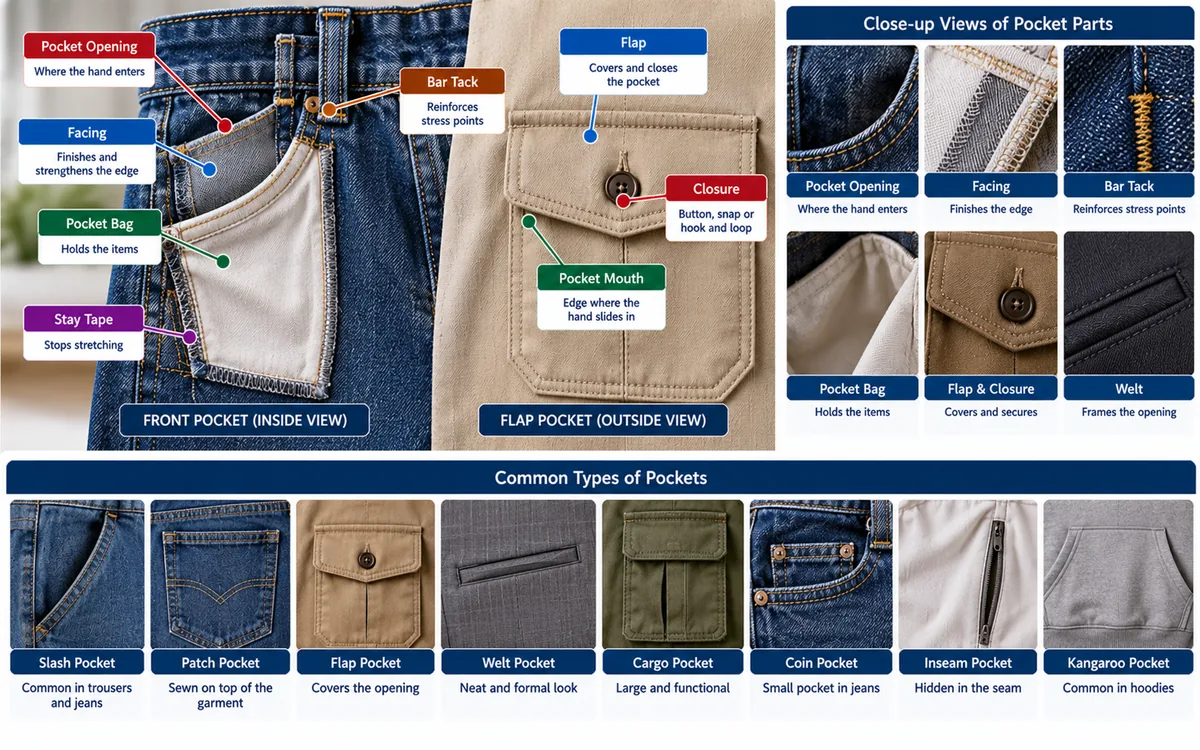
This guide covers the parts of a pocket, the main pocket types and how each is built in a factory. It is useful for shoppers, students and sewing teams. If you want to see how pockets fit into a whole garment, read our guides on the parts of a pant and the parts of jeans.
What a pocket is
A pocket is a small bag of fabric attached to a garment. It holds small items and keeps hands warm. Some pockets are only for show. These are called false or decorative pockets, and they have no bag behind them.
A working pocket has two main sections. One is the opening, which you see on the outside. The other is the bag, which hangs inside. The garment style decides how these two sections are built.
Parts of a pocket at a glance
| Part | Location | Job |
|---|---|---|
| Pocket opening | Outside | Where the hand enters |
| Pocket bag | Inside | Holds the items |
| Facing | Edge of the opening | Finishes and strengthens the edge |
| Flap | Above the opening | Covers and closes it |
| Welt | Edges of a slit | Frames the opening |
| Bar tack | Corners | Reinforces stress points |
| Pocket mouth | Edge of the opening | The edge where the hand slides in |
| Stay tape | Seam edge | Stops stretching |
| Closure | On the opening | Button, snap, zipper or hook and loop |
The pocket opening and mouth
The opening is the slit or curve where the hand goes in. The edge of this opening is called the pocket mouth. It is the part of a pocket that gets the most wear, because hands rub against it again and again.
A good pocket mouth stays flat and does not stretch. To keep it firm, factories add a stay tape, which is a thin strip of woven tape sewn into the seam. They also add a line of topstitching close to the edge. If the mouth gapes, items can fall out.
The pocket bag
The pocket bag is the fabric pouch behind the opening. It is made of one or two layers of fabric, folded or sewn into a bag shape. The bag should be big enough to hold a phone, keys or wallet, and light enough not to add bulk.
Most trouser and jeans bags are made of cotton or poly cotton. This fabric is smooth, strong and breathable. Some bags are made from the same fabric as the garment. Others use a lighter fabric, which feels thinner under the outer fabric.
The bag has seams on its sides and bottom. A weak bottom seam is one of the most common pocket failures. To prevent splits, factories use a double-fold seam, also called a French seam, which encloses the raw edges. Others use an overlock stitch with a second row of stitching.
Pocket bag depth
Deeper bags hold more but sag. A typical front trouser pocket bag is around 15 to 20 cm deep, though it varies by garment. A shallow bag may let items fall out. A deep one can make the garment hang awkwardly.
The facing
A facing is a strip of fabric on the inside of the opening. It finishes the edge and gives it strength. In trousers, the facing sits between the pocket opening and the pocket bag. It is often cut from the main fabric, so it matches the garment color if the pocket gapes.
The flap
A flap is a piece of fabric that hangs over the pocket opening. It keeps rain and dirt out and prevents items from falling. The flap is made from two layers of fabric, sewn together and turned, with interfacing in between to give it shape. It can have a point, a curve or a straight edge.
Flaps often close with a button, snap or hook-and-loop tape. The button on the pocket sits below the flap. On cargo pockets, the flap is large and closes with a hook-and-loop strip.
The welt
A welt is a narrow strip of fabric that frames a slit pocket. A single welt has one strip. A double welt, sometimes called a double jetted pocket, has two. These are common on blazers and back trouser pockets.
Welt pockets look neat, but they are hard to sew. The slit must be cut very precisely. The corners must be clean. Any slip shows right away.
Bar tacks and reinforcement
A bar tack is a short, dense block of stitches, usually 8 to 16 mm long. It is placed at the corners of pocket openings to resist tearing. Hands pull at these corners all day. Without a bar tack, a seam will open.
Other reinforcement methods include:
- Rivets: Metal studs placed at corners. Common on jeans.
- Triangle stitching: A small triangle of stitching at the corner.
- Back stitching: A few extra stitches at the start and end of a seam.
- Extra fabric patches: A scrap of fabric sewn behind a stress point.
Types of pockets
Pocket types are named by the way the opening is built.
Patch pocket
A patch pocket is a flat piece of fabric sewn onto the outside of the garment. It has no hidden bag. The top edge is folded and stitched, and the sides and bottom are sewn down. Patch pockets are easy to sew and give a casual look. They appear on shirts, jeans, work trousers and jackets. Back jeans pockets are patch pockets.
Welt pocket
A welt pocket is a slit in the garment, with strips of fabric at the edge. The bag is hidden inside. Welt pockets look clean and are common on trousers and blazers.
Flap pocket
A flap pocket is a welt or patch pocket with a flap on top. It is common on blazers and cargo trousers.
In-seam or side seam pocket
An in-seam pocket is sewn into a side seam, so the opening is hidden. It is common on dresses, skirts and casual trousers. The advantage is that it does not spoil the line of the garment.
Slant pocket
A slant pocket is cut at an angle from the waistband to the side seam. It is the standard front pocket on trousers and chinos. The angle makes it easy to reach.
Scoop or jeans pocket
A scoop pocket has a curved opening, like the front pocket of jeans. Inside, there is often a small extra pocket, called a coin pocket.
Cargo pocket
A cargo pocket is large and sits on the outer leg. It usually has a flap and bellows, which is a pleat that lets it expand. It is common on work trousers and military-style clothes.
Kangaroo pocket
A kangaroo pocket is a large front pocket on hoodies. It has two openings, one on each side, so both hands can slide in. Our guide on the parts of a hoodie explains how it is attached.
Zipper pocket
A zipper pocket has a zipper along the opening. It keeps items secure. It is common on jackets, sports shorts and travel pants. The zipper can sit in a welt or a plain slit. Our guide to the different parts of a zipper explains how zippers work.
Chest pocket
A chest pocket sits above the chest. On shirts, it is usually a patch pocket. On blazers, it is a narrow welt pocket, often used for a pocket square. See our pocket guide for dress shirts for more detail.
Hidden or security pocket
A hidden pocket is sewn inside the garment for valuables. It is common on travel clothes.
Coin pocket
A coin pocket is a small extra pocket inside the main front pocket of jeans.
Pocket placement
Where the pocket sits matters. A pocket too high feels awkward. A pocket too low is hard to reach. Pattern makers mark the position using notches or drilled holes. The pockets on the left and right must be at the same height and angle.
On a shirt, a chest pocket usually sits about 15 to 20 cm below the shoulder seam, though the position varies by style. On trousers, the front pocket opening starts at the waistband and runs about 15 to 17 cm down the side seam. These numbers shift with size and style, so use them as a general guide only.
How a pocket is made
Here is a simple order for a patch pocket.
- Cut: The pocket piece is cut with seam allowances.
- Hem the top: The top edge is folded twice and stitched.
- Fold the sides: The remaining edges are folded in. A template or folding machine is used to make clean creases.
- Mark placement: The pocket position is marked on the garment.
- Attach: The pocket is stitched on the garment with topstitching.
- Reinforce: A bar tack or small triangle of stitching is added at the top corners.
A slant pocket takes more steps. The bag is attached to the front panel, flipped and topstitched. The facing is added. The bag is then joined to the side seam and waistband.
For a deeper look at timing, see our operation breakdown and SMV of a trouser.
Common faults
- Pocket tearing at corners: A missing or weak bar tack.
- Crooked placement: The pocket is not square with the grain or not level with the other.
- Pocket gaping: The mouth is stretched or lacks stay tape.
- Pocket bag showing: The bag is longer than the opening.
- Twisted bag: The bag flips out when the hand enters.
- Visible pocket outline: A pocket bag shows through thin outer fabric.
- Puckered topstitching: Uneven tension or thread breaks.
- Hole in the bag: Weak seams or poor bag fabric.
Our guide on sewing defects and root causes shows how teams fix many of these.
How to choose a good pocket
- Look at the corners. A neat bar tack is a good sign.
- Put your hand in. The bag should feel smooth and roomy.
- Check the stitching. It should be straight and even.
- Test the closure. Buttons and zippers should work easily.
- Pull the mouth gently. It should not stretch.
- Look inside. The bag should be made of strong fabric.
Final thoughts
A pocket is a small structure with many parts. The opening lets your hand in, the bag holds your things, the facing and flap protect the edge, and the bar tack keeps the corners from tearing. When you check a garment, put your hand in the pocket and look at the corners first. If they feel strong and neat, you have found a well-made piece.
Frequently asked questions
The main parts are the opening, the mouth, the bag, the facing, the flap, the welt and the reinforcement. Not every pocket has all of them.
The inside is called the pocket bag. It is the fabric pouch hidden behind the opening.
A bar tack is a short, dense line of stitches at the corner of a pocket. It stops the corner from tearing.
A patch pocket is a piece of fabric sewn onto the surface. A welt pocket is a slit cut into the garment with a hidden bag behind it.
A kangaroo pocket is a large pouch on the front of a hoodie, with an opening on each side so both hands can enter.
A flap covers the opening to keep items from falling out and to protect them from rain or dirt.
Cotton or poly cotton is common. It is smooth, light and strong.