Pick up any jacket and turn it inside out. What you see is a small puzzle. Dozens of pieces of fabric, tape, lining and thread have been cut, joined and pressed into one shape. If you want to buy a jacket well, repair one, or write a tech pack for a factory, you need to know the parts of a jacket by name.
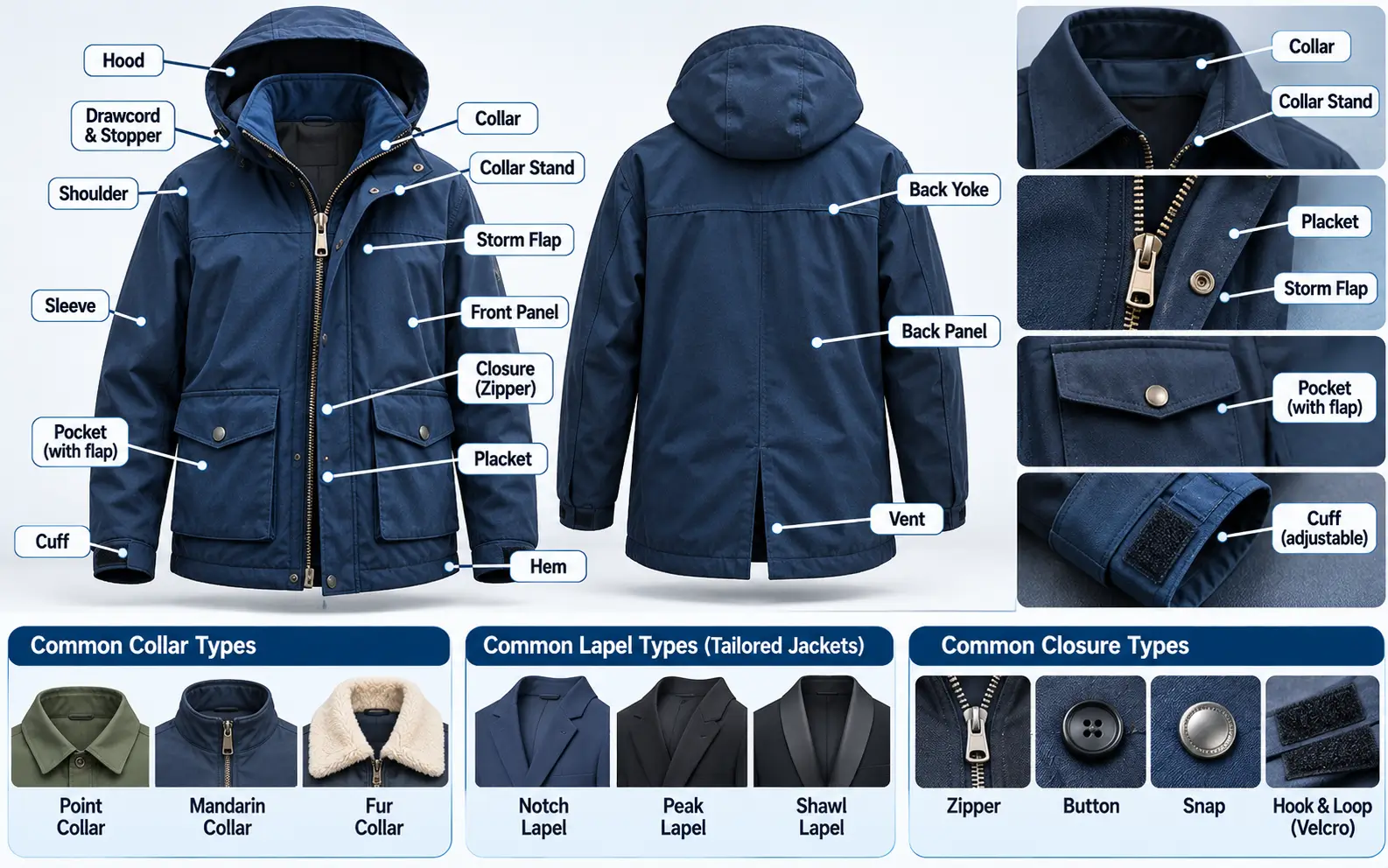
This guide lists every main part of a jacket, from the collar down to the hem. For each part, you will find what it is, what it does and what a factory checks before the garment ships. Some parts only appear on certain styles, so I mark those too. If you want the same kind of breakdown for other garments, our guides to the parts of a shirt and the parts of a pant work the same way.
What counts as a jacket
A jacket is a short coat that covers the upper body. It usually stops somewhere between the waist and the hip. It opens at the front, has sleeves, and closes with buttons, a zipper, snaps or a belt.
That description covers a lot of styles. A bomber, a denim trucker, a field jacket, a windbreaker and a track jacket are all jackets. A tailored blazer is a jacket too, though it has extra tailoring parts that casual jackets skip. Because the styles differ, the parts list below starts with the parts almost every jacket has and then moves to the ones that appear only on some.
The main parts of a jacket at a glance
Here is a quick table. The sections after it explain each part in more detail.
| Part | Where it sits | What it does |
|---|---|---|
| Collar | Around the neck | Frames the face and blocks wind |
| Collar stand | Under the collar | Lifts the collar and gives it shape |
| Lapel | Front, below the collar | Folds back to show the inner front |
| Shoulder | Top of the sleeve line | Sets the width and fit |
| Armhole | Where the sleeve joins | Lets the arm move |
| Sleeve | Covers the arm | Gives warmth and movement |
| Cuff | End of the sleeve | Finishes the sleeve and holds heat in |
| Front panel | Chest and belly | Main body of the jacket |
| Back panel | Across the back | Main body, often with a vent or yoke |
| Closure | Center front | Opens and closes the jacket |
| Pockets | Front, chest or inside | Carry small items, warm the hands |
| Lining | Inside | Hides seams and helps the jacket slide on |
| Interlining | Between shell and lining | Adds warmth or structure |
| Hem | Bottom edge | Finishes the edge and sets length |
Collar and neck area
Collar
The collar is the part that wraps around your neck. On a jacket, it does more than look good. A high collar blocks cold wind. A flat collar frames the face. Jacket collars come in many shapes. A point collar looks like a shirt collar. A mandarin collar stands straight up with no fold. A hooded jacket replaces the collar with a hood.
Factories build a collar from two layers of fabric, called the upper collar and the under collar. A fusing layer, which is a thin sheet with heat-activated glue, goes on the inside to give it body. When a collar curls at the tips, it is often because the under collar was cut too small or because the fusing was not matched to the fabric.
Collar stand
The collar stand is a narrow band that connects the collar to the neckline. On shirts, it is easy to see. On jackets, it is often hidden. Its job is to lift the collar so it sits neatly around the neck. If the stand is too short, the collar lies flat and looks weak. If it is too tall, it chokes the wearer.
Neck tape and hanger loop
Inside the back neck, most jackets have a strip of tape that covers the seam. A small loop of tape often sits near it. This is the hanger loop, and it lets you hang the jacket on a hook without stretching the shoulders. It is a small part, but buyers do check that it is strong.
Hood and drawcord
Casual and outdoor jackets often have a hood. The hood is made of two side pieces joined along the center. A drawcord runs through a channel along the face opening so the wearer can tighten it. Small metal or plastic eyelets let the cord pass out of the fabric. A cord stopper, which is a tiny spring clip, holds the cord in place.
Front of the jacket
Front panels
The front panels are the two main pieces that cover your chest and belly. Pattern makers shape them with darts or curved seams so the jacket follows the body. On a plain bomber, the front is nearly flat. On a tailored jacket, the front has more shaping and often an extra layer of canvas inside.
Lapel
A lapel is the folded-back flap of fabric below the collar. It is common on tailored jackets and blazers. The two common lapel types are notch and peak. A notch lapel has a small triangular cut where the collar meets the lapel. A peak lapel points upward and looks more formal. A shawl lapel curves in one smooth line with no notch at all.
The fold line of the lapel is called the roll line. Skilled tailors press and stitch this line so the lapel rolls softly instead of lying flat. On mass-produced jackets, fusing and pressing do most of that work.
Revers
The revers is the inner face of the lapel, the part you see when it folds back. It is cut from the same fabric as the outside, and it must match the shade well. A shade difference between the lapel face and the revers is a common reason for rejection.
Placket and front closure
The placket is the strip of fabric along the front opening where the closure sits. On a zip jacket, it covers or supports the zipper tape. On a button jacket, it holds the buttons and buttonholes. A wide placket feels sturdy. A narrow one looks light.
Most jackets use one of four closures:
- Zipper: A metal or plastic chain on tape. Sports jackets, bombers and windbreakers use it. Our guide to the parts of a zipper explains the slider, teeth and stops.
- Buttons: Used on blazers, field jackets and denim jackets. Buttons are sewn through the fabric and fastened through buttonholes.
- Snaps: Used on some work and rain jackets. A snap has four small pieces that press together.
- Hook and loop: Often used as a second closure over a zipper, or on cuffs.
Storm flap
Some outdoor jackets have a strip of fabric that covers the zipper from the outside. This is the storm flap. It stops wind and rain from pushing through the zipper teeth. It is held shut with snaps or hook and loop tape.
Button stance
Button stance is the position of the buttons on the jacket front. On a two-button jacket, the buttons sit near the waist line. Pattern makers fix the stance carefully, because a button set too high or too low changes the whole look of the jacket.
Shoulders, armholes and sleeves
Shoulder and shoulder seam
The shoulder is the line that runs from the neck to the edge of the arm. The shoulder seam joins the front and back panels. This seam sets the jacket’s width across the top. If the shoulder seam sits too far out, the jacket looks big. If it sits too far in, the arms feel tight.
Shoulder pad
Tailored jackets often have a small pad under the shoulder. It gives a clean, square line. Casual jackets usually skip the pad. A thin pad may also be used to hide uneven shoulders.
Yoke
A yoke is a shaped panel across the upper back. It carries the weight of the jacket from the shoulders. Denim jackets and work jackets often have a yoke. It also gives the back a place for pleats or decorative stitching.
Armhole
The armhole is the opening where the sleeve is attached. Its shape matters a lot. A deep, low armhole gives room to move but can look baggy. A high, snug armhole looks sharp but limits arm lift. Pattern makers balance this with the sleeve shape.
Sleeve and sleeve head
The sleeve is a tube of fabric that covers the arm. A two-piece sleeve, common on tailored jackets, has an upper and an under section. This shape follows the natural bend of the elbow. A one-piece sleeve is simpler and cheaper to sew.
The top curved edge of the sleeve is the sleeve head, also called the sleeve cap. It is slightly larger than the armhole, so the sewing operator has to ease it in. Easing means spreading a small extra amount of fabric evenly across the curve. Done well, the sleeve head looks smooth. Done badly, it puckers.
Cuff
The cuff finishes the sleeve end. It can be a plain hem, a folded band, a rib knit, an elastic band, or a strap with a button or hook and loop. Bomber jackets use rib knit cuffs, which hold warm air near the wrist. Tailored jackets usually have a plain hem, often with working or decorative buttons.
Pockets
Pockets are one of the biggest differences between jacket styles. These are the common types.
- Patch pocket: A piece of fabric sewn flat onto the outside. It is simple and easy to see.
- Welt pocket: A slit in the fabric finished with narrow strips on the edges. It looks neat and is common on tailored jackets. The slit has to be cut cleanly, and the corners need strong reinforcement.
- Flap pocket: A welt or patch pocket with a small cover on top. It keeps items from falling out and keeps rain from getting in.
- Slant pocket: A pocket cut at an angle, which makes it easier to reach.
- Zip pocket: A pocket closed with a small zipper, common on sports and outdoor jackets.
- Inside pocket: A pocket sewn to the lining. It holds a phone, wallet or pen.
Corners of pockets take the most stress, because hands pull on them all day. Factories add a bar tack, which is a short, very dense block of stitching, at pocket corners. A missing or weak bar tack is a standard fault. For more on how pocket styles are built, see our pocket guide for dress shirts.
Inside the jacket
Lining
The lining is a second layer of lightweight fabric inside the jacket. It hides raw seams and helps you slide the jacket on over other clothes. Common lining fabrics are polyester taffeta, viscose and cotton. In winter jackets, the lining may be fleece or quilted for warmth.
Lining can be full or half. A full lining covers the whole inside. A half lining covers only the upper back and sleeves, which keeps the jacket lighter and cooler.
Interlining and canvas
Interlining is an extra layer between the outer fabric and the lining. Padded jackets use wadding as interlining. The wadding can be polyester fill or down. Tailored jackets use a canvas, a stiff woven cloth made from cotton, hair or similar fibers. The canvas gives the chest its shape. Cheaper jackets use fusible interlining, which is bonded with heat instead of stitched in.
Facing
The facing is a strip of fabric on the inside edge of the front opening. It supports the lapel and the buttonholes. In lined jackets, the facing meets the lining at a seam.
Care label and size label
Inside the back neck or side seam, you will find labels. The care label shows how to wash the jacket. The size label shows the size and fit. The main label shows the brand. Many buyers require labels to be sewn in a set position, and a label that sits crooked can fail an inspection. Our guide on trims and accessories inspection shows how teams check them.
Back and bottom of the jacket
Back panel and center back seam
The back is made of one or more pieces. A center back seam, running down the middle, lets the pattern maker shape the jacket to the spine. Without it, a tailored jacket would look boxy.
Vent
A vent is a slit at the bottom of the back that lets the wearer sit and move easily. A single center vent is the most common. Side vents sit on each side. A ventless jacket has no slit at all, and this gives a very clean look but less ease when sitting.
Hem
The hem is the bottom edge. It can be turned and stitched, finished with a rib band, or held by an elastic or drawcord. Sports jackets with drawcord hems let the wearer tighten the bottom against the wind. Tailored jackets have a plain, sharp hem, often with the lining attached just above it.
Smaller parts that make a difference
- Darts: Triangular folds sewn into the fabric to shape it around the chest or waist.
- Gorget: The seam where the collar meets the lapel.
- Elastic and drawcord channels: Narrow tunnels for elastic or cord.
- Eyelets and grommets: Metal rings that reinforce small holes.
- Seam tape: Waterproof tape sealed over seams on rain jackets.
- Reflective trim: Strips that bounce light back, used on safety and sports jackets.
- Elbow patch: A piece of extra fabric sewn over the elbow for style or wear.
How a factory builds a jacket
Knowing how a jacket is made helps you understand why each part exists. The usual order looks like this.
- Cutting: Fabric is spread in layers and cut into pieces using a pattern.
- Fusing: Interlining is bonded to collars, facings, plackets and cuffs. Poor fusing causes bubbles and is one of the top faults. See our guide on fusing process and quality inspection.
- Small part making: Pockets, flaps, collars and cuffs are sewn separately.
- Body assembly: Front and back panels are joined at the shoulders and sides.
- Sleeve setting: Sleeves are attached to the armholes.
- Lining: The lining is made as a separate unit and joined to the jacket shell.
- Closures and buttonholes: Zippers, buttons and snaps are fitted.
- Finishing: Threads are trimmed, the jacket is pressed, tagged and packed.
Each of these steps becomes a line on the operation breakdown. If you want to see a real list of jacket operations with their times, read our operation breakdown and SMV of a jacket.
Common faults to watch for
Inspectors usually look at the same places, because the same problems keep appearing.
- Collar tips curling: Often from wrong fusing or uneven cutting.
- Puckered seams: Caused by tension problems or fabric that was stretched during sewing. Our guide on sewing defects and root causes goes through the usual fixes.
- Uneven sleeve length: A small mismatch between left and right sleeves is easy to miss and easy to spot on a customer.
- Shade difference between panels: Often from mixed fabric rolls.
- Zipper waves: The zipper tape ripples because the zipper was sewn under tension.
- Loose buttons: Poor thread tension or a missing shank.
- Crooked pockets: Patch pockets sewn off the marked line.
- Lining too tight or too long: The lining hangs below the hem or pulls the shell inward.
A short check on these eight faults catches most customer returns.
How to choose a jacket using these parts
If you are buying rather than making, the parts list can guide you.
- For cold weather, look for a high collar, an interlining, a storm flap and rib or elastic cuffs.
- For rain, look for taped seams, a hood with a drawcord and a zipper with a storm flap.
- For office wear, look for a notch lapel, welt pockets, a lining and a center vent.
- For travel, look for inside zip pockets and a lightweight lining.
Check the stitching at pocket corners and at the shoulder seams. These two places show quickly whether a jacket is built well.
Final thoughts
Once you can name the parts of a jacket, you can read a tech pack, judge a sample or explain a problem in a few words. Instead of saying that something looks off near the neck, you can say that the under collar is too tight. That clarity saves time with suppliers and buyers.
If you work in a factory, print the parts table and keep it at the inspection table. If you shop for jackets, check the collar, the shoulder seam, the pocket corners and the lining before you decide. Those four places tell you most of the story.
Frequently asked questions
The main parts are the collar, lapel, shoulders, armholes, sleeves, cuffs, front and back panels, closure, pockets, lining and hem. Some jackets also have a hood, a yoke or a vent.
That part is the collar. If the jacket has a hood instead, the hood sits at the neckline. The band under a collar is called the collar stand.
The collar wraps around the back and sides of the neck. The lapel is the folded-back flap that continues down the front of the jacket. Casual jackets often have a collar but no lapel.
The lining hides the inside seams, makes the jacket slide on easily and adds a bit of warmth. It also protects the shell fabric from sweat and wear.
A vent is a slit at the bottom of the back seam. It lets the jacket open when you sit or reach. Single and double vents are the most common styles.
The sleeve cap, or sleeve head, is the curved top of the sleeve that fits into the armhole. It is cut slightly larger than the hole, so the operator eases it in to get a smooth, round shape.
It depends on the style. A simple bomber may have around 15 to 20 pieces including pockets and rib. A lined tailored jacket can have 30 or more once you count the lining, canvas and facings.