A garment is only as good as its seams. A seam is the line where two or more pieces of fabric are joined by stitches. It holds the garment together, shapes it and decides how it looks and feels on the skin. A seam that is too weak splits. A seam that is too bulky rubs. A seam in the wrong place ruins the fit.
This guide explains the main types of seams in garments, in simple words. You will see how seams are classified, which one to use for which job, how to choose between them and how to calculate thread use. A worked example shows the numbers. Whether you sew at home, work in a factory or write a tech pack, this reference should help.
What is a seam
A seam is a joint made with stitches. Two ideas are often mixed up, so let us separate them.
- Stitch: the way the thread loops and locks with itself to form a line, such as a lockstitch or a chain stitch.
- Seam: the way the fabric pieces are placed on each other before stitching, such as overlapped or folded.
Any seam type can be made with different stitch types. For example, a plain seam can be sewn with a lockstitch or with an overlock stitch. See our list of sewing machines used in the apparel industry for which machine makes which stitch.
Parts of a seam
| Part | Meaning |
|---|---|
| Seam allowance | The strip of fabric between the cut edge and the stitching line |
| Seam line | The line where the stitches go |
| Seam width | The distance from the stitching to the cut edge |
| Stitch density | Stitches per inch (SPI) or per centimetre |
| Seam finish | The treatment of raw edges, such as overlocking, binding or pinking |
| Seam type | The way the fabric is arranged, such as plain or French |
Classification of seams (ISO 4916)
The international standard ISO 4916 groups seams into classes by how the fabric is arranged. Older standards used letter codes, such as SS for superimposed. Factories still use both names.
| Class | Name | Short idea | Typical use |
|---|---|---|---|
| 1 | Superimposed seam (SS) | One piece laid on top of the other, joined near the edge | Side seams, shoulder seams, inseams |
| 2 | Lapped seam (LS) | Pieces overlap, then are stitched | Jeans outseam, side seams of shirts, felled seams |
| 3 | Bound seam (BS) | An edge is wrapped with a separate strip | Neck edges, armholes, hems |
| 4 | Flat seam (FS) | Edges butt together and a stitch covers both | Underwear, sportswear, flatlock |
| 5 | Decorative seam (OS) | Stitching for looks, over the cloth | Topstitching, quilting, smocking |
| 6 | Edge neatening (EF) | Stitching to finish a raw edge only | Overlocked edges, narrow hems |
In this guide, we also cover common named seams, such as French and flat-felled, which belong to these classes.
Main types of seams
1. Plain seam (open seam)
Two pieces are placed right sides together and stitched along the seam line. The allowance is then pressed open or to one side. It is the most common seam, found in skirts, dresses, trousers and jackets. It is flat and easy to alter, but raw edges need finishing in woven fabric to stop fraying. Class: superimposed.
2. Plain seam with edge finish
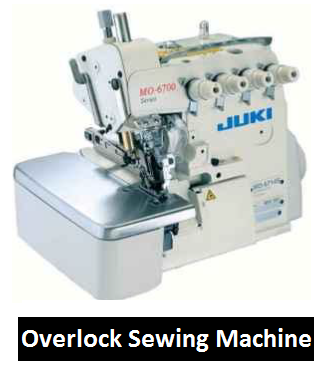
The same as above, but the raw edges are overlocked, zigzagged, pinked or bound. In factories, a 3-thread or 4-thread overlock sews and trims the seam in one pass. See our guide on overlock machines and settings.
3. French seam
A seam within a seam. First, wrong sides are placed together and stitched at about 6 mm. The seam is trimmed, turned and stitched again, so that the raw edges are enclosed. It leaves no raw edges, so it is used for sheer fabric, silk, baby clothes and fine lingerie. It is neat inside but needs care and is slower to sew.
4. Flat-felled seam
A strong seam, made by folding one allowance over the other, folding it under and stitching it down with one or two rows. It is used on jeans, shirts, workwear and sportswear, where strength and a clean inside matter. Machines with folders make it fast in factories. Because the seam is double the thickness, it can be bulky at crossings.
5. Run-and-fell seam
A simpler cousin of the flat-felled seam. The seam is stitched, one allowance is trimmed, the other folded over it and stitched flat. Used in shirts, nightwear and children’s clothes.
6. Lapped seam
One edge overlaps the other, with no folded allowance, and one or two rows of stitches hold them. It is used for fabrics that do not fray, such as leather, felt and non-wovens. It cuts bulk in thick fabric.
7. Welt seam
A plain seam in which one allowance is trimmed to half and the wider one is pressed over it, then topstitched. It adds strength and flatness and hides the raw edge. Used on coats and trousers.
8. Bound seam
The raw edge is enclosed with a strip of fabric or tape. It gives a neat, decorative finish and no fraying. Used inside unlined jackets, on necklines, armholes and hems of knit tops.
9. Hairline seam
A very narrow, almost invisible seam used on sheer fabrics. The allowance is trimmed to about 3 mm and finished by hand or by a narrow stitch. Used on fine blouses and bridal wear.
10. Mock safety seam
The edge is overlocked and then stitched again with a straight stitch near it. It gives the strength of two seams without the folded layers. Used for shirts and light jackets.
11. Taped seam
Tape is applied over the seam, by stitching or heat sealing, for strength or waterproofing. It is used for rainwear, outdoor gear and some stretch fabrics.
12. Topstitched seam
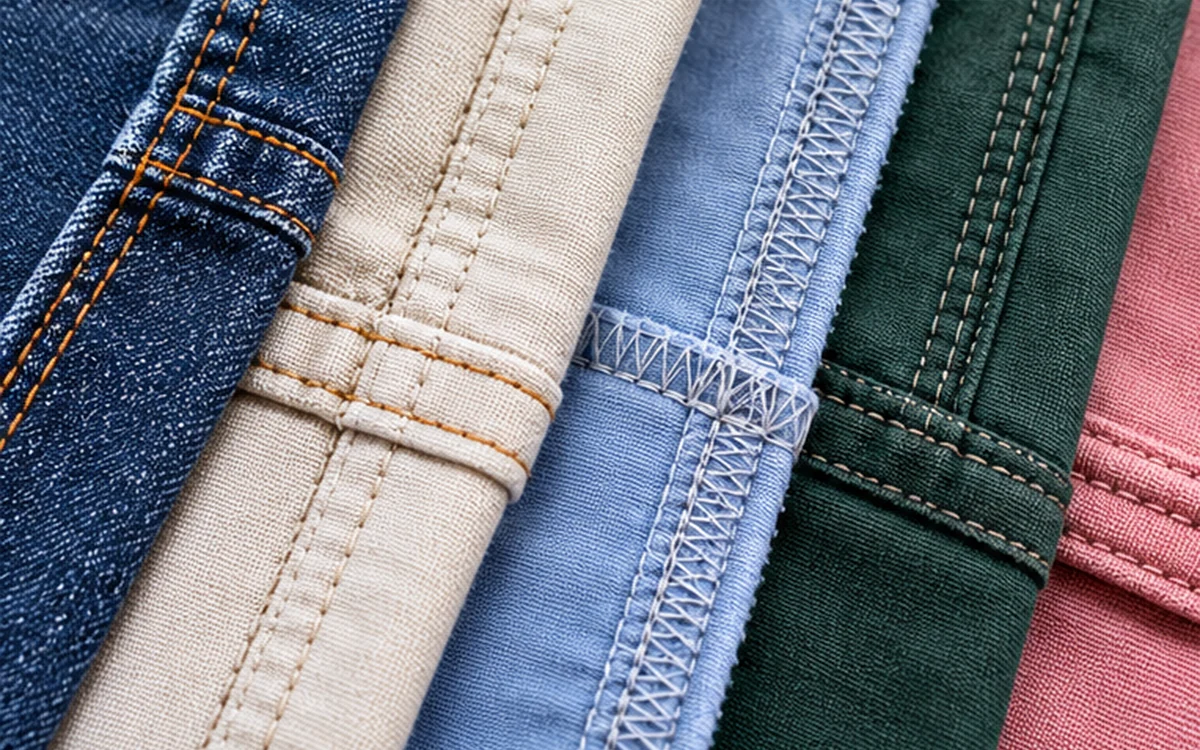
A plain seam with a visible line of stitching on the outside, near the seam. It is both strong and decorative. Used on jeans, jackets and trousers.
13. Double-stitched seam
Two parallel lines of stitching, often in a contrast colour. Used on denim and workwear for a bold look and added strength.
14. Flatlock seam
Edges are butted or overlapped and sewn with a stitch that lies flat. It is used in underwear, sports tops and base layers, where bulk would rub the skin. See our page on the flatlock machine.
15. Overlock safety seam
A seam sewn with a combination of a chain stitch and an overlock stitch in one pass, with 5 threads. It is strong and neat, so it is used in knit garments, jeans and woven shirts.
16. Slot seam
Two pieces are joined by a plain seam, and a strip of fabric is placed beneath it. The seam opens as a slot and shows the strip. Used in tailoring for decoration.
17. Piped seam
A narrow tube of fabric (the piping) is inserted into the seam. Used in cushions, uniforms, trousers and sports clothing.
Seam types by garment
| Garment | Seam commonly used |
|---|---|
| T-shirt | Overlocked side seams and shoulder seams (3 or 4 thread), flatlock or coverstitch hem |
| Dress shirt | Flat-felled or mock-safety side seams, topstitched collar |
| Jeans | Flat-felled outseam and inseam, safety seam in the rise |
| Trousers | Plain seams pressed open, overlocked edges, welt or topstitch on pockets |
| Jacket or blazer | Plain seams, bound or taped edges inside |
| Underwear | Flatlock, bound edges |
| Baby clothes | French seams or covered seams to avoid scratch |
| Rainwear | Taped or welded seams |
| Sheer blouse | French or hairline seam |
| Sportswear | Flatlock or bonded seams |
For the pants seams, you will see many named parts. A pair of trousers includes the outseam (side), inseam (inner leg), crotch or rise seam, yoke seam, waistband seam and pocket seams. Each has its own typical type. For example, the inseam of jeans may be a flat-felled seam, while the rise uses a safety or double-stitched seam for strength.
How to choose a seam
Ask these questions in order.
- What fabric is it? Fraying fabrics need an enclosed or finished edge. Knits need seams that stretch. Sheer fabrics need narrow seams.
- How much stress will it face? High-stress areas like jeans crotch need strong seams such as flat-felled or safety seams.
- Where is it on the body? Skin-contact areas need flat seams.
- What look do you want? Decorative seams show on the outside.
- What machine and skills do you have? A factory with folders can make flat-felled seams fast. A home sewer may prefer a plain seam with a zigzag finish.
- What is the cost? Complex seams cost more in time and thread.
- What does the buyer’s spec say? A tech pack often lists the seam and stitch codes. See our guide on the tech pack for clothing.
Worked example: thread and fabric used by a seam
Thread cost is hidden but real. A common way to estimate it is the thread consumption ratio, which is the length of thread used per unit length of seam. Ratios vary with fabric thickness, stitch density and machine. The values below are rough rules of thumb.
| Stitch | Typical ratio (thread length ÷ seam length) |
|---|---|
| Lockstitch (301) | 2.5 to 3.5 |
| Chain stitch (401) | 4 to 5 |
| 3-thread overlock (504) | 12 to 14 |
| 4-thread overlock (514) | 15 to 18 |
| 5-thread safety (516) | 20 to 25 |
| Coverstitch (602/605) | 20 to 30 |
Example: side seams of a T-shirt
- Two side seams, each 60 cm long, sewn with a 4-thread overlock at a ratio of 16
- Thread used = 2 × 60 × 16 = 1,920 cm = 19.2 metres
- For a 5,000-piece order, total = 19.2 × 5,000 = 96,000 metres = 96 km
If the thread cone holds 5,000 metres, that is 96,000 ÷ 5,000 = 19.2, so about 20 cones for the side seams alone. Add other seams and a waste allowance of 5 to 10 percent to plan the full order. A factory that measures real consumption on a sample, using a marked length of thread, will get a better number than a ratio from a table.
Example: fabric used by seam allowance
On a plain seam with a 1 cm allowance on both sides, a 60 cm seam holds 2 × 1 × 60 = 120 cm² of fabric in the allowance. A flat-felled seam needs a wider allowance, for example 1.5 cm on one side and 1 cm on the other, plus the fold. Over a trouser leg of 100 cm, that can use about 100 × (1.5 + 1.0) = 250 cm² before the fold is counted. It is a small amount for one garment, but over a big order, it can change consumption and cost. The pattern should include correct allowances for each seam. See our guide on measurement of top and bottom garments and our page on how to calculate product cost for how this flows into price.
Seam strength and quality
A seam should be as strong as the fabric needs, and it should look neat. Check these points.
- Stitch density. Too few stitches per inch weakens the seam. Too many cut the fabric. Typical ranges are 10 to 14 SPI for woven shirts, and 8 to 12 for knits, depending on thread and fabric.
- Thread type and size. Match the thread to the fabric weight and use.
- Seam slippage. Yarns slide out of the seam under load, mostly in smooth or loose fabrics. Increase allowance or stitch density.
- Seam pucker. Wavy seams caused by tension, feed or fabric shrinkage.
- Seam elasticity. In knits, seams must stretch with the fabric, so use a stretch stitch.
- Seam strength test. Standard tests pull a seam until it breaks. Buyers set a minimum.
For common faults, see our guide on sewing defects and root causes.
Common seam problems and fixes
| Problem | Cause | Fix |
|---|---|---|
| Puckering | Tight tension, wrong needle or feed | Reduce tension, check feed and use the right needle |
| Seam popping | Stitches too few, stitch not stretchy | Use stretch stitch, raise stitch density |
| Raw edges fraying | No edge finish | Overlock, bind or use a French seam |
| Bulk at crossings | Thick folded layers | Grade seams, trim corners, press |
| Skipped stitches | Wrong needle, tension or timing | Replace needle, adjust, service the machine |
| Wavy seams on knit | Stretching while sewing | Use differential feed and a light presser pressure. See presser feet |
| Uneven seam width | Poor guide | Use a seam guide or folder |
| Seam slippage | Loose weave, low density | Raise density, add allowance, choose another seam |
Final thoughts
The right seam makes a garment strong, comfortable and good-looking. Learn the six classes, then the common named types and choose by fabric, stress, comfort, look and cost. Estimate thread and fabric use early, check seam quality with simple tests and write the seam and stitch types clearly in the tech pack. Small decisions at the seam save big problems later.
Frequently asked questions
The main classes are superimposed, lapped, bound, flat, decorative and edge-neatening. Common named seams include plain, French, flat-felled, welt, bound and topstitched seams.
Flat-felled and safety seams are among the strongest, and they are common on jeans and workwear.
Overlock and flatlock seams, since they stretch with the fabric.
It encloses raw edges inside the seam. It is used in sheer fabrics, silk and baby clothes.
A stitch is how the thread forms a line. A seam is how fabric pieces are arranged and joined by stitches.
It is the strip of fabric between the cut edge and the stitching line, where the seam is made. Common widths are 1 to 1.5 cm in woven garments.
Pants have several seams, including the outseam, inseam, crotch seam, yoke seam and waistband seam. Each is sewn with a type chosen for strength and comfort.