
TPM in garment factory settings means total productive maintenance, a way of looking after machines in which operators, mechanics and supervisors all share the work, and the target is no breakdowns, no defects caused by machines and no accidents. In many sewing floors the mechanic is called only when a machine stops, and the operator is seen as someone who only sews. TPM changes that. The operator cleans, checks and notices small changes in the machine every day, and the mechanic works to a plan instead of running from fault to fault.
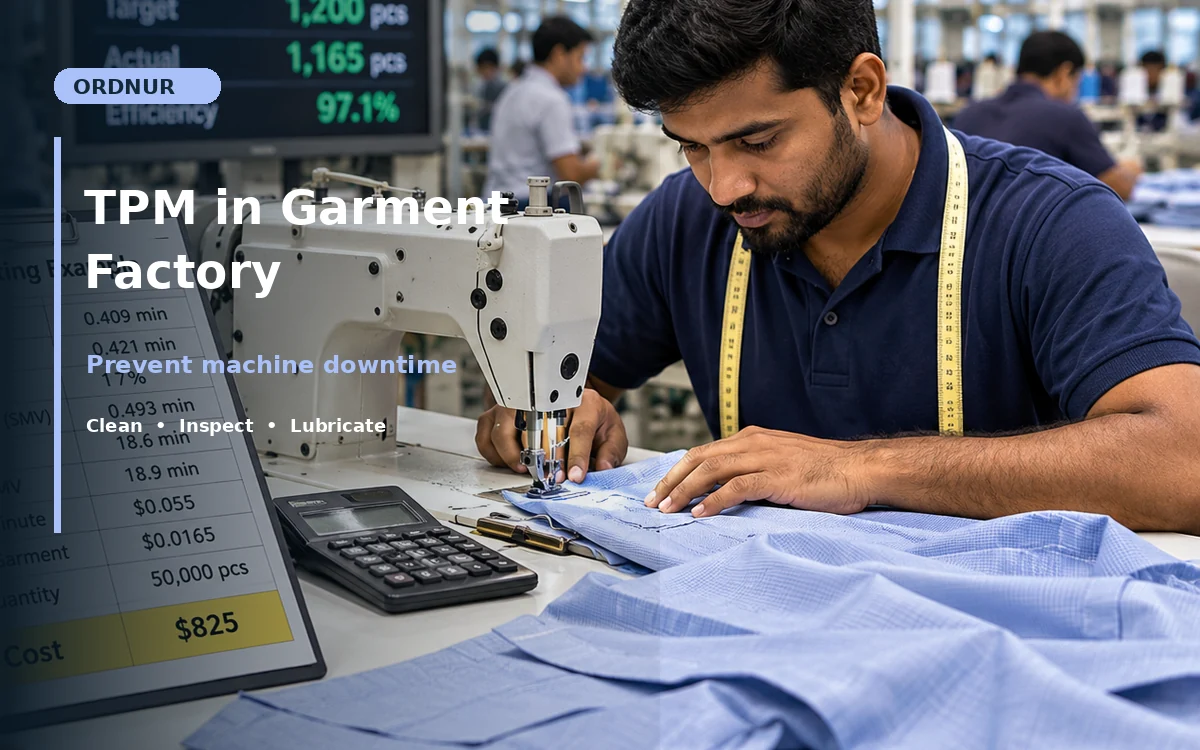
This guide explains what TPM is, how its pillars and six big losses apply to a sewing line, how to calculate MTBF, MTTR and availability, and how to start on one line without a large budget. It is written for industrial engineers, maintenance heads and production managers.
What TPM is
TPM comes from Japan and is built around keeping equipment in its best condition so that it makes good output all the time. The word total has three meanings.
- Total effectiveness: the aim is the best output from the machine, measured by overall equipment effectiveness. See OEE in garment manufacturing.
- Total system: care of machines is planned for the whole life of the equipment, from purchase to retirement.
- Total participation: everyone takes part, from operators to top management.
This is different from the older idea that production makes the garments and maintenance fixes the machines. In TPM, operators have a part in looking after the machine they use every day.
Why TPM suits a garment factory
A sewing machine looks simple, but a line of 40 machines holds many chances for loss. A machine that runs poorly gives skipped stitches, thread breaks, puckered seams and oil stains. A machine that stops costs the output of one operator, and often of the whole section behind it. See our guide on the bottleneck in a sewing line to see how one stopped machine can hold back the line.
Common machine related problems in a sewing floor include:
- Needle breakage and wrong needle size
- Thread breaks from poor tension or a rough thread path
- Skipped stitches from timing or needle problems
- Feed problems from worn feed dogs or presser feet
- Oil leaks and stains on fabric
- Motor, belt and pedal faults
- Bobbin case problems
- Poor lighting or dirty working place that hides problems
Many of these are noticed first by the operator, and small ones can be solved by the operator, if trained, in a few minutes.
The six big losses, in a sewing line
TPM groups the time and quality losses of equipment into six big losses. Here they are, with sewing examples.
| Big loss | In a sewing line |
|---|---|
| Breakdowns | Motor failure, broken belt, timing problem, machine stuck until a mechanic comes |
| Setup and adjustment | Changing needle, thread and presser foot for a new style, adjusting stitch length and tension |
| Minor stops and idling | Thread breaks, bobbin change, jams, short stops that are not recorded |
| Reduced speed | Machine run slower than its speed to avoid breakage, worn parts that limit speed |
| Process defects | Skipped stitches, puckering, oil stains and uneven stitch caused by machine condition |
| Start up losses | Poor output and quality in the first hour after a long stop or style change |
The first two are time losses. The next two are speed losses. The last two are quality losses. Together they explain much of the gap between the machine’s possible output and what the line really makes. See style changeover time reduction in sewing for the setup part.
The pillars of TPM
TPM is usually described by eight pillars. The names vary, but the ideas stay the same.
- Autonomous maintenance. Operators clean, oil, tighten and inspect their own machines every day.
- Planned maintenance. The maintenance team services machines on a schedule, based on running time and condition, not only after breakdown.
- Focused improvement. Small teams attack the biggest losses on selected machines or lines.
- Quality maintenance. The conditions of the machine that affect quality are defined and checked, to prevent defects.
- Early equipment management. Lessons from existing machines are used when new machines are chosen and installed.
- Training and education. Operators learn to inspect and do basic care. Mechanics learn advanced skills.
- Safety, health and environment. Safe work methods, guards in place, clean floors and a healthy workplace.
- Administrative (office) TPM. The same ideas of waste removal in planning, stores and support work.
In a garment factory, you do not need to start with all eight. Autonomous maintenance, planned maintenance and focused improvement give the largest gains first.
Autonomous maintenance in a sewing line
This is the pillar that changes the daily habits on the floor.
What the operator does
- Cleans the machine at the start or end of each shift: remove lint and thread waste from the feed dog, bobbin area and under the throat plate.
- Checks the needle for bend or damage and changes it on schedule.
- Oils the points marked, in the right amount, on the set day or hour. Too much oil stains garments.
- Checks tension, stitch and thread path at the start with a test piece.
- Looks and listens for unusual noise, heat, vibration or loose parts.
- Reports small faults at once with a tag, instead of working around them.
- Keeps the work place clean and tools in place. See implementation of 5S in the apparel industry.
A simple daily check sheet
| Check | Time | Done |
|---|---|---|
| Clean lint from feed dog and bobbin area | Start of shift | |
| Needle straight, correct size | Start of shift | |
| Oil at marked points (as per schedule) | As scheduled | |
| Test stitch on scrap fabric | Start of shift | |
| Belt guard and eye guard in place | Start of shift | |
| Unusual noise or vibration | During shift | |
| Report fault with tag | When found |
The check sheet should be short, in the local language, with pictures. Operators should be trained for it. A supervisor signs it, and the maintenance team looks at the faults reported.
A tag on a machine with a problem makes it visible. Red tags can mark faults that need a mechanic. White tags can mark faults that an operator can fix. Review the tags at a fixed time each day, and remove each tag only when the fault is closed.
Planned maintenance
- Make a machine register with a number for each machine, its type, location, age and history. See list of sewing machines used in the apparel industry.
- Set a service plan by machine type, with tasks and intervals. Our sewing machine maintenance schedule and preventive machine maintenance checklist are a good base. See also sewing machine maintenance in garments.
- Plan service around production, for example on a weekend or between styles, so it does not cut output.
- Keep a spare parts store with the parts that fail most, such as needles, belts, bobbin cases, feed dogs and presser feet, and a reorder level. Know the parts of a sewing machine and their functions.
- Keep a history card for each machine, with each fault, the cause, the fix and the date.
- Use the history to find repeat problems and old machines worth replacing.
- Train mechanics on the main machine types, including electronic and computerised machines.
Measuring TPM: MTBF, MTTR and availability
Three simple measures show whether maintenance is working.
MTBF (mean time between failures) = total operating time ÷ number of breakdowns
MTTR (mean time to repair) = total repair time ÷ number of repairs
Availability = MTBF ÷ (MTBF + MTTR)
A high MTBF means machines run for a long time between faults. A low MTTR means faults are fixed quickly. Together they give the share of time a machine is available.
A worked example
A group of machines ran for 200 hours in a month and had 8 breakdowns. The total time spent on repair was 6 hours. The numbers are assumed.
- MTBF = 200 ÷ 8 = 25 hours
- MTTR = 6 ÷ 8 = 0.75 hour
- Availability = 25 ÷ (25 + 0.75) = 0.971, or 97.1 percent
To raise availability, either cut the number of breakdowns, through care and planned service, or cut the repair time, through better spare parts, skilled mechanics and fast response. Track both.
Other useful measures
- Machine downtime as a percentage of working time, by line and by cause
- Number of breakdowns per 100 machines per month
- Planned maintenance completed on time, as a percentage
- Needle breaks per 1,000 pieces
- Defects caused by machine condition, such as skipped stitches and oil stains. See DHU in a garment factory.
- OEE for the line, to link maintenance with output
Steps to start TPM on one line
1. Choose a pilot line
Pick a line with steady styles and a clear problem, such as frequent stops. A single line makes it easy to see results and learn lessons.
2. Measure the starting point
For two to four weeks record downtime by cause, breakdowns, needle breaks and machine related defects. This baseline is what you will compare against.
3. Do an initial clean and restore
Clean every machine in the line thoroughly, from top to bottom. Cleaning is also inspection: loose bolts, leaks, worn parts and missing guards come to light. Fix them, and tag those that cannot be fixed on the spot.
4. Set standards
Write short, clear standards for daily cleaning, oiling and checks, with photos. Mark oil points, set the needle sizes by fabric, and put the standard at the line.
5. Train operators and mechanics
Train operators in the daily check and simple fixes. Train mechanics to work to the plan. Use practical sessions on the machine and one point lessons of one page each.
6. Start the routines
Run the daily check sheets, tag system and planned service. A supervisor reviews them every day for the first weeks.
7. Work on the top losses
Use the data to find the biggest loss, form a small team with an operator, a mechanic and a supervisor, find the cause and fix it. Our guide on kaizen in a garment factory shows how to run improvements in small steps.
8. Measure and show results
Compare the numbers with the baseline each month and display them. Recognise the line team for results.
9. Spread to other lines
Use what you learned to extend to other lines, one by one, with the pilot line as an example.
Making it last
- Management support. Leaders should visit the line, ask about the numbers and support the time spent on routines.
- Time for the routines. Daily checks need a few minutes of paid time. If they are done on the operator’s own time or squeezed out by output pressure, they will stop.
- Simple forms. Long forms are not filled in.
- Fair treatment. Do not blame operators for faults they report. Reward good reports.
- Link to performance. Include machine care in supervisor and line scorecards. See KPI factors of garments.
- Skills growth. Operators who learn machine care can grow into multi skilled and mechanic roles.
- Regular audits. Check the routines, with a simple scoring sheet, every month.
Common mistakes
- Treating TPM as a mechanic’s project. It needs operators.
- Starting on the whole factory at once. Begin with a pilot.
- Ignoring data. Without downtime records, effort goes to the wrong problems.
- Too much paper. Keep forms short.
- No spare parts. A machine waiting for a part is still down.
- Skipping training. Operators cannot check what they do not understand.
- Over oiling. It causes stains on garments.
- Letting routines fade. Without review, daily checks stop after a few weeks.
- Buying machines without thought for maintenance, such as no local service or spare parts.
Final thoughts
TPM in garment factory work is a way to share the care of machines between operators, mechanics and supervisors, with the goal of fewer breakdowns, fewer machine caused defects and better output. It deals with the six big losses: breakdowns, setup, minor stops, reduced speed, defects and start up losses.
Start small. Pick one line, measure its downtime, clean and restore the machines, give operators a short daily check, plan the mechanics’ work and track MTBF, MTTR and availability. When the pilot shows results, spread it. A sewing machine that is cared for every day rarely needs rescue.
Frequently asked questions
TPM means total productive maintenance. It is a system where operators, mechanics and supervisors share the care of machines to cut breakdowns and defects.
Breakdowns, setup and adjustment, minor stops, reduced speed, process defects and start up losses.
It is the part of TPM in which operators clean, oil and inspect their own machines every day and report faults early.
MTBF is total operating time divided by the number of breakdowns. MTTR is total repair time divided by the number of repairs.
Preventive maintenance is a service done on a schedule, mostly by the maintenance team. TPM includes it, but adds operator care, loss analysis and team improvement.
On one pilot line with a clear downtime problem. Measure, clean and restore, set standards, train, then spread to other lines.
By reducing breakdowns, stops and speed losses, which raises availability and performance, and by cutting machine caused defects, which raises quality.