
Style changeover in sewing is the work of switching a line from one style to the next. Machines are moved, attachments are changed, bundles are cleared, new trims arrive, operators learn new operations and the first garment is checked. On a floor that runs short orders in many styles, changeover happens again and again. Each time, the line makes few or no garments while the people on it are still paid.
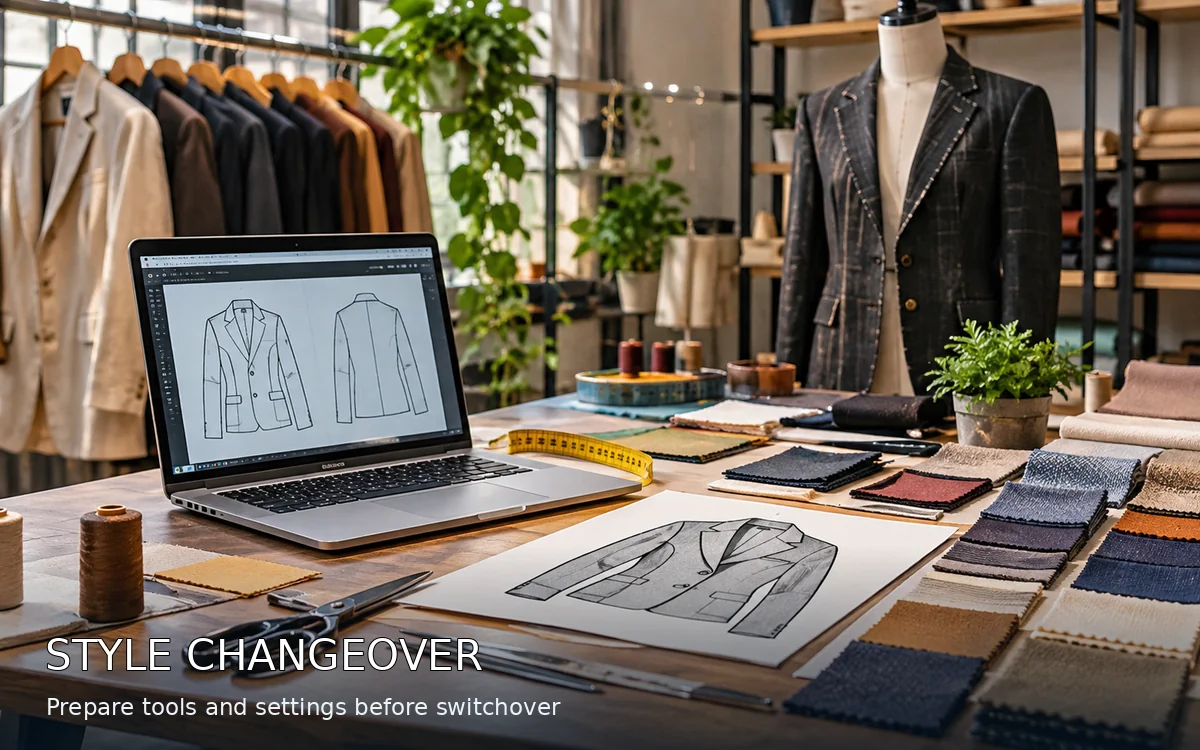
This guide explains where changeover time goes, how to split the work into tasks that can be done early and tasks that need the line stopped, and how to build a checklist. A cost example shows what a few hours of lost time are worth, and a set of practical steps shows how factories cut that time without hurrying and spoiling quality.
What a changeover is
A changeover covers everything between the last good garment of the old style and the first good garment of the new style that is made at a normal pace. It has two parts.
- The stop. The time when the line makes nothing, while the old style is cleared and the new one set up.
- The ramp up. The time after the first piece, when output and efficiency are below normal while operators learn the new operations. Our guide on the sewing operator learning curve shows how long this can take.
Many factories count only the first part. The second is often larger. Both cost money, so measure both.
Why changeover time matters
- It reduces output. Every hour spent on changeover is an hour not spent making garments.
- It raises cost per piece. Labour, power and overheads continue while the line stands still.
- It hurts efficiency figures. A line that changes style often will always look worse on paper than one on a long run.
- It makes small orders expensive. A short run bears the same changeover cost as a long one, spread over fewer pieces. This feeds straight into the costing sheet and the price you quote.
- It affects delivery. Lost time eats into the time and action calendar.
The trend in the industry is toward smaller orders and more styles, so changeover matters more every year.
Where the time goes
A typical changeover includes these tasks.
| Task | Typical problem |
|---|---|
| Finish and clear the old style | Leftover bundles, pieces and threads on machines |
| Remove old attachments and folders | Search for the right tools |
| Move or re-arrange machines | Machines in the wrong places, waiting for the mechanic |
| Fit new attachments, needles and threads | Parts not ready, wrong needle size, wrong thread |
| Set machine speed, tension and stitch length | Trial and error |
| Bring in new bundles and trims | Material not at the line, trims missing |
| Brief operators and explain operations | No time, unclear instructions |
| Make the first sample pieces | Corrections and re-work |
| Get first piece approval | Quality or merchandiser not available |
| Reach normal pace | Slow learning, unclear targets |
When you list them like this, it becomes clear that much of the delay is waiting, searching and fixing, not real work.
The key idea: internal and external tasks
The method comes from an approach called SMED, which stands for single minute exchange of die. It was developed in Japanese manufacturing to cut changeover times on press machines, and the same thinking works in a sewing line.
It sorts every changeover task into two groups.
- Internal tasks can only be done while the line is stopped. For example, taking a machine out of the line, or fitting a folder to a machine that is in use.
- External tasks can be done while the line is still running the old style. For example, bringing new bundles to a staging area, pre-setting folders in a kit, or briefing the operators on the next style’s operations.
The work then follows three steps.
- Write down every task and mark it as internal or external.
- Move tasks from internal to external wherever possible. Prepare things before the stop.
- Streamline the remaining internal tasks. Make them shorter by better tools, better layout, standard settings and more hands.
Most factories can cut a large share of changeover time at step 2 alone, because they simply do tasks too late.
Steps to reduce changeover time
1. Measure the current changeover
Time a few changeovers from the last good piece of the old style to the first good piece of the new one, and then until the line reaches its target. Write down each task, who did it, and how long each task took. Use a stopwatch and a simple sheet, or video with the workers’ agreement. Without numbers, you cannot tell if any change helped.
2. Plan the next style early
The planning team should know which style comes next and release the details in good time. Use the production planning and control process to give the line notice of several days. Include the sample, the operation breakdown, the layout and the target.
3. Prepare the operation breakdown and layout in advance
The industrial engineer should have the new line layout ready, with every operation assigned to a machine position and an operator grade. Our guides on the operation breakdown and SMV of a knit T-shirt and line balancing show how this is done.
4. Stage material before the line stops
Cut pieces, trims and packing items for the first day should be at the line, sorted, before the old style finishes. The trim card and the bundle ticket help the store and the line to find the right items quickly.
5. Make attachment and folder kits
Keep the attachments, folders, guides, needles and thread for each style in a labelled kit, one per operation. When the style comes up, the kit is already assembled. A shadow board or a labelled cabinet stops the search.
6. Pre-set machines where possible
If a spare machine is free, set it up for the new style while the old style runs. When the changeover comes, the operator moves to the machine that is ready, in place of waiting for adjustment. This needs spare machines, but it is a trade between machine cost and lost line time.
7. Use a changeover checklist
A checklist stops forgotten steps. It also lets people work in parallel, because each task has an owner. A simple one is shown below.
8. Brief the operators early
Show operators the sample and the operation sheet a day before, when possible. Let them practise tricky operations on spare pieces. A short briefing at the line at the start of the shift, with the sample on a stand, is much better than learning by mistake.
9. Work in parallel
Mechanics, helpers, the quality team and the supervisor should all work at the same time on different tasks. A changeover done in sequence takes much longer than one with several people working together.
10. Standardise machine settings
Record the needle, thread, tension, stitch length and speed that gave a good result on each style. Reuse them the next time the same fabric and operation come up. Our guide on stitches per inch for different garments lists common values to start from.
11. Review after each changeover
Compare the actual time with the plan. What went wrong? What was missing? Update the checklist and the kits. This is a good habit to build in the style of kaizen in a garment factory.
A sample changeover checklist
| Task | Owner | Done |
|---|---|---|
| Next style sample, operation breakdown and layout at the line | Industrial engineer | |
| Trims and cut parts staged | Store and cutting | |
| Old style cleared, last pieces counted | Line supervisor | |
| Machines moved to the new layout | Mechanic | |
| Attachments, folders and guides fitted | Mechanic | |
| Needles and threads changed and checked | Operators and mechanic | |
| Settings recorded on the machine tag | Mechanic | |
| Operators briefed with the sample | Supervisor and IE | |
| First pieces sewn | Operators | |
| First piece approved | Quality and merchandiser | |
| Target set and shown on the line | Industrial engineer | |
| Line start time recorded | Supervisor |
Add or remove items to fit your own floor.
What changeover costs: an example
The figures below are assumed. Replace them with your own.
- A line of 45 people.
- The labour cost per person per hour is 45 taka, including allowances.
- Each changeover costs 4 hours of lost full output.
- The factory changes style 3 times a month.
Cost per changeover
45 people × 4 hours × 45 taka = 8,100 taka
Cost per month
8,100 × 3 = 24,300 taka
Cost per year
24,300 × 12 = 291,600 taka
This is the labour alone. It leaves out the value of the garments that could have been made, overheads that run while the line stands still, and any lost chance to ship on time.
Now suppose changeover is cut from 4 hours to 2.5 hours.
- Saving per changeover: 45 × 1.5 × 45 = 3,038 taka
- Saving per month: 3 × 3,038 = 9,113 taka
- Saving per year: 109,350 taka, again for labour alone, for one line.
Multiply by the number of lines in the factory, and the sum is worth chasing. Good changeover practice also reduces defects, because a calm, prepared start makes fewer mistakes.
Special points for sewing lines
Machine type and layout
A line that uses different machines for each style changes more than one that uses a standard set. Where possible, group styles that use similar machines and operations, so that the next style needs fewer changes.
Production system
Different production systems handle changeover differently. A modular or team-based line can often switch styles faster than a long progressive bundle line. See our guide on garment production systems.
Order sequencing
The planner can reduce changeover by running similar styles one after another, for example two shirts with the same collar, or two knit tops with the same neck. Match fabric types and colours too, since thread changes and cleaning take time when the colour change is large.
Quality at the start
A quick start is of no use if the first hundred pieces are defective. Make sure that the first pieces are properly checked, and the inline checkers know what to look for. Our guide to sewing defects and their root causes helps with early problems.
Common mistakes
- Not measuring changeover. If nobody times it, nobody improves it.
- Doing external tasks while the line is stopped. Staging material after the line stops is the commonest waste.
- No standard kit. People hunt for attachments each time.
- Late information. The line gets the sample and breakdown on the morning of the change.
- Ignoring the ramp up. Counting only the stop hides the larger part of the loss.
- One person doing everything in sequence. Parallel work is faster.
- Rushing the first piece approval. A mistake found late costs far more than the time saved.
- No review. The same problems come back at the next change.
Final thoughts
Style changeover in sewing costs the factory both the time the line stands still and the time it takes to reach a normal pace. The cure is to split the work into tasks that can be done early and tasks that need a stop, move as much as possible to the early group, and make the rest short with kits, checklists, parallel work and standard settings.
Start by timing your next changeover task by task. Fix the biggest delay first, then the next. In a few months the changeover will take noticeably less time, with no extra people and no loss in quality.
Frequently asked questions
It is the process of switching a line from one style to another. It includes clearing the old style, setting machines and attachments, bringing materials, briefing operators and approving the first pieces.
Measure it, plan the next style early, stage materials before the line stops, prepare attachment kits, pre-set machines, use a checklist, work in parallel and review each changeover.
SMED means single minute exchange of die. It is a method to cut changeover time by moving tasks that do not need the line stopped to before the stop, and by streamlining the tasks that remain.
It varies widely with the style, the machines and the factory’s preparation. Measure your own, from the last good piece of the old style to the point where the new style reaches its target.
It is the period after the first good piece when output and efficiency are below normal because operators are learning the new operations.
Yes. Lost time raises the labour and overhead cost per piece, especially on small orders. It should be reflected in the costing and the quotation for short runs.
The line supervisor, a mechanic, the industrial engineer, quality staff, store and cutting staff for material, and, where needed, the merchandiser for approvals.