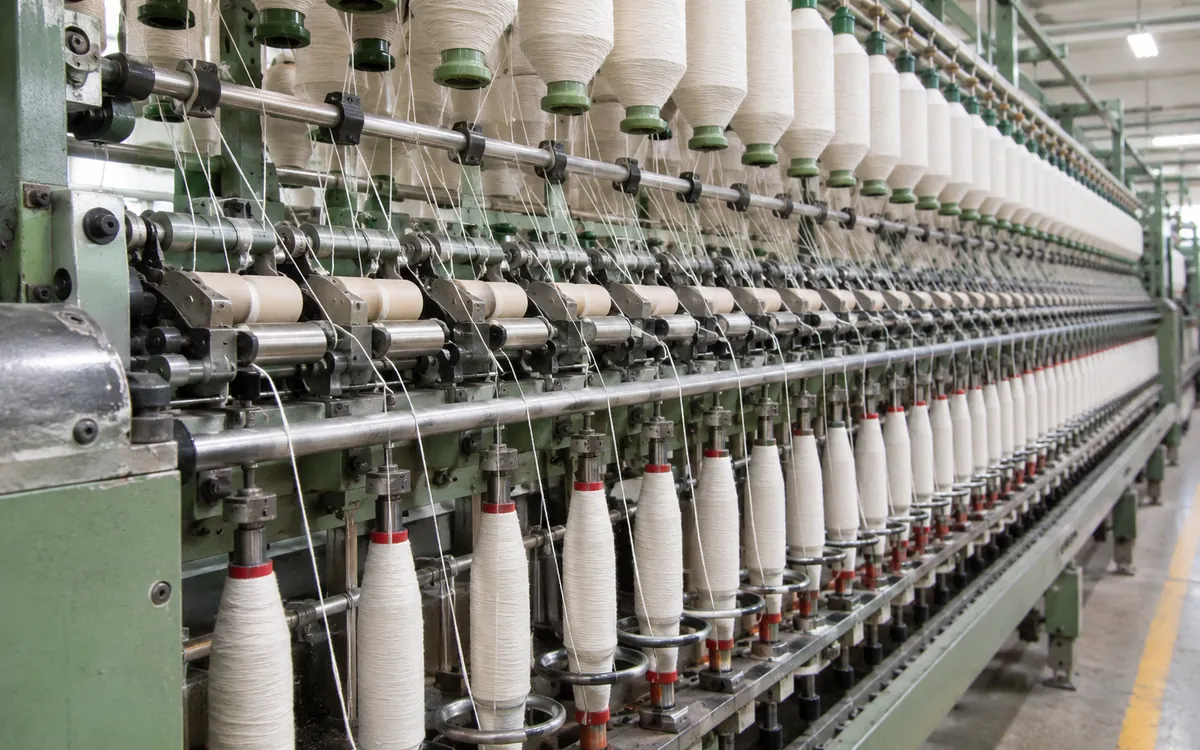
Walk into a spinning mill and the ring frame is the machine you hear first. Hundreds of spindles hum at once, each one turning a bobbin so fast that you cannot see the yarn. The ring frame machine is the last big step in the making of ring-spun yarn. Everything before it prepares the fibre. This machine turns that fibre into the yarn that weavers and knitters actually buy. Later in this guide you will learn the ring frame production calculation formula with example numbers, step by step.
This guide explains how a ring frame machine works in plain steps, what each part does, why the ring and traveller set a speed limit, and how to work out twist, delivery speed and output. The worked example at the end follows one machine from spindle speed to kilograms per day, with the arithmetic shown. If you want a parts diagram first, our page on the parts of a ring frame is a good companion to this one.
What the ring frame does
A ring frame has three jobs, and it does all three at the same time.
- Draft. It thins the roving (a loose, slightly twisted strand) down to the thickness of the final yarn.
- Twist. It twists the thinned strand so the fibres grip each other and the yarn gets strength.
- Wind. It winds the finished yarn onto a bobbin, forming a package called a cop.
Ring spinning is one of the oldest spinning systems and is still widely used for fine and medium yarns. It gives yarn with good strength and a soft, even feel, but it is slower than rotor or air-jet spinning. Our guide on ring, rotor and air-jet yarn types compares the three.
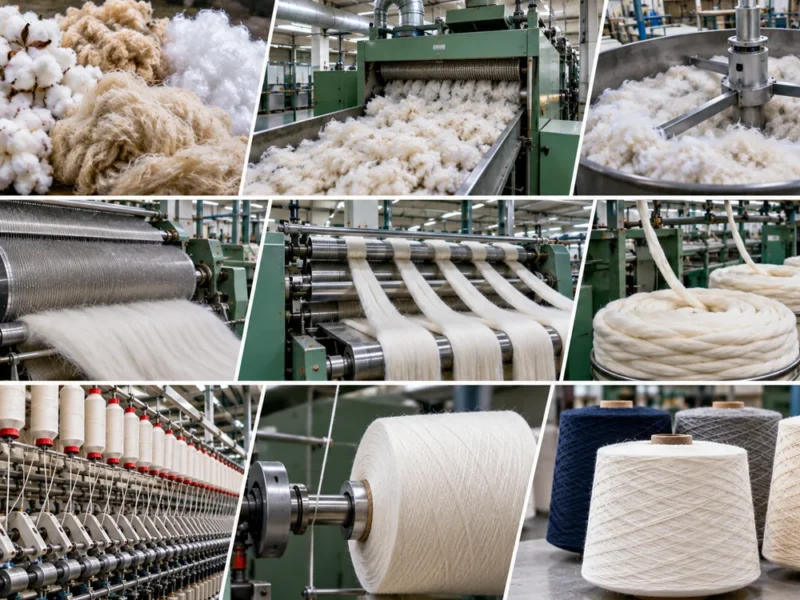
For the full route from raw fibre, see our overview of the yarn making process from fibre to yarn. The ring frame sits near the end. Before it come the blowroom, card, draw frame and the roving frame (also called the speed frame).
The main parts of a ring frame machine
| Part | What it does |
|---|---|
| Creel | Holds the roving bobbins and feeds them to the drafting zone |
| Drafting system | Rollers and aprons that thin the roving. It stretches the strand to many times its length |
| Yarn guide (lappet) | Guides the yarn from the front rollers to the spindle |
| Separator | Keeps the balloon of one spindle from touching the next |
| Ring | A steel ring fixed on the ring rail. The traveller runs on it |
| Traveller | A small steel or nylon clip that glides round the ring and drags the yarn |
| Spindle | Spins the bobbin at high speed |
| Bobbin (tube) | Carries the cop as it builds |
| Ring rail | Moves up and down to lay the yarn in layers on the bobbin |
| Builder motion | Controls the lift of the ring rail so the cop builds in the right shape |
| Drive and gearbox | Powers the rollers, spindles and rail in the right ratios |
You can see these parts in more detail in our list of spinning machines for yarn making.
How a ring frame machine works, step by step
- Roving enters the creel. Each roving bobbin is hung above a spindle position.
- Drafting. The roving passes between sets of rollers that turn at different speeds. The front rollers turn faster than the back ones, so the strand is pulled thinner. Aprons guide the short fibres so they do not scatter.
- Twist insertion. The thin strand leaves the front rollers and runs down through the yarn guide, round the traveller and onto the bobbin. The spindle turns the bobbin. The traveller, dragged by the yarn, follows round the ring. Each turn of the traveller puts one turn of twist into the strand.
- Balloon. Between the yarn guide and the traveller, the yarn swings out in a spinning curve called the balloon. The separator stops one balloon from touching the next.
- Winding. The traveller lags a little behind the spindle. That small difference in speed pulls the yarn onto the bobbin. The ring rail moves up and down slowly so the yarn lays in neat layers.
- Doffing. When the cops are full, the machine stops and a doffer replaces the full bobbins with empty tubes. Many modern machines do this automatically.
The traveller is the key detail. Twist is added by the spindle and traveller together, and the yarn pulls the traveller round, so yarn tension and traveller weight are linked.
Why the ring and traveller set the speed limit
Ring spinning is limited by friction. The traveller slides on the steel ring at very high speed, pressed there by the pull of the yarn. That generates heat and wear.
Some figures from ring and traveller makers help show the scale. These are guidance values, and each mill should check the maker’s data for its own machine.
- A traveller on a flange ring glides at about 40 m/s, which is around 140 km/h. Coated rings are quoted as high as about 45 m/s.
- Temperatures at the contact are typically around 300°C. Readings of 400 to 500°C point to unstable running and damage.
- Traveller life is often quoted at 200 to 300 operating hours.
- Ring running surfaces are hard, about 800 to 850 Vickers. Travellers are a little softer, about 650 to 700 Vickers, so the traveller wears first and is the cheap part to replace.
- Friction work rises with the third power of spindle speed. That means a small rise in rpm gives a much larger rise in heating and wear.
- A common rule for the cop shape is that the bobbin length is about five times the inside ring diameter.
Machine makers keep raising speed. One maker states that its newest spindle package reaches up to 28,000 rpm, up from a 25,000 rpm limit it quotes for earlier designs, with delivery speeds up to 40 m/min. It does this partly by using a smaller ring, so the traveller covers less distance per turn. These are maker claims for one product, not typical mill figures, and most mills run well below such limits.
Traveller weight
Choosing the traveller is one of the most common daily decisions on a ring frame. The general rules are:
- Lighter travellers suit higher spindle speeds, new rings and short tubes.
- Heavier travellers suit old rings and long tubes, and they tend to reduce hairiness.
- Too light a traveller gives a soft, loose bobbin. Too heavy raises yarn tension and causes end breaks.
The right weight also depends on yarn count, yarn strength and the fibre being spun. Mills usually follow the traveller maker’s chart and fine-tune from there.
Twist, delivery speed and production: the formulas
You need three ideas.
1. Twist per inch (TPI) from the twist multiplier (TM). For cotton yarn in the English count system (Ne):
TPI = TM × √Ne
2. Twist per metre (TPM). One inch is 0.0254 m, so:
TPM = TPI ÷ 0.0254
3. Front roller delivery speed. The spindle speed (rpm) divided by twist per metre gives the length of yarn delivered per minute:
Delivery speed (m/min) = spindle rpm ÷ TPM
This ignores the small loss of twist from the traveller lag, so it is a good first estimate and not an exact figure. Our guide on twist in yarn, TPI and twist multiplier explains where TM comes from and how to choose it.
Production per spindle then follows from the yarn count. The tex number tells you the weight of 1,000 m of yarn:
tex = 590.5 ÷ Ne
If you need a refresher on yarn counts, see our page on yarn count.
A worked example: one machine, from rpm to kilograms
Let us calculate the output of a ring frame running a 30s Ne cotton yarn.
Given
- Yarn count: 30s Ne
- Twist multiplier (TM): 3.6
- Spindle speed: 18,000 rpm
- Efficiency: 92 percent
- Number of spindles: 1,008 (an example machine size)
- Running time: 24 hours a day
Step 1: Twist per inch
TPI = 3.6 × √30 = 3.6 × 5.477 = 19.72
Step 2: Twist per metre
TPM = 19.72 ÷ 0.0254 = 776.3
Step 3: Delivery speed
Delivery speed = 18,000 ÷ 776.3 = 23.19 m/min
Step 4: Yarn tex
tex = 590.5 ÷ 30 = 19.68 tex, so 1,000 m weighs 19.68 g.
Step 5: Output per spindle at 100 percent
Grams per minute = 23.19 × 19.68 ÷ 1,000 = 0.4564 g/min
Grams per hour = 0.4564 × 60 = 27.38 g/h
Step 6: Apply the efficiency
27.38 × 0.92 = 25.19 g/h per spindle
Step 7: Whole machine
- Per hour: 25.19 × 1,008 = 25,392 g = 25.4 kg/h
- Per day: 25.4 × 24 = about 609 kg/day
Step 8: Check the traveller speed
Suppose the ring has an inside diameter of 42 mm. The spindle surface speed at the ring is:
π × 0.042 × 18,000 ÷ 60 = 39.6 m/s
The traveller runs a little slower than this because it lags the spindle. The result sits close to the roughly 40 m/s flange ring figure quoted earlier, so this setting is near the practical limit for a standard ring and not far below it. If the mill wants a higher spindle speed, it would need a smaller ring or a coated ring and a traveller suited to it.
What the numbers tell you
- Higher rpm gives more yarn, but only if twist stays the same. At 20,000 rpm with the same TM, the delivery speed rises to 25.76 m/min, which is 11.1 percent more (20,000 ÷ 18,000 = 1.111). Output rises by the same ratio, from 609 to roughly 677 kg/day.
- A finer yarn gives less weight per day. The same machine on a finer count has a higher TPI, so the front roller speed falls, and the yarn is lighter per metre.
- Efficiency matters as much as speed. A rise from 92 to 94 percent efficiency adds 2.2 percent to output without raising rpm (94 ÷ 92 = 1.022).
Draft in this example
If the roving is 1.2 Ne (a coarse strand), the draft needed to reach 30s Ne is:
Draft = 30 ÷ 1.2 = 25
So the drafting system stretches the roving to 25 times its length. Roving hank is an example value here. Real mills pick the roving count to suit the yarn count and the fibre.
Common problems on a ring frame
| Problem | Likely causes |
|---|---|
| End breaks (yarn snaps) | Worn or wrong-weight traveller, poor roving, wrong twist, dirty rollers, high humidity swings |
| Snarls | Too much twist, or low tension |
| Hairiness | Light traveller, poor fibre, worn aprons |
| Thick and thin places | Uneven roving, worn drafting parts, poor roller settings |
| Soft or ugly cops | Traveller too light, wrong builder motion setting |
| Hot, blue-black travellers | Over-speed or poor lubrication. Change the traveller and check the ring |
Regular cleaning, correct roller settings and timely traveller change deal with most of these. A lot of end breaks come down to the small things that no one checked.
Compact spinning and automation
Many ring frames now have a compact attachment. It narrows the fibre strand just after the drafting zone, so more fibres are caught in the yarn, and the yarn has less hairiness. Our flow chart of compact yarn shows where this step sits.
Other modern features include automatic doffing, spindle monitoring that spots a broken end quickly and drives that adjust speed through the cop build. These cut labour and lift efficiency, but they still need steady basic care.
Final thoughts
A ring frame machine drafts, twists and winds in one pass, and it does it at spindle speeds that most people never see. The ring and traveller set the limit, since friction and heat rise fast with speed. The formulas are short: TPI from TM and count, delivery speed from rpm and twist, and output from tex and efficiency.
In our worked example, a 1,008-spindle machine running 30s Ne yarn at 18,000 rpm and 92 percent efficiency produced about 25.4 kg per hour, or roughly 609 kg per day. Use the same steps with your own numbers, and you will see where a gain in speed, twist or efficiency actually shows up in kilograms.
Frequently asked questions
It is the spinning machine that drafts roving to yarn thickness, twists it with a spindle, ring and traveller, and winds it onto a bobbin to form a cop.
The traveller is a small clip that slides round the ring. It is dragged by the yarn, adds twist and, by lagging slightly behind the spindle, helps wind the yarn onto the bobbin.
Multiply the twist multiplier by the square root of the English yarn count. For 30s Ne with a TM of 3.6, TPI is about 19.7.
Divide the spindle speed in rpm by the twist per metre. At 18,000 rpm and 776 TPM, delivery speed is about 23.2 m/min.
Friction and heat between the ring and traveller. Friction work rises with the third power of spindle speed, so higher speeds quickly raise wear and the risk of end breaks.
Often quoted traveller life is 200 to 300 operating hours, but it depends on the yarn, the speed and the ring. Follow the maker’s advice and change when wear or end breaks rise.
Ring yarn is strong, soft and even, and the system suits a wide range of counts. Rotor and air-jet spinning are faster, but they make a different yarn.