
Garment factory capacity calculation answers a question that every merchandiser and planner meets on the first day of an order: can we make this, in this time, with what we have? A buyer asks for 150,000 pieces in 45 days. A quick yes can fill the floor with work it cannot finish. A quick no can lose an order the factory could have handled. A proper calculation gives a reply with numbers behind it.
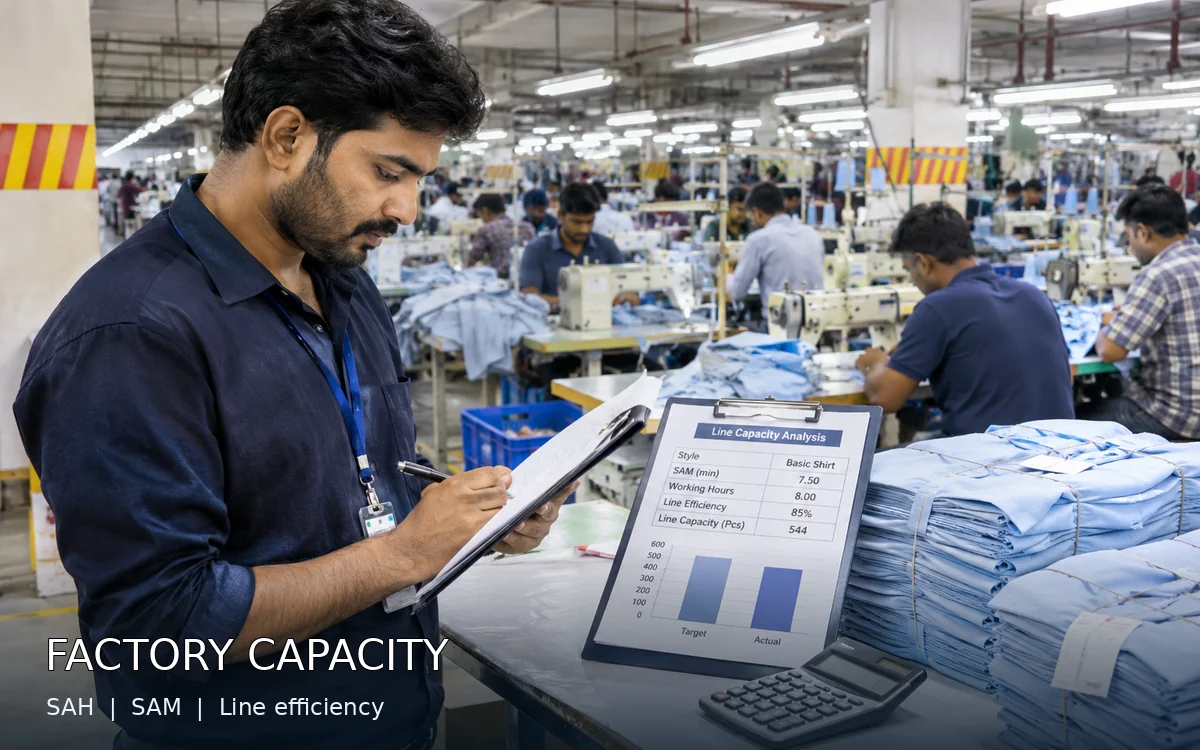
This guide shows how to measure capacity in a way that works for mixed styles, using standard minutes and standard allowed hours. It explains the formulas, the limits that different departments set, how to find capacity utilisation, and how to work through a full example with assumed figures. It also covers the mistakes that make capacity look larger than it is.
What capacity means
Capacity is the most work a factory, a line or a department can do in a given period under normal conditions. Two points matter.
- Normal conditions. It is not the best day ever recorded. It is what the floor can do on a regular day, with usual absenteeism, usual efficiency and usual breakdowns.
- Period. Capacity is stated per hour, per day, per week or per month.
There are different ways to state capacity.
- In pieces. Simple, but it only works for one style. A factory that makes T-shirts and jackets has no single piece capacity.
- In standard minutes or standard allowed hours (SAH). Works for any mix of styles, because each garment is converted into the amount of work it contains.
The second method is the one planners use. The standard minute value, or SMV, tells how much work a garment holds. Our guide on how to calculate standard allowed minutes explains how to find it.
The basic idea: work content and work available
Every order has a work content. It is the number of garments multiplied by the SMV of the style.
Work content (standard minutes) = order quantity × SMV
Work content in SAH = order quantity × SMV ÷ 60
The factory has a work capacity. It is the standard minutes that its sewing operators can produce in the period.
Capacity (standard minutes per day) = operators × working minutes per day × efficiency × (1 − absenteeism rate)
Capacity in SAH per day = standard minutes per day ÷ 60
You compare the two. If the work content is more than the capacity in the period, the order does not fit. If it is less, it fits, with the difference showing the spare time.
The inputs you need
Number of operators or machines
Count the sewing operators who will work on the order, line by line. If the number of machines is lower than the number of operators, the machines set the limit. Include only the direct sewing operators in this count. Helpers, checkers and others do not produce standard minutes.
Working minutes per day
Use paid, productive time. For an 8 hour shift, that is 480 minutes. Subtract any fixed non-productive time if your floor has it. Overtime is a separate decision, shown later.
Efficiency
Use a figure that your floor has really achieved on similar work, not a target you hope for. A new style or a new line will not run at your best figure on day one. Our guide on productivity vs production efficiency formulas explains how efficiency is measured, and the SMV and efficiency variance report shows how to track it.
Absenteeism
Use your recent average. A 5 percent rate means that of 100 operators on the roll, about 95 are at work on a normal day. See our article on the cost of absenteeism and turnover.
Working days
Count the real working days in the period, after weekly holidays, public holidays and planned shutdowns.
A worked example
The figures are assumed.
The factory: 12 sewing lines, with 35 sewing operators on each line. That is 420 operators.
Working time: 8 hours a day, which is 480 minutes, and 26 working days a month.
Efficiency: 60 percent.
Absenteeism: 5 percent.
Step 1: operators at work on a normal day
420 × (1 − 0.05) = 420 × 0.95 = 399 operators
Step 2: standard minutes per day
399 × 480 × 0.60 = 114,912 standard minutes per day
Step 3: convert to SAH
114,912 ÷ 60 = 1,915.2 SAH per day
Step 4: monthly capacity
1,915.2 × 26 = 49,795 SAH per month
Step 5: compare with the orders
The planner has three orders for the month.
| Order | Quantity | SMV | Work content (SAH) |
|---|---|---|---|
| Style A, a knit shirt | 60,000 | 8.0 | 8,000 |
| Style B, a woven jacket | 40,000 | 12.5 | 8,333 |
| Style C, a basic T-shirt | 100,000 | 5.2 | 8,667 |
| Total | 25,000 |
Step 6: capacity utilisation
Utilisation = work booked ÷ capacity available × 100
25,000 ÷ 49,795 × 100 = 50.2 percent
Step 7: days needed
25,000 ÷ 1,915.2 = 13.05 days of full factory capacity
So these three orders use about half the month. There is room for about another 24,800 SAH. For example, a style with an SMV of 6.5 could add roughly 229,000 more pieces. That is 24,795 × 60 ÷ 6.5. Whether the factory can really take it depends on the other limits below.
Step 8: single style output
If the whole factory made only Style A for a day:
114,912 ÷ 8.0 = 14,364 pieces per day
This is the way to convert SAH capacity back into pieces. It changes with each style, since the SMV changes.
Step 9: what if efficiency changes?
At 70 percent efficiency, with the same people:
399 × 480 × 0.70 = 134,064 standard minutes per day, which is 2,234 SAH.
That is 16.7 percent more capacity from the same operators. At 50 percent:
399 × 480 × 0.50 = 95,760 standard minutes per day, or 1,596 SAH.
Efficiency is the most sensitive number in the calculation. A planner who assumes the wrong efficiency will get the wrong answer, however careful the other steps.
Other limits that set real capacity
The sewing line is only one department. The factory’s real capacity is set by the weakest part of the flow.
Cutting
Check the cutting room capacity in pieces or fabric per day. It depends on the number of tables, the spreading and cutting methods, the number of cutters and the fabric. A big sewing capacity is of no use if cutting cannot feed it. Our guides on the cutting department, fabric spreading methods and the cut order plan explain the flow.
Embroidery, printing and washing
If the style needs special processes, the machines for them, whether inside the factory or outside, may be the bottleneck. Check their capacity in pieces per day and compare it with the sewing output.
Finishing and packing
Pressing, checking, folding and packing also take time and people. Finishing capacity should match the sewing output, and some factories find it is the real limit. Our guide on the layout and SMV of a garment finishing process gives a look at the work.
Machines
Count the machines by type, such as lockstitch, overlock, flatlock, bartack and button. A style needing 15 overlock machines on one line cannot run if the line has only 10. Our article on garment manufacturing machinery covers machine types.
Materials
Fabric and trims must arrive on time. The calendar in the time and action plan shows when the material is due.
Utilities and space
Power supply, boiler steam, compressed air and floor area can also set limits.
The factory’s real capacity for a style is the lowest of these department capacities, expressed in the same unit.
Adjusting for ramp up and changeover
A new style does not reach full efficiency on day one. The first days are slower, as operators learn. Include this in the plan. A common method is to apply a lower efficiency for the first few days and the planned efficiency after. Our guide to the sewing operator learning curve shows the pattern, and the article on style changeover in sewing explains how much time can be lost when styles change.
Short orders are hit hardest. An order that runs for three days may spend a third of that time ramping up.
Using overtime as extra capacity
Overtime adds working minutes. If the line works 2 extra hours a day, the working minutes rise from 480 to 600, which is 25 percent more time. Capacity rises by about the same, but efficiency in late hours is often lower. Overtime also costs more per hour. See the overtime pay calculation in a garment factory for the cost and the legal limits. Plan normal capacity first, and treat overtime as a safety margin, not part of the base plan.
Capacity planning for a new order: a quick process
- Get the order details. Quantity, styles, SMV, delivery date, fabric and trim readiness.
- Convert the order to SAH.
- Check the free capacity in the sewing lines for the time window, after existing orders.
- Check the other departments for the same window.
- Allow for ramp up and changeover.
- Decide. Accept, accept with changes (such as a split delivery, overtime or subcontracting), or decline.
- Record the plan and update it as the order runs. The daily production report shows whether the plan holds.
This also links to the wider job of production planning and control in garments.
Capacity and cost
Capacity utilisation drives cost. Fixed costs such as rent, salaries of staff and machine depreciation are spread over the production of the month. At 50 percent utilisation, each garment carries more of these costs than at 85 percent. That is why factories chase orders to fill the lines. It also shows why a factory should not accept an order at a price that does not cover its variable cost. See our guides on factory overheads in garment costing and break-even analysis for the apparel industry.
Common mistakes in capacity calculation
- Using pieces, not SAH, for mixed styles. A piece count hides the difference in work between a T-shirt and a jacket.
- Using the best efficiency ever achieved. Use a normal, proven figure.
- Forgetting absenteeism. Capacity on paper assumes everyone comes.
- Counting helpers and checkers as producers. Only direct sewing operators make standard minutes.
- Ignoring other departments. Cutting, finishing or special processes may limit output.
- Not allowing for ramp up and changeover. Short orders suffer.
- Using the wrong SMV. A guess here changes everything. Check it by time study.
- Counting days that are not working days. Weekly holidays and festival breaks matter.
- Booking to 100 percent. Leave some room for breakdowns, delays and re-work. Many planners keep a buffer.
Final thoughts
Garment factory capacity calculation comes down to two numbers: the work content of the orders in SAH, and the work capacity of the floor in SAH. In our example, 399 operators at 60 percent efficiency produced 1,915 SAH a day, or about 49,800 SAH in a month, and three orders worth 25,000 SAH took about half of it.
Keep the inputs honest, check the other departments, and allow for ramp up. Then when a buyer asks whether you can take an order, you can answer with a date and the numbers that support it.
Frequently asked questions
Multiply the operators at work by the working minutes per day and the efficiency to get standard minutes per day. Divide by 60 for SAH. Compare this with the work content of the orders, which is quantity times SMV.
SAH means standard allowed hours. It is the work content of a garment or order expressed in hours, equal to quantity times SMV divided by 60.
Divide the standard minutes of capacity by the SMV of the style. The result is the number of pieces that can be made in that time.
It is the share of available capacity that is booked with work, found by dividing the work booked in SAH by the capacity available in SAH and multiplying by 100.
Capacity is directly proportional to efficiency. A change from 60 to 70 percent raises capacity by about 17 percent without any new people.
Plan capacity on normal working hours. Treat overtime as extra margin, since it costs more and efficiency is often lower in late hours.
The weakest department in the flow, which could be cutting, sewing, special processes, finishing, machines, materials or utilities.