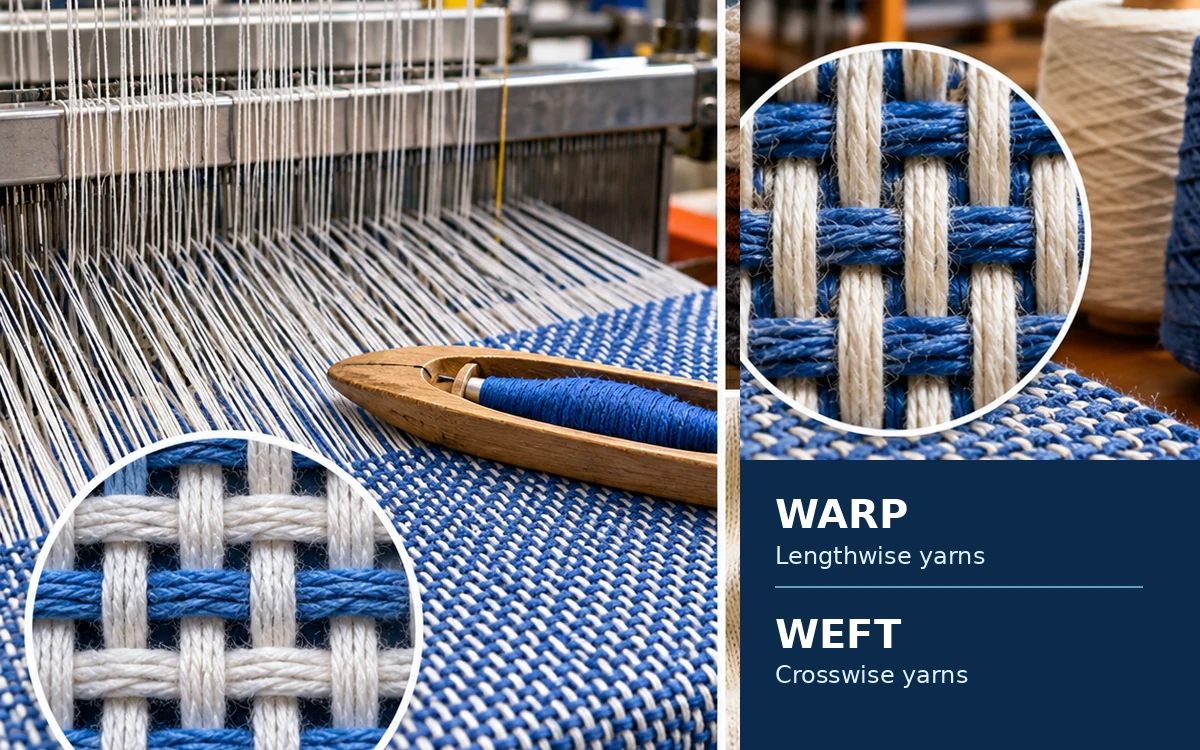
Every woven fabric you have ever touched, from a cotton shirt to a denim jacket to a silk scarf, is built from two sets of threads that cross each other at right angles. One set runs along the length of the cloth. The other runs across it. These two sets have names: warp and weft. So, what is warp and weft, how do they differ and why does the difference matter when you cut, sew or buy fabric?
This guide answers those questions in plain language. You will learn the definitions, how to tell warp from weft in a fabric sample, how the two behave differently in strength and stretch, how weaving puts them together and how to calculate how much yarn each one uses. There is a worked example for a real cotton shirting fabric. If you want the full story of how a loom works, our guide to the weaving process from yarn to fabric is a good companion.
The short answer
The warp is the set of yarns that run lengthwise in the fabric, parallel to the selvedge. The weft is the set of yarns that run crosswise, from one selvedge to the other. Weaving is the process of interlacing the weft through the warp. Warp yarns are held under tension on the loom, while weft yarns are inserted one at a time.
Warp threads are also called ends. Weft threads are also called picks or filling. In the United States, “filling” is common. In most other places, “weft” is the usual word, and “woof” is an older term for it.
A simple memory trick: the weft travels from left to right and back again, while the warp stays put, stretched on the loom for the whole job.
Why the words matter in the trade
In the textile trade these words are used exactly. You will see them on fabric specifications, loom reports, quality sheets and buyer claims. A buyer who writes “warp strength 450 N” means something very different from “weft strength 450 N,” so it pays to know which is which.
What the warp does
The warp is the structure of the fabric. Before weaving, hundreds or thousands of yarns are wound side by side onto a large roll called a beam. This step is called warping. Then the yarns may be coated with size, a starch-based film that protects them from rubbing during weaving. Finally the ends are threaded through the loom’s heald wires and the reed.
On the loom, warp yarns:
- Run along the length of the fabric
- Are held under steady tension
- Move up and down in groups, forming an opening called the shed
- Rub against the reed, heald wires and weft, so they need to be strong and smooth
For more about the first stage, see our guide to warping machine types and how they work and our page on textile sizing.
What the weft does
The weft fills the fabric. A weft yarn is carried across the width of the warp through the shed. Then the reed pushes it firmly against the previous weft, making a tight line called a pick. The shed changes, and the next weft goes in.
Weft yarn:
- Runs across the width
- Is usually wound on a small package, such as a pirn, cone or large bobbin
- Does not need to be as strong as warp, because it is not under tension for long
- Is inserted at high speed on modern looms
Weft insertion is the feature that separates loom types. Shuttle looms throw a small carrier. Rapier looms use rods or tapes. Projectile looms use a small gripper. Air jet and water jet looms use a stream of air or water. Our overview of loom types compares them.
Warp against weft: key differences
| Point | Warp | Weft |
|---|---|---|
| Direction | Lengthwise | Crosswise |
| Also called | Ends, lengthwise yarns | Picks, filling, woof |
| Tension on loom | High, constant | Low, for the instant of insertion |
| Preparation | Warping, sizing, drawing-in | Winding onto a package |
| Strength needed | Higher | Lower |
| Yarn quality | Usually stronger, better twisted | May be softer, lower twist |
| Movement | Moves up and down to form the shed | Passes through the shed |
| Count in fabric | Ends per inch (EPI) or per cm | Picks per inch (PPI) or per cm |
| Edge | Selvedge runs along the warp | Weft turns back at the edge |
How to tell warp from weft in a fabric
You may need to identify the direction in a cut piece. Try these clues, from the most reliable to the least.
- Look for the selvedge. The selvedge is the finished edge where the weft yarn turns back. It runs parallel to the warp. If your fabric has a selvedge, the warp runs in that direction.
- Check the strength. Pull a small strip along each direction. The warp direction is usually stronger and stretches less.
- Check the stretch. Weft often has slightly more give, especially in stretch wovens, where elastic yarn is used in the weft.
- Look at the yarn. If the two directions use different yarns, the finer, stronger and smoother one is probably the warp.
- Count the threads. Fabric commonly has more ends per inch than picks per inch. The direction with the higher count is often the warp, but there are exceptions.
- Look for sizing residue. Unwashed fabric may show a stiff, whitish coating on the warp.
- Tear the fabric. Woven cloth tears straighter along one yarn direction than the other. Tearing needs a different technique and works better for plain, firm fabrics.
No single clue is perfect, so use two or three together.
Grain: why this matters in sewing
In sewing and pattern making, the warp direction is called the lengthwise grain, and the weft direction is called the crosswise grain. The diagonal at 45 degrees is the bias.
- Lengthwise grain (warp): The strongest direction and the one with the least stretch. Pattern pieces for trouser legs, skirt panels and shirt fronts are cut with the grain line parallel to the selvedge.
- Crosswise grain (weft): Slightly more give and often a bit softer. Used for some yokes, cuffs and waistbands.
- Bias: The most stretch and the best drape. Used for bias binding, cowl necklines and flowing skirts.
If a garment is cut off-grain, it may twist, hang badly or hold wrinkles. Aligning the grain line on the pattern with the warp is one of the first rules of cutting. Our guide to woven versus knit fabric explains why woven fabrics behave this way.
How warp and weft make different weaves
The way the weft goes over and under the warp is the weave. Three basic weaves cover most fabrics:
- Plain weave. The weft goes over one warp, then under one, and the pattern reverses on the next row. It is simple and strong. Shirting and poplin are plain weaves.
- Twill weave. The weft passes over two or more warps and under one or more, stepping across by one thread each row to create diagonal lines. Denim and gabardine are twills. See our guide to twill weave types, structure and uses.
- Satin weave. The weft or warp floats over four or more yarns, giving a smooth, shiny face. It is soft and drapes well.
When more warp shows on the face, the fabric is called warp-faced. When more weft shows, it is weft-faced. Satin, for instance, is often warp-faced, with long warp floats on the surface. To learn how to recognise the three weaves, read our page on twill, satin and plain weave identification.
Ends and picks: how fabric density is described
A woven fabric is described by its construction. For example: 40 × 40 / 100 × 70. This means:
- Warp yarn count 40s Ne
- Weft yarn count 40s Ne
- 100 ends per inch (EPI)
- 70 picks per inch (PPI)
Often the warp comes first, then the weft. Thread count in bedsheets is the sum of ends and picks per square inch. For counts, our page on calculating English yarn count explains the numbers.
A worked example: yarn used in a cotton shirting fabric
Let us calculate the amount of warp and weft yarn in one metre of a cotton shirting and use it to check the fabric weight.
Given
- Construction: 40s Ne × 40s Ne, 100 EPI × 70 PPI
- Fabric width: 58 inches
- Warp crimp (extra yarn length used up by bending over and under the weft): 6 percent
- Weft crimp: 4 percent
- Size on the warp yarn is ignored, to keep things simple
Step 1: Convert the width.
58 inches × 0.0254 = 1.4732 m
Step 2: Total number of warp ends.
Ends = EPI × width in inches = 100 × 58 = 5,800 ends
(In real fabric, extra ends are added for the selvedges, which we ignore here.)
Step 3: Length of warp yarn in 1 metre of fabric.
Each end runs the full 1 metre of fabric length, plus the crimp.
Warp length = 5,800 × 1 × 1.06 = 6,148 m
Step 4: Number of picks in 1 metre of fabric.
PPI is 70 per inch. There are 39.37 inches in a metre, so picks per metre = 70 ÷ 0.0254 = 2,755.9.
Step 5: Length of weft yarn in 1 metre of fabric.
Each pick runs the full width of 1.4732 m, plus crimp.
Weft length = 2,755.9 × 1.4732 × 1.04 = 4,060 × 1.04 = 4,222 m
(2,755.9 × 1.4732 = 4,060.0.)
Step 6: Find the tex of the yarn.
Tex = 590.5 ÷ Ne = 590.5 ÷ 40 = 14.76 tex. This means 14.76 g per 1,000 m.
Step 7: Weight of each yarn.
- Warp weight = 6,148 × 14.76 ÷ 1,000 = 90.75 g
- Weft weight = 4,222 × 14.76 ÷ 1,000 = 62.33 g
- Total = 153.1 g
Step 8: Fabric weight in GSM.
The piece is 1 m long and 1.4732 m wide, so its area is 1.4732 m².
GSM = 153.1 ÷ 1.4732 = 103.9, about 104 GSM
So this shirting weighs about 104 grams per square metre before size and finishing. That fits what you would expect from a light poplin-type shirting.
Two things stand out. First, warp yarn makes up about 59 percent of the weight (90.75 ÷ 153.1), because there are more ends than picks and the warp has more crimp. Second, the warp runs to more than 6 km in one metre of cloth, which is why warp breaks are a big source of loom stops. The yarn must be strong and smooth to cope. Our guide to the GSM of fabric shows other ways to find fabric weight.
What happens when warp or weft goes wrong
Weaving faults often have a clear link to one of the two directions.
| Fault | Direction | Cause |
|---|---|---|
| End break or missing end | Warp | Weak yarn, poor sizing, loom damage |
| Warp streak | Warp | Uneven yarn count or tension |
| Broken pick or missing pick | Weft | Weft yarn break, insertion fault |
| Weft bar | Weft | Uneven weft yarn, tension changes, loom stops |
| Slub | Either | Thick place in yarn |
| Float | Either | Yarn that skips an interlacing |
Fabric inspectors learn to name these faults by direction, because the cause and the fix are different.
Other places you will meet warp and weft
- Weaving in craft. Hand weavers and handloom workers use the same words.
- Knitting. Knitted fabrics have an equivalent idea. Warp knitting uses yarns that run lengthwise and form loops along the fabric, while weft knitting forms loops across the fabric from one yarn. Most T-shirts are weft knitted.
- Geotextiles and technical fabrics. Strength is rated separately in warp and weft directions.
- Everyday phrases. The “warp and weft” of a story or a community means the basic structure and detail that hold it together.
Final thoughts
So, what is warp and weft? The warp is the lengthwise set of yarns held under tension on the loom. The weft is the crosswise yarn that passes through them. Together they make every woven fabric. Warp is generally stronger and stretches less, and weft fills in and gives the cloth its width. Knowing which is which helps you cut on the right grain, read a fabric specification and track down weaving faults.
Next time you handle a piece of cloth, find the selvedge, pull gently along both directions and see how it behaves. You will feel the difference between warp and weft in your own hands.
Frequently asked questions
Warp is the set of yarns running lengthwise in a woven fabric. Weft is the set running crosswise. Weaving interlaces the weft with the warp to make cloth.
The warp is usually stronger, because it is made of higher quality, more twisted yarn that has to bear tension on the loom. The fabric tends to be stronger and stretch less in the warp direction.
Find the selvedge, which runs parallel to the warp. Also check the direction with less stretch, the finer yarn and the higher thread count. Use more than one clue.
Ends are individual warp yarns. Picks are individual weft yarns. Fabric density is given as ends per inch (EPI) and picks per inch (PPI).
The grain line shows the direction of the warp. Lining it up with the selvedge keeps the garment hanging straight and prevents twisting.
Yes. Filling is another name for weft, used mostly in the United States.
The terms are used differently. In warp knitting, yarns run lengthwise to form loops along the fabric. In weft knitting, a yarn forms loops across the fabric. Woven fabrics are the ones with true warp and weft interlacing.