A wide roll of fabric is a great way to store cloth, but it is rarely the size a customer wants. Labels need a narrow strip. Bandages need tapes. Knit fabric comes off the knitting machine as a tube that has to be opened before it can be dyed flat. In each case the job is done by a slitting machine, a tool that cuts a material along its length into narrower pieces or opens it flat.
This guide explains what a slitting machine is in a textile setting, the main types, the blade methods and where each one is used. It includes worked examples for planning cuts and for opening tubular knit fabric. A short note first: the word slitting is also used in metal, paper and film industries. This article is about slitting machines for fabric, tape, nonwovens and similar flexible materials. For where slitting fits in knit processing, see our guides on stenter machine functions and the compactor and calender machine for knit finishing.
What is a slitting machine
A slitting machine is a machine that cuts a continuous material lengthwise into two or more narrower pieces. The material may be fed from a large parent roll, then the narrow strips are rewound onto separate cores. This type is called a slitter rewinder. In knitting, a different type of slitter cuts a tube of fabric open along its length so that it can be processed as a flat sheet.
The word slitting describes the cut: a straight line along the direction of travel. It differs from cross-cutting, where the material is cut across its width into sheets or pieces.
Where slitting is used in textiles
| Area | What is slit | Why |
|---|---|---|
| Knit finishing | Tubular knit fabric | To open the tube into open-width fabric before stentering or compacting |
| Woven fabric converting | Wide woven rolls | To make narrower rolls for customers or cut-and-sew lines |
| Tapes and ribbons | Wide woven or nonwoven web | To produce narrow tapes, ribbons and labels in quantity |
| Elastic and webbing | Wide base fabric | To make strips of set width |
| Nonwovens | Wide rolls of spunbond, meltblown, spunlace | To make narrow rolls for masks, wipes, hygiene and medical products |
| Technical textiles | Coated fabric, geotextile, filter fabric, glass cloth | To cut to project widths |
| Garment industry | Bias strips, binding | To make bias binding and trims |
| Labels | Printed woven or satin label rolls | To cut into single label strips |
| Home textiles | Curtain, upholstery rolls | To make roll widths for retail |
Main types of slitting machines
1. Roll slitter rewinder
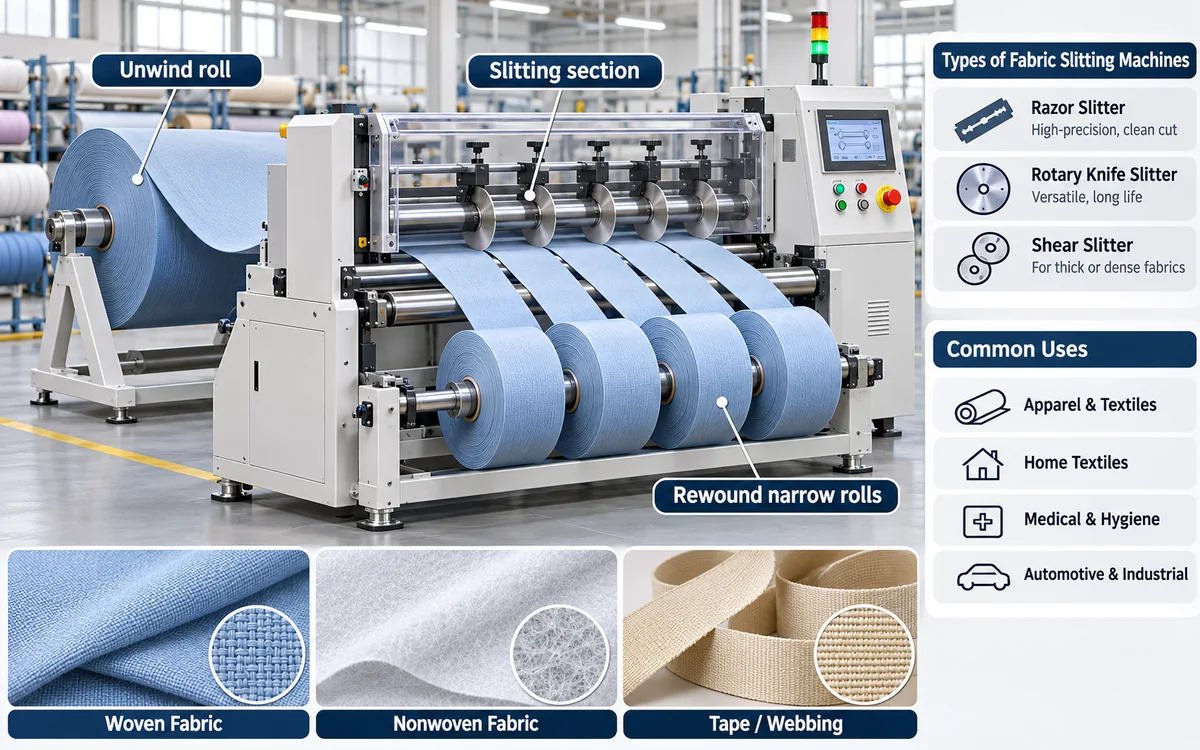
The parent roll is mounted on an unwind stand. The web passes through a slitting section with a row of blades, and the narrow strips are wound onto cores on a rewind shaft. Web tension is controlled so the new rolls are even. Used for woven fabric, nonwoven, film-laminated fabrics and tapes.
2. Whole-roll (log) slitter
The entire wound roll is placed on a rotating shaft, and a circular blade moves in and cuts through the roll to make narrower rolls. It is faster for stiff or heavy rolls, and is common for tapes and nonwoven rolls where the roll can be supported. Care is needed because roll compression can affect the cut.
3. Tubular knit fabric slitter
Knit fabric from circular knitting machines is a tube. The slitting machine opens the tube along a course or a wale line, and the opened fabric is spread flat and wound or plaited. Features include a guide to find the cutting line, such as a rib line or a marker, a sharp knife or a heated knife, and spreading rollers. Some slitters are part of a dry-line before the stenter. Others are used after dyeing.
4. Tape and narrow-fabric slitting machine
A compact machine with many knives set close together, used to cut ribbons, tapes, labels, elastic and webbing from wider fabrics. Hot-knife and ultrasonic versions seal the edge so that it does not fray.
5. Bias cutter
A special slitter that cuts woven fabric at a 45-degree angle to make bias strips for binding.
6. Laser and ultrasonic slitters
For delicate or synthetic materials. Both create sealed, neat edges. They are more costly.
Blade methods
| Method | How it cuts | Best for | Edge | Notes |
|---|---|---|---|---|
| Razor (blade) | A sharp blade cuts through a moving web | Thin, stable nonwovens and fabrics | Clean but can fray | Cheap, blades need frequent change |
| Shear | A pair of upper and lower circular knives cut like scissors | Most woven and knit fabrics, heavier materials | Clean | Durable, needs correct alignment |
| Score or crush | A circular knife presses against a hard roller (anvil) | Thin, soft materials | Compressed edge | Can leave a hard edge |
| Hot knife | A heated blade melts through synthetic fibres | Polyester, nylon, polypropylene tapes and webbing | Sealed edge | Does not suit cotton, which would scorch |
| Ultrasonic | High-frequency vibration cuts and seals | Synthetic fabrics, nonwovens, labels | Sealed, soft | Higher cost |
| Laser | A laser beam cuts | Fine, precise shapes and materials | Sealed, accurate | Energy use, fumes need extraction |
| Rotary (circular) blade on roll | A rotating knife cuts into the wound roll | Whole-roll cutting | Depends on blade | Supports high output for thick rolls |
For natural fibres like cotton and viscose, shear or razor methods are usual, because heat would burn them. For synthetics, heat-based methods give sealed edges and stop fraying.
Main parts of a slitting machine
| Part | Function |
|---|---|
| Unwind stand | Holds the parent roll and lets it unwind under control |
| Brake or tension control | Keeps web tension steady |
| Guide rollers and edge sensors | Keep the web straight and track its edge |
| Slitting section | The knives, blade holders and anvil |
| Blade positioning system | Sets the width of each strip, by hand or by electronic positioning |
| Trim removal | Pulls away or sucks up the edge waste |
| Spreader rollers | Separate the narrow strips so they wind cleanly |
| Rewind shafts | Hold the cores and wind the strips |
| Lay-on rollers | Press the strip onto the roll to control air and density |
| Drive and control panel | Sets speed, tension and counts length |
| Safety guards and stops | Protect the operator |
| Length counter and cutter | Counts length and can cut at set length |
Worked example 1: planning a roll slit
A converter has a parent roll of woven polyester fabric that is 1,500 mm wide and 2,000 m long. A customer wants rolls 290 mm wide.
Step 1: how many strips fit?
- 1,500 ÷ 290 = 5.17, so 5 full strips fit
Step 2: waste.
- Used width = 5 × 290 = 1,450 mm
- Trim = 1,500 − 1,450 = 50 mm, which means 25 mm trimmed from each edge
- Waste = 50 ÷ 1,500 = 3.3 percent
Step 3: output from one parent roll.
- 5 daughter rolls, each 2,000 m long
- Total slit length = 5 × 2,000 = 10,000 m of narrow tape-width fabric
Step 4: time. At a slitting speed of 100 m per minute:
- Run time = 2,000 ÷ 100 = 20 minutes per parent roll
- With 30 minutes to set up the blades and load the roll for the first run, and 5 minutes to unload and reload each roll after, a shift of 8 hours (480 minutes) can handle: (480 − 30) ÷ (20 + 5) = 18 rolls
Step 5: output per shift. 18 rolls × 10,000 m = 180,000 m of slit fabric. Shorter jobs, more width changes and blade swaps reduce this. Always measure real run times on your own machine.
Is a different width a better fit? If the order was for 250 mm rolls, then 1,500 ÷ 250 = 6 exactly, with no waste except for a thin edge trim. When you have a choice, plan the parent width and the cut width together to reduce trim.
Worked example 2: opening tubular knit fabric
A circular knitting machine produces single jersey tubes with a lay-flat width of 50 cm.
- Open width of the fabric ≈ 2 × lay-flat width = 2 × 50 = 100 cm (the tube is cut open and flattened, so the circumference becomes the width, and the circumference is twice the flat width)
If the same fabric is 180 GSM (grams per square metre) and a knitted batch is 1,200 kg:
- Fabric area = 1,200,000 g ÷ 180 = 6,667 m²
- Length at open width 1.0 m = 6,667 m
If the slitting line runs at 40 m per minute:
- Time = 6,667 ÷ 40 = 167 minutes, or about 2.8 hours
If the factory instead uses a stenter-friendly tube-to-open step with a faster line at 60 m per minute, the time is 6,667 ÷ 60 = 111 minutes. The faster speed saves 56 minutes but needs good edge guiding to keep the cutting line straight. Note that the 180 GSM figure is for finished, relaxed fabric. Weight and width change after dyeing and finishing, so use the grey (unfinished) numbers for the knitting stage and the finished ones for later steps.
Not all knit mills slit before dyeing. Many dye the fabric in tubular form and slit it after dyeing, then stenter or compact it. Slitting before dyeing is used when the dyeing method needs open-width fabric, and it avoids crease marks from the tube edges. See our guide on the stenter machine for what happens next.
Slitting in tape, label and nonwoven production
Most narrow fabrics, such as elastic, ribbons and woven labels, are made on narrow looms. But many tapes are cut from a wide base material. For example, a nonwoven roll for face masks may be slit into the small widths needed by the mask machine. A woven polyester satin for labels is printed in wide rolls, then slit into single label strips with a hot knife to seal the edges. A heat-cut edge on a label avoids the rough scratchy edge of a cut label and keeps the label from fraying in the wash. See our article on heat transfer labels for related products.
How to choose a slitting machine
- Know the material. Woven, knit, nonwoven, coated or laminated materials behave differently.
- Know the widths. Check the widest parent roll, the narrowest strip and the tolerance you need.
- Know the volume. Roll size, weight and number of rolls per shift decide speed and automation.
- Choose the cutting method for the edge you need. Sealed edge for synthetics, clean cut for natural fibres.
- Check tension control. Stretchy and thin fabrics need very good control.
- Check the unwind and rewind. The machine must handle your roll weight and core size.
- Look for easy blade setting. Quick blade changes and digital positioning save a lot of time.
- Check safety. Guards, interlocks, emergency stops and lock-out features.
- Ask for a trial. Send your own material and test the start, middle and end of a roll. Agree on width tolerance, edge quality and roll shape before the trial.
- Consider service and spare parts. Blades wear and need replacing.
Common problems and fixes
| Problem | Likely cause | Fix |
|---|---|---|
| Frayed or rough edges | Dull blades, wrong method | Replace blades, try a hot knife for synthetics |
| Width varies along the roll | Web wandering, poor tension | Fit edge guides, adjust tension |
| Telescoping rolls (rolls slide sideways) | Uneven tension or loose winding | Increase wind-on tension, use lay-on rollers |
| Wavy or puckered strips | Uneven tension across width | Check rollers, adjust tension on each strip |
| Burnt or hard edges | Hot knife too hot, speed too slow | Lower heat, raise speed |
| Stretched knit fabric | Too much tension | Lower tension, use positive feed rollers |
| Blade wear and breakage | Wrong blade or material too hard | Choose a suitable blade, change on schedule |
| Lint and dust | Fabric shedding | Add vacuum extraction and regular cleaning |
| Strips of unequal length | Slip on the rewind | Use differential shafts or slip-clutch cores |
| Cutting line wanders on tubular fabric | Poor guide or fabric twist | Fix the guide, correct fabric twist before slitting |
Safety
Blades are a serious hazard. Follow these basic points.
- Keep guards and interlocks in place. Never bypass them.
- Use lock-out and tag-out before changing blades or clearing jams.
- Wear cut-resistant gloves when handling blades.
- Tie back hair, and avoid loose clothing and jewellery near moving parts.
- Use the right tool to remove waste, not your hands.
- Provide dust and fume extraction for hot knife, laser and ultrasonic cutting of synthetics.
- Train operators and keep written procedures.
Maintenance
- Clean lint and dust after every shift.
- Check blades daily for nicks and wear. Replace or sharpen on schedule.
- Check the alignment of upper and lower shear knives.
- Lubricate bearings and guide rollers according to the manual.
- Calibrate the width positioning and tension sensors regularly.
- Keep spare blades and cores on hand.
- Log the metres cut per blade to predict replacement time.
For comparison, other fabric-handling machines are covered in our guide to the dyeing and finishing machinery. For checking the output after slitting, see the fabric inspection procedure.
Final thoughts
A slitting machine is a simple tool in idea, yet it affects waste, quality and delivery. Pick the machine and the blade method to suit the material and the edge you need. Plan your cuts to reduce trim. Keep tension steady, blades sharp and guards in place. Test on your own fabric before you buy, and record your settings for each job. Good slitting turns a wide roll into exactly what the next step in the chain wants.
Frequently asked questions
It is a machine that cuts a continuous material along its length into narrower strips or opens a tube flat. In textiles it is used for rolls of fabric, tapes, nonwovens and tubular knit fabric.
A slitter cuts lengthwise along the direction of travel. A cutter, such as a cross-cutter, cuts across the width.
A hot knife or ultrasonic blade is common, because it seals the edge and stops fraying. A shear knife also works for many woven polyester fabrics.
To open the tube into a flat sheet so it can be dried, stentered and finished in open width, or to avoid crease lines at the tube edges.
Widths range from narrow tape machines to industrial lines handling parent rolls of more than 2 metres. Check the specification of the model.
Yes, if it uses heat, ultrasonic or laser cutting on suitable synthetic materials.
Plan the parent roll width and the cut width together, so that the trim left over is small. Keep blades sharp and tension steady.