
The types of men’s underwear on a shop wall can feel like a maths test. Briefs, boxers, trunks, boxer briefs, bikinis. Each looks a little different, and each feels different on the body. Pick the wrong one and you spend the day tugging, riding up or sweating.
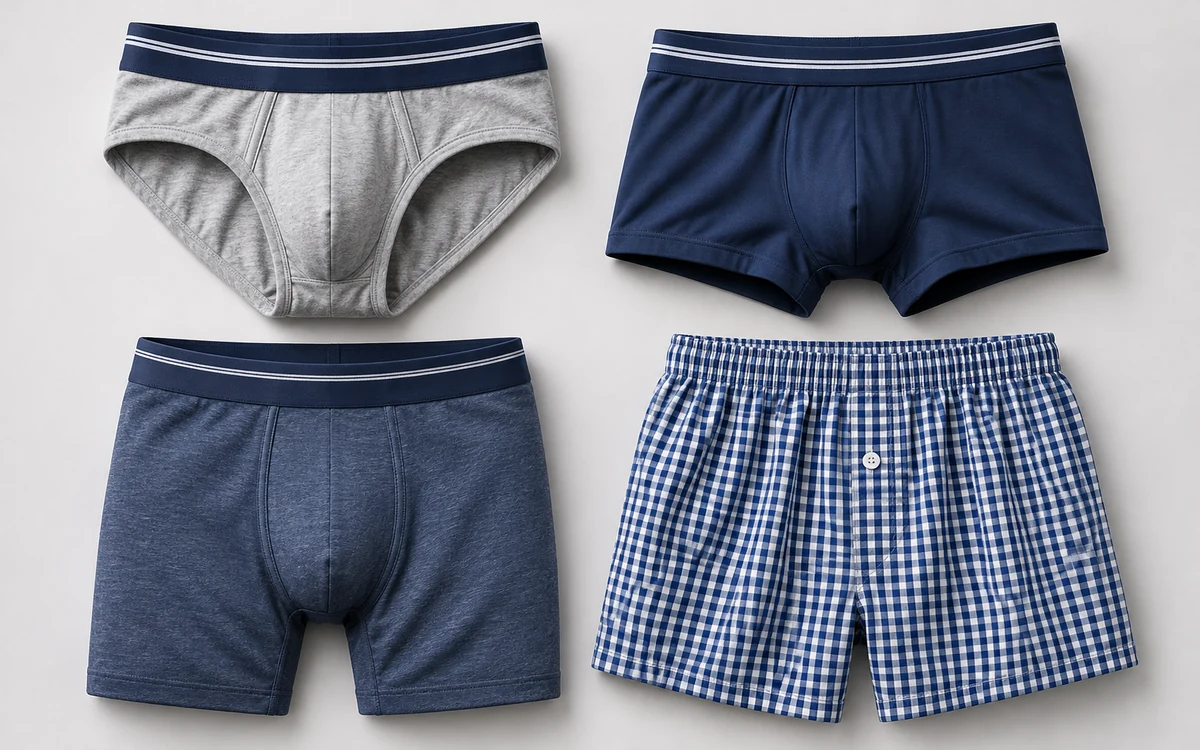
This guide covers each style in plain language. You will see how each style is cut, who it suits, which fabrics work well and how to choose a size. There is also a worked sizing example, and a short section for people who work in garment factories, with the construction points that matter in production. If you want to know the parts of the garment first, our page on the parts of underwear is a good starting point.
The main types at a glance
| Style | Leg length | Support | Typical feel | Good for |
|---|---|---|---|---|
| Briefs | None | High | Snug, secure | Everyday wear, sport, under fitted trousers |
| Boxer shorts | Mid-thigh | Low | Loose, airy | Sleeping, relaxed days, warm weather |
| Boxer briefs | Mid-thigh | High | Fitted, no ride-up | Everyday wear, gym, running |
| Trunks | Short leg | Medium to high | Fitted with short legs | Everyday wear, summer |
| Bikini briefs | None, low rise | Medium | Light, minimal | Warm weather, under low-rise trousers |
| Jockstraps | None | Very high | Open back, strap | Sports that need support |
| Thongs and g-strings | None | Medium | Minimal coverage | Under very tight clothes |
| Long johns | Full leg | Low | Warm base layer | Cold weather |
1. Briefs
Briefs are the classic. They cover the hips with no leg, have a snug fit and a supportive pouch at the front. A waistband holds them in place, and the leg openings are elasticated.
Pros: Good support, stay in place, little fabric to bunch under trousers. Cons: Some men find them too warm or too tight. The leg elastic can leave marks on the skin if the size is wrong.
Briefs come in a few rises. A low rise sits below the navel, a mid rise sits at the navel and a high rise comes up above it.
2. Boxer shorts
Boxer shorts are loose, usually made from woven fabric, and the legs reach mid-thigh. They have an elastic or partly elastic waistband and often a button or an overlapped fly.
Pros: Airy and relaxed. Good in warm weather and for sleeping. Cons: Little support. The fabric can bunch up under slim trousers, and the leg can ride up.
Woven boxers are often made from cotton poplin or a cotton blend. Knit boxers are also common and feel more like a soft T-shirt fabric.
3. Boxer briefs
Boxer briefs mix the support of briefs with the longer leg of boxers. They are fitted, knit and stretchy, and the leg runs down the thigh. That longer leg stops chafing and keeps the garment from riding up.
Pros: Support, comfort and a smooth line under clothes. Popular for sport. Cons: More fabric, so they can feel warm.
Leg lengths vary. A short leg is around 3 inches (7.5 cm) and a long leg runs down to about 9 inches (23 cm), but every brand sets its own.
4. Trunks
Trunks sit between briefs and boxer briefs. They have a short leg, often 2 to 4 inches, and a fitted shape. They are lighter than boxer briefs and cover more than bikinis.
Pros: Fitted but cool. Suit summer wear and swim-style looks. Cons: Less leg coverage than boxer briefs, so thigh chafing is possible for some people.
5. Bikini briefs
Bikini briefs have a low rise, narrow sides and minimal fabric. They are made from stretchy knits and feel very light.
Pros: Light and easy under low-rise trousers. Cons: Less coverage and less support than regular briefs.
6. Jockstraps
A jockstrap has a pouch at the front, a waistband and two straps at the back. It gives strong support and keeps airflow around the sides. It is mostly worn for sport, often with a protective cup in contact sports.
7. Thongs and g-strings
These styles keep coverage to a minimum. They are used under clothes where a visible line must be avoided, or by choice. Comfort depends strongly on fit and fabric.
8. Long johns and thermal underwear
Long johns cover the legs to the ankle. They are knit from cotton, wool, polyester or blends and are used as a base layer in cold weather. Our page on why we wear woollen clothes in winter explains how trapped air keeps the body warm.
Fabrics used in men’s underwear
| Fabric | Why it is used | Watch out for |
|---|---|---|
| Cotton | Soft, breathable, absorbent | Slow to dry. Can lose shape when wet |
| Cotton with elastane (spandex) | Cotton feel with stretch and recovery | Elastane weakens under high heat |
| Modal or other viscose-based fibres | Very soft, smooth, absorbs moisture | Can be less durable if washed hard |
| Microfibre (polyester or nylon) | Light, smooth, quick-drying | Less breathable for some people |
| Bamboo viscose | Soft, drapey | Marketed claims vary, so check the fibre content on the label |
| Wool blends | Warmth and some moisture control | Needs gentle washing |
For a deeper look at stretch fibres, see our guide to spandex, elastane and Lycra. If you want to compare cotton with synthetics for everyday wear, read our guide on cotton vs polyester.
Most knit underwear fabric is single jersey, rib or interlock, with a weight in the range of roughly 140 to 200 GSM, depending on the style. Our page on GSM explains how that weight is measured.
How to choose the right style
- Think about the day. Gym or long walk? Boxer briefs or trunks. Office day in fitted trousers? Briefs or trunks. Sleeping at home? Boxers.
- Think about the weather. Hot and humid? Lightweight cotton, modal or a breathable microfibre in a short cut. Cold? Long johns.
- Think about your clothes. Slim jeans or suit trousers need a smooth line, so knit styles often work better than woven boxers.
- Think about comfort. Check for flat seams, soft waistbands and tag-free labels.
- Try before you stock up. Buy one pair and wear it for a full day first.
A short buying checklist
Before you pay, run through this list on the pack or the garment.
- Fibre content. Look for the percentages on the label. Cotton with 3 to 8 percent elastane is a common mix for a knit brief or boxer brief, and the exact share varies by brand.
- Waistband. Is it soft on the inside? Is the elastic covered? A rough edge will rub by midday.
- Seams. Run your finger along the inside. Flat seams feel smooth. Thick ridges will press into the skin.
- Pouch and gusset. A shaped front pouch and a lined gusset improve comfort and keep the garment in place.
- Leg opening. It should grip without squeezing.
- Care label. If it needs special washing you will not follow, choose another pair.
- Return policy. Fit is personal, so a shop that takes back unworn pairs is a plus.
A worked sizing example
Most brands size men’s underwear by waist measurement. Let us walk through one.
Step 1: Measure your waist. Wrap a soft tape measure around the waist at the level of the navel, over a thin layer. Do not pull it tight. Say you get 84 cm.
Step 2: Convert to inches if needed. 84 ÷ 2.54 = 33.07, or about 33 inches.
Step 3: Look at a size chart. Here is an example chart. Brands vary, so always check the one on the pack.
| Size | Waist (cm) | Waist (in, approx.) |
|---|---|---|
| S | 71 to 79 | 28 to 31 |
| M | 80 to 89 | 31.5 to 35 |
| L | 90 to 99 | 35.5 to 39 |
| XL | 100 to 109 | 39.5 to 43 |
84 cm falls in the M range.
Step 4: Check the fit. The waistband should sit flat without digging in. The leg elastic should hug without leaving deep marks. If you are close to the top of a size range, many people try the next size up for comfort, and the next size down if the garment feels loose after washing.
Step 5: Plan how many pairs. If you do laundry once a week and wear a fresh pair daily, you need 7 pairs. If you wash twice a week, 4 pairs per wash cycle gives 8 pairs in rotation. A few extra pairs let you rotate wear and make each one last longer.
The factory view: what makes underwear comfortable
If you work in a garment factory, a few construction points decide whether a pair feels good.
- Elastic waistband. Waistbands are often made from elastic tape covered with the main fabric or exposed with branding. The elastic has to stretch enough to fit and recover after wash. As an example, a band that measures 62 cm relaxed and stretches to 90 cm has an elongation of (90 − 62) ÷ 62 = 45 percent. Too little stretch fits badly, and too much loses shape.
- Seams. Flat seams or bonded seams reduce rubbing. Four-thread overlock and flatlock stitches are common. Our page on shirt hem types and stitching shows other hem details you might also see on lounge wear.
- Fabric shrinkage. Knit cotton can shrink, so factories pre-treat and test. See the guide to shrinkage control in the garment factory.
- Labels. Tagless prints reduce itch from care labels.
- Pattern accuracy. Small shape errors show clearly on a close-fitting garment. Pattern making and grading need care, and our page on pattern grading shows how size steps work.
- Measurements. Underwear sizes are small, so tolerance is tight. Our shirt measurements guide shows how points of measure and tolerances are set, and the same logic applies here.
Care tips
- Wash new pairs before wearing.
- Use warm or cool water and a gentle cycle. Hot water and strong heat can wear out elastic.
- Skip fabric softener on stretch fabrics, since it can coat the fibres.
- Air dry or tumble dry on low.
- Replace pairs when the elastic is loose, the fabric is thin or the seams come apart. Many people replace underwear every year or so, depending on use.
Common questions about fit and health
Underwear is a personal matter, and comfort matters more than rules. A few simple points are helpful:
- Choose breathable fabric if you sweat a lot.
- Change daily, and after exercise.
- If you have a skin problem or pain that does not go away, talk to a doctor. Underwear choice is rarely the only cause, so do not rely on a single style to fix it.
Final thoughts
The types of men’s underwear come down to a few choices: with or without a leg, loose or fitted, and what fabric suits your day. Briefs give support, boxers give air, boxer briefs give both, and trunks sit in the middle. Fit by waist size, check the fibre content and wear a new style for a full day before you buy many.
For anyone in the industry, small details such as elastic stretch, seam type and fabric shrinkage decide whether a pair feels good after the tenth wash. The same garment looks simple on a shelf and takes real care to make well.
Frequently asked questions
Briefs, boxer shorts, boxer briefs, trunks, bikini briefs, jockstraps, thongs and long johns.
Boxers are loose, usually woven and offer little support. Boxer briefs are fitted, stretchy knits with a longer leg and more support.
It depends on comfort and clothes. Many people choose boxer briefs, trunks or briefs for daily wear, and boxers for relaxed days.
Cotton is soft and breathable, and cotton with a little elastane adds stretch. Modal feels very soft. Microfibre dries fast and suits sport.
Measure your waist at the navel and compare it with the brand’s chart. For example, an 84 cm waist is a medium on many charts.
Replace it when the elastic loosens, the fabric thins or the seams fail. Many people do this about once a year, depending on use and washing.
Neither is better for everyone. Pick the fit that is comfortable and does not leave deep marks. If you have a health concern, ask a doctor.

