A collar is a small piece of fabric that does a lot of work. It frames the face, finishes the neckline, adds structure and changes the mood of a blouse, dress or coat. A soft round collar feels sweet and vintage. A sharp notched collar feels tailored. A tall stand feels modern and clean. If you have ever wondered what a certain collar is called, this guide to the types of collars for women with names and uses is for you.
We cover the main collar families, the names you will meet in shops and patterns, what each one looks like and where it suits best, how a collar is built and fitted, and the mistakes to avoid. A worked example near the end drafts a mandarin band, matches a flat collar to a neckline and works out the fabric one collar needs, with the arithmetic shown. Our guide on the types of necklines for dresses covers openings without a collar, and our page on shirt collar styles goes deeper into the classic shirt.
What is a collar?
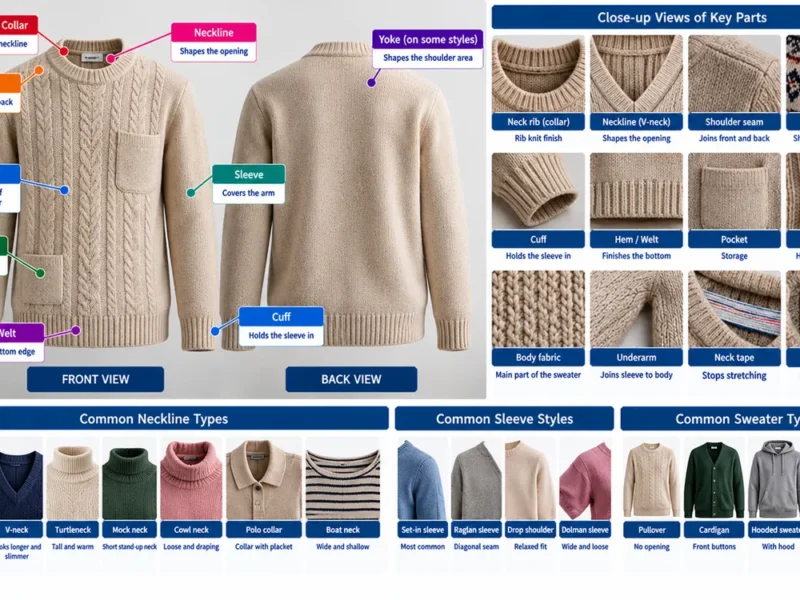
A collar is a separate piece of fabric attached to the neckline of a garment. It may stand up, lie flat or roll over. It is different from a neckline, which is only the shape of the opening. A dress with a scoop neck has a neckline but no collar. A blouse with a Peter Pan has both a neckline and a collar.
Our guide on the parts of a collar names the pieces. Two terms matter most:
- Stand (or band). The part that rises from the neckline and sits against the neck.
- Fall. The part that folds over and shows on the outside.
Some collars, such as the Peter Pan, have almost no stand. Others, such as the mandarin, are only a stand.
The four collar families
One useful way to sort collars is by how they sit.
| Family | How it sits | Examples |
|---|---|---|
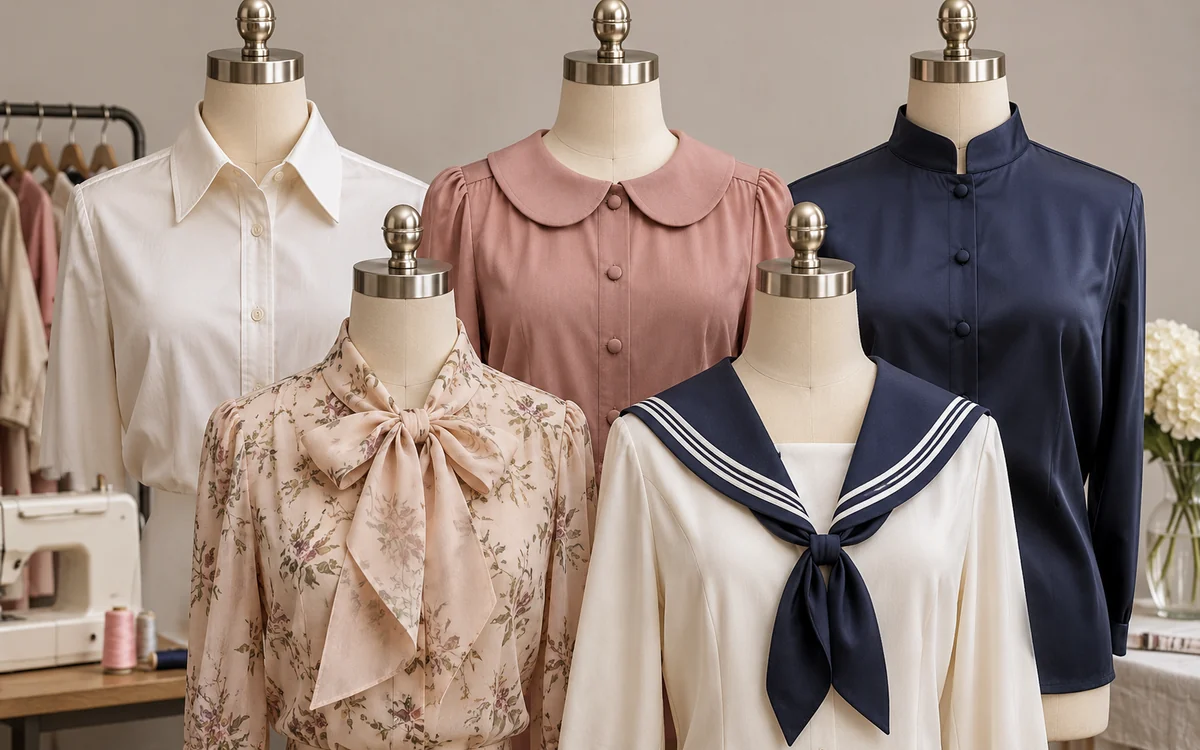
| Flat collars | Lie close to the garment, little or no stand | Peter Pan, sailor, Bertha |
| Standing collars | Rise up from the neckline | Mandarin, band, funnel, ruffled stand, wing |
| Rolled (shirt) collars | A stand plus a fall that rolls over it | Classic shirt collar, convertible |
| Tailored collars | Collar joined to a lapel, with a roll line | Notched, shawl, Ulster |
Flat collars
Peter Pan collar
The Peter Pan collar has soft, rounded ends and lies flat against the garment. It is often called the archetype of flat collars. It appears on blouses, dresses and children’s wear. It suits cotton, poplin, crepe and light knits and can be plain, lace-trimmed or contrast-coloured.
Sailor collar
The sailor collar is a wider flat collar. It usually falls over the shoulders and back in a large square or rounded shape. It is used in dresses, tops and casual wear.
Bertha collar
A Bertha collar is also wide and flat. It often covers the shoulders and sits as a decorative cape-like piece on the neckline. It appears on formal blouses and dresses.
Standing collars
Mandarin collar
The mandarin is a short, straight band that stands upright without folding over. It meets or nearly meets at the front. It looks clean and simple and is used in tunics, kurtas, jackets and shirts.
Band collar
A band collar is a plain strip that finishes the neckline. It is common on collarless shirts. It is much like the mandarin, and the names are often used for the same shape.
Funnel collar
A funnel collar is a taller stand that rises from the shoulders toward the jaw. It is used in knitwear, coats and some jackets. It keeps the neck warm.
Ruffled stand collar
A ruffled stand collar has a gathered or pleated band that stands and flares in a decorative way. It gives a romantic look and is common on blouses.
Wing collar
A wing collar is a stand collar with small folded points. It is mostly formal, worn with evening dress, and appears on some tuxedo-style shirts.
Rolled and shirt collars
Classic shirt collar
A classic shirt collar has a stand that rises from the neckline and a separate fall that rolls back over it. This is the collar of the traditional shirt. Women’s shirts use the same construction, with a slightly smaller size and fit. Proportion matters a lot. Too little stand and the collar collapses. Too much and it feels like it is strangling.
Convertible collar
A convertible collar is made in one piece and can be worn open or closed. It is common on camp shirts, resort shirts and relaxed blouses.
Tailored collars
Notched collar
A notched collar has a stepped notch where the collar meets the lapel. It is the standard suit collar and is used in blazers, coats and tailored jackets. See our page on the parts of a blazer for how the collar and lapel fit together.
Shawl collar
A shawl collar rolls in one continuous, curved line with no notch. It looks soft and luxurious and appears on cardigans, wrap coats, tuxedo jackets and robes.
Ulster and coat collars
Ulster and other coat collars widen the lapel-and-collar system for outerwear. They are bigger and often sit higher on the neck to give warmth. See our guide on the parts of a jacket for related terms.
Which collar suits which garment?
| Garment | Common collars |
|---|---|
| Blouse | Peter Pan, band, ruffled stand, convertible |
| Shirt | Classic shirt, convertible, band |
| Dress | Peter Pan, shirt, mandarin, sailor |
| Tunic and kurta | Mandarin, band |
| Jacket and blazer | Notched, shawl, band |
| Cardigan | Shawl |
| Coat | Notched, funnel, Ulster, shawl |
| Knitwear | Funnel, shawl, shirt-style knit collar |
| Evening wear | Wing, Bertha, shawl |
How a collar is built
Most collars are made of two layers: an upper collar and an under collar. A basic build looks like this.
- Cut the pieces, often with interfacing on one layer to give shape.
- Fuse the interfacing. Heat and pressure bond it to the fabric.
- Sew the layers right sides together along the outer edges.
- Trim and clip the seam allowance, especially on curves.
- Turn and press so the seam sits at the edge.
- Topstitch, if the design needs it.
- Attach the collar to the neckline, matching the notches and centre points.
Our guide to types of seams in garments shows the seams used here, and the page on stitches per inch for different garments gives guidance for visible topstitching.
Matching the collar to the neckline
The collar’s neck edge must fit the garment’s neckline. A few ideas from pattern drafting help.
- A flat collar has a neck edge that is strongly curved, to follow the neckline of the garment.
- A standing collar has a neck edge that is nearly straight.
- A rolled collar falls between the two.
- A slight difference in the curve between collar and neckline creates a small, comfortable roll, instead of a collar that lies dead flat.
- A straight band feels tight at the throat, while a slightly curved band follows the neck more comfortably.
For women’s wear, fit also depends on the neck shape, the shoulder slope and the style of the garment. Our guide to pattern making in fashion design explains the basics of drafting.
Fabric choices
The fabric changes how the collar behaves.
| Fabric | Effect on the collar |
|---|---|
| Crisp cotton or poplin | Holds a sharp edge. Good for Peter Pan and shirt collars |
| Linen | Relaxed, crinkled look. Needs good interfacing |
| Satin or silk | Soft, draping. Good for shawl and Bertha collars. Needs careful pressing |
| Knit | Stretchy, so it needs a stable interfacing or a rib trim |
| Wool and tweed | Hold shape in tailored collars |
| Lace | Delicate. Often used on flat collars with a lining |
A worked example: mandarin band, flat collar match and fabric
Let us run three small calculations. All numbers are examples.
Part 1: Draft a mandarin collar band
- Neck girth of the wearer: 34 cm
- Ease so the collar is comfortable: 2 cm
- Overlap at the front where the band closes: 2 cm
- Finished band height: 3.5 cm
- Seam allowance: 1 cm on every side
Finished band length = 34 + 2 + 2 = 38 cm
Each piece is cut with the seam allowance on all sides:
- Length = 38 + 1 + 1 = 40 cm
- Width = 3.5 + 1 + 1 = 5.5 cm
- Area of one piece = 40 × 5.5 = 220 cm²
A mandarin collar has an upper and an under piece, so two pieces are cut, which makes 440 cm² in total. Interfacing for one layer needs 220 cm².
Part 2: Match a flat collar to a neckline
A blouse neckline measures 40 cm all the way around the seam. A Peter Pan collar has a neck edge on each side. The collar is meant to lie flat with a slight roll, so the neck edge of the collar is drafted a little shorter than the neckline. Assume the collar neck edge totals 39 cm. This is an assumed figure to test in a fit sample.
Ratio = 39 ÷ 40 = 0.975, which is 2.5 percent shorter than the neckline.
The 1 cm difference is eased in along the neckline when the collar is attached. Too large a difference makes the collar stand up or cup. Too small makes it lie dead flat or flip. A fit sample decides the final figure.
Part 3: Fabric for one Peter Pan collar
A Peter Pan collar has four pieces: an outer and an under piece for each side. Each piece is about 20 cm along the neck edge and 7 cm deep. With a 1 cm seam allowance on all sides:
- Piece size = (20 + 2) × (7 + 2) = 22 × 9 = 198 cm²
- Four pieces = 4 × 198 = 792 cm² = 0.0792 m²
Small curved pieces do not pack as tightly as straight ones. Assume a marker efficiency of 65 percent, which means 65 percent of the fabric used ends up in pieces.
- Fabric used per collar = 0.0792 ÷ 0.65 = 0.1218 m²
- At 120 GSM, weight = 0.1218 × 120 = 14.6 g
For 10,000 blouses:
- Fabric area = 0.1218 × 10,000 = 1,218 m²
- On 150 cm wide fabric, length = 1,218 ÷ 1.5 = 812 m
In practice, collar pieces are often placed inside the larger pattern pieces of the same garment, so the collar may use less extra fabric than this standalone figure suggests. Our guide to how to calculate fabric yardage explains marker efficiency and the allowance for waste.
Common mistakes
- Wrong stand height. Too tall chokes, too short collapses.
- Skipping interfacing, which leaves a floppy collar.
- Cutting the collar off grain. It can twist after washing.
- Not trimming curved seams. The collar looks lumpy.
- Making the neck edge too long or too short. It then stands away or pulls tight.
- Pressing satin or silk too hot. It leaves marks.
- Ignoring the neckline shape. A collar must suit the opening it is sewn to.
Tips for choosing a collar
- Match the collar to the occasion. Peter Pan and ruffled collars are soft and playful. Notched and shawl collars are tailored.
- Match it to the fabric. Crisp fabrics hold shape. Soft fabrics need more support.
- Think about your neck and face shape and your comfort. Tall stands suit some people more than others.
- Check that the collar lies well when seated and when you move.
- For a bulk order, approve a fit sample and a wash test, since collars can shrink or twist.
Final thoughts
The types of collars for women fall into four families: flat, standing, rolled and tailored. The Peter Pan, sailor and Bertha lie flat. The mandarin, band, funnel, ruffled stand and wing rise up. The classic shirt and convertible collars roll over a stand. The notched and shawl collars belong to jackets and coats. The right choice depends on the garment, the fabric and the fit.
Our worked example drafted a mandarin band of 38 cm finished length, matched a flat collar that is 2.5 percent shorter than its neckline and found that one Peter Pan collar uses about 0.12 m² of fabric. Pick the family, check the proportions and always test a sample before you cut a whole order.
Frequently asked questions
The main families are flat collars (Peter Pan, sailor, Bertha), standing collars (mandarin, band, funnel, wing), rolled collars (classic shirt, convertible) and tailored collars (notched, shawl).
It is a flat collar with soft, rounded ends that lies close to the garment. It is often seen as the classic flat collar.
A mandarin collar is a short, straight band that stands upright and does not fold over. It meets or nearly meets at the front.
A neckline is the shape of the opening. A collar is a separate piece of fabric attached to the neckline.
A notched collar has a stepped notch where the collar meets the lapel. A shawl collar rolls in one continuous curve with no notch.
The two main parts are the stand, which rises from the neckline, and the fall, which folds over. Some collars have only a stand, and some have almost none.
Use the right interfacing, get the stand height in proportion to the fall and cut the collar on the correct grain.