The neckline is the first thing the eye notices on a dress. It frames the face, shapes the upper body and sets the mood of the whole garment. A high, round neckline feels calm and casual. A deep V feels bold. A wide boat neck feels classic. Learning the types of necklines for dresses with names helps you shop with confidence, describe a style to a tailor and write clear instructions for a pattern or a spec sheet.
This guide explains the common neckline names, how each one looks and where it works well, how to choose one, and how a neckline is measured in a garment factory. A worked example at the end calculates the neckline length and the rib needed for a knit top, using simple geometry. If you also want the parts of a dress or top, our guide to the parts of a T-shirt shows where the neckline sits.
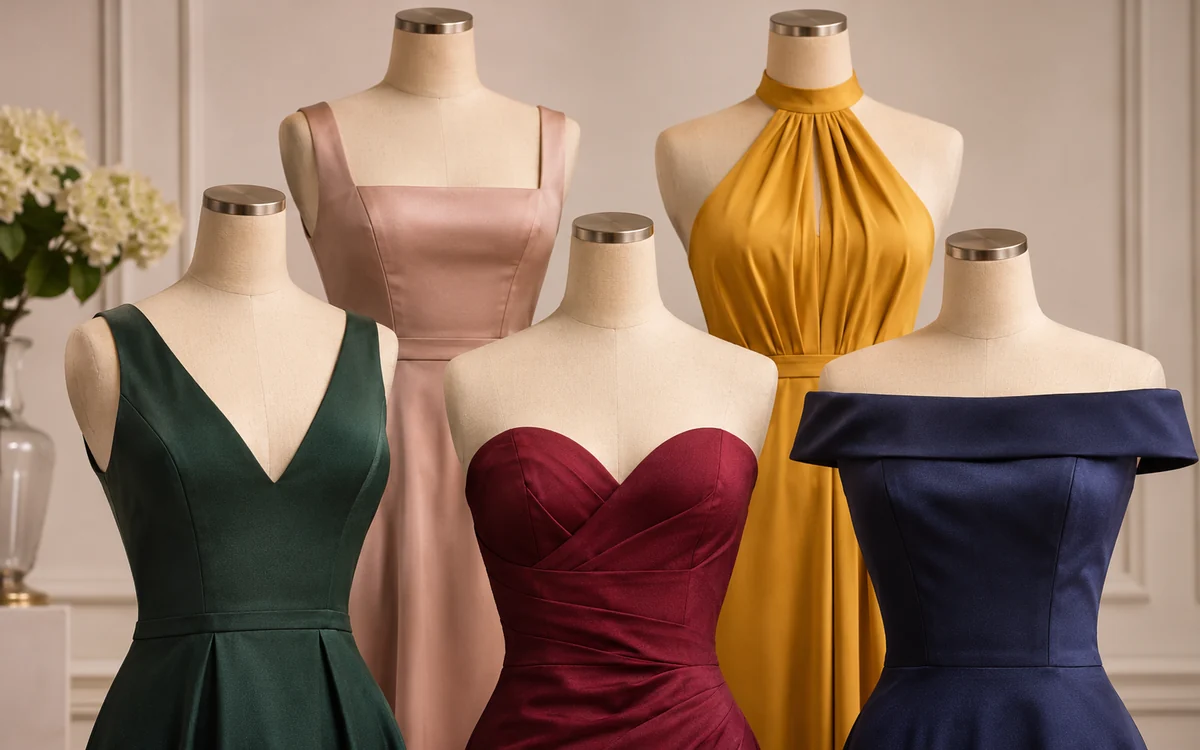
What is a neckline?
A neckline is the shape of the opening at the top of a garment, where the fabric meets the neck, chest and shoulders. It is not the same as a collar. A collar is a separate piece of fabric attached to the neckline. A neckline can exist without any collar, and many dresses have only a neckline. For collars, see our guide to the types of collars for women.
Three things describe a neckline:
- Width. The distance across the opening, from one shoulder seam to the other.
- Depth (drop). How far the opening falls below the shoulder line, at the centre front and the centre back.
- Shape. The curve or line between the edges: round, pointed, straight, curved or draped.
The common types of necklines
Crew neck (round neck)
A crew neck is a round opening that sits close to the base of the neck. It is the classic T-shirt neckline and is common in casual dresses, jersey dresses and knitwear. It suits everyday wear and layers well under jackets.
Scoop neck
A scoop neck is U-shaped and dips lower than a round neckline. It can look similar to a square neckline but is rounder, and it often comes with thinner straps. Scoop necks are common in summer dresses and fitted knit dresses.
V-neck
A V-neck forms a V in the front, with the point falling between the collarbones or lower. The depth and the width of the V can change a lot, from a small notch to a deep plunge. V-necks are popular in knitwear, wrap dresses and shirt dresses.
Boat neck (bateau)
A boat neck runs from one shoulder to the other in a wide, shallow, curved opening. It sits across the collarbones. It looks clean and classic and is often used in fitted dresses with sleeves.
Square neck
A square neck has a squared-off opening, often with wider straps that cover the tops of the shoulders. It appears in empire-line dresses, sundresses and structured styles.
Sweetheart neckline
A sweetheart neckline has a curved, heart-shaped dip at the front. It may or may not have straps. It is used in cocktail, prom and bridal dresses and in many corsets and bodices.
Halter neck
On a halter neck, fabric wraps around the back of the neck, leaving the shoulders and arms bare. It is a staple of summer and evening dresses.
Cowl neck
A cowl neck is draped, with a soft, folded look around the neck. The fabric falls in loose folds. Soft knits and fluid fabrics such as satin work well. See our guide to satin fabric for a fabric that drapes in this way.
Off-the-shoulder
An off-the-shoulder neckline sits below the shoulders, leaving them bare. It may have sleeves or straps on the arms, and often uses elastic or a smocked band to stay in place.
One-shoulder
A one-shoulder neckline has a single strap going over one shoulder, leaving the other bare. It is a popular choice for evening and party dresses.
Keyhole
A keyhole neckline has a small, round or teardrop-shaped cutout at the centre front, usually just below a high neckline. It adds interest without much exposure.
Plunging neckline
A plunging neckline is a very deep V or U that reaches well down the chest. It is usually seen in evening and party dresses and needs careful construction so that it stays in place.
High neck, mock neck and turtleneck
These necklines cover the neck.
- A high neck rises close to the throat.
- A mock neck is a short, fitted band that stands up around the neck without folding over.
- A turtleneck is a taller tube that folds over on itself.
They are common in knitwear and winter dresses.
Strapless (bandeau)
A strapless neckline is a straight or slightly curved top edge that sits across the chest, with no straps. It needs internal structure, such as boning or silicone grippers, to stay up.
Quick comparison
| Neckline | Opening shape | Typical use |
|---|---|---|
| Crew | Round, close to neck | Casual and jersey dresses |
| Scoop | Deep U | Summer and knit dresses |
| V-neck | Pointed, variable depth | Wrap, shirt and knit dresses |
| Boat | Wide, shallow curve | Classic fitted dresses |
| Square | Straight top, corners | Sundresses, empire styles |
| Sweetheart | Heart shape | Cocktail, prom, bridal |
| Halter | Straps behind the neck | Summer and evening dresses |
| Cowl | Draped folds | Satin and knit dresses |
| Off-the-shoulder | Below the shoulders | Summer and party dresses |
| One-shoulder | One strap | Evening dresses |
| Keyhole | Small cutout | Details on high necklines |
| Strapless | Straight or curved, no straps | Evening and bridal dresses |
How to choose a neckline
There is no single correct answer, since taste and comfort matter most. These simple ideas are widely used in styling advice:
- Think about the occasion. Crew and boat necks feel casual or classic. Sweetheart, one-shoulder and plunging necks are more formal or bold.
- Think about the weather. High necks and turtlenecks keep warm. Halter and strapless necks suit hot days.
- Think about comfort and movement. A dress that needs constant adjusting is not a good fit for a long day.
- Think about layering. A scoop or V-neck can sit under a jacket or a shirt.
- Think about necklaces and scarves. A simple round neckline shows a pendant well. A busy neckline competes with jewellery.
- Try before you buy. Sizes and shapes differ between brands, so look at the neckline in a mirror and when you move.
How a neckline is measured in a garment factory
On a spec sheet, necklines are described by a few numbers. For a closer look at the whole process, see our guide to the measurement of a T-shirt.
- Neck width. Measured straight across the opening from one shoulder-neck seam to the other (often called neck point to neck point).
- Front neck drop. Measured from a line joining the shoulder-neck points down to the lowest point at the centre front.
- Back neck drop. Measured in the same way at the centre back.
- Neck opening (stretched or relaxed). The full distance around the opening, which matters for pull-over styles.
- Neck binding or rib length and width, if there is a trim on the edge.
Factories give a tolerance for each point, such as plus or minus 1 cm. That is tight. It has to be. A small error at the neckline is easy to see, because it frames the face. Our guide to garment spec sheets explains what else goes into a spec.
Fabric and construction matter too
The same neckline looks different in different fabrics.
- Woven fabrics hold a crisp shape. They are finished with facings, bias binding or a lining.
- Knit fabrics stretch, so the neckline is often finished with a rib or a self-fabric binding that pulls the edge in. See our guide to knitted rib fabric.
- Heavy fabrics need a firmer finish so the neckline does not gape.
- Lightweight fabrics can ripple at a wide neckline, so a light interfacing or stay tape may be used.
Gaping is a common neckline fault, where the edge stands away from the body, leaves a hollow gap at the chest and makes a garment that looked neat on the hanger look sloppy on a real person who bends, reaches and moves through the day. It happens when the neckline is too wide or too stretched. A stay tape sewn into the seam, a shorter rib or a small dart can help. Our page on types of darts shows how darts shape fabric.
A worked example: neckline length and rib for a knit dress top
Let us calculate the length of a round neckline and the rib needed to finish it. The numbers are examples. We treat each half of the neckline as half of an ellipse.
Given
- Neck width (shoulder-neck point to point): 18 cm
- Front neck drop: 8 cm
- Back neck drop: 2.5 cm
- Rib length is planned at 85 percent of the neckline length (an assumed figure, to be tested in a fit sample)
Step 1: Set up the shape
Half the width is 18 ÷ 2 = 9 cm. For the front curve, the half-ellipse has a horizontal half-axis of 9 cm and a vertical half-axis of 8 cm. For the back, the half-axes are 9 cm and 2.5 cm.
Step 2: Perimeter of an ellipse
A good approximation for the perimeter of an ellipse with half-axes a and b is:
P = π × [3(a + b) − √((3a + b)(a + 3b))]
Front curve (a = 9, b = 8):
- 3(a + b) = 3 × 17 = 51
- (3a + b)(a + 3b) = (27 + 8)(9 + 24) = 35 × 33 = 1,155
- √1,155 = 33.99
- P = 3.1416 × (51 − 33.99) = 3.1416 × 17.01 = 53.45 cm
- The front is half of this: 26.7 cm
Back curve (a = 9, b = 2.5):
- 3(a + b) = 3 × 11.5 = 34.5
- (3a + b)(a + 3b) = (27 + 2.5)(9 + 7.5) = 29.5 × 16.5 = 486.75
- √486.75 = 22.06
- P = 3.1416 × (34.5 − 22.06) = 3.1416 × 12.44 = 39.08 cm
- The back is half of this: 19.5 cm
Step 3: Full neckline length
Neckline length = 26.7 + 19.5 = 46.3 cm
Step 4: Rib length
Rib length = 46.3 × 0.85 = 39.3 cm
The rib is shorter than the opening so that it pulls the neckline in and lies flat against the body. If the rib were as long as the opening (46.3 cm), it would sit loose and may gape.
Step 5: Check the stretch demand
When the neckline goes over the head, the rib has to stretch to the opening size and more. The ratio between the neckline length and the rib length is:
46.3 ÷ 39.3 = 1.18
That is an 18 percent stretch just to fit the opening. Rib has far more stretch than that, so it will pass over the head easily. You would run a real stretch and recovery test, as shown in our guide to knitted rib, before approving the rib.
Step 6: What if the neckline is a deep V?
A V-neck with the same width and a front drop of 15 cm has two straight sides. Each side is the hypotenuse of a right triangle with legs of 9 cm and 15 cm.
Side = √(9² + 15²) = √(81 + 225) = √306 = 17.5 cm
Front length = 2 × 17.5 = 35.0 cm
Add the same 19.5 cm back curve: 35.0 + 19.5 = 54.5 cm. The neckline is 8.2 cm longer than the round neck, so the rib or binding must be longer too: 54.5 × 0.85 = 46.3 cm. A deeper neckline means a longer trim.
Mistakes to avoid
- Mixing up neckline and collar. A collar is an added piece, and a neckline is the shape of the opening.
- Cutting the neckline too wide for the fabric. It can slip off the shoulders or gape.
- Copying the same rib length for every neckline. A deeper neckline needs a longer rib.
- Skipping stay tape on a wide or stretchy neckline.
- Ignoring tolerance. A 1 cm difference in neck width is easy to see.
- Forgetting the back neckline. A back that is too low or too high makes the front hang badly.
Final thoughts
The types of necklines for dresses cover a wide range of shapes, from the calm crew neck to the dramatic plunge. Each one is defined by its width, depth and shape, and each suits a different fabric, season and occasion. In a factory, the neckline is controlled with a few measurements and a tolerance, because small errors show up at once.
Our worked example found a round neckline of 46.3 cm and a rib of 39.3 cm at 85 percent of that length, while a deep V of the same width needed about 54.5 cm of neckline. Pick the neckline that suits the fabric and the occasion, measure width and drop on every sample and test the trim before production.
Frequently asked questions
Common types include crew, scoop, V-neck, boat, square, sweetheart, halter, cowl, off-the-shoulder, one-shoulder, keyhole, plunging, high neck and strapless.
A crew neck is a round opening close to the base of the neck. A scoop neck is a deeper U shape that dips lower on the chest.
It is a neckline with a curved, heart-shaped dip at the front. It may have straps or be strapless.
A neckline is the shape of the opening. A collar is a separate piece of fabric sewn to the neckline.
Measure the neck width from one shoulder-neck point to the other, then the front and back drops from the shoulder line down to the lowest point of the opening.
A cowl neck is a draped neckline that falls in soft folds around the neck. Soft knits and fluid fabrics such as satin suit it well.
It gapes when the opening is too wide, too stretched or cut on the wrong grain. Stay tape, a shorter rib or a small dart can help.