A skirt looks like the simplest garment in your wardrobe. It has no sleeves, no collar and no legs. Yet when a skirt twists, gapes at the waist or hangs unevenly, the problem usually sits in one small part. Knowing the parts of a skirt lets you spot that part and describe it clearly.
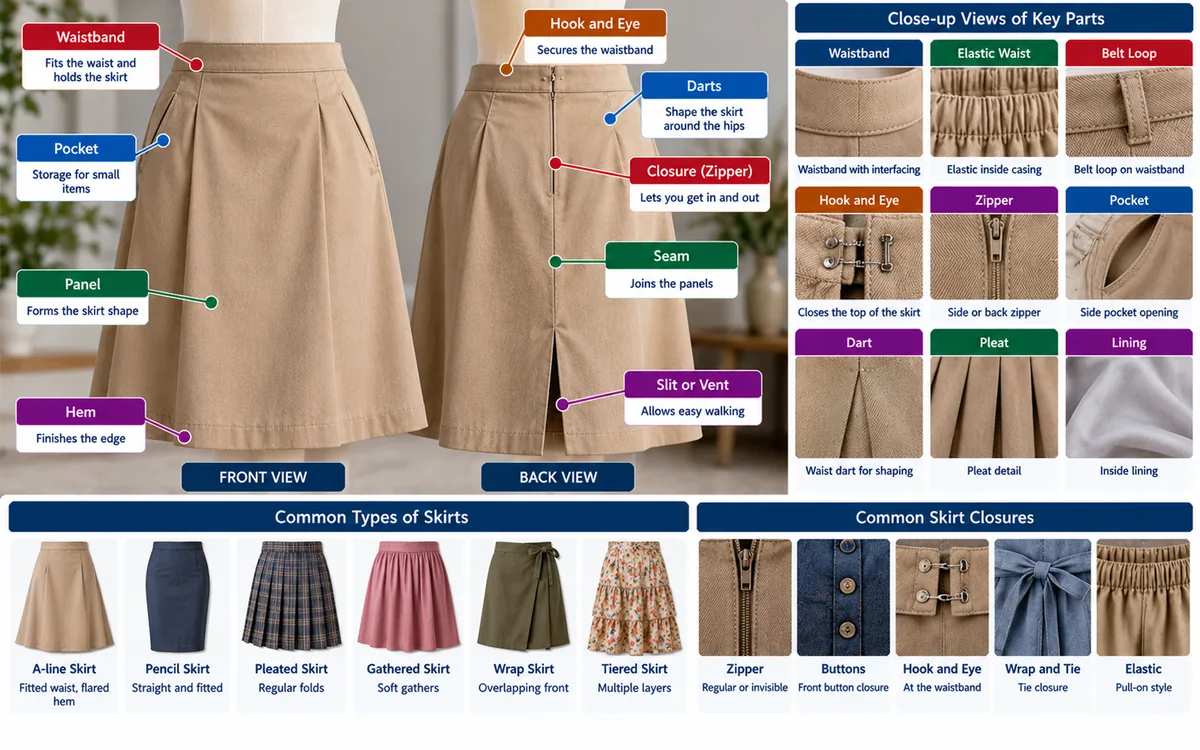
This guide covers every main part, from the waistband down to the hem. You will see how different skirt shapes are built, what the factory checks and which faults to look for. If you also want to learn about trousers, read our guide on the parts of a pant, because the waist area works in a similar way.
The basic idea of a skirt
A skirt hangs from the waist and covers the lower body. It is open at the bottom, so it has just one main opening at the top, where it fits the waist. This is why the waist area is the most important part of the garment. It must fit well and carry the weight of the whole skirt.
Everything else follows from the waist. The panels set the shape. The closure lets you step in. The lining helps the skirt hang. The hem finishes the bottom.
Parts of a skirt at a glance
| Part | Location | Job |
|---|---|---|
| Waistband | Top | Fits the waist and holds the skirt |
| Closure | Back or side | Lets you get in and out |
| Darts | Waist | Shape the skirt around the hips |
| Panels | Body | Form the skirt shape |
| Seams | Between panels | Join the pieces |
| Pockets | Side or front | Storage |
| Slit or vent | Hem | Allows walking |
| Lining | Inside | Smooth fit and opacity |
| Hem | Bottom | Finishes the edge |
The waist area
Waistband
The waistband is a strip of fabric sewn around the top of the skirt. It does two jobs. It gives the skirt a neat, firm top edge, and it takes the strain of holding the skirt up. Waistbands can be straight, curved or contoured. A straight band is easiest to sew. A curved band follows the shape of the body and sits more comfortably.
Most waistbands have a layer of interfacing inside. Interfacing is a stiffener that stops the band from stretching and rolling over. Without it, the band will fold and twist after a few wears.
Elastic waist
Casual skirts often use elastic instead of a stiff band. The elastic runs through a tunnel in the fabric, called a casing, or is sewn directly to the fabric. Elastic makes the skirt easy to put on and gives some room for size changes. The drawback is a lack of structure, so the skirt can lose shape in time.
Yoke
A yoke is a shaped piece at the top of the skirt, usually covering the hip. It gives a smooth fit at the hip and lets the lower part fall loose in gathers or pleats. Yoke skirts are common in denim and in gathered styles.
Waist stay
In well-made skirts, a strip of tape sits inside the waistband. It stops the waist from stretching and takes the weight of the skirt.
Belt loops
Some skirts include loops sewn around the waistband so that a belt can be worn. They are placed evenly around the waist, usually at the side seams and back.
Closures
The closure lets you get the skirt on and off. The most common types are:
- Zipper: Usually set in the back seam or side seam. A regular zipper has visible teeth on the outside. An invisible zipper hides its teeth in the seam for a smooth look. For a breakdown of zipper pieces, see our guide on the different parts of a zipper.
- Buttons: A row of buttons down the front is common on denim and A-line skirts. Learn about button types in our guide to different types of buttons for clothes.
- Hook and eye: A small metal hook that sits above the zipper at the top of the waistband. It takes the strain so the zipper does not open.
- Wrap and tie: A wrap skirt overlaps at the front and ties at the side.
- Pull-on: Knit and elastic skirts need no closure.
Darts and shaping
Skirts are shaped to fit the curve between the waist and hips. The most common tool is the dart.
Waist darts
A waist dart is a narrow triangle of fabric folded and stitched at the top of the skirt. It takes up the extra fabric at the waist, so the skirt can fit snugly over the hips. Back darts are usually longer than front darts, because the hips curve out more at the back.
Gathers
Instead of darts, some skirts use gathers. Gathers are small folds created by pulling a thread along the top of the fabric. They add fullness around the waist.
Pleats
Pleats are sharp, pressed folds. Knife pleats all face the same direction. Box pleats face two ways. Inverted pleats fold inward. A pleated skirt has more fabric at the waist than a plain one.
Panels and gores
A gore is a long panel that gets wider toward the hem. A skirt made of several gores gets its flare from the shape of each panel. A six-gore skirt looks fitted at the hip and flares at the bottom, and it is smooth because it has no gathers.
Skirt shapes and their parts
The type of skirt decides which parts it has.
| Skirt type | Key features |
|---|---|
| Pencil | Straight and fitted, back slit or vent |
| A-line | Fitted at the waist, flared to the hem |
| Circle | Cut as a circle, no seams except a closure |
| Pleated | Rows of pressed folds |
| Gathered | Full fabric pulled at the waist |
| Wrap | Overlapping panels with a tie |
| Tiered | Layers of gathered fabric stacked |
| Skater | Fitted waist, short flared skirt |
| Maxi | Long length, often with a flowing shape |
Pencil skirt
A pencil skirt is tight through the hips and straight to the knee. Because it is so narrow, it needs a slit or vent at the back or the wearer cannot walk comfortably. The vent is cut into the back seam and finished with an overlap.
A-line skirt
An A-line skirt is fitted at the waist and widens toward the hem. It has darts at the waist and sometimes a center back seam. It suits most body shapes and is the most common shape in everyday wear.
Circle skirt
A circle skirt is cut as one big ring of fabric with a hole at the center for the waist. It has the fullest flare. Because parts of the fabric are cut on the bias, the hem can drop and stretch. The skirt is usually hung for a day before the hem is finished.
Pleated skirt
A pleated skirt has folds pressed or stitched in place. Pleats can be permanent, heat-set into polyester fabric, or temporary, made by pressing and stitching.
Seams and panels
Side seams
Side seams join the front and back panels. In many skirts they carry the zipper or pockets.
Center back seam
A seam that runs down the center of the back panel. It often holds the zipper. It also lets the pattern maker shape the skirt at the back.
Seam allowances
The seam allowance is the strip of fabric between the sewn line and the cut edge. A typical allowance for a skirt is about 1 to 1.5 cm (around half an inch). Factories often make the allowance wider at the side seams to leave room for later alterations.
Pockets
Skirts can have several types of pockets.
- In-seam pocket: Hidden inside the side seam. It is the most common type and does not spoil the look.
- Patch pocket: A piece of fabric sewn on the outside, common on denim and cargo skirts.
- Slash pocket: A pocket cut at an angle in the front of the skirt.
- Welt pocket: A narrow slit with a bound edge.
Pocket openings should be reinforced with a bar tack or a small stay of tape, because they take stress from hands. Read about common pocket styles in our pocket guide for dress shirts.
Lining
Many skirts have a lining, which is a thin inner skirt attached at the waist. The lining stops the skirt from being see-through. It also lets the skirt slide over tights and stops it from clinging. A lining is normally a little shorter than the skirt, so it does not peek out at the hem.
A half lining covers only the front or back. A full lining covers the whole inside. Some skirts have a built-in slip, which is a loose petticoat sewn into the waistband.
Slits, vents and kick pleats
A slit is an opening at the hem. A vent is a slit with an overlap. A kick pleat is a folded pleat set into the hem, which lets the skirt open when you walk and close when you stop. These parts are important in narrow skirts. Without one of them, you would have to take tiny steps.
Hem
The hem is the finished bottom edge. Skirt hems come in many forms.
- Double-turned hem: The edge is folded twice and stitched. A strong, standard choice.
- Blind hem: The stitches are nearly invisible from the outside.
- Rolled hem: A very narrow hem, used on light and flowing skirts.
- Faced hem: A shaped band is attached inside, used on curved hems.
- Horsehair or stiff braid: Inserted to hold a full hem out.
- Raw hem: Left unfinished on purpose, such as on denim.
On circle skirts and bias-cut skirts, the hem needs special care. The fabric stretches, so the hem is shaped and eased by hand or machine.
Fabrics and fit
Fabric changes how every part behaves.
- Denim: Strong and structured. Needs heavy needles and strong thread.
- Cotton: Easy to sew, can wrinkle.
- Wool: Holds pleats well and hangs nicely.
- Polyester: Resists wrinkles, holds heat-set pleats.
- Chiffon: Light and floaty, needs lining.
- Knit jersey: Stretchy and comfortable, needs elastic waist.
For more about denim, see our guide on what is denim.
How a skirt is made
A basic skirt follows this order in a factory.
- Cutting: Front and back panels are cut from the fabric.
- Darts and pleats: Waist darts or pleats are sewn.
- Side seams: Panels are joined, leaving the zipper opening.
- Zipper: The zipper is set in.
- Waistband: The band is attached and the ends are closed.
- Closure: Hook, eye, button or snap is added.
- Lining: The lining is attached.
- Hem: The bottom edge is finished.
- Pressing and packing: The skirt is pressed and folded.
The order changes with style. A pull-on skirt skips the zipper. A wrap skirt needs tie strings.
Common faults
- Twisted skirt: The side seams swing toward the front or back. It happens when fabric was cut off grain.
- Gaping waist: The waistband is too big or lacks interfacing.
- Rippling zipper: The zipper was sewn under tension or the fabric stretched.
- Uneven hem: The hem hangs lower on one side.
- Puckered darts: The dart point was not sewn out cleanly.
- Showing lining: The lining is longer than the skirt.
- Visible pocket bag: Pocket lines show through lightweight fabric.
Many of these link to sewing setup. Our guide on sewing defects and root causes shows how teams solve them.
Buying checklist
- Hold the waistband between your fingers. It should feel firm.
- Check the zipper by moving it up and down. It should glide.
- Turn the skirt inside out. Seams should be neat and stitches even.
- Hold the skirt by the waist and let it hang. The hem should hang level.
- Look at the lining. It should be shorter than the skirt.
- Sit down. The skirt should not ride up too far.
Final thoughts
A skirt may be small in size, but each part has a clear job. The waistband holds it up, the darts shape it, the panels set the style, the lining gives comfort and the hem finishes the look. Once you know those five, you can talk about any skirt with confidence. Before you buy or approve one, check the waistband, the zipper, the side seams and the hem.
Frequently asked questions
The main parts are the waistband, closure, panels, seams, darts or pleats, lining, pockets and hem. Some skirts also have slits or vents.
The top of a skirt is called the waistband. It sits at your waist and holds the skirt in place.
A gore is a long, tapering panel. Several gores sewn together create a skirt that flares toward the hem without gathers.
A pencil skirt is narrow, so the slit or vent lets you walk and sit without the fabric pulling.
A slit is a simple opening in the seam. A vent has an overlapping flap of fabric, so it opens only when you move.
A curved, interfaced waistband gives a comfortable fit for tailored skirts. Elastic is easier for casual and pull-on skirts.
For most woven skirts, a hem of about 2.5 to 4 cm (1 to 1.5 inches) is common. Light fabrics use a narrow rolled hem.