Humidity affects sleep quality more than most people give it credit for. Most hot sleepers focus on room temperature and bedding, but the moisture level in the air plays an equally important role. Too much humidity traps heat against your skin and slows the body’s natural cooling process.
Too little dries out airways and triggers subtle respiratory discomfort that fragments sleep without you realizing why. Getting humidity right is one of the most overlooked fixes for consistently poor rest. This guide breaks down exactly how humidity affects sleep and what to do about it.
What Humidity Does to Your Body During Sleep
Your body relies on two primary cooling mechanisms during sleep: vasodilation and sweat evaporation. Vasodilation pushes heat from your core to the skin surface. Sweat evaporation then carries that heat away from the skin into the surrounding air.
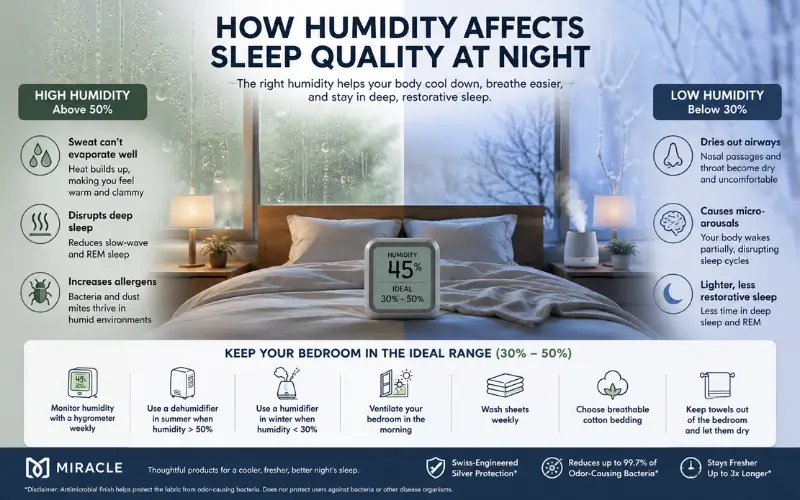
High humidity breaks the second part of that process. When the air already holds a high concentration of water vapor, sweat can’t evaporate efficiently. Your skin stays damp. Heat builds up instead of escaping. Your body keeps trying to cool down and keeps failing, which triggers micro-arousals that pull you out of deep sleep without fully waking you.
A peer-reviewed study published in PMC found that humid heat exposure during sleep directly disrupts both slow-wave sleep and REM sleep. These are the two most restorative stages of the sleep cycle. When humidity interferes with thermoregulation, you lose time in both stages even if you stay in bed for a full eight hours.
The Thermal Load Problem
Humid heat creates what researchers call an increased thermal load. Your body generates more effort to maintain its core temperature without success. Heart rate stays slightly elevated. Metabolic activity doesn’t drop as deeply as it should. The result is sleep that feels light and unrefreshing even when the duration looks adequate on paper.
This is why hot, humid summer nights feel so much worse than dry heat. Dry air lets sweat evaporate and do its job. Humid air doesn’t. The temperature might be the same, but the sleep quality gap between the two conditions is significant.
The Ideal Humidity Range for Sleep
The Sleep Foundation identifies a relative humidity range of 30% to 50% as optimal for sleep. Within this range, sweat evaporation works efficiently, airways stay comfortable, and the body can complete its natural cooling cycle without interference.
Above 50% humidity, the evaporation problem kicks in. The sleep surface feels warmer and clammier. Bacteria and dust mites also thrive in high-humidity environments, which increases allergen levels in the bedroom over time.
Below 30% humidity, the problem shifts. Dry air pulls moisture from respiratory mucous membranes. Nasal passages and throat dry out during sleep, which causes discomfort and prompts the body to rouse partially to address it. Healthline confirms that low-humidity environments elevate physiological stress markers and cause sleep fragmentation through exactly this mechanism.
How to Measure Your Bedroom Humidity
A simple hygrometer gives you an accurate reading of your bedroom’s relative humidity. These devices are inexpensive and widely available. Place one near your bed for the most relevant reading. Check it at different times of day and in different seasons since humidity levels shift with weather and heating or cooling use.
High Humidity and Your Bedding
Your bedding plays a direct role in how humidity affects your sleep surface. Dense, synthetic fabrics trap moisture against your skin instead of allowing it to move away. In a high-humidity room, this compounds the problem significantly. You’re already dealing with air that can’t absorb sweat efficiently. Sheets that hold moisture rather than releasing it make that worse at every point of contact.
Breathable cotton allows airflow across the skin surface and gives sweat somewhere to move instead of pooling against the body. This doesn’t solve a severely humid room on its own, but it reduces the impact considerably compared to moisture-trapping synthetic alternatives.
Silver-treated fabric adds a layer of protection that matters specifically in humid conditions. High humidity accelerates bacterial growth on sleep surfaces. Cooling sheets treated with Swiss-engineered silver reduce up to 99.7% of odor-causing bacteria, keeping the sleep surface fresher up to 3x longer than untreated fabric.* That freshness benefit compounds in summer months when humidity and sweat levels are both at their highest.
Low Humidity and Sleep Disruption
Dry air causes a different set of problems. Many people experience poor sleep in winter without connecting it to humidity. Heating systems dry out indoor air significantly, often pushing relative humidity below 20% in colder climates during the heating season.
At these levels, the lining of the nose and throat dries out during sleep. Breathing becomes slightly more effortful. Snoring increases. The body registers this as a mild physiological stressor and responds with partial awakenings that break up the sleep cycle without producing full consciousness.
Over a full night, these micro-disruptions reduce time in slow-wave and REM sleep, which are the same stages that high humidity disrupts through thermal load. The mechanism is different, but the outcome is similar: you wake up feeling less rested than your hours in bed should justify.
How to Raise Humidity in a Dry Bedroom
A cool-mist or ultrasonic humidifier brings dry bedroom air back into the optimal range quickly. Place it a few feet from the bed rather than directly next to it. Running it on a timer during sleep hours prevents the room from tipping past 50% relative humidity by morning.
Houseplants release moisture through transpiration and can provide a small natural humidity boost in very dry rooms. This effect is modest but adds up in smaller spaces with limited air exchange.
Practical Steps to Control Bedroom Humidity Year-Round
Humidity management is a year-round task because the problem shifts with the season. Summer brings high humidity in most climates. Winter brings dry air from heating systems. A few consistent habits keep the bedroom in the optimal range regardless of what’s happening outside.
Here’s what to build into your routine:
- Use a hygrometer to monitor bedroom humidity weekly
- Run a dehumidifier in summer when humidity rises above 50%
- Run a humidifier in winter when heating systems push humidity below 30%
- Ventilate the bedroom in the morning to flush out overnight moisture buildup
- Wash sheets weekly to prevent bacterial and dust mite accumulation in high-humidity conditions
- Choose breathable cotton bedding that manages moisture at the skin surface
Towel habits matter here too. Damp towels left in the bedroom after a shower add moisture to the air and raise the local humidity level. Hanging towels in the bathroom with proper ventilation keeps that moisture out of the sleep space. Antimicrobial towels that dry faster between uses reduce both the moisture contribution and the bacterial load that humid conditions accelerate.
Why Humidity Is Worth Taking Seriously
Most sleep advice focuses on screen time, caffeine, and darkness. Humidity rarely gets the same attention, but the physiological impact is just as real. Both high and low humidity disrupt the body’s thermoregulation and respiratory comfort in ways that directly reduce time in the most restorative sleep stages.
The fix is straightforward once you measure what you’re dealing with. A hygrometer, a dehumidifier or humidifier depending on the season, and breathable bedding that works with your body’s cooling process rather than against it covers most of what you need.
Small environmental adjustments compound over weeks and months into meaningfully better sleep. Start with what you can measure and build from there. Miracle made products are built to support a sleep environment that keeps you cool, fresh, and comfortable through every season.
Disclaimer: Antimicrobial finish helps protect the fabric from odor-causing bacteria. Does not protect users against bacteria or other disease organisms.