
A bag carries your phone, your lunch and sometimes your whole workday. When a bag fails, it usually fails at one small point. A handle tears off, a zipper jams or a seam splits at the corner. Knowing the parts of a bag helps you pick one that lasts and describe a repair or a design clearly.
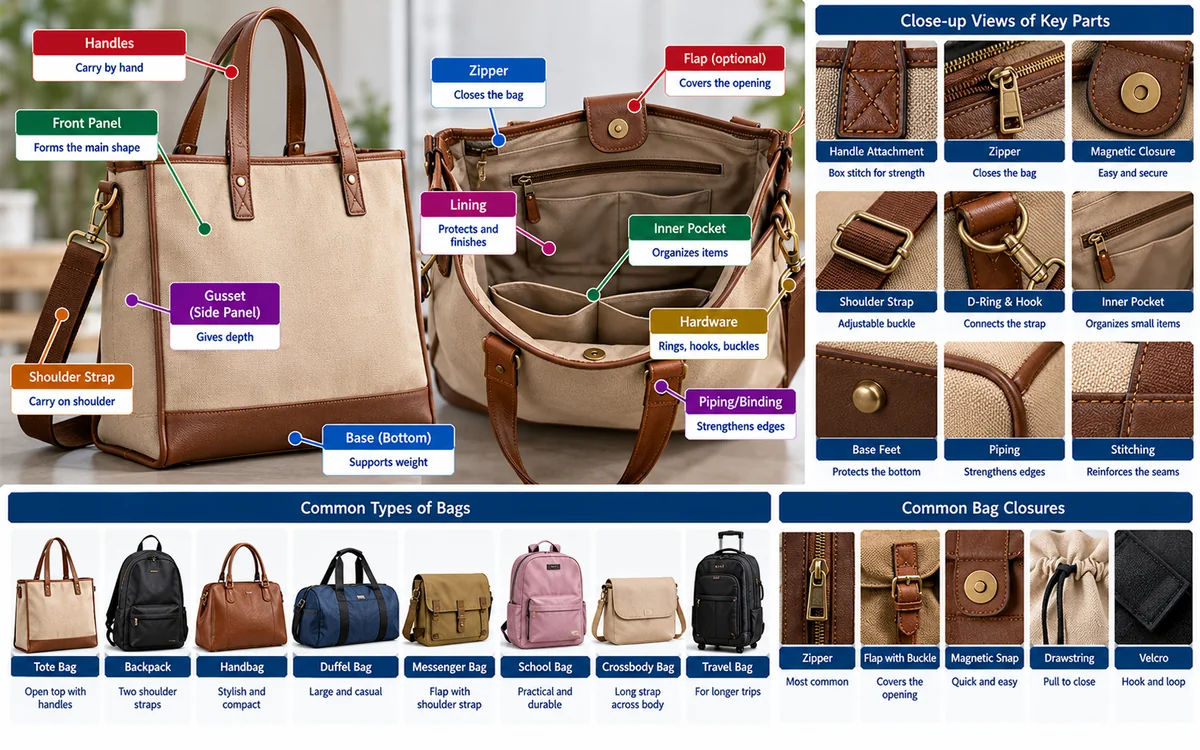
This guide walks around the whole bag, from the outer body to the base and the inner lining. It explains what each part does, which materials are common and where bags usually break. It is useful for shoppers, designers and factory teams. For an idea of the supply side, see our notes on choosing a bag manufacturing factory.
The basic structure
Every bag has the same basic idea. There is a container that holds things, a way to open and close it and a way to carry it. Everything else is a variation.
The container is the body. The opening is the mouth. The closure is a zipper, flap, magnet or drawcord. The carrying method is a handle or strap. The rest are supports, pockets and trims.
Parts of a bag at a glance
| Part | Location | Job |
|---|---|---|
| Body (shell) | Main walls | Holds items |
| Front and back panels | Large faces | Form the main shape |
| Gusset (side panel) | Sides | Gives depth |
| Base (bottom) | Underside | Supports weight |
| Handles | Top | Carry by hand |
| Shoulder strap | Sides | Carry on shoulder |
| Zipper | Opening | Closes the bag |
| Flap | Over opening | Covers the opening |
| Lining | Inside | Protects and finishes |
| Pockets | Inside and outside | Organize items |
| Hardware | Various | Rings, hooks, buckles, rivets |
| Interlining and foam | Between layers | Gives shape and padding |
| Piping and binding | Seams | Strengthens edges |
| Feet or studs | Base | Protect the bottom |
Body and panels
Shell fabric
The body is the large outside shell. Its material decides the character of the bag.
- Canvas: Plain woven cotton. Strong and casual, used in totes and backpacks. See our guide on canvas fabric for weight grades.
- Nylon: Light, strong and quick drying. Common in backpacks and sports bags.
- Polyester: Cheaper than nylon with decent strength. Popular for school bags.
- Leather: Durable and ages well. Used in premium handbags.
- Faux leather (PU): A coated fabric that looks like leather at a lower price.
- Jute: Natural, strong and eco-friendly. Used for shopping and promotional bags.
- Non-woven: Cheap and light, used for single-use promotional bags. See our guide on what is non-woven fabric.
Fabric strength is often described by denier, which measures the thickness of the yarn. A 600D polyester or 1000D nylon is a heavy duty bag fabric. A higher denier is generally tougher, though weave and coating also matter.
Front and back panels
The front and back panels are the two large faces. In a simple tote, they are two rectangles sewn together at the sides and bottom. In a backpack, the back panel is padded and shaped for comfort.
Gusset
The gusset is the side panel that joins the front and back. It gives the bag depth. A bag with no gusset is flat, like an envelope. A bag with a wide gusset can hold more. In a box bag, the gusset wraps around the sides and bottom in one piece.
Base
The base is the bottom of the bag. It carries the weight, so it needs strength. Many bags use a double layer of fabric or a rigid board here. Rubber or plastic feet may be placed at the corners to protect the base from the floor.
A well-built base keeps the bag standing upright. A flimsy base sags and wears through.
Handles and straps
Top handles
Top handles are the straps you grip. They can be one loop or two. Handle width and thickness affect comfort. A thin handle digs into the hand. A wide or padded handle spreads the load.
Handle attachment is a major strength point. The best bags use a box stitch or a bar tack to attach handles. A box stitch is a square of stitches with an X inside. A bar tack is a dense block of stitches. Both resist pulling. A handle only sewn with a single row of stitches will fail.
Shoulder straps
A shoulder strap runs from one side of the bag to the other. It may be fixed or adjustable. Adjustable straps use a slide buckle or a ladder lock. Padded straps are more comfortable for heavy loads.
Backpack straps
Backpacks have two shoulder straps, shaped and padded. They connect at the top of the back panel and at the bottom corners. A sternum strap across the chest and a waist belt improve load support in larger packs.
Webbing
Many straps are made from webbing, which is a flat woven tape. It comes in cotton, nylon and polyester. Nylon webbing is strong and common on outdoor bags.
Closures
Zipper
A zipper is the most common closure. Large bags use a coil zipper with a metal or plastic slider. Zipper size is shown by number, such as #5 or #8. A bigger number means a larger zipper and a stronger pull. For more on zipper parts, see our guide to the different parts of a zipper.
A weak zipper is one of the most common reasons a bag is thrown away. Common faults include teeth separation, a slider that no longer grips and tape that tears away from the fabric.
Flap
A flap is a piece of fabric that folds over the opening. It may be held by a buckle, a magnet, a snap or hook and loop tape.
Drawstring
A drawstring bag closes with a cord that pulls the opening shut. It is simple and light, common in sports and gym bags.
Magnetic snap
A small magnet in the flap and body holds the bag closed without effort. It is used on handbags and clutches.
Buckles and clips
Buckles hold flap closures and straps. Plastic buckles are light. Metal ones are stronger. Side release clips are common on backpacks.
Lining and interior
The lining is a layer of fabric inside the bag. It protects the shell, hides seams and gives a neat look. Common linings are polyester taffeta, cotton or nylon. Some bags use a waterproof lining.
Inside, bags may include:
- Slip pockets: Open pockets for phones and keys.
- Zip pockets: Pockets with a zipper for valuables.
- Laptop sleeves: Padded compartments sized for laptops.
- Key leashes: Short straps with a clip.
- Dividers: Panels that split the interior.
- Bottle holders: Elastic pockets on the sides.
Pockets on the outside
External pockets include:
- Front zip pocket: For quick access.
- Side pocket: For bottles or umbrellas.
- Back pocket: For items you want to keep close to the body.
- Patch pockets: Simple open pockets sewn on the outside.
Our guide on the parts of a pocket explains how such pockets are built.
Interlining and padding
Between the shell and lining, bags often have a layer that gives shape.
- Foam: Soft padding for comfort or protection, used in laptop bags and backpack straps.
- Fusible interlining: A thin sheet bonded to the fabric to add body.
- Plastic board or card: A stiff sheet in the base or sides.
- Stiffener: A coated fabric or heavy non-woven that gives structure.
Interlining affects how the bag stands and feels. A bag without interlining feels floppy.
Hardware
Hardware means all the metal or plastic parts.
- D-rings: For attaching straps.
- O-rings: Round rings for handles.
- Swivel hooks: Allow straps to be removed.
- Rivets: Small metal pins that reinforce stress points.
- Eyelets and grommets: Metal rings around holes.
- Feet: Metal or plastic studs on the base.
- Logo plates: Brand marks.
Hardware quality is a big part of the price. Cheap hardware rusts, breaks or loses plating.
Seams, piping and binding
Seams
Bag seams must be strong. Most use lockstitch, which is a stitch with two threads locked in the fabric. Heavy bags use thick thread and a longer needle. Seams at corners take the most stress and are often reinforced.
Piping
Piping is a cord wrapped in fabric, sewn into a seam. It strengthens the edge and adds a decorative line.
Binding
Binding is a strip of fabric that wraps over raw edges, hiding them and adding strength.
How a bag is made
A basic tote bag goes through these steps.
- Cutting: Fabric panels, handles and lining are cut.
- Printing or embroidery: Logos are added.
- Handle making: Straps are folded and stitched.
- Pocket making: Inside pockets are sewn to the lining.
- Body assembly: Front, back and gusset are sewn.
- Lining assembly: The lining is made as a separate bag.
- Joining: The lining and shell are sewn at the top edge.
- Handle attach: Handles are attached with box stitches.
- Finishing: Threads trimmed and bag turned right side out.
- Packing: Bags are folded and packed.
More complex bags, like backpacks, follow a similar logic with more steps.
Bag size and capacity
Bag capacity is often given in liters for backpacks and in centimeters for handbags and totes. A small daypack may hold around 15 to 20 liters. A school bag is usually between 20 and 30 liters. A travel backpack can pass 40 liters. These are rough ranges and brands differ. To compare bags, look at the length, width and depth, then multiply and divide by 1,000 to get liters. For example, a bag that is 45 cm tall, 30 cm wide and 15 cm deep holds about 20 liters. Capacity matters less than how well the weight is carried, so check the straps and back panel too.
Common faults
- Handle tears off: Weak attachment stitching.
- Seam splits at the corner: Poor reinforcement or low stitch density.
- Zipper jams: Fabric caught in the teeth or poor zipper.
- Lining ripped: Lining fabric too weak.
- Color bleeding: Dye runs on wet weather.
- Water leaks: Seams not sealed or coated.
- Sagging base: No reinforcement.
- Rust on hardware: Cheap metal.
- Crooked pocket: Poor cutting or sewing.
- Odor: Poor material or glue.
Our guide on sewing defects and root causes shows how teams fix many of these.
How to choose a bag
- Check the handles. The stitching at attachment points should be dense.
- Test the zipper. It should glide with no catch.
- Feel the fabric. It should be thick, not thin.
- Look inside. The lining should be tidy.
- Check the base. It should be firm and reinforced.
- Look at the corners. They should be neat.
- Weigh it empty. A very heavy empty bag can be tiring.
Final thoughts
A bag is a simple container made from many small parts. The shell gives shape, the gusset adds depth, the base carries weight, the handles take the strain and the zipper keeps everything inside. Before you buy or approve a bag, check the handle stitching, the zipper, the corners and the base. If those four areas are strong, the bag will serve you for many years.
Frequently asked questions
The main parts are the body, gusset, base, handles or straps, zipper or closure, lining and pockets. Hardware and trims complete the bag.
A gusset is the side panel that gives a bag its depth. It joins the front and back panels.
Heavy canvas, nylon of 600D or higher and full grain leather are strong choices. The best choice depends on use and weather.
A box stitch is a square of stitches with an X inside. It is used to attach handles and straps because it resists pulling.
Denier measures the thickness of a yarn. In bag fabrics, a higher denier usually means a tougher and heavier fabric.
A good coil zipper is secure and common. Buckles and flaps add extra protection. The best closure depends on the bag type.
They break when the stitching at the attachment point is weak or the webbing is too thin. Box stitching and bar tacks prevent this.


