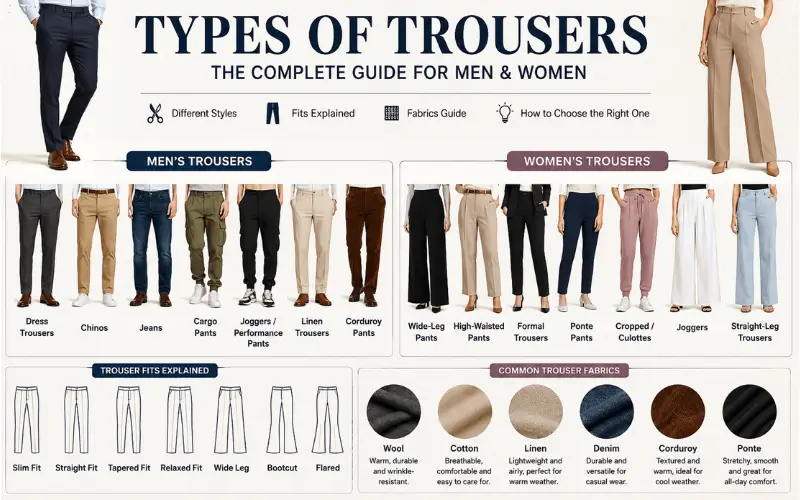
Two pairs of trousers can both say size 32 on the label and still fit in completely different ways. One feels tight at the thigh. The other flaps loosely around the ankle. The reason is that a size label gives only one number, the waist, while a pair of pants has many more measurement points. The leg opening, the rise and the thigh girth all decide how the pants sit, move and look.
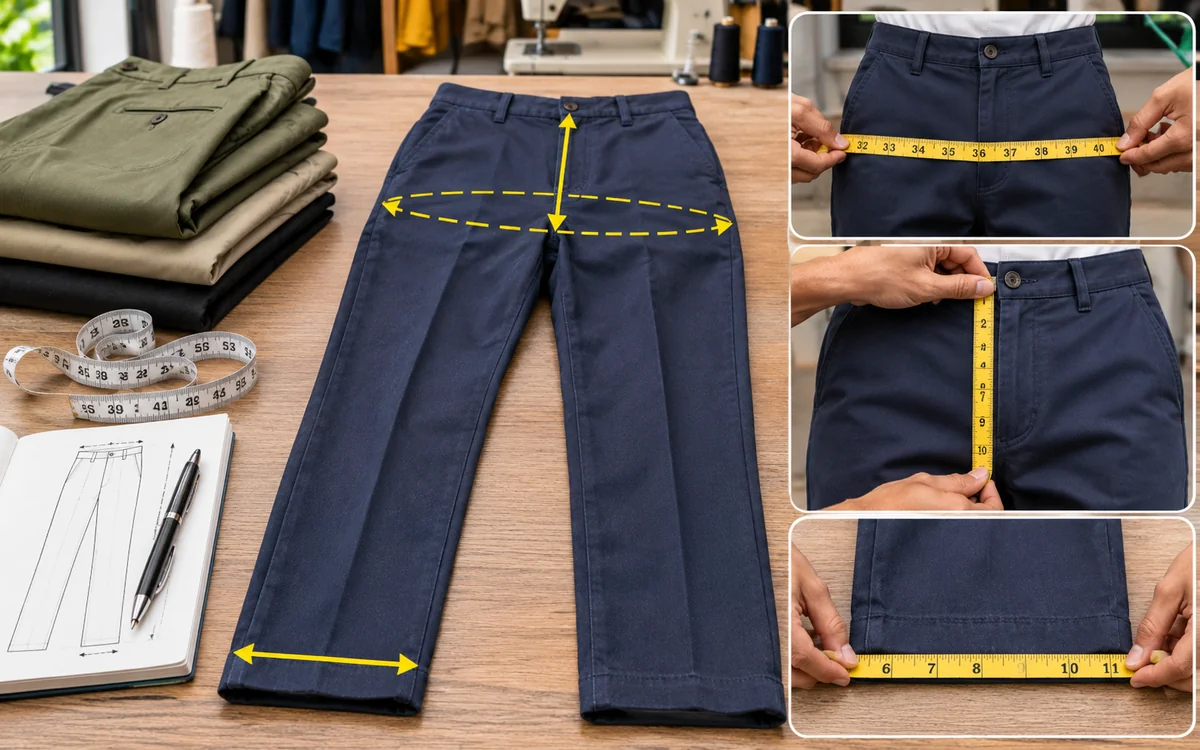
This guide explains the key pant measurements in plain words, with a focus on the leg opening. You will learn what each point means, how to measure it flat and around the body, what tolerances buyers allow and how to use the numbers in a spec sheet. It also includes worked examples. For the names of every part of the garment, see our guide on the parts of pant. For the wider method of taking measurements on tops and bottoms, read our article on the measurement of top and bottom garments.
What is the leg opening
The leg opening is the width of the pant leg at the bottom hem. It is also called the hem width, bottom opening or leg hem. It tells you how wide the trouser is at the ankle. Slim and skinny pants have a narrow opening. Straight pants have a medium one. Bootcut, flared and wide-leg pants have a wide one.
The leg opening is usually measured flat. You lay the pant on a table, smooth it, and measure straight across the hem from one side seam to the other, along the edge. That number is the flat width. To find the full circumference, double it. If a flat leg opening is 17 cm, the leg opening circumference is 34 cm.
Spec sheets must say whether the figure is flat or around. A buyer who reads 17 cm as the full circumference will think the pant is far too narrow, and a factory that makes 34 cm flat will make a trouser twice as wide as planned. This is a common source of mistakes.
Other key pant measurements
Here are the main points that a spec sheet for trousers or jeans covers.
| Measurement | What it is | How it is taken |
|---|---|---|
| Waist | Width or circumference at the top of the waistband | Flat across the top edge, doubled for circumference |
| Hip | Width at the widest part of the seat | Flat, usually a set distance below the waistband, doubled |
| Front rise | Crotch seam to the top of the waistband at the front | Along the seam, from the crotch point up to the top edge |
| Back rise | Crotch seam to the top of the waistband at the back | Along the back seam, from the crotch point up to the top edge |
| Thigh | Width at the thigh, just under the crotch | Flat, 2.5 cm below the crotch seam, doubled |
| Knee | Width at the knee point | Flat, at a set distance below the crotch, doubled |
| Leg opening | Width at the bottom hem | Flat across the hem, doubled for circumference |
| Inseam | Length along the inside leg | From the crotch point to the hem along the inner seam |
| Outseam | Length along the outside leg | From the top of the waistband to the hem along the side |
| Crotch length (total rise) | Front rise plus back rise | Along the crotch seam, from the waistband front to back |
| Waistband height | Width of the band | Straight across the band |
The word girth means the distance around a body or a part of the garment. When a measurement chart lists thigh girth or leg opening girth, it means the full circumference, not the flat width. A pair with a flat thigh of 33 cm has a thigh girth of 66 cm.
What is rise
The rise is the distance from the crotch seam to the top of the waistband. It decides where the pant sits on the body. A high rise sits at or above the navel. A mid rise sits a little below. A low rise sits on the hip bones.
As a rough guide for adult trousers, the front rise might fall in these ranges. The ranges differ by brand, size and style.
| Rise type | Typical front rise |
|---|---|
| Low rise | Shorter, about 18 to 22 cm |
| Mid rise | About 24 to 27 cm |
| High rise | About 28 to 33 cm |
The back rise is longer than the front rise because the seat needs more room. The difference is often 8 to 10 cm. A rise that is too short feels tight in the crotch. A rise that is too long leaves extra fabric and a droopy seat.
Inseam and outseam
The inseam runs along the inner leg. It sets the length of the pant for a person’s leg. Many brands sell one waist size with several inseam lengths, such as 30, 32 and 34 inches. The outseam runs along the outside of the leg from waistband to hem. The outseam equals the inseam plus the front rise, with small differences from curve and waistband.
How to measure pants flat
- Lay the pant on a flat table. Smooth out wrinkles without stretching the fabric.
- Close the fly and fasten the button.
- Align the side seams and the crotch seam so the pant lies square.
- Use a soft tape measure and place it along the seam or the edge for each point.
- Measure the waist across the top edge of the waistband and record the flat number.
- Measure the hip at the stated distance below the waistband.
- Measure the thigh 2.5 cm below the crotch seam, in a straight line across.
- Measure the knee and leg opening in straight lines across.
- Measure the inseam along the inner seam from the crotch to the hem.
- Measure the front and back rise along the seams.
Always note which side of the garment was measured, and whether the figure is flat or full. Measure each sample the same way to compare them fairly.
Measuring on the body
If you want to buy pants or draft a pattern from a person’s body, measure the body, not the garment.
- Waist: Around the natural waist, the narrowest part of the torso.
- Hip: Around the fullest part of the hips.
- Thigh girth: Around the fullest part of the upper thigh.
- Inseam: From the crotch to the ankle bone along the inner leg.
- Rise: Sit on a chair and measure from the seat of the chair to the waist, along the side.
Garment measurements are larger than body measurements, because the garment needs ease, which is extra room for comfort and movement. The amount depends on the style and fabric. Stretch fabrics need less ease than rigid ones.
Worked example 1: leg opening in a spec sheet
A buyer sends a spec for slim-fit trousers in size 32. The leg opening is listed as 34 cm circumference.
- Flat leg opening = 34 ÷ 2 = 17 cm
- If a factory wrongly makes 34 cm flat, the circumference becomes 68 cm, which is twice as wide.
To avoid errors, write both numbers on the spec: “Leg opening: 17 cm flat, 34 cm full.”
Worked example 2: size grading
Say the base size 32 has a full leg opening of 34 cm, which is 17 cm flat. The buyer wants the full leg opening to grow by 1 cm for each size step. The flat grade is 1 ÷ 2 = 0.5 cm per step.
| Size | Flat leg opening | Full leg opening |
|---|---|---|
| 30 | 16.5 cm | 33 cm |
| 32 | 17.0 cm | 34 cm |
| 34 | 17.5 cm | 35 cm |
| 36 | 18.0 cm | 36 cm |
Always build the table from the real base size and the grade rule, then check that each flat figure is exactly half of the full one. Our guide on pattern grading shows how to share grade amounts across points.
Tolerances
A tolerance is the allowed difference between the spec and the finished garment. Buyers write tolerances in the spec sheet. As an example only, a common practice is to allow about plus or minus 1 cm on waist and hip, plus or minus 0.5 to 1 cm on thigh and leg opening, and plus or minus 1 cm on inseam. Tight-fitting or high-end styles may have tighter limits. Always follow the number written in your buyer’s technical pack, not a general rule. See our article on the garment spec sheet for how these tables are laid out.
Worked example 3: checking the leg opening of a sample
A factory sends a pre-production sample of straight-fit trousers. The spec says the leg opening is 18 cm flat, with a tolerance of plus or minus 0.5 cm. The quality team measures the sample and writes down 17.2 cm on the left leg and 18.3 cm on the right leg.
- Left leg: 17.2 − 18 = −0.8 cm. This is outside the tolerance, because the limit is 0.5 cm.
- Right leg: 18.3 − 18 = +0.3 cm. This is inside the tolerance.
- The difference between the two legs is 18.3 − 17.2 = 1.1 cm. Even if each leg were inside the limit, a gap this large would look odd to the eye.
The sample fails. The team should check the pattern pieces, the cutting marks and the hem allowance on the left leg. A hem that was folded too deep or a panel cut slightly narrow can both cause this.
How to build a pant measurement chart
A good chart is short, clear and used by everyone in the same way. Follow these steps.
- List the points in a fixed order, from the waist down to the leg opening.
- Give each point a letter or code, such as A for waist, B for hip and so on, so drawings and tables match.
- State the unit once at the top. Use centimetres or inches, but never mix them.
- Mark each figure as flat or full.
- Add the tolerance next to each point.
- Add a small sketch that shows where each line is taken.
- Show the base size and the grade for every other size.
Small details such as the exact spot where the thigh is measured, or whether the waistband is stretched, should be written down. When two people read the same chart, they should get the same number. Charts for jeans often add the knee width, the front rise with and without the waistband, and the back pocket position. Charts for stretch pants should say if the fabric was relaxed or pulled when measured.
Leg opening and style
| Style | Leg opening (flat, as a rough guide) | Look |
|---|---|---|
| Skinny | Narrow, about 12 to 14 cm | Close to the ankle |
| Slim | About 14 to 17 cm | Close fit, tapered |
| Straight | About 17 to 20 cm | Even from knee to hem |
| Bootcut | About 20 to 22 cm | Slightly wider to fit over boots |
| Wide leg | About 24 cm and above | Loose and flowing |
| Flare | Wider at the hem than at the knee | Fitted thigh, flared hem |
These are guides for adult sizes, and they depend on brand and size. Check the spec for your own pattern.
Common problems linked to measurements
- Pants feel tight at the thigh: The thigh or the crotch curve is too small.
- Pants hang loose at the seat: The back rise or hip is too large.
- Hems twist or pull up: The leg opening, grain or inseam is uneven.
- Crotch seam pulls: The rise is too short for the wearer.
- Pants shrink in length: Fabric shrinks in the warp direction. See our guide on shrinkage control.
- Left and right legs differ: Cutting or sewing error. Check the first piece after cutting.
Final thoughts
The leg opening is one small number that changes the whole look of a pair of pants. Add rise, inseam and thigh girth, and you have the key figures that decide fit. Measure in the same way each time, write whether a figure is flat or full, and keep tolerances in the spec. If you design, grade or buy trousers, these points will save you from sample rounds and returns.
Frequently asked questions
The leg opening is the width of the pant leg at the bottom hem. It is usually measured flat across the hem and doubled for the full circumference.
Lay the pant flat, then measure straight across the hem from one side to the other. Double the number if you need the circumference.
The rise is the distance from the crotch seam to the top of the waistband. It decides where the pants sit on the body.
The inseam runs along the inside of the leg from the crotch to the hem. The outseam runs along the outside from the waistband to the hem.
Girth is the full distance around a part, such as the thigh or hem. A flat measurement is half of the girth.
It depends on the style. Skinny pants have a narrow opening, and wide-leg pants have a much larger one.
Because the two differ by a factor of two. Listing both avoids errors in production.