This ground has also been covered in more checklist form, in compressed air energy loss, optimizing a compressed air system, and a compressed air audit checklist. Compressed air has a reputation among utility engineers as the most expensive way to deliver mechanical work in a typical factory, and that reputation is earned. Every stage of compressing air, moving it through distribution piping, and using it at the point of application loses energy, and a factory that hasn’t examined its compressed air system’s actual efficiency in some time is very likely paying considerably more for the compressed air it uses than a well-run system would cost.
Building the Case: What an Upgrade Actually Targets
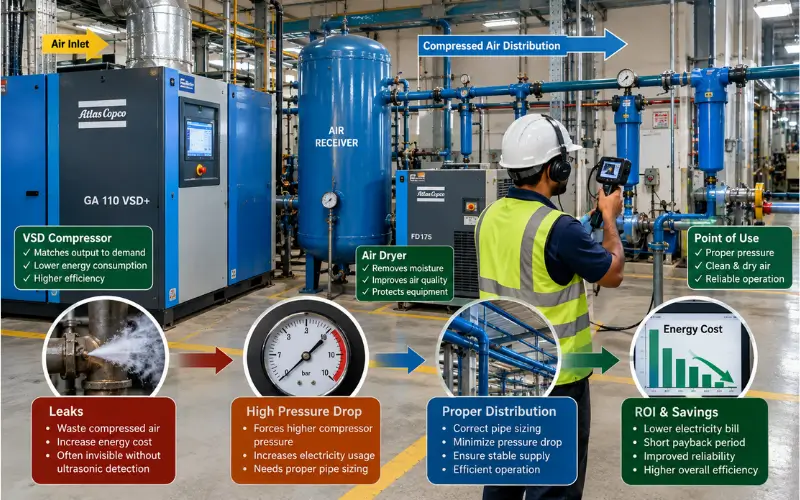
A compressed air system ROI model needs to compare a defined “before” state against a defined “after” state, and the improvement usually comes from some combination of fixing leaks, right-sizing compressor capacity to actual demand, and upgrading to more efficient compressor technology, most commonly variable speed drive (VSD) compressors in current practice. Treating these as a single blended upgrade project, rather than three separable decisions, actually understates the case for action in most audits, since leak repair alone often delivers a compelling payback on its own before capital equipment upgrade even enters the picture.
Step One: Establishing Actual CFM Demand
Before pricing any upgrade, a mill needs an honest picture of actual CFM (cubic feet per minute) demand, not the sum of every connected equipment’s nameplate maximum draw, which overstates real simultaneous demand considerably in almost every factory, since equipment rarely all draws peak air at the same moment. A proper demand assessment measures actual system output and pressure over a representative operating period, capturing genuine peak demand rather than a theoretical maximum that inflates the case for oversized compressor capacity.
This step matters for the ROI model specifically because a compressor sized against inflated demand figures will be oversized for actual need, which itself carries an efficiency cost, since compressors, particularly fixed-speed types, run less efficiently at partial load than when operating closer to their designed output.
Step Two: Quantifying Leak Losses
Compressed air leaks are the direct equivalent of the failed steam traps covered in the previous article, individually small, collectively expensive, and invisible without deliberate inspection. An ultrasonic leak survey, walking the full compressed air distribution system with a detector tuned to the acoustic signature of escaping compressed air, identifies leak locations that visual inspection alone would miss entirely, since most leaks are far too small to hear over normal factory ambient noise without specialized equipment.
Each identified leak can be estimated for its air loss based on orifice size and system pressure, using standard compressed air leak flow tables, and converted to an electricity cost using the compressor’s actual power consumption per CFM delivered, a figure available from compressor specifications or measurable directly on an operating system. Leak losses across a factory that hasn’t run a leak survey recently commonly represent a substantial fraction of total compressed air demand, sometimes representing air that the compressor is generating and the factory is paying to compress, but that never does a single unit of useful work anywhere in the plant.
Step Three: Pricing the Pressure Drop Problem
Excessive pressure drop between the compressor and the point of use forces the compressor to operate at a higher output pressure than the actual equipment requires, just to compensate for losses along an undersized or poorly configured distribution system. Every additional unit of pressure the compressor has to generate costs real energy, and a system audit that measures pressure at multiple points, not just at the compressor, often reveals that a meaningful portion of a factory’s compressed air cost is being spent overcoming distribution system losses rather than delivering useful pressure at the point where work actually happens.
Step Four: Evaluating VSD Compressor Technology
Fixed-speed compressors run at constant motor speed regardless of actual demand, cycling on and off or unloading to manage variable demand, both of which carry real efficiency penalties compared to a compressor that can actually match its output to real-time demand. VSD compressors adjust motor speed continuously to match demand, which delivers a meaningful efficiency advantage specifically in facilities with variable compressed air demand over the course of a shift or day, a pattern common in garment and textile factories where compressed air draw fluctuates with cutting table usage, pressing equipment cycles, and other intermittent demand.
The efficiency advantage VSD technology delivers depends heavily on how variable the facility’s actual demand pattern is. A facility with genuinely steady, constant compressed air demand sees a smaller efficiency benefit from VSD technology than one with highly variable demand, which is why the demand assessment in step one matters directly for evaluating whether a VSD upgrade is likely to deliver a strong return for a specific facility’s actual usage pattern, rather than assuming VSD technology delivers the same benefit universally regardless of context.
Beyond a Single Compressor: Multi-Compressor Strategies
For larger facilities running multiple compressors, a further efficiency lever beyond VSD technology on any individual unit is how the overall compressor fleet is sequenced and controlled. Running several fixed-speed compressors with a basic on/off control strategy often means more total compressor capacity cycling on and off than actual demand requires, since each individual compressor has a minimum practical run time and capacity step. A properly configured sequencing controller, which manages when each compressor in a multi-unit system starts, stops, or modulates based on real-time demand, can capture meaningful efficiency gains even without replacing any individual compressor, by better matching total running capacity to actual demand across the full fleet rather than optimizing each unit in isolation. For facilities already planning a VSD upgrade on one or more units, evaluating the sequencing strategy for the full compressor fleet at the same time, rather than treating each compressor as an independent decision, often reveals additional savings the single-machine ROI model in this article wouldn’t capture on its own.
Building the ROI Calculation
Pulling these pieces together into an actual ROI model: calculate current annual compressed air electricity cost from actual measured or reasonably estimated consumption and current electricity rate. Calculate the annual savings from leak repair using the leak survey findings above. Calculate the annual savings from right-sizing compressor capacity to actual demand, if current capacity is oversized considerably relative to the assessment in step one. Calculate the annual savings from a VSD upgrade specifically, using the facility’s actual demand variability pattern to estimate a realistic efficiency improvement rather than a generic industry claim. Sum these annual savings figures, and divide the capital cost of the proposed upgrade, leak repair labor and materials, any compressor replacement or retrofit cost, by that combined annual savings figure to arrive at a payback period in years.
What Realistic Payback Periods Actually Look Like
Leak repair alone typically shows the fastest payback in this model, since it requires relatively modest labor and materials cost against a savings figure that can be substantial in a system that hasn’t been surveyed recently. Right-sizing compressor capacity and VSD upgrades represent larger capital investments with correspondingly longer payback periods, though still often attractive paybacks when leak savings and pressure optimization are properly included in the combined annual savings figure rather than evaluating the VSD upgrade in isolation against electricity savings alone.
A model that separates these three improvement categories, rather than blending them into a single project cost and single savings figure, gives a factory the flexibility to sequence the investment sensibly: fix leaks first, since it’s typically the fastest payback and lowest capital requirement, then evaluate compressor right-sizing and VSD upgrade with a clearer picture of what demand actually looks like once leak losses are no longer inflating the apparent demand figure.
A Worked ROI Example
Say a factory’s compressed air system currently costs $42,000 a year in electricity, based on measured compressor power draw and current electricity rate. A leak survey identifies leaks totaling an estimated 18 percent of total system output, representing roughly $7,560 a year in wasted electricity ($42,000 × 0.18). Repairing the identified leaks is quoted at $3,200 in labor and fittings.
Separately, a demand assessment finds the facility’s compressed air draw is genuinely variable across a shift, with periods of low demand during non-cutting operations and sharp peaks during active cutting table use, a pattern well suited to VSD technology. Upgrading the existing fixed-speed compressor to a VSD unit is quoted at $28,000, with an estimated 22 percent efficiency improvement on the remaining (post-leak-repair) electricity cost of $34,440 a year ($42,000 − $7,560), representing a further $7,577 in annual savings.
Leak repair payback: $3,200 ÷ $7,560 ≈ 0.42 years, roughly 5 months.
VSD upgrade payback (evaluated after leak repair, against the reduced baseline): $28,000 ÷ $7,577 ≈ 3.7 years.
Combined view: total capital of \$31,200 against combined annual savings of $15,137 once both measures are in place, for a blended payback of roughly 2.1 years.
Notice how sequencing the two measures, fixing leaks first, then evaluating VSD against the corrected baseline, gives a clearer picture than treating them as a single bundled project. The leak repair alone pays back in under half a year and should proceed regardless of the VSD decision, while the VSD upgrade’s longer payback is a separate capital decision that can be evaluated on its own merits once the leak-corrected baseline makes its real savings potential clear. Rebuild this calculation with your own facility’s measured electricity cost, survey findings, and actual equipment quotations before committing capital.
Keeping the Model Honest
An ROI model is only as useful as the honesty of its inputs, and it’s worth resisting the temptation to use optimistic assumptions, particularly around leak detection completeness and VSD efficiency improvement, that make the payback period look more attractive than a conservative, well-supported estimate would show. Getting an actual quotation for leak repair labor and materials, an actual current electricity rate rather than an assumed figure, and VSD efficiency estimates based on the facility’s own measured demand variability rather than a vendor’s best-case marketing claim, produces a model a factory can actually trust and act on with confidence, rather than one that looks compelling on paper but doesn’t hold up once the upgrade is actually implemented and measured against reality.
Verifying Results After Implementation
The final step in a credible compressed air ROI project is verifying actual results against the model’s projections once the upgrade is complete, rather than assuming the projected savings materialized simply because the equipment was installed. This means measuring post-upgrade electricity consumption against the pre-upgrade baseline established during the initial audit, ideally over a full representative operating cycle rather than a single unusually light or heavy demand period. A facility that skips this verification step loses the opportunity to confirm the model’s assumptions held up in practice, and loses valuable calibration data for building more accurate ROI models on the next utility efficiency project this facility undertakes.
Frequently Asked Questions
Why is compressed air considered the most expensive utility per unit of useful work?
Compressing air is inherently less efficient than delivering the same mechanical work through electricity directly, which is why leaks and oversizing waste more real money in compressed air systems than in most other utility categories.
What typically has the fastest payback in a compressed air efficiency project?
Leak repair, usually paying back within months given relatively low labor and materials cost against savings that can be substantial in a system that hasn’t been surveyed recently.
Does a VSD compressor upgrade always deliver strong savings?
Only where demand is genuinely variable across a shift. A facility with steady, constant compressed air demand sees a smaller efficiency benefit from VSD technology than one with sharp demand peaks and troughs.
Should leak repair and a VSD upgrade be evaluated together or separately?
Separately, then combined. Fixing leaks first and evaluating VSD against the corrected baseline gives a clearer picture than bundling both into a single project cost and savings figure.