Effluent treatment sits in an unusual category for a mill’s capital planning. It’s not a system that adds production capacity or improves product quality, and it can be tempting to treat it as a compliance cost to minimize rather than an operational system worth genuine planning attention. That framing gets expensive fast, since the gap between a properly sized, well-run effluent treatment plant and an inadequate one shows up directly in compliance risk, ongoing operating cost, and, increasingly, in whether a mill can win business from buyers whose own compliance requirements extend down through their supply chain.
Conventional ETP: What It Actually Does
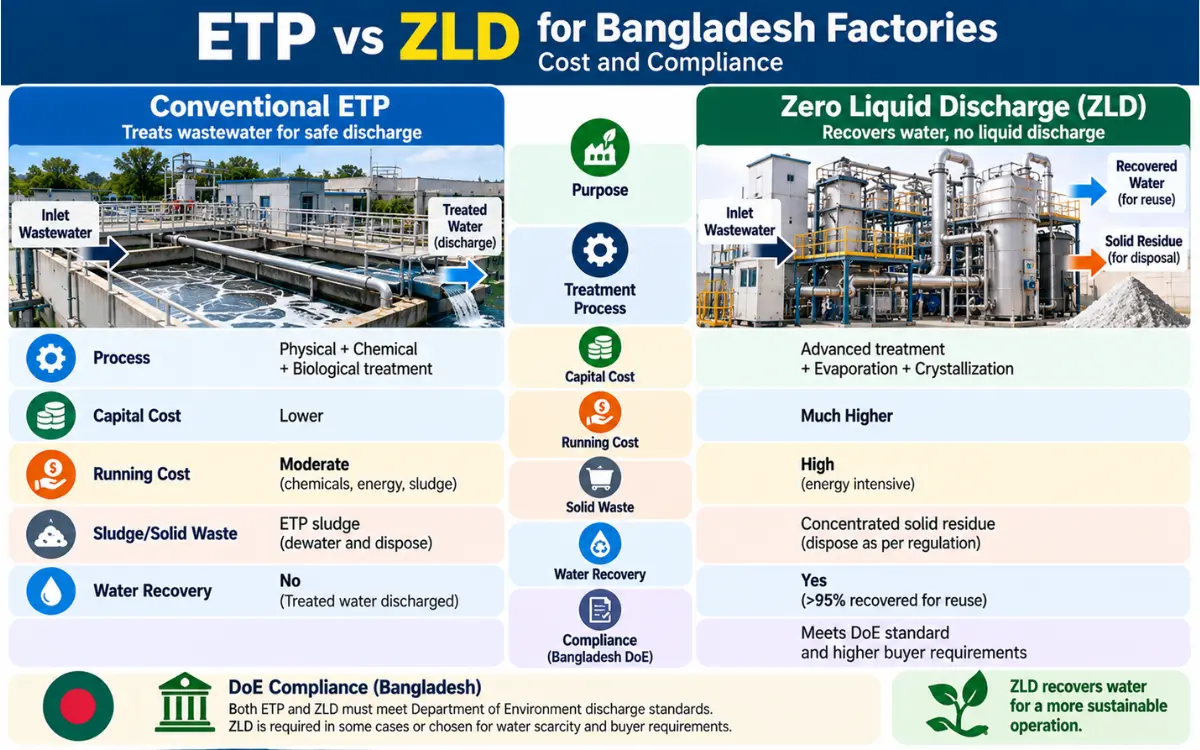
A conventional effluent treatment plant (ETP), covered from a more foundational angle in effluent treatment overview, treats wastewater to reduce pollutant load before discharge, typically combining physical, chemical, and biological treatment stages. Physical treatment removes suspended solids through settling and filtration. Chemical treatment, using coagulants and flocculants, helps settle finer suspended material and can address specific chemical parameters requiring targeted treatment. Biological treatment relies on microbial digestion of organic load, reducing the biochemical oxygen demand (BOD) and chemical oxygen demand (COD) that are among the key parameters regulators measure for discharge compliance.
A well-run conventional ETP treats wastewater to a standard suitable for discharge, whether that’s to a water body directly or to a shared treatment facility, depending on the specific regulatory framework and location. It doesn’t eliminate wastewater volume, it treats it to an acceptable discharge standard.
Zero Liquid Discharge: A Fundamentally Different Approach
Zero liquid discharge (ZLD) takes a different approach entirely, treating wastewater to the point where essentially all water is recovered for reuse and only solid residue remains for disposal, with no liquid effluent discharged at all. This typically involves more intensive treatment stages beyond what a conventional ETP requires, often including advanced filtration, evaporation, and crystallization stages to concentrate and ultimately eliminate the liquid discharge stream.
ZLD represents a substantially larger capital and operating cost commitment than a conventional ETP, given the additional treatment intensity required to achieve full water recovery rather than treatment to a discharge standard. It’s generally pursued either where regulatory requirements specifically mandate it, where water scarcity in a given location makes water recovery and reuse a genuine operational priority beyond compliance alone, or where a mill’s buyer base specifically requires it as part of a broader environmental positioning.
Capital Cost Comparison
A conventional ETP’s capital cost scales with treatment capacity and the specific treatment stages required to meet the applicable discharge standard for the mill’s effluent characteristics and discharge location. ZLD capital cost runs substantially higher, given the additional evaporation and crystallization equipment required, and the gap between conventional ETP and ZLD capital cost is generally large enough that it represents a genuine strategic decision rather than a marginal upgrade choice.
Running Cost Comparison
Beyond capital cost, running cost differs meaningfully between the two approaches. Conventional ETP operating cost centers on chemical consumption for coagulation and treatment, energy for pumping and aeration in biological treatment stages, and sludge handling and disposal. ZLD operating cost adds substantial energy consumption for the evaporation stages central to achieving zero discharge, since evaporating water to concentrate and eliminate it as a liquid stream is inherently energy-intensive, which connects ZLD’s running cost directly to the energy cost and benchmarking considerations covered elsewhere.
Sludge and Solid Waste Handling
Both approaches generate solid waste requiring disposal, though the volume and character differ. Conventional ETP sludge, primarily from the biological and chemical treatment stages, requires dewatering and disposal according to applicable waste management regulations. ZLD’s solid residue, the concentrated material remaining after evaporation and crystallization, represents effectively all the dissolved and suspended material originally present in the wastewater, now concentrated into a solid or semi-solid form requiring its own disposal pathway, and the volume and disposal cost of this concentrated residue is a real operating cost consideration that ZLD’s water recovery benefit needs to be weighed against.
DoE Compliance in Bangladesh
Bangladesh’s Department of Environment (DoE) sets discharge standards that textile and garment wet processing facilities need to meet, and compliance requirements have generally tightened over time as environmental regulation has matured alongside the industry’s growth. A conventional, properly designed and operated ETP can meet current DoE discharge standards for most mills, and ZLD isn’t a blanket regulatory requirement for the sector, though specific circumstances, discharge into particularly sensitive water bodies, or specific buyer requirements layered on top of baseline regulatory compliance, can shift the calculation toward ZLD even where conventional ETP would technically satisfy DoE standards alone.
Given how regulatory requirements can evolve, any mill making a major effluent treatment capital decision should confirm current DoE discharge standards and any location-specific requirements directly with DoE or a qualified environmental compliance consultant, rather than relying on a general industry understanding that may not reflect the most current regulatory position.
When ZLD Makes Sense Despite the Higher Cost
Beyond pure regulatory compliance, a few scenarios make ZLD’s substantially higher cost a more reasonable strategic choice. Water-scarce locations, where the value of recovered, reusable water genuinely offsets a meaningful portion of ZLD’s higher operating cost, make the economics more favorable than in a location with abundant, low-cost water supply. Buyers with specific environmental requirements that extend beyond baseline regulatory compliance, increasingly common among global apparel brands with their own sustainability commitments, can make ZLD a genuine commercial requirement for retaining or winning specific business, not just an environmental choice made independent of commercial considerations. And mills anticipating tighter future discharge regulation may choose to invest ahead of a regulatory requirement that seems likely to arrive eventually, avoiding a more disruptive retrofit under future compliance pressure.
Partial ZLD and Hybrid Approaches
Between a conventional ETP and full ZLD sits a middle ground worth knowing about: partial water recovery systems that reclaim and reuse a meaningful share of process water, commonly 50 to 80 percent depending on the specific technology and effluent characteristics, without pursuing the full zero-discharge endpoint that drives ZLD’s highest capital and energy costs. This hybrid approach can capture a substantial share of ZLD’s water conservation benefit and a meaningful reduction in discharge volume, at a capital and operating cost considerably closer to a conventional ETP than to full ZLD. For mills where water scarcity or discharge capacity is a genuine operational concern but full ZLD’s cost isn’t justified by current regulatory or buyer requirements, partial recovery represents a real middle path worth evaluating alongside the two endpoint options this article has focused on, rather than treating the decision as a strict binary between conventional treatment and full zero discharge.
Staging a ZLD Investment Over Time
For mills that conclude ZLD is the right long-term direction but aren’t positioned to fund the full capital cost immediately, a staged investment approach is worth considering over an all-at-once build. This typically means installing a conventional, well-designed ETP first, sized and configured in a way that anticipates future integration with advanced treatment stages, then adding the evaporation and crystallization equipment that pushes the system toward full zero discharge in a later capital cycle once the mill’s financial position or a firmer regulatory or buyer requirement timeline justifies the additional investment. This staged approach requires more upfront engineering coordination than building the full system at once, since the initial ETP design needs to genuinely anticipate the later addition rather than requiring substantial rework when the advanced stages are eventually added, but it spreads the capital burden across a timeline that may be considerably more manageable than a single large commitment, while still keeping the mill on a credible path toward full ZLD if that’s the eventual goal.
Operator Training and Ongoing System Management
Both conventional ETP and ZLD systems require genuinely skilled ongoing operation to perform at their designed treatment level, and this operational requirement is worth factoring into the decision alongside the capital and running cost comparison covered above. Biological treatment stages in a conventional ETP depend on maintaining a healthy microbial population, which requires operators who understand how to monitor and adjust conditions like dissolved oxygen and nutrient balance rather than simply running the system on fixed settings regardless of actual biological performance. ZLD systems, with their additional evaporation and crystallization stages, generally demand an even higher level of specialized operational skill, given the more complex equipment involved and the tighter tolerances needed to achieve genuine zero discharge reliably rather than intermittently. A mill evaluating ZLD needs to honestly assess whether it can recruit and retain operators with this skill level, or budget for the ongoing training and possibly specialized third-party support needed to keep a ZLD system performing as designed, since a poorly operated ZLD system can end up costing its full premium capital and operating expense without reliably delivering the full zero-discharge outcome that was the entire point of choosing it over a conventional ETP in the first place.
A Practical Framework for the Decision
For a mill evaluating this decision, the practical starting point is confirming actual current DoE discharge requirements for the specific location and effluent characteristics involved, since a properly designed conventional ETP meeting those requirements is the lower-cost path where it’s sufficient. Layer in any specific buyer requirements the mill’s actual or targeted customer base imposes, since this can shift the decision independent of regulatory minimums. Factor in local water cost and scarcity, which affects how much of ZLD’s higher operating cost gets offset by water recovery value. And build a genuine capital and operating cost comparison using actual quotations for the mill’s specific capacity and effluent characteristics, rather than relying on general industry cost figures that vary considerably based on site-specific factors like effluent composition, required discharge standard, and local labor and energy cost.
Frequently Asked Questions
Is zero liquid discharge legally required for Bangladeshi textile mills?
No, not as a blanket requirement. A properly designed conventional ETP can meet current DoE discharge standards for most mills, though specific buyer requirements or discharge location sensitivity can shift the case toward ZLD.
Why does ZLD cost so much more than a conventional ETP?
ZLD requires additional evaporation and crystallization stages to fully recover water and eliminate liquid discharge entirely, both in capital cost and in the considerable energy the evaporation stages consume.
Can a mill adopt ZLD gradually rather than all at once?
Yes. A staged approach installs a conventional ETP designed to anticipate later integration with advanced treatment stages, spreading capital cost across a more manageable timeline than building the full system at once.
Does ZLD require more skilled operators than a conventional ETP?
Yes, generally. The additional evaporation and crystallization equipment demands tighter operational tolerances, and a poorly operated ZLD system can fail to deliver genuine zero discharge despite its full capital and operating cost.