Pick up a cotton T-shirt and it feels simple. Soft, light and plain. But how cotton is made into fabric is a long story, because that shirt began as a fluffy white boll on a plant and went through at least ten different steps before it reached your wardrobe. Many of those steps happen in different countries. Some take only minutes. Others take days.
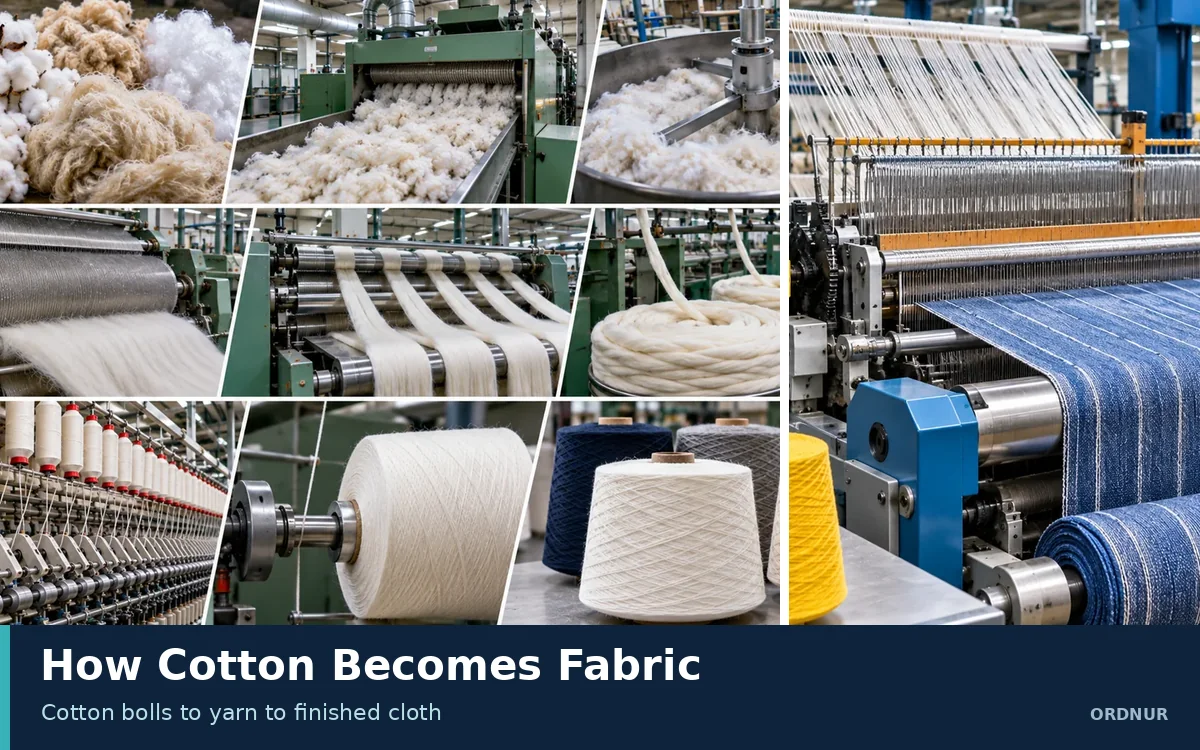
This guide explains each stage in plain language. You will see what happens in the field, the gin, the spinning mill, the weaving or knitting mill and the dyeing house. There is also a worked example that follows a single 170 kg bale of cotton all the way to metres of fabric and finished T-shirts. If you only want the quick version, jump to the summary table near the end.
The big picture
Here is the whole route in one line.
Cotton boll → seed cotton → lint → yarn → fabric → dyed and finished fabric → garment
Each arrow is a separate process, often run by a separate company, sometimes in a separate country, and every handover adds cost, waiting time and a little waste. A farmer grows the cotton. A ginner separates the fibre from the seed. A spinner turns fibre into yarn. A weaver or knitter turns yarn into fabric. A dyer colours and finishes it. A garment factory cuts and sews it.
Bangladesh sits in the middle of this chain. Its spinning mills, knitting mills, dyeing houses and garment factories are large, but most of the raw cotton is bought from other countries. That is why a basic knowledge of cotton fibre is useful for anyone in the industry, from merchandisers to quality teams.
Stage 1: Growing and picking
Cotton is grown in warm regions with a long frost-free season. The plant flowers, the flower falls, and a green boll forms. When the boll ripens it splits open and the white fibre pops out, attached to the seeds. This mix is called seed cotton.
Picking is done in two ways:
- By hand. Workers pick open bolls by hand, which gives cleaner cotton with less trash (leaf and stalk pieces). It is common in many countries.
- By machine. Pickers or strippers harvest large fields fast, but more leaf and trash come along with the cotton.
The seed cotton is pressed into big modules or bundles and sent to a gin.
Stage 2: Ginning
At the gin, machines pull the fibre away from the seed. A saw gin uses rotating saw teeth to catch the fibre while the seeds fall away. A roller gin uses a leather or composite roller and is gentler, so it is often used for long staple cotton. Our guide to the ginning process of cotton goes through both types.
What comes out of the gin is called lint. The seeds are not wasted. They go to oil mills for cottonseed oil, and the leftover meal is used as animal feed.
The proportion of lint in the seed cotton is called ginning outturn or lint turnout. For many cottons it falls in the range of about 33 to 40 percent. A 35 percent outturn means that 100 kg of seed cotton gives about 35 kg of lint.
The lint is then pressed into bales. Bale weights differ by country. A bale of about 170 kg is common in several markets, and a bale of about 218 kg (480 pounds) is the standard in the United States.
Stage 3: Grading and testing
Before a spinning mill buys cotton, it checks the quality. The main properties are:
| Property | What it tells you |
|---|---|
| Staple length | How long the fibres are. Longer fibres make stronger, smoother yarn. |
| Micronaire | Fineness and maturity of the fibre. |
| Strength | How much force the fibres can take before they break. |
| Uniformity | How even the lengths are. |
| Colour and trash | How white the lint is and how much leaf is left in it. |
These tests are often done on an instrument line in a lab. The mill then mixes bales from different lots to get steady quality, which is called bale laydown or bale management. It helps to keep yarn from changing shade or strength from one batch to the next. To learn how fibre quality shows up in clothing, see our guide to cotton fabric for T-shirts.
Stage 4: Spinning cotton into yarn
Fibres alone cannot be woven or knitted. They must be cleaned, straightened and twisted together into a continuous strand. That strand is yarn. Our overview of the yarn making process from fibre to yarn covers it in depth, so here is the short version.
- Blowroom. Machines open the compressed tufts of cotton, remove dirt and trash, and mix the lots.
- Carding. Wire-covered rollers separate the fibres one by one and pull them roughly parallel. The output is a loose rope called a sliver. This is where short fibres and tiny neps (small knots) are cut down.
- Combing (for finer yarn). A comber removes the shortest fibres and aligns the rest even more. This step costs more and removes extra waste, but gives a smoother, stronger, finer yarn. See the difference between the carded yarn and combed yarn routes.
- Drawing. Several slivers are joined and stretched so they become even and the fibres line up.
- Roving. The sliver is thinned and given a little twist to form a roving, which is wound onto a bobbin.
- Ring spinning. The roving is drafted again, twisted and wound onto a bobbin. Twist gives the yarn its strength.
Other systems exist, such as open-end (rotor) spinning and air-jet spinning. They are faster and cheaper, with some difference in feel and strength.
Yarn count
Spinners describe how fine the yarn is with a count. In the English system (Ne), a higher number means a finer yarn. For example, 30s Ne is finer than 20s Ne. In the tex system, a lower number means finer yarn. You can convert with tex = 590.5 ÷ Ne. A 30s Ne yarn is about 19.7 tex, and a 40s Ne yarn is about 14.8 tex. For the basics, see our page on yarn count.
Stage 5: Turning yarn into fabric
There are two main ways to make cotton fabric. Each gives a different feel and look. Our comparison of woven and knit fabric lays out the details.
Weaving
Weaving crosses two sets of yarn at right angles. The lengthwise yarns are the warp and the crosswise yarns are the weft.
- Warping and sizing. Hundreds or thousands of warp yarns are wound side by side onto a beam. Many are coated with a starch-like size to protect them from rubbing on the loom. See how warping machines work.
- Weaving. On the loom, the warp yarns are lifted in patterns. The weft yarn passes through the opening and is beaten into place. Plain weave, twill and satin are three basic patterns.
- Inspection. The fabric, called greige or grey cloth, is checked for faults.
Woven cotton is used for shirts, trousers, denim, bed linen and towels. Our step-by-step guide to the weaving process from yarn to fabric walks through each part.
Knitting
Knitting makes fabric by looping yarn through itself. Instead of two sets of yarn crossing each other, one yarn (or many) forms a chain of loops. This gives natural stretch and softness. T-shirts, polo shirts, underwear and hoodies are mostly knitted. For machine parts, see our guide to the parts of a knitting machine.
Stage 6: Preparation, dyeing and finishing
Grey fabric is not ready to wear. It has natural waxes, size, oil and a creamy colour. The wet processing mill cleans and colours it.
| Step | What it does |
|---|---|
| Singeing (woven) | Burns off surface hairs so the fabric looks smooth. |
| Desizing (woven) | Removes the size that was added to the warp. |
| Scouring | Washes out natural waxes and dirt so the fabric can absorb water and dye. |
| Bleaching | Whitens the cloth, usually with hydrogen peroxide. |
| Dyeing | Adds colour. Reactive dyes are the usual choice for cotton. |
| Printing (optional) | Adds patterns. |
| Finishing | Gives a final hand feel, width and stability, for example by softening, stentering or compacting. |
For the dye step, read our guide to the cotton dyeing process with reactive dyes. For the heat setting and width control stage, see stenter machines for textile finishing.
Two other treatments are common. Mercerising treats cotton with a strong caustic soda solution under tension. It makes the fibre swell, which adds lustre, strength and better dye uptake. Pre-shrinking (for example, compacting a knit or sanforising a woven) reduces the chance that a garment shrinks in the first wash.
A worked example: one bale to T-shirts
Let us follow one bale through the chain with simple, rounded numbers. These are example assumptions, since real losses depend on the mill, the cotton and the yarn type.
Starting point
- One bale of lint: 170 kg
- Target yarn: 30s Ne carded ring-spun, for single jersey T-shirt fabric
- Spinning loss (blowroom, card and other waste): 12 percent
- Knitting loss: 2 percent
- Dyeing and finishing weight loss: 6 percent
- Fabric: single jersey, 160 GSM, open width 1.8 m
- T-shirt: 0.2 kg of finished fabric each, including cutting waste
Step 1: Seed cotton behind the bale
With a 35 percent ginning outturn, seed cotton needed = 170 ÷ 0.35 = about 486 kg. The other 316 kg or so is mostly seed, along with some trash.
Step 2: Yarn
Yarn = 170 × (1 − 0.12) = 149.6 kg
Step 3: Length of yarn
For 30s Ne, tex = 590.5 ÷ 30 = 19.68. That means 1,000 m of yarn weighs 19.68 g. So 1 kg holds 1,000 ÷ 19.68 = about 50.8 km of yarn. Then 149.6 kg holds roughly 149.6 × 50.8 = 7,600 km of yarn. Laid end to end, that is a long road. All from one bale.
Step 4: Grey knit fabric
Grey fabric = 149.6 × (1 − 0.02) = 146.6 kg
Step 5: After dyeing and finishing
Finished fabric = 146.6 × (1 − 0.06) = 137.8 kg
Step 6: Metres of fabric
Length of fabric = weight in grams ÷ (GSM × width in metres)
= 137,800 ÷ (160 × 1.8) = 137,800 ÷ 288 = about 478 m
If you need a refresher on GSM, see our page on GSM meaning and calculation.
Step 7: T-shirts
T-shirts = 137.8 ÷ 0.2 = about 689 pieces
So a single 170 kg bale becomes roughly 690 T-shirts under these assumptions. Each shirt uses about 0.2 kg × 50.8 km per kg, or roughly 10 km of yarn. That number surprises most people.
Summary of the losses
| Stage | Weight left (kg) |
|---|---|
| Lint in the bale | 170.0 |
| Yarn | 149.6 |
| Grey fabric | 146.6 |
| Finished fabric | 137.8 |
About 19 percent of the lint weight is lost along the way. (170 − 137.8 = 32.2 kg, and 32.2 ÷ 170 = 18.9 percent.) Most of it is spinning waste, which is often sold to other mills for lower-grade yarn, along with impurities washed out in scouring and bleaching.
Time and water
The whole route takes weeks to months. A cotton crop needs several months to grow. Ginning takes hours. Spinning a lot of yarn takes days. Weaving or knitting takes days. Dyeing and finishing takes about a day or two for a lot. Cutting and sewing adds more days.
Cotton is a thirsty crop and wet processing also uses a lot of water, so many mills now focus on recycling water, better dye methods and lower chemical use. Sustainable and organic cotton schemes try to reduce the impact in the field as well. If you are sourcing, ask for details instead of trusting a label alone.
Quick summary table
| Stage | Input | Output | Who does it |
|---|---|---|---|
| Growing and picking | Cotton plant | Seed cotton | Farmer |
| Ginning | Seed cotton | Lint and seed | Ginner |
| Spinning | Lint | Yarn | Spinning mill |
| Weaving or knitting | Yarn | Grey fabric | Weaving or knitting mill |
| Wet processing | Grey fabric | Dyed, finished fabric | Dyeing and finishing mill |
| Garment making | Finished fabric | Clothes | Garment factory |
Final thoughts
Cotton fabric looks simple, but it is the product of many careful steps. The farmer picks the boll, the gin separates the fibre, the spinner makes yarn, the weaver or knitter forms the cloth, and the dyer gives it colour and hand feel. Along the way, a fair share of the weight is lost and a lot of skill goes in.
Our worked example showed that one 170 kg bale can become around 690 T-shirts, using roughly 7,600 km of yarn. Numbers like these help a buyer, a merchandiser or a student see where cost and waste come from. If you want to go deeper into one stage, pick the spinning route or the dyeing route first, since those shape the quality of the final fabric the most.
Frequently asked questions
Cotton is picked, ginned to separate the fibre from the seed, spun into yarn, woven or knitted into grey fabric and then dyed and finished.
Fibre is the raw hair-like material. Yarn is fibres twisted into a continuous strand. Fabric is yarn made into a flat sheet by weaving or knitting.
Ginning is the process that separates cotton fibre (lint) from the seeds. Saw gins and roller gins are the two main types.
Carded yarn goes through the card only. Combed yarn also goes through a comber that removes short fibres, so it is smoother, stronger and costs more.
It depends on losses, fabric weight and shirt size. With the assumptions in our example, a 170 kg bale gives roughly 690 T-shirts of 0.2 kg each.
Grey fabric holds natural waxes, size and a creamy colour. Scouring and bleaching clean it so it can take dye evenly.
Growing takes months. Ginning, spinning, fabric forming and dyeing together usually take a few weeks for a typical order, depending on the mill schedule.