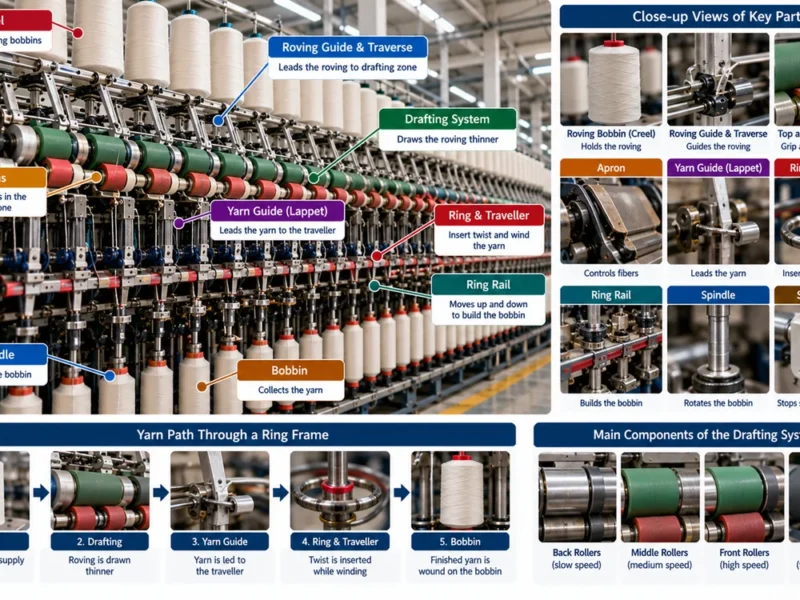
Long before the first factory, every thread in every piece of cloth was spun by hand. A person held a bundle of loose fibre, pulled out a few strands, gave them a twist and wound the new yarn onto a stick. The same basic act is still used today, in craft studios, villages and homes, and it is the root of every modern spinning machine. If you can understand hand spinning, you understand what a ring frame, a rotor machine and a card are trying to do at huge speed.
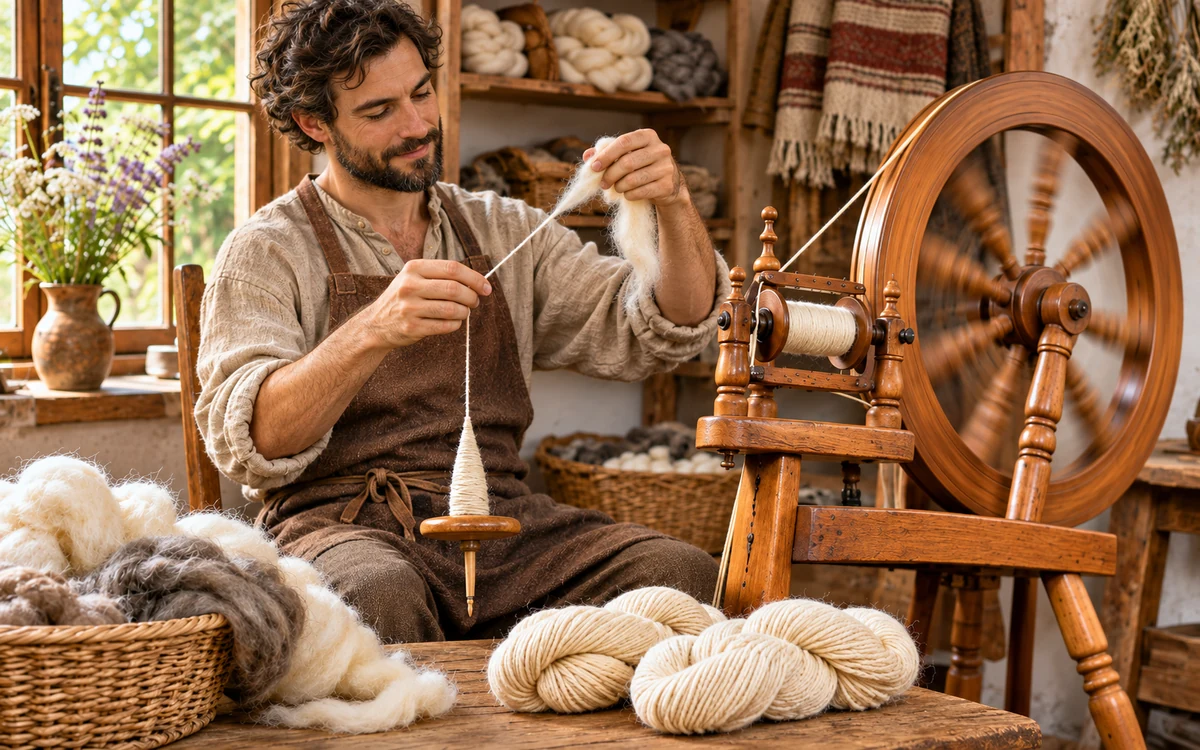
This guide explains what hand spinning is, the main tools (the drop spindle, the spinning wheel and the charkha), the steps from fibre to finished yarn, how twist is controlled, what fibres are easy to start with and how long it takes. There is a worked example that shows the twist and the output of a wheel in numbers. If you want the factory version of the story, our guide to making yarn from fibre follows the same stages on machines.
What is hand spinning?
Hand spinning is the craft of making yarn from loose fibres using only simple, hand-operated or foot-powered tools. It has two basic actions that happen together:
- Drafting. The fibres are pulled out and thinned to the width of yarn you want.
- Twisting. The drafted fibres are twisted so they lock together into a strong strand.
Then a third action, winding on, stores the new yarn. These three actions are the same in any spinning system, from a drop spindle to an air jet machine.
Why people still spin by hand
- Craft and creativity. Spinners make unique yarns, colours and textures that mills do not.
- Use of special fibres. Small lots of fleece, alpaca, silk or plant fibre can be turned into yarn without a factory.
- Heritage and livelihood. Hand spinning supports traditional textiles such as khadi in South Asia. The famous muslin of old Bengal depended on extremely fine hand-spun cotton yarn.
- Learning. For students of textiles, spinning by hand gives a feel for twist, fibre length and drafting that no book can match.
The main hand spinning tools
1. The drop spindle
A drop spindle is a stick (the shaft) with a weight (the whorl) near one end. You attach a bit of fibre to a leader yarn, set the spindle spinning like a top, let it hang from the yarn and draft the fibre with your hands as the twist travels up.
- Top-whorl spindle. The whorl sits at the top, with a hook. It spins quickly and is the easiest to start with.
- Bottom-whorl spindle. The whorl is at the bottom. It is stable and spins for a long time.
- Supported spindle. The tip rests in a bowl or on the ground. It is used for very fine yarns, including fine cotton.
Cost is very low, and the spindle is portable. The drawback is that you must stop to wind on the yarn.
2. The spinning wheel
A wheel makes the spinning faster and continuous. A large drive wheel, turned by a foot treadle, rotates a smaller flyer assembly through a drive band. The flyer twists the yarn and winds it onto a bobbin at the same time.
Common types:
- Great wheel (walking wheel). A very large wheel turned by hand. Used for wool, and the user walks back and forth as they spin.
- Saxony wheel. A treadle wheel with a horizontal layout and a flyer on one side.
- Castle and upright wheels. Compact versions with the flyer above the wheel.
- Double-drive wheel. A band goes around both the bobbin and the flyer for smooth action.
- Scotch tension wheel. A brake band holds back the bobbin, which gives control over how quickly the yarn is pulled on.
3. The charkha
The charkha is the traditional hand-turned spinning wheel of South Asia. It is a compact wheel with a spindle, driven by turning a handle. It became a symbol of self-reliance in the Indian independence movement and is still used for khadi yarn. A smaller box version, the portable charkha, spins cotton and other fibres on a table. Charkha spinners usually spin short-staple cotton from carded rolls (called slivers or punis).
4. Other tools
- Hand cards and combs. Prepare fibre before spinning. Cards give a fluffy, airy preparation, and combs give a smooth, aligned one.
- Niddy noddy or skein winder. Makes hanks of finished yarn.
- Lazy kate. Holds bobbins for plying.
- Distaff. A stick that holds the fibre in a loose bundle, used with a spindle.
The steps of hand spinning
Step 1: Choose and prepare the fibre
For beginners, medium wool such as corriedale or blends with a staple length of 8 to 12 cm is easiest. Fibre can be:
- Raw fleece. Needs washing and carding.
- Roving or top. Pre-prepared and ready to spin. Roving is loose and airy. Top is combed and smooth.
- Rolags and punis. Small rolls made on hand cards. They give a lofty yarn.
Our guide on wool processing from shearing to scouring explains how fleece is cleaned before spinning.
Step 2: Draft the fibre
Hold the fibre in one hand and pinch with the other. Pull your hands apart gradually so the fibres slide past each other and thin out. The pinch point controls where twist enters.
Two basic drafting methods:
- Short forward draft (woollen). The fibres are drawn out while twist enters, which gives a soft, airy yarn.
- Long backward draw (worsted). The fibre is pinched and drawn back, with twist held behind the pinch. The yarn is smooth and strong.
Step 3: Add twist
With a spindle, spin the shaft and let the twist travel up the drafted fibre. With a wheel, the flyer inserts twist as you feed the fibre. Always treadle in the same direction. Most spinners spin clockwise, which gives a Z twist. Our article on twist in yarn explains S and Z twist and the twist multiplier.
Step 4: Wind on
On a spindle, stop and wind the yarn around the shaft. On a wheel, the bobbin winds it for you.
Step 5: Ply (optional)
Two or more singles can be twisted together in the opposite direction. Plying balances the yarn so that it does not curl, and it makes it stronger and rounder.
Step 6: Set the twist
Wash the finished yarn in warm water, rinse, squeeze and hang it to dry, sometimes with a light weight. This relaxes the yarn and fixes the twist.
Which fibres are good for beginners?
| Fibre | Staple length | Ease for beginners | Notes |
|---|---|---|---|
| Medium wool (corriedale, romney) | 8 to 15 cm | Easy | Grippy, forgiving |
| Merino | 6 to 10 cm | Medium | Very fine and soft, slippery |
| Alpaca | 8 to 12 cm | Medium | Slippery, needs more twist |
| Silk (tops) | 10 to 15 cm | Harder | Slippery, lovely lustre |
| Cotton (carded) | 2 to 3 cm | Harder | Short staple, needs fine drafting and good twist |
| Flax (linen) | Long | Harder | Needs wet spinning, special prep |
| Jute and hemp | Variable | Harder | Coarse, needs wet or special handling |
Short fibres like cotton need more twist to hold together, as the shorter fibre has fewer contact points. For details on the fibre itself, see our guide to the properties of cotton.
Controlling twist and thickness
Two things decide the yarn:
- Thickness depends on how much you draft the fibre.
- Twist depends on how fast the flyer or spindle turns relative to how fast you feed the yarn.
If you feed fibre slowly while the wheel keeps turning, twist builds up and the yarn becomes hard and overtwisted. If you feed too quickly, the yarn is under-twisted and may drift apart.
Spinners often count wraps per inch (WPI), which is how many times the yarn wraps side by side around a ruler in one inch. A thinner yarn has more wraps per inch. Common ranges are about 30 for lace weight, 18 for fingering, 12 for DK and 8 or fewer for bulky. Treat these as rough guides.
A worked example: twist and output on a spinning wheel
Let us calculate the twist put into a yarn on a wheel and the time needed to spin enough yarn for a sweater. These are typical-style numbers chosen for the example.
Given
- Drive ratio (flyer turns per one wheel turn): 10 to 1
- Treadling speed: 60 wheel turns per minute
- Yarn delivery (how fast the yarn is drawn through your hands): 1.5 m per minute
- Finished yarn weight: DK, about 120 m per 50 g
Part 1: Twist
Step 1: Flyer speed.
10 × 60 = 600 turns per minute
Step 2: Turns per metre (TPM).
Twist = turns per minute ÷ metres drawn per minute = 600 ÷ 1.5 = 400 TPM
Step 3: Turns per inch (TPI).
TPI = TPM × 0.0254 = 400 × 0.0254 = 10.2 TPI
That is a moderate twist, suitable for a DK-weight yarn. If you wanted more twist, you could treadle faster, use a smaller whorl to speed up the flyer or draw the yarn more slowly. If you delivered 2.0 m per minute instead of 1.5, the twist would drop to 600 ÷ 2.0 = 300 TPM, or 7.6 TPI, giving a softer, looser yarn.
Part 2: Output
Step 4: Yarn per hour.
1.5 m/min × 60 = 90 m per hour
Step 5: Weight per metre.
120 m per 50 g means 50 ÷ 120 = 0.417 g per metre.
Step 6: Weight per hour.
90 × 0.417 = 37.5 g per hour
Step 7: Time for a sweater.
Suppose a medium sweater needs 600 g of yarn (this depends on style and size).
600 ÷ 37.5 = 16 hours of actual spinning, not counting fibre preparation, plying and finishing.
That puts a hand-spun sweater in context. A single person spinning at this pace makes only 90 m of yarn in an hour, and a modern ring frame spindle running at 16,000 rpm makes a similar length every few minutes. For the maths of machine spinning, see our worked examples in the article on twist in yarn. The tex of this DK yarn, from 50 g per 120 m, is 0.417 g/m × 1,000 = 417 tex, a thick yarn compared with the 20 tex cotton yarns used in T-shirts.
Hand spinning compared with machine spinning
| Point | Hand spinning | Machine spinning |
|---|---|---|
| Speed | About 90 m per hour per person (this example) | Many metres per minute per spindle |
| Yarn count | Usually thicker, can be very fine with skill | Wide range, very fine possible |
| Evenness | Variable, with character | Very even |
| Cost per kilo | High | Low |
| Fibre choice | Anything, even small lots | Needs bulk lots |
| Volume | Tiny | Huge |
| Typical use | Craft, heritage cloth | All commercial textiles |
For a look at how factories spin, see our overview of ring, rotor and air jet yarns.
Hand spinning and handloom weaving
Hand-spun yarn goes naturally into hand-woven cloth. In many parts of South Asia, village spinners and weavers still produce khadi and handloom textiles. Handloom fabrics prize the slightly uneven, textured surface of hand-spun yarn. Our guide to how a handloom works explains the weaving side.
Common beginner problems
| Problem | Likely cause | Fix |
|---|---|---|
| Yarn breaks | Too little twist or too much drafting | Slow down the draft, add twist |
| Yarn too tight and kinky | Too much twist | Feed faster, treadle slower |
| Lumpy, uneven yarn | Uneven drafting | Pre-draft the fibre, keep the draft steady |
| Fibres drift apart | Fibre too slippery or too short | Choose grippy wool, add more twist |
| Bobbin does not pull yarn on | Tension too low | Adjust brake or tension |
| Singles curl after removal | Not set | Wash and hang to dry, or ply |
Tips for starting
- Start with a cheap drop spindle and 100 g of medium wool roving.
- Practise drafting without twist before putting them together.
- Spin short lengths and wind on often.
- Keep a sample card of your yarn for reference.
- Learn to ply, because plied yarn is easier to knit and crochet.
- Join a spinning group or watch an experienced spinner. A few minutes of live demonstration is worth hours of reading.
If you plan to knit or crochet your yarn, our comparison of crochet vs knitting will help you choose a craft.
Final thoughts
Hand spinning is the original textile technology. It shows in the simplest way how loose fibres become a strong thread through drafting, twisting and winding on. The tools range from a stick with a weight to a treadle wheel or a charkha, but the principles stay the same, and they are the same ones that run inside every spinning mill.
If you work in textiles, try it once. If you want a craft, it is rewarding in its own right. Our worked example showed that a good wheel spinner makes about 90 metres of DK yarn an hour, and that a sweater means around 16 hours of spinning. That number alone helps you see why machines changed the world.
Frequently asked questions
Hand spinning is making yarn from loose fibre by hand, using a drop spindle, spinning wheel or charkha. It involves drafting the fibre, adding twist and winding the yarn on.
A top-whorl drop spindle is cheap, portable and easy to learn. A wheel is faster, but it costs more and takes time to set up.
Medium wool roving with a staple length of about 8 to 12 cm is easy to draft and grips well. Very slippery or very short fibres are harder.
It depends on the pace and the size of the sweater. In our example, spinning 600 g of DK yarn at 90 m per hour took about 16 hours.
Both are hand-operated wheels for spinning. The charkha is the traditional compact wheel of South Asia, typically used for cotton and khadi. European-style spinning wheels use a flyer and bobbin, often with a foot treadle.
They are the directions of the twist spiral. Most hand spinners spin clockwise, which gives a Z twist, and ply in the opposite direction, S, to balance the yarn.
Yes. Cotton has short fibres, so it needs fine drafting and enough twist. Many spinners use a supported spindle or a charkha for cotton.