
Crochet vs knitting is a question every new maker asks. Picture two people sitting side by side with the same ball of wool. One holds two long needles and moves loops from one to the other in a steady rhythm. The other holds a single small hook and pulls the yarn through one loop at a time. After an hour, both have a few rows of soft fabric. But the fabrics are not the same, and they will not behave the same when worn, washed or stretched.
So which should you pick? This guide sets out the differences clearly, whether you are choosing a new hobby or trying to understand the fabrics you buy and sell. You will learn what each craft is, how the tools and stitches differ, how the finished fabrics feel and stretch, how much yarn each one needs, how both relate to factory knitting and which one is easier to start. There is a worked yarn estimate for a scarf so you can see the difference in numbers. For the wider picture of fabric types, our guide to woven versus knit fabric is a helpful companion.
The short answer
Both crochet and knitting turn yarn into fabric by making loops that hold each other. The key difference is how the loops are kept.
- Knitting keeps many loops “live” (open) on a needle at the same time. Each new row is made by passing those loops through new ones, using two needles or a machine.
- Crochet works with only one live loop at a time, on a single hook. The hook pulls a new loop through the one it holds, and the stitches are built one by one.
Knitted fabric is generally thinner, smoother and stretchier, like a T-shirt or sweater. Crocheted fabric is generally thicker, denser and more textured, with less stretch, like a blanket or a lace doily. Crochet is often easier to start and to fix. Knitting is often faster for large, even areas of plain fabric.
What is knitting?
Knitting is the making of fabric by interlooping yarn. In hand knitting, you work with two needles. Stitches sit on the left needle, and you pull a new loop through each stitch with the right needle, creating a new row.
Two basic stitches make nearly all hand-knit patterns.
- Knit stitch. Forms a V shape on the front.
- Purl stitch. Forms a bump, which looks like a small horizontal bar.
Alternating these in rows or in the round makes stockinette (smooth V’s on one side), garter (ridges), rib (vertical stripes) and many more.
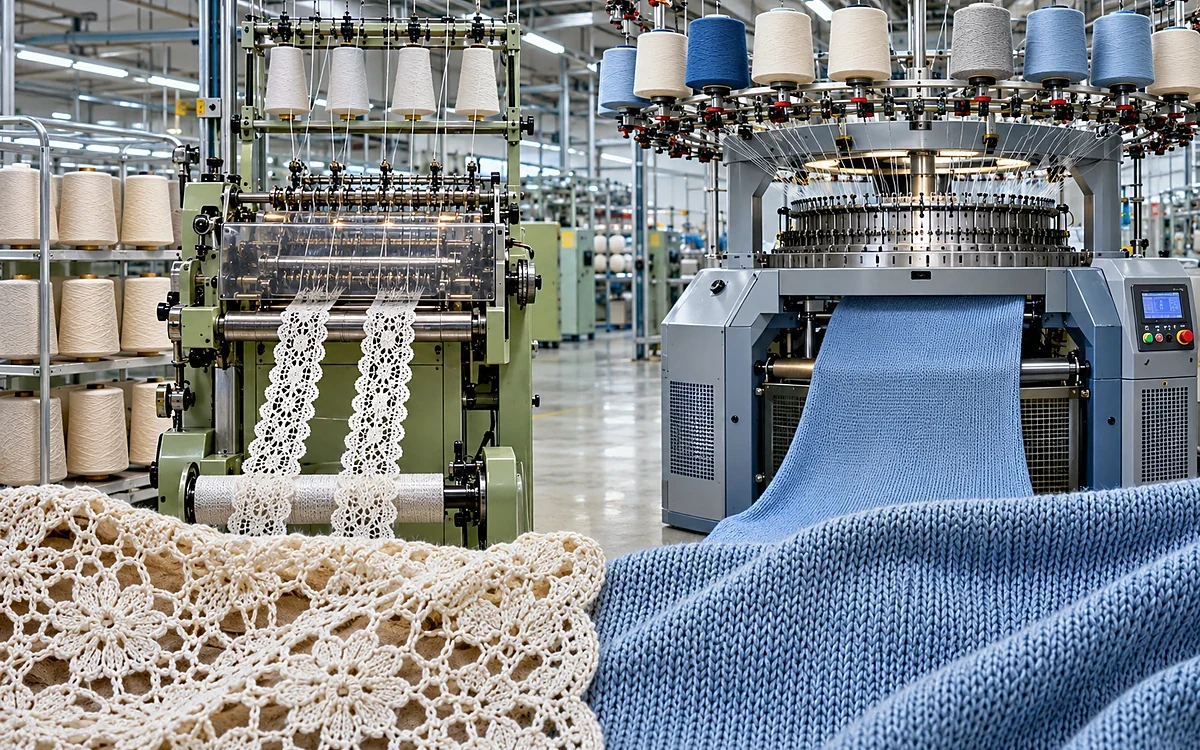
Knitting is also done by machine. In fact, almost all knitted clothes you buy, from T-shirts to socks, are knitted on machines. Weft knitting machines make loops across the fabric, and warp knitting machines make loops along its length. To see what the machine is made of, read our guide on the parts of a knitting machine.
What is crochet?
Crochet comes from a French word for “hook.” You work with one hook. Each stitch is made by wrapping the yarn over the hook and drawing it through one or more loops.
Basic stitches include:
- Chain stitch. The foundation, a row of linked loops.
- Slip stitch. Joins and finishes.
- Single crochet. A short, tight stitch.
- Double crochet. A taller stitch with a more open fabric.
- Treble crochet. Even taller, for lacy and light work.
Crochet is mostly a hand craft. There are industrial crochet machines, but they are used mainly for trims, lace and decorative edges and not for everyday clothing.
Side-by-side comparison
| Point | Knitting | Crochet |
|---|---|---|
| Tools | Two needles (or circular needles, or a machine) | One hook |
| Live loops | Many at once | One at a time |
| Basic stitches | Knit and purl | Chain, single, double, treble |
| Fabric feel | Smooth, flat, flexible | Thicker, bumpy, firm |
| Stretch | High, especially across rows | Low to medium |
| Drape | Soft and fluid | Stiffer, sculptural |
| Speed for plain fabric | Faster | Slower per row, but each stitch is bigger |
| Yarn use | Less | Often more |
| Mistakes | A dropped stitch can run down the fabric | Easier to undo and fix |
| Shaping | Increases and decreases | Easy to shape in any direction |
| Best for | Sweaters, socks, hats, scarves | Blankets, bags, toys, lace, appliqué |
| Industrial use | Almost all knitwear | Trims and lace |
How the fabrics behave
Stretch and recovery
Knitted fabric stretches well because each loop can open out and spring back, especially across the width. This makes it excellent for socks, caps and fitted tops. Crochet fabric stretches less, because the stitches are taller and held more firmly, so garments need to be shaped to fit.
Thickness and warmth
Crochet makes denser fabric with more yarn per square centimetre, so it feels thicker and can be warm for blankets and winter bags. Open crochet patterns can also be airy, as in summer tops and shawls. Knit fabric can be light and breathable or thick and cosy depending on yarn and needle size.
Drape
Knitting tends to drape softly. Crochet tends to hold its shape, which suits bags, baskets, toys and structured pieces.
Unravelling
If you cut or snag a knitted fabric, many loops can release in a chain, which makes a run or ladder. Crochet unravels as well if you pull the working loop, but a break in one stitch usually does not spread as far, because the stitches are linked in a different way.
A worked example: how much yarn for a scarf?
Beginners often ask which craft uses more yarn. In general, crochet uses more yarn for the same area, and the best way to know is to work a swatch and measure. Here is how you can estimate it. The yarn lengths below are assumed numbers for demonstration, using a medium-weight yarn and needles or a hook of matching size.
Given
- Scarf size: 20 cm wide × 150 cm long
- A 10 cm × 10 cm swatch in stockinette used 12 m of yarn
- A 10 cm × 10 cm swatch in double crochet used 16 m of yarn
- Yarn: 100 g balls with 200 m each, so 0.5 g per metre
Step 1: Area of the scarf in swatches.
Scarf area = 20 × 150 = 3,000 cm²
One swatch area = 10 × 10 = 100 cm²
Number of swatches = 3,000 ÷ 100 = 30
Step 2: Yarn length.
- Knitted: 30 × 12 = 360 m
- Crocheted: 30 × 16 = 480 m
Step 3: Yarn weight.
- Knitted: 360 × 0.5 = 180 g
- Crocheted: 480 × 0.5 = 240 g
Step 4: Number of balls.
- Knitted: 180 ÷ 100 = 1.8, so buy 2 balls
- Crocheted: 240 ÷ 100 = 2.4, so buy 3 balls
Step 5: Compare.
Crochet uses 480 ÷ 360 = 1.33 times the yarn, or about a third more, in this example. That fits the common advice that crochet takes more yarn, but the exact amount depends on the stitch pattern, the hook and needle size, the yarn thickness and your tension. A lace-style crochet pattern might use less than a dense knit pattern. Always swatch first and add a margin of 10 to 15 percent for safety.
For a more detailed view of how stitch size, yarn count and fabric weight connect in machine knitting, see our guide to knitting machine gauge and fabric GSM.
Gauge: the number that makes patterns fit
Both crafts use gauge, which is the number of stitches and rows in a set distance, usually 10 cm. Patterns assume a certain gauge. If your gauge is different, the finished item will be larger or smaller.
Example: A pattern says 20 stitches in 10 cm. You want a hat that is 50 cm around. Stitches needed = 20 × 50 ÷ 10 = 100 stitches. If your swatch gives only 18 stitches in 10 cm, you would make 18 × 50 ÷ 10 = 90 stitches for the same size, or use a smaller hook or needle to reach 20.
Check gauge after washing, because wool and cotton can change size.
Which is easier to learn?
Many people find crochet easier to begin with, for three reasons:
- You only need one tool.
- You have only one loop to manage, so mistakes are easy to see and fix.
- Basic stitches can be learned in an afternoon.
Knitting takes a little longer to feel natural, because you manage two needles and many loops. But once you have the rhythm, knitting is quick for large, plain areas such as sweaters and scarves. Both are learned through practice. If you already enjoy making things with your hands, either will feel rewarding.
Which is cheaper to start?
Both are low-cost. A crochet hook costs little, and a pair of knitting needles costs a bit more. Yarn is the main cost. Crochet may need more yarn per project, as shown above. Knitting needles in many sizes can add up, but circular needles with interchangeable tips cover many projects.
What can you make?
Better for knitting
- Sweaters, cardigans and fitted garments
- Socks and gloves
- Hats and beanies
- Plain scarves with good drape
Better for crochet
- Blankets and throws
- Bags, baskets and rugs
- Toys (amigurumi)
- Lace, doilies and shawls
- Flowers, appliqué and edging
Many makers combine them, for example a knitted sweater with a crocheted edge.
Colour and yarn choice
Both crafts use the same yarns, though some yarns suit one craft better. Smooth, round yarns show stitch definition well in both. Fluffy or textured yarns hide stitches and are easier in knitting for simple fabric, or in crochet for bulky projects. For ideas on choosing colours, see our guide to crochet yarn and colour theory. Fancy novelty yarns with loops and slubs can be tricky for beginners. Our article on fancy yarns shows what they are.
Hand craft and the textile industry
For a textile professional, the real link is between hand knitting and factory knitting. The loops in a hand-knitted sweater are the same as the loops in a T-shirt made on a circular knitting machine, only larger. Terms such as course (row), wale (column) and stitch length are used for both.
- Weft knitting. Loops are formed across the width, one row at a time. Hand knitting and most machine knitting of tubes, sweaters and socks are weft knitting.
- Warp knitting. Loops are formed along the length, with many yarns at once. Used for lace, tulle, mesh and technical fabrics.
- Crochet galloon machines. A type of warp knitting machine that makes crochet-like trims and laces.
If you are curious about faults that arise in knitted fabrics, our page on knitting defects, causes and remedies explains the common ones.
Common beginner mistakes
In knitting
- Casting on too tightly, which stops the fabric from stretching at the edge
- Dropping stitches and not noticing for several rows
- Twisting stitches by accident
- Changing tension from row to row
In crochet
- Working too tightly, which makes stiff fabric
- Miscounting the turning chain at the start of a row
- Adding or losing stitches at the edges
- Using the wrong hook size for the yarn
In both
- Skipping the gauge swatch
- Buying too little yarn from one dye lot
Final thoughts
In the end, crochet vs knitting is not a contest, because they make different fabrics for different jobs. Knitting uses many live loops and two needles, and it makes smooth, stretchy, flexible fabric. Crochet uses one live loop and a hook, and it makes denser, sturdier, more sculptural fabric. Our worked scarf example showed crochet using about a third more yarn than knitting for the same area, though real results vary with pattern and tension.
If you want to make clothes that fit like a T-shirt, start with knitting. If you want to make bags, blankets and toys, start with crochet. If you cannot decide, buy a hook and a medium-weight yarn, make a small square and see how it feels. Then try the needles.
Frequently asked questions
Knitting keeps many loops on needles at the same time and uses two needles. Crochet works one loop at a time with a single hook.
Most beginners find crochet easier at first because it needs one tool and one live loop. Knitting needs more coordination, but it becomes quick and rhythmic with practice.
Crochet usually uses more yarn for the same size of fabric, often by about a third, though it varies with stitch and tension. Always make a swatch to check.
Knitted fabric is stretchier, especially across the rows. Crochet is firmer and has less stretch unless it is worked in special stitches.
Not directly, because the stitches are different. Some designers make matching patterns for both, but you usually follow a pattern written for the craft you are using.
Some industrial machines make crochet-like trims and laces, but most crochet work is done by hand. Most knitted clothing is made by machine.
Knitting is better for fitted garments that need stretch, such as sweaters and socks. Crochet is better for structured items, accessories and home goods, though skilled makers use it for clothes too.


