Shorts are the everyday workhorse of warm weather. People wear them to the gym, the beach, the office on casual Fridays and around the house. They look simple, but they carry nearly all the parts of full-length trousers, packed into a smaller space. Learning the parts of shorts helps you read a size chart, talk to a tailor and spot poor workmanship.
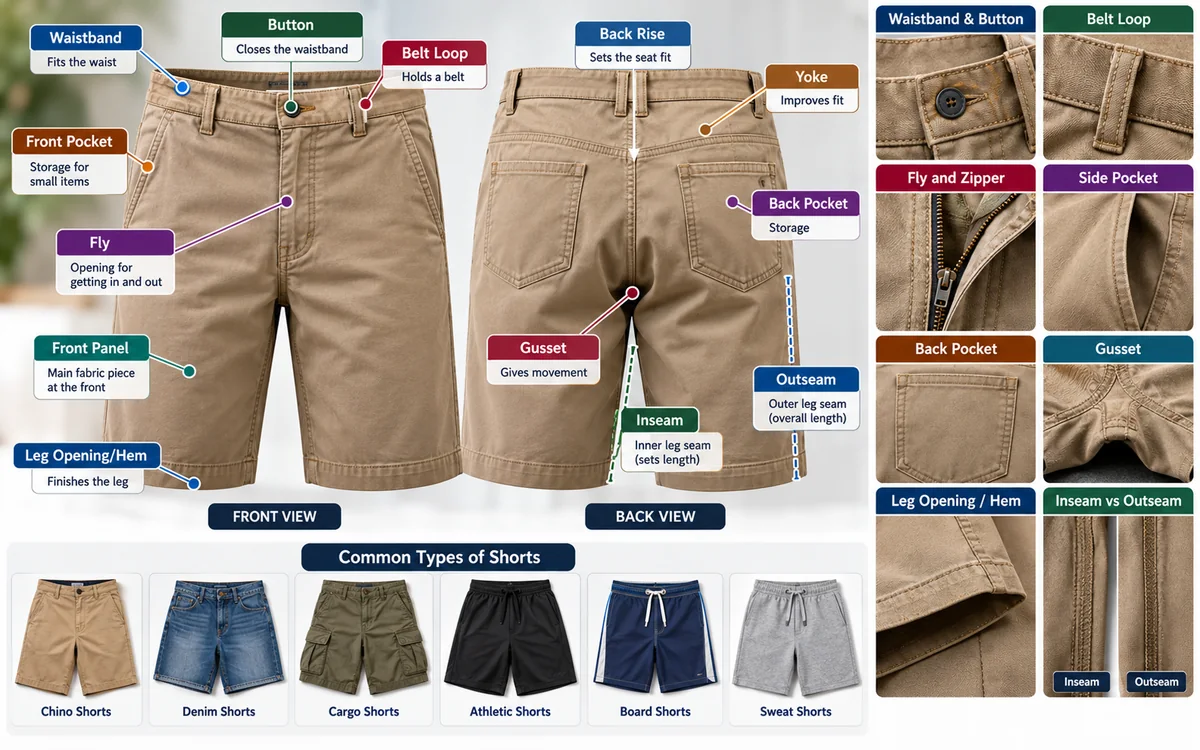
This guide goes through each part from the waist down. You will see what each one is called, what it does and what a good one looks like. If you already know trousers, our guide to the parts of a pant will feel familiar. The main change is that shorts end above the knee, so the leg is shorter and the details sit closer together.
What counts as shorts
Shorts are a lower-body garment that ends above the knee. The length varies a lot. Some shorts end high on the thigh. Others, like Bermuda shorts, finish just above the knee. Common types include:
- Chino shorts: Smart casual, in cotton twill.
- Denim shorts: Cut from jean fabric.
- Cargo shorts: Loose with large side pockets.
- Athletic shorts: Light, often with an elastic waist and a liner.
- Board shorts: Quick-drying shorts for swimming and surf.
- Bermuda shorts: Longer, tailored shorts that end near the knee.
- Sweat shorts: Soft knit shorts for lounging.
The parts below apply to most of these, and I point out where a type is different.
Parts of shorts at a glance
| Part | Location | Job |
|---|---|---|
| Waistband | Top | Fits the waist |
| Belt loops | Waistband | Hold a belt |
| Fly | Front center | Opening for getting in and out |
| Front rise | Front crotch seam height | Sets the fit at the waist |
| Back rise | Back crotch seam height | Sets the seat fit |
| Pockets | Sides and back | Storage |
| Inseam | Inner leg | Sets the length |
| Outseam | Outer leg | Overall length |
| Leg opening | Hem | Finishes the leg |
| Gusset | Crotch | Gives movement |
The waist area
Waistband
The waistband is the strip around the top. On woven shorts, it is stiff and has interfacing inside to stop it stretching. On athletic shorts, the band is elastic. Some shorts combine the two, with a flat front and an elastic back for comfort. A well-made waistband lies flat against the body and does not roll over.
Belt loops
Belt loops are small strips of fabric stitched to the waistband. Most shorts have five to seven of them. They are placed evenly around the waist, with extra loops near the back. The ends are reinforced by a bar tack, which is a short dense block of stitches. A missing bar tack means the loop will pull away.
Drawcord
Many sports and casual shorts have a drawcord that threads through the waist. It lets the wearer adjust the fit. The cord exits through two small eyelets at the front. The ends have small tips so they do not fray.
Button, snap and hook
On woven shorts, the waistband closes with a button or snap. A hook-and-bar is another option, which sits flat and holds well. Our guide on snap button pinch setting explains how snaps are checked.
The front
Fly
The fly is the opening at the front. On woven shorts it is usually a zip fly. A zipper runs down a front seam and is covered by a strip of fabric called the fly facing. On the outside, a line of stitching in the shape of a J, known as the J-stitch, holds the fly in place. Elastic-waist shorts often have no fly at all, or a fake one for looks.
Fly shield and extension
Behind the zipper, a small strip of fabric called the fly shield stops the zipper teeth from touching the skin. The fly extension is the piece on the other side that holds the button and buttonhole.
Zipper
Zips come in metal or plastic. Metal ones last longer on heavy fabric like denim. Plastic ones suit light fabrics. Read more in our guide to the different parts of a zipper.
Front rise
The front rise is the distance from the crotch seam up to the top of the waistband at the front. A high rise sits at or above the belly button. A mid rise sits just under. A low rise sits on the hips. The rise decides how the waist feels and where the fly sits.
Back rise
The back rise is the distance from the crotch seam up the back to the waistband. It is longer than the front rise. This gives room for the seat. If the back rise is too short, the waist pulls down when you sit.
Pockets
Pockets are one of the main differences between shorts styles.
- Slant pocket: Cut at an angle from the waistband to the side seam. Common on chino and tailored shorts. The angle makes it easy to reach into.
- Front scoop pocket: A curved pocket opening on jeans-style shorts.
- Side seam pocket: Hidden in the side seam. Common on athletic and sweat shorts.
- Back patch pocket: A square piece of fabric sewn onto the back.
- Back welt pocket: A slit with bound edges on the back, sometimes closed with a button.
- Cargo pocket: A large, bellows-style pocket on the outer thigh, sometimes with a flap.
- Coin pocket: A tiny extra pocket inside the main front pocket.
- Zip pocket: A pocket with a small zipper, common on sports and travel shorts.
Pocket corners get pulled every day, so factories add a bar tack at the top corners. Pocket bags, which are the fabric pouches behind the openings, should be made from a durable cotton or poly cotton, and should not twist or flip when the shorts are worn. For more on pocket construction, see our pocket guide for dress shirts.
The legs
Inseam
The inseam is the seam that runs along the inside of the leg, from the crotch to the hem. It is how most brands describe short length. A 5-inch inseam is short. A 7-inch inseam is mid-length. A 9 to 11-inch inseam is longer and ends near the knee.
Outseam
The outseam runs along the outside of the leg, from the waist to the hem. It is longer than the inseam because it includes the rise.
Thigh and leg opening
The thigh measurement is taken across the leg about an inch below the crotch. The leg opening is the width of the hem. A wide leg opening gives a relaxed look. A narrow one gives a slim, tailored look.
Crotch seam and gusset
The crotch seam joins the two legs at the center. It takes more strain than any other seam on the garment. On athletic shorts and workwear, a diamond-shaped gusset sits in the crotch. It spreads the stress and gives room to move. If a seam splits, it is often here.
Side seams
The side seams run down the outside of each leg. On some shorts, they are sewn with a double row of stitching for strength.
The hem
The hem is the finished edge of the leg opening. There are several kinds.
- Plain turned hem: The edge is turned under twice and stitched. The most common kind.
- Cuffed hem: Folded up and tacked, often used on chino and Bermuda shorts.
- Raw hem: Left cut on purpose, common on denim shorts.
- Vented hem: A small slit at the side seam, helps with movement.
- Elastic hem: Stretchy hem used on sweat shorts.
Liner and inner parts
Brief liner
Many athletic and swim shorts have a built-in brief or mesh liner. It replaces underwear and stops chafing. It is sewn into the waistband and leg openings. The liner should be soft, with flat seams to avoid rubbing.
Mesh lining
Board shorts often have a mesh inner layer. It lets water drain quickly.
Waistband lining
Some shorts add a soft fabric lining inside the waistband, so it feels comfortable against skin.
Care label and size label
Inside the waistband or side seam, you will find labels for size and care. Some brands print them on the fabric to avoid itching.
Fabric choices
The fabric shapes how each part works.
- Cotton twill: Strong and smart. Used for chino and cargo shorts.
- Denim: Hard-wearing and classic. Needs strong needles and thread. See our guide on what is denim.
- Polyester: Light and quick drying. Common for sports shorts.
- Nylon: Strong and light. Used in board shorts and outdoor shorts.
- Linen: Cool and airy, wrinkles easily.
- Fleece or terry: Soft and warm, used for sweat shorts.
- Spandex blends: Add stretch for comfort.
How shorts are made in a factory
The usual order for a pair of woven shorts is:
- Cutting: The front, back, pocket bags, waistband and loops are cut.
- Pocket making: The pockets are made and attached to the front panels.
- Fly: The zip and fly are set.
- Back pockets: Back patch pockets are attached.
- Seams: The side seams and inseams are sewn.
- Crotch: The crotch seam is joined.
- Waistband and loops: The band and loops are attached.
- Buttonhole and button: The buttonhole and button are added.
- Hem: The leg openings are hemmed.
- Finishing: The shorts are trimmed, pressed and folded.
If you want to see how these steps are timed in a factory, read our operation breakdown and SMV of a cargo short pant and the one for a chino short pant.
Common faults
- Twisted legs: The seams spiral after washing. The fabric was cut off grain.
- Wavy waistband: The band was stretched while sewing.
- Pocket bag showing: The bag is longer than the opening and flips out.
- Fly puckering: The zip tape is too tight or the fly facing is too short.
- Uneven leg length: One leg is longer than the other.
- Crotch seam split: The stitch is too weak or the fabric is too stretched.
- Loose belt loops: Missing or weak bar tacks.
- Shrinkage: The shorts get shorter in the wash.
You can find more about how factories solve these problems in our guide on sewing defects and root causes.
Quick checklist for buyers
- Check the inseam against your preferred length.
- Squat down in the fitting room. The waist should not slip and the seam should not pull.
- Pull on the pocket corners. They should not rip.
- Check the fly. The zipper should run smoothly.
- Look for a gusset on athletic styles.
- Wash a test pair if possible. See how much they shrink.
Final thoughts
The parts of shorts are the same as trousers, but they sit in a smaller space and face the same strain. The waistband holds the shape, the fly opens the front, the pockets handle storage, the inseam sets the length and the crotch seam holds everything together. Before you buy, check the waistband, the pocket corners, the crotch seam and the hem. These places show you in a minute whether the shorts were built well.
Frequently asked questions
The main parts are the waistband, belt loops, fly, pockets, rise, inseam, outseam, crotch seam and hem. Athletic shorts often have a liner and a drawcord.
The inseam is the length of the seam on the inside of the leg, from the crotch to the hem. It is the measurement most brands use to describe how short a pair of shorts is.
The rise is the distance from the crotch seam to the top of the waistband. A high rise sits near the belly button. A low rise sits on the hips.
Bermuda shorts are longer and usually end just above the knee. They are often tailored and made of chino or linen.
The liner works like underwear. It reduces chafing and keeps you comfortable, especially for running and swimming.
A gusset is a diamond-shaped piece of fabric sewn into the crotch. It reduces stress on the seam and gives more room for movement.
Cotton twill, linen and light polyester are common choices. They are breathable and dry quickly.