A blazer looks simple on a hanger. Two sleeves, a collar, a few buttons. But once you start talking to a tailor or a pattern maker, the words fly fast. Gorge, break point, canvas, top collar, gusset. If you do not know the parts of a blazer, those words sound like a secret language.
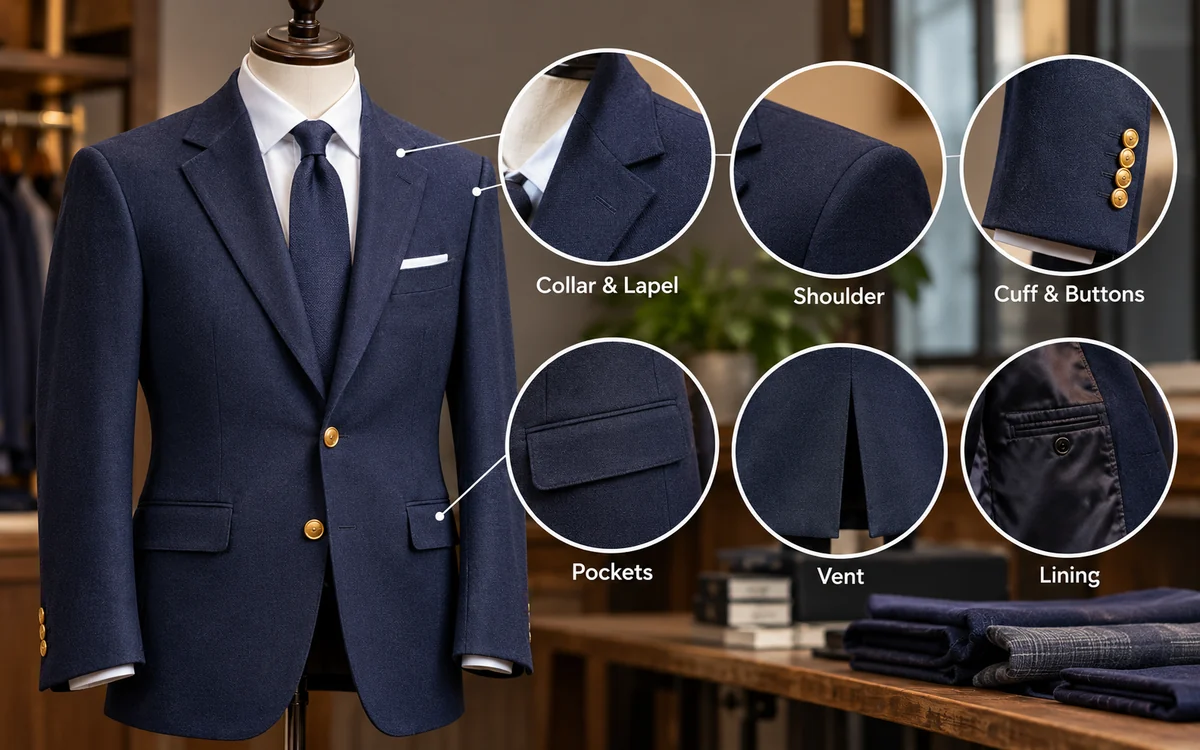
This guide explains each part in plain words. You will learn where it sits, what it does and what a good one looks like. It is written for shoppers, students and garment staff who want to read a blazer the way a tailor does. If you have already read our guide to the parts of a jacket, you will notice many parts repeat. The blazer simply adds more tailoring on top.
Blazer, jacket and sport coat
People use these words loosely, so let us fix them first. A jacket is the wide word for any short coat. A blazer is a structured jacket that traditionally comes in a solid color, often navy, with metal buttons. A sport coat is similar but is usually made from textured fabric like tweed, and it was first made for outdoor sport. Today the lines have blurred. Most stores call any tailored, single-piece jacket a blazer.
What sets a blazer apart is its structure. It has a lapel, a lining, shaped panels and often a layer of canvas or fusing inside. That structure is why a blazer holds its shape while a hoodie does not.
Parts of a blazer at a glance
| Part | Location | Job |
|---|---|---|
| Top collar | Outer collar | Shows the collar shape |
| Under collar | Inner collar | Supports the top collar |
| Lapel | Front fold | Frames the chest |
| Gorge | Seam where collar meets lapel | Sets the look of the neckline |
| Chest piece | Inside the chest | Adds shape |
| Front panel | Chest and belly | Main body |
| Shoulder | Top of the arm | Sets width |
| Sleeve | Over the arm | Movement and style |
| Cuff and buttons | Sleeve end | Finish |
| Pockets | Front and inside | Storage and looks |
| Vent | Back hem | Allows sitting |
| Lining | Inside | Comfort |
| Hem | Bottom edge | Sets length |
The collar and lapel area
The neck area makes the biggest first impression, so tailors spend a lot of time on it.
Top collar and under collar
A blazer collar has two layers. The top collar is the outer layer that you see. The under collar sits underneath it. The under collar is often made from a special felt-like cloth so that it can be shaped into a smooth curve. The top collar is cut a little larger so it can wrap around the felt without pulling.
If a blazer collar sticks out from the neck at the back, the cause is often a poorly shaped under collar. A good collar hugs the neck and folds neatly over the shirt collar beneath it.
Lapel
The lapel is the flap at the front, just below the collar. It is a folded-back part of the front panel. There are three common shapes:
- Notch lapel: The most common. A small notch separates the collar from the lapel.
- Peak lapel: The lapel points up toward the shoulder. It looks sharper and more formal.
- Shawl lapel: A smooth, rounded lapel with no notch. It is common on dinner jackets.
Lapel width also changes the look. A wide lapel feels classic. A narrow lapel feels modern and slim. As a rule, the lapel should be in balance with the rest of the blazer. A wide lapel on a small chest can look odd.
Gorge
The gorge is the seam where the collar meets the lapel. It sits right under the chin and is one of the most noticed lines on the blazer. A high gorge gives a classic, upright look. A low gorge looks relaxed and modern. The seam must be sharp and straight. A wavy gorge line is a quick sign of low-quality work.
Roll line and break point
The roll line is the soft fold where the lapel turns back. A good tailor lets the lapel roll naturally. A cheaper blazer may press the lapel flat and fuse it, which produces a harder look. The break point is the spot where the lapel first begins to fold. It sits near the top button. If the jacket is buttoned, this point decides how the lapels fall.
Front of the blazer
Front panels and darts
The front panels cover your chest and belly. Two vertical darts, usually from the chest pocket area down toward the waist, give shape. A front dart is a slim fold sewn out of the fabric so the jacket nips in at the waist. Without darts, the blazer would hang straight like a box.
Chest piece and canvas
Behind the front fabric sits the secret of a good blazer. There are three common constructions:
- Fully canvassed: A woven canvas, made from cloth that may include hair or cotton threads, is hand stitched to the front. It molds to your body over time. This is the most expensive kind.
- Half canvassed: Canvas extends through the chest and lapels, and the lower front is fused.
- Fused: A fusible interlining is bonded to the fabric with heat and pressure. It is lighter, cheaper and faster to make. It can also bubble over time if the glue fails.
Most ready-made blazers are fused or half canvassed. If you want to learn how fusing is checked in a factory, read our guide to the fusing process and quality inspection.
Blazers are built in two styles. A single-breasted blazer has one column of buttons and the front edges meet in the middle. A double-breasted blazer has two columns, and one side wraps over the other. Single-breasted blazers usually have one, two or three buttons. The two-button style is the most popular.
The button stance means where the buttons sit. The top button of a two-button blazer normally lines up near the natural waist, around the belly button. A stance that is too high shortens the torso. A stance that is too low makes the legs look short. To learn more about the buttons themselves, see our guide on different types of buttons for clothes.
Buttonholes
Blazer buttonholes are made on a special machine or by hand. A keyhole buttonhole has a round end that gives the shank room. A straight buttonhole is more common on shirts. On expensive blazers, the buttonhole on the lapel is a real working one, called a boutonniere. It is made for a flower stem.
Shoulders and sleeves
Shoulder and shoulder pad
The shoulder is where the blazer rests on your body. If the shoulder seam sits past the edge of your shoulder bone, the blazer feels too big and the sleeves hang low. If it sits inside the bone, the jacket pulls. A thin shoulder pad is usually added to give a clean line. Soft Italian styles often use a very light pad or none at all. British styles use a more structured pad.
Armhole
The armhole is the opening for the sleeve. It affects both comfort and look. A high, small armhole fits more snugly and lets you lift your arm without the whole jacket rising. A low, large armhole feels loose but restricts lifting. Many people buy a blazer that is too wide in the armhole because it feels easy to put on, and they pay for it in the way the jacket looks.
Sleeve, sleeve head and sleeve length
A blazer sleeve is usually cut in two pieces, an upper and an under sleeve. This follows the bend of the arm. The top of the sleeve, called the sleeve head, is eased into the armhole. This means the fabric is a little larger than the opening, and the operator spreads the extra length evenly.
Sleeve length is easy to check. With your arms relaxed, the blazer sleeve should end near the wrist bone, showing about a half inch of shirt cuff. A sleeve that covers the whole cuff looks too long.
Blazer cuffs are plain, with no fold. They usually have three or four buttons. On cheaper blazers, the buttons are sewn on top of a closed sleeve and are only for show. On better ones, the sleeve really opens and the buttons work. This is called a working cuff, or surgeon’s cuff. Tailors also leave the last button undone on purpose for style.
Pockets
Pockets on a blazer are small design features and also have a practical job.
- Flap pocket: A pocket with a flap on top. This is the standard choice.
- Jetted pocket: A slim slit with no flap. It looks neat and is common on formal jackets.
- Patch pocket: A piece of fabric sewn on the outside. It looks casual.
- Ticket pocket: A small extra pocket above the right-hand main pocket. It was first used for rail tickets.
- Chest pocket: A narrow pocket on the left chest, used for a pocket square.
- Inside pockets: Pockets in the lining for a phone or wallet.
Pockets must lie flat and sit level on both sides. A pocket that rides up on one side is a common fault. Pocket corners should be reinforced with stitching so they do not tear. Our pocket guide for dress shirts shows common pocket constructions.
Back, vents and hem
Back panel and center back seam
The back is cut in two pieces, joined at the center back seam. The seam helps shape the jacket to the spine. Along the sides, side body panels give more shape.
Vents
A vent is a slit at the bottom of the back. It helps you sit, reach and put your hands in your pockets without pulling the fabric. There are three types:
- Single vent: One slit in the center. Common in American styles.
- Double vent: Two slits at the sides. Common in British styles and often considered more flattering.
- No vent: A clean back with no slit. Common in Italian formal styles.
Hem
The hem is the bottom edge of the blazer. A good blazer length covers the seat of your trousers. A rough way to check is to let your arms hang at your sides. The hem should meet your curled fingers.
Inside the blazer
Lining
The lining is a thin layer of fabric inside. It hides the seams, makes the jacket glide over a shirt and adds a bit of comfort. Common lining fabrics are viscose, cupro and polyester. Cupro breathes better. Polyester is cheaper and hardwearing.
A blazer can be fully lined, half lined or unlined. A half-lined blazer is lined only in the upper back and sleeves. It is cooler and lighter, so it suits hot weather. An unlined blazer is very light and gives you a relaxed look.
Interlining and padding
Interlining is a layer between the shell and the lining. In a blazer, it may be canvas, fusible fabric or a thin wadding. It decides how stiff the jacket feels.
Facings
The facing is the inside strip along the front edge. It supports the buttons and buttonholes. It is sewn to the lining at a neat seam.
Labels
A blazer carries a brand label, a size label and a care label. On many blazers, the sleeve also has a label that must be removed after purchase. The care label shows how to wash the jacket, and for many blazers it will say dry clean.
What a factory looks at when making a blazer
A blazer has many operations. In large factories, an operation breakdown can list more than 100 steps, from preparing the collar to pressing the finished jacket. The areas that cause the most rejections are usually the same few.
- Collar and lapel: The collar must be symmetrical and the lapel roll must be even.
- Sleeve setting: Wrinkles in the sleeve head are a common fault.
- Pocket placement: Left and right pockets should match in height and angle.
- Fusing: Bubbles and shine on the surface are signs of poor fusing.
- Pressing: A blazer that is over pressed can look shiny. One that is under pressed looks tired.
- Lining fit: The lining should have a small pleat of ease so it does not pull the shell.
To see how long each blazer operation takes, read our operation breakdown, SMV and layout for blazer manufacturing.
Quick fit checklist for buyers
You do not need to be a tailor to check a blazer. Try these simple tests.
- Shoulder test: The seam should sit at the edge of your shoulder bone.
- Collar test: The collar should rest against your neck with no gap.
- Button test: Fasten the top button. The jacket should close without a tight X-shaped crease.
- Arm test: Raise your arms. The jacket should rise only a little.
- Sleeve test: Show about half an inch of shirt cuff.
- Length test: The hem should cover your seat.
- Stitch test: Look inside for loose threads, uneven stitches and untidy lining seams.
Tailoring terms you may hear
- Drape: The way fabric hangs from the shoulders.
- Waist suppression: How much the blazer narrows at the waist.
- Quarter: The panel of fabric on the side of the jacket.
- Skirt: The part of the blazer below the waist.
- Top button: The first fastening button on the front.
- Pick stitching: Tiny hand stitches along the lapel edge for decoration.
- Break: The way the lapel folds at the top button.
Final thoughts
Once you know the parts of a blazer, shopping and tailoring talk get much easier. You can tell the shop what feels wrong, and you can see which parts decide quality. Look at the collar, the shoulder, the sleeve head and the lapel roll first. If those four are clean, the rest of the blazer is usually in good shape.
Frequently asked questions
The main parts are the collar, lapel, gorge, shoulders, sleeves, cuffs, front panels, buttons, pockets, vent, lining and hem. Better blazers also have a chest piece and canvas inside.
The gorge is the seam where the collar meets the lapel. It sits close to the chin. Its height changes how formal the blazer looks.
A suit jacket is sold with matching trousers and made from the same fabric. A blazer is meant to be worn alone with different trousers. Blazers often have metal buttons and come in solid colors.
A vent is a slit at the bottom of the back. It gives room to sit and move. Single, double and no-vent styles are all common.
Working buttons come from custom tailoring, where the sleeve can be opened and rolled. Ready-made blazers usually have buttons sewn on for looks.
It means a woven canvas layer is sewn into the front of the blazer by stitching, not glue. It lets the blazer mold to your body and usually lasts longer than a fused one.
The shoulder seam should end at the edge of your shoulder. The fabric should lie flat with no dimples or wrinkles.