
Look closely at a checked shirt, a striped sweater or a pair of jeans. The pattern comes from yarns that were coloured before the cloth was made. That is the idea behind yarn dyeing. Instead of dyeing the finished fabric, the mill dyes the yarn first, then weaves or knits it. The result is a cloth where colour runs through the structure, so stripes, checks and mixed shades are possible.
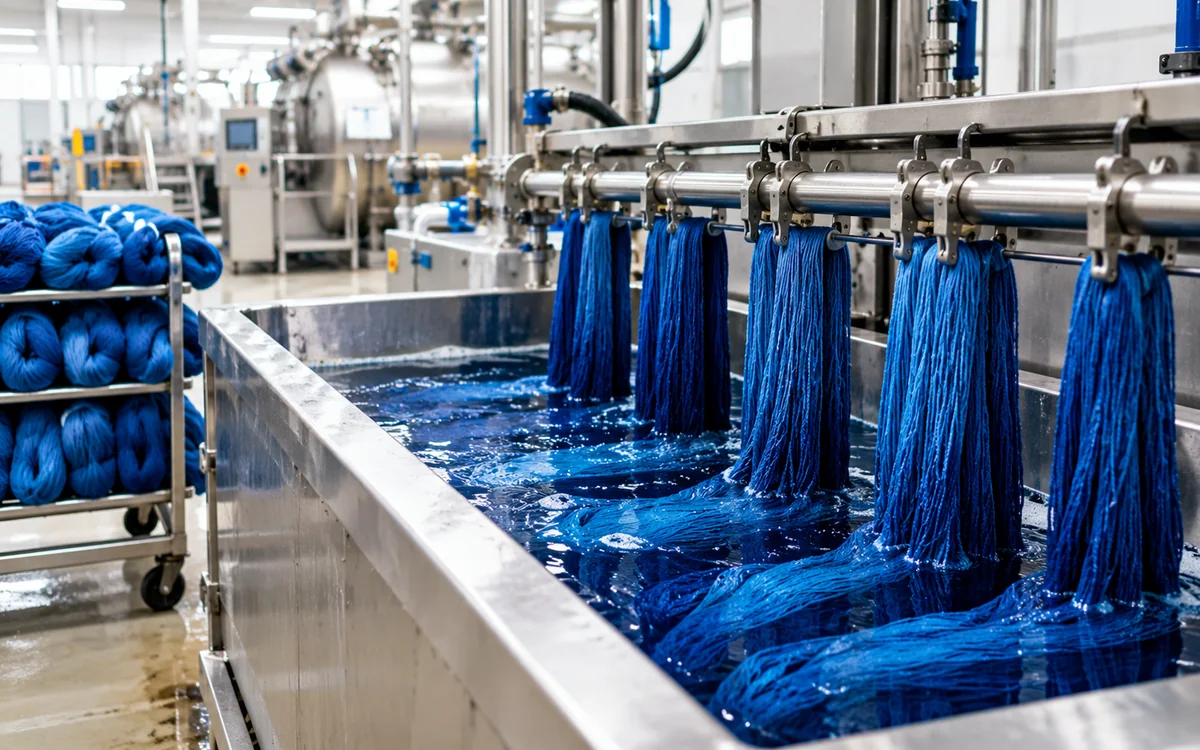
This guide explains yarn dyeing in plain words. It covers why mills choose it, the main methods, the machines, the steps of a typical process and a worked reactive dye recipe with real quantities. It also lists common faults and a simple way to pick the right method. For dye classes, see our guide on the classification of dyes, and for the wider process, our guide on dyeing process stages and methods.
What is yarn dyeing
Yarn dyeing is the process of colouring yarn in the form of hanks, cones (packages), beams or loose fibre before it is woven or knitted. Fabric made this way is called yarn-dyed fabric. Fabric dyed after weaving or knitting is called piece-dyed.
Yarn dyeing is not the same as dyeing the fibre in the raw state (stock dyeing), though both are done before the fabric stage. Fibre dyeing happens before spinning. Yarn dyeing happens after.
Why dye yarn instead of fabric
- Patterns. Stripes, checks, plaids and jacquards need yarns of different colours.
- Colour depth. Dye can reach the centre of the yarn, which gives a rich look.
- Melange and heather looks. Mixing dyed and undyed fibre or yarn gives soft mixed shades.
- Colour fastness. Properly dyed yarn can have better wash and rubbing fastness, since dye is inside the structure.
- Small lots. Yarn can be dyed in small lots and woven or knitted later.
- Quality look. Yarn-dyed shirts and suits are often seen as higher quality.
The trade-offs are higher cost, longer lead time, more stock held in colours and more planning. Piece dyeing is more flexible, because you can dye the fabric last, close to the order.
Forms of yarn for dyeing
| Form | Description | Common use |
|---|---|---|
| Loose stock (fibre) | Loose fibre before spinning | Melange yarns, wool |
| Top (sliver) | Combed wool or fibre ropes | Worsted wool |
| Package (cone or cheese) | Yarn wound on a perforated tube | Most cotton and synthetic yarns |
| Hank (skein) | Yarn loosely wound in loops | Bulky, soft yarns, wool, carpet |
| Beam | Warp yarn wound on a perforated beam | Warp for woven fabric |
| Rope or sheet (denim) | Warp yarns in rope or sheet form | Indigo denim |
| Space-dyed | Yarn coloured in repeated spots | Fancy knit yarns |
| Spun-dyed (dope-dyed) | Colour added to the polymer before spinning | Synthetic yarn for fast colours |
Main methods of yarn dyeing
1. Package dyeing
Yarn is wound on perforated tubes or springs, called cones or cheeses, in a soft, even density. The packages are loaded on spindles in a dye vessel. The dye liquor is pumped through the yarn. The flow is alternately out to in and in to out. It is the most common method for cotton, polyester and blends in knitting and weaving. Packages must be wound with even density so the liquor passes evenly.
- Good for medium to large lots
- Low liquor ratio, around 1:5 to 1:10 in modern machines
- Needs good winding quality
- Risk of dye differences between the inside and outside of the package if the density varies
2. Hank dyeing
Yarn is wound into loose hanks, hung on sticks or carriers and moved in the dye bath. It is gentle on the yarn and keeps the bulk. Used for wool, acrylic bulky yarn, hand-knitting yarns and carpet yarn. The yarn needs to be wound into hanks first, and later wound back onto cones, which adds cost.
- Good for bulky and delicate yarns
- Higher liquor ratio, around 1:15 to 1:20
- More labour
- Excellent levelness and softness
3. Beam dyeing
Warp yarn is wound on a perforated beam, and the dye liquor is forced through it. Used for warp yarns, mostly for woven fabrics that need solid colour in the warp, and sometimes for fine fabrics. It is less common today.
4. Rope and sheet dyeing (indigo denim)
For denim, the warp yarns are dyed in rope form or in sheet form, passing through a series of dye baths and air oxidation stages. Indigo stays mostly at the surface of the yarn, so the centre stays white. This is why jeans fade with wear. Rope dyeing and slasher dyeing are the two main systems.
5. Loose stock and top dyeing
Fibre is dyed before spinning in a stock dyeing machine or a top dyeing machine. This allows blends of different colours to be spun into melange yarn. It is standard for wool and for fancy yarns.
6. Space dyeing
Colour is applied in spots or bands along the yarn, in a repeat pattern, by printing or dipping. Used for fancy knit yarns and craft yarn.
7. Spun dyeing (dope dyeing)
Pigments are added into the polymer melt or solution before the yarn is spun, so the colour is part of the fibre. It gives excellent fastness, uses very little water and is used for polyester, nylon and viscose. The shade range is fixed at the spinning stage, so it suits large, repeat colours.
Machines used for yarn dyeing
| Machine | What it does | Typical capacity per batch |
|---|---|---|
| Vertical package dyeing machine | Packages on spindles in a vertical pressure vessel | From 20 to several hundred kg |
| Horizontal package dyeing machine | Same idea, in a horizontal vessel | Hundreds of kg |
| High-temperature (HT) package machine | Pressurised, used for polyester at around 130 degrees Celsius | Similar |
| Hank dyeing machine | Hanks hung on carriers, liquor circulated or hanks moved | 10 to 500 kg |
| Beam dyeing machine | Perforated beam in a pressure vessel | 100 kg and more |
| Rope dyeing range (denim) | Series of dye boxes, washing and oxidation | Large, continuous |
| Slasher dyeing range | Sheet of warp yarns dyed and sized in one line | Large, continuous |
| Stock dyeing machine | Loose fibre in a perforated basket | Hundreds of kg |
| Winding machines | Make packages with uniform density | Before dyeing |
| Hydro extractor | Spins out water after dyeing | After dyeing |
| Package dryer (RF or hot air) | Dries packages evenly | After extraction |
For how dye house machinery fits together, see our dyeing and finishing machinery guide and our guide on dyeing machine capacity planning.
Steps in package dyeing of cotton yarn
- Winding. Yarn is wound onto perforated tubes at the right density, often in the range of 0.30 to 0.40 g/cm³ for cotton cheeses, depending on the machine.
- Loading. Packages are placed on the spindles with pressing and spacing as per the machine.
- Scouring and bleaching. Impurities are removed so dye can enter. See our guide on the scouring process.
- Dyeing. Dye, salt and alkali are added in stages. Reactive dyes are common for cotton. See the guide to reactive, disperse and vat dye selection.
- Washing off and soaping. Unfixed dye is removed with hot rinses and a soaping agent.
- Neutralising and after-treatment. Acid is used to neutralise alkali. Fixing agent or softener may be added.
- Hydro extraction. Water is spun out of the packages.
- Drying. Packages are dried evenly.
- Checking. Shade, fastness and yarn quality are checked before delivery.
Worked example: reactive dyeing of 100 kg of cotton yarn
A mill dyes 100 kg of 30s cotton yarn in packages to a medium shade with a hot-brand reactive dye. Numbers are a typical starting recipe, to be confirmed by lab dips.
- Liquor ratio: 1:8
- Reactive dye: 2.0 percent owf
- Glauber’s salt (sodium sulfate): 60 g/L
- Soda ash: 20 g/L
- Wetting agent and sequestering agent: 1 g/L each
Quantities
- Water = 100 × 8 = 800 litres
- Dye = 100 × 0.02 = 2.0 kg
- Salt = 800 × 60 = 48,000 g = 48 kg
- Soda ash = 800 × 20 = 16,000 g = 16 kg
- Wetting agent = 0.8 kg and sequestering agent = 0.8 kg
Packages and spindles
- Package weight: 1.2 kg
- Packages = 100 ÷ 1.2 = 83.3, so 84 packages
- If one spindle takes 12 packages, spindles = 84 ÷ 12 = 7
- Actual yarn weight = 84 × 1.2 = 100.8 kg
Time
- Heat from 30 to 60 degrees at 1.5 degrees per minute = 20 minutes
- Salt addition and circulation: 15 minutes
- Soda ash addition: 20 minutes
- Fixation at 60 degrees: 60 minutes
- Washing off, soaping and neutralising: about 90 minutes
- Total cycle: about 205 minutes, or roughly 3.4 hours, plus loading and unloading
Cost of chemicals (illustrative)
If dye costs 12 dollars per kg, salt 0.25, soda ash 0.35 and auxiliaries 2.0 per kg:
- Dye = 2.0 × 12 = 24.00
- Salt = 48 × 0.25 = 12.00
- Soda ash = 16 × 0.35 = 5.60
- Auxiliaries = 1.6 × 2.0 = 3.20
- Total = 44.80 dollars, or 0.448 dollars per kg of yarn
Water, steam, power and labour are on top. Using a lower liquor ratio cuts water and salt, which often have the biggest effect on cost. Our guide on liquor ratio and dyeing cost shows how.
Dyes used for yarn dyeing
| Fibre | Common dye class |
|---|---|
| Cotton, viscose, linen | Reactive, direct, vat, sulphur |
| Polyester | Disperse |
| Nylon, wool, silk | Acid, metal-complex. See acid dyes |
| Acrylic | Basic (cationic) |
| Denim warp | Indigo (vat), sulphur |
| Blends | Two-bath or one-bath methods with matching dyes |
Quality factors in yarn dyeing
- Winding density. Uneven density gives uneven dyeing.
- Water quality. Hardness and iron change shades.
- Pretreatment. Poor scouring causes patches.
- Liquor flow. Reversal time and pump pressure matter.
- Dye selection. Dyes of similar behaviour mix well.
- Process control. Temperature rise, chemical dosing and time need strict control.
- Shade matching. Use a spectrophotometer and a set tolerance.
- Fastness. Test wash, rubbing, perspiration and light fastness. See our guide on colour fastness tests.
Common faults and fixes
| Fault | Cause | Fix |
|---|---|---|
| Inside-outside difference on a package | Uneven density or poor flow | Fix winding, adjust flow direction and pump pressure |
| Shade variation between batches | Variation in water, chemicals or yarn | Standardise recipe, test each lot |
| Patchy dyeing | Poor scouring, quick dye addition | Improve preparation, add dye slowly |
| Channelling in packages | Loose spots in the package | Wind more evenly |
| Poor rubbing fastness | Unfixed dye left on the surface | Wash off and soap well |
| Yarn damage | High temperature or strong chemicals | Adjust recipe and temperature |
| Hard packages after drying | Over-drying or high temperature | Dry carefully, use softener |
| Dye specks | Undissolved dye | Dissolve fully and strain |
| Lot-to-lot cone shade difference | Mixed yarn lots | Keep lots separate |
| Barre in knits | Yarn count variation | Check yarn quality before dyeing |
Yarn-dyed fabric versus piece-dyed fabric
| Point | Yarn-dyed | Piece-dyed |
|---|---|---|
| When dyed | Before weaving or knitting | After weaving or knitting |
| Patterns | Stripes, checks, jacquards | Solid shades, then print |
| Lead time | Longer | Shorter |
| Minimum order | Higher per colour | Lower |
| Colour depth | Deep, through the yarn | Surface to depth depends on process |
| Flexibility | Low, committed to colours early | High, decide late |
| Cost | Higher | Lower |
| Typical products | Shirting, flannel, suiting, denim | T-shirts, plain trousers, sheets |
How to choose a yarn dyeing method
- Cotton or polyester yarn for knitting or weaving: package dyeing.
- Bulky, soft or wool yarn: hank dyeing.
- Denim warp: rope or slasher dyeing.
- Melange or heather yarn: stock or top dyeing, then spinning.
- Large volumes of a single synthetic colour: consider spun dyeing.
- Fancy knitting yarn: space dyeing.
- Short lead time and many colours: consider piece dyeing instead.
Think about volume, colour changes, yarn type, quality target and the cost of water and energy. A trial lot is cheaper than a failed order.
Final thoughts
Yarn dyeing gives fabrics with rich colour and patterns that fabric dyeing cannot match. The key to good results is even winding, good preparation, a tested recipe and tight process control. Choose the method that fits your yarn, your order size and your lead time, and run a trial before you commit. With these habits, mills can produce colour that stays true through many washes.
Frequently asked questions
It is the process of colouring yarn before it is woven or knitted into fabric.
The main methods are package, hank, beam, rope or sheet, loose stock, top and space dyeing, plus spun dyeing at the fibre stage.
It involves extra steps, longer lead time, more stock handling and higher minimum order quantities.
Reactive dyes are the most common. Direct, vat and sulphur dyes are also used.
It is a method where yarn wound on perforated cones is loaded into a vessel and dye liquor is pumped through it.
Yarn dyeing colours the yarn before the fabric is made. Fabric dyeing colours the finished cloth.
It is when colour is added to the polymer before the yarn is spun. The colour is part of the fibre and has very high fastness.