
Linen shirts, kitchen towels and summer bedsheets all start in a field of tall plants with small blue flowers. The plant is flax, and its stem gives us flax fiber, one of the oldest textile fibres known. People have used it for thousands of years. Today it is valued for its coolness, strength and natural look.
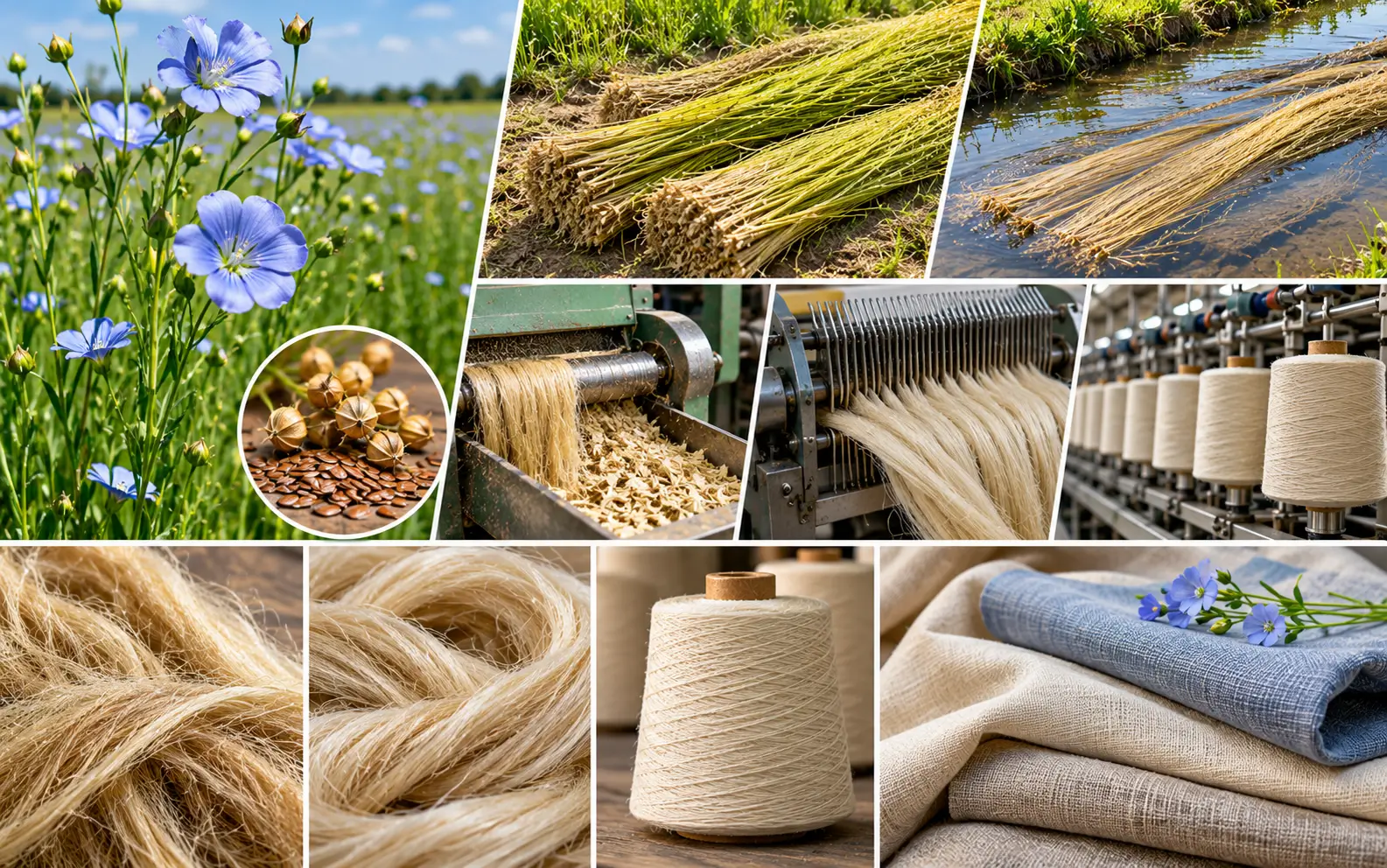
This guide explains what flax fiber is, how it grows and how it becomes linen yarn and cloth. You will see the key properties in a table, the steps of processing, a worked example of yield from straw to fabric, and the uses, limits and care tips. For a wider view of fibre families, see our guides on the classification of textile fibres and the properties of textile fibres.
What is flax fiber
Flax fiber is a natural cellulose fibre taken from the stem of the flax plant, Linum usitatissimum. It is a bast fibre, which means it comes from the inner bark layer of the stem, not from the seed or the leaf. Other bast fibres include jute and ramie. Cloth made from flax fibre is called linen.
The same plant has two main crop types. One is grown for fibre, with tall straight stems. The other is grown for seed, which gives linseed oil and flaxseed for food, and is shorter and more branched. This article is about the fibre type.
The flax plant and how it grows
Fibre flax is a cool-climate crop. It grows best where there is moderate rain, mild temperatures and fertile, well-drained soil. The plant reaches about 80 to 120 cm in roughly 100 days from sowing. It is sown densely, so the stems grow tall and straight with few branches. Farmers rotate it with other crops, often leaving a gap of several years before flax is grown in the same field again, to keep disease low.
Western Europe, especially France, Belgium and the Netherlands, is known for growing a large share of the world’s spinning-quality flax. China, Russia, Belarus and Egypt also grow it. Figures change from year to year, so check current trade statistics if you need exact numbers.
Unlike cotton, flax is pulled from the ground by the roots, not cut. This keeps the full length of the fibre in the stem.
Structure of the flax stem
A flax stem has several layers. From the outside to the inside:
- Epidermis and cuticle. The thin outer skin.
- Cortex (bark) with fibre bundles. This is the layer that holds the useful fibre.
- Woody core (shive). The hard centre of the stem.
- Hollow centre. A small channel in the middle.
The fibre bundles, called technical fibres, are made of many shorter ultimate fibres glued together by pectin. A technical fibre can be as long as 60 to 100 cm or more. An ultimate fibre is only about 20 to 40 mm long. The pectin must be loosened so the bundles can be separated from the woody core. That is the job of retting.
Processing flax fibre: from field to yarn
Step 1: Harvesting
When the plant turns yellow and the lower leaves drop, farmers pull it up and lay it in rows in the field. Pulling keeps the fibre long.
Step 2: Rippling (deseeding)
The seed capsules, called bolls, are removed by running the stems through combs. The seed can be sold for oil or sowing.
Step 3: Retting
Retting is a controlled rotting that loosens the pectin glue. The common methods are:
| Method | How it works | Notes |
|---|---|---|
| Dew retting | Stems lie in the field for several weeks. Moisture and microbes do the work | Common in Europe, low cost, depends on weather |
| Water retting | Stems are soaked in tanks or pits | Gives good fibre but pollutes water and is strictly limited in many places |
| Enzyme retting | Pectin-breaking enzymes are applied in controlled conditions | Quicker and more even, costs more |
| Chemical retting | Chemicals soften the gum | Less common |
Over-retting weakens the fibre. Under-retting leaves the fibre hard to separate. Both lower the price.
Step 4: Drying and baling
After retting the straw is dried to a safe moisture level, then rolled or baled for storage.
Step 5: Breaking and scutching
The dry straw is passed between fluted rollers to crush the woody core. Then rotating blades beat the crushed stems to scrape away the broken wood, called shive. What is left are long, clean bundles. This stage is also called scutching. The short fibres that fall out in the process are called tow.
Step 6: Hackling
The scutched fibre is combed through rows of steel pins to separate the fibres, remove short pieces and align the long ones. Long, combed fibre is called line flax. The short waste is hackling tow. Line flax is used for fine yarn. Tow is used for coarser yarn, paper or composites.
Step 7: Spinning
Flax can be spun in two ways.
- Wet spinning is the method for fine linen yarn. The roving is passed through warm water just before drawing, which softens the pectin and lets the fibres slide, so a very fine and smooth yarn can be made.
- Dry spinning is used for tow and for coarse yarns. The yarn is hairier and thicker.
Linen yarn count is often shown in lea. One lea count means 300 yards per pound of yarn. A higher number means a finer yarn.
Step 8: Weaving or knitting
The yarn is woven into plain and twill fabrics, or knitted for lighter wear. Warping and sizing are the same as for other staple yarns. See our guide on the warping machine for how warp beams are prepared.
Step 9: Finishing
Linen is bleached or dyed, washed and sometimes softened. Many linen fabrics are “washed” or “enzyme-washed” to make them soft and to pre-shrink them. Others are finished crisp for tablecloths.
Properties of flax fiber
| Property | Typical value or description |
|---|---|
| Composition | About 70 to 80 percent cellulose, with hemicellulose, pectin and lignin |
| Fibre type | Bast, natural, cellulosic |
| Technical fibre length | Often 60 to 100 cm after processing |
| Ultimate fibre length | About 20 to 40 mm |
| Colour | Cream to grey-brown, can be bleached |
| Lustre | Natural soft sheen |
| Density | About 1.5 g/cm³ |
| Tenacity | High, stronger than cotton, and gets stronger when wet |
| Elongation at break | Low, about 2 to 3 percent |
| Elasticity | Poor, creases easily |
| Moisture regain | About 12 percent (standard), can absorb much more without feeling wet |
| Thermal conductivity | High, feels cool on the skin |
| Resistance to moths | Good |
| Resistance to mildew | Poor if left damp |
| Effect of sunlight | Fair, prolonged exposure weakens it |
| Effect of heat | Takes high ironing temperatures |
| Effect of alkali | Good resistance |
| Effect of acid | Damaged by strong acids |
| Static | Low |
Values vary with the variety, growth and processing. Treat the numbers as typical ranges, not fixed limits.
Why linen feels cool
Flax fibre conducts heat well and absorbs moisture quickly. It draws sweat from the skin and lets it evaporate from the surface. The yarn is also uneven, with slubs that leave small air gaps in the fabric. These features make linen a favourite for hot weather. Cotton is also soft and absorbent. Read our page on the properties of cotton for a comparison.
Worked example: from straw to linen fabric
The figures below are illustrative. Real yields change with the crop, the retting and the mill. They show how to think about the chain.
A mill starts with 10,000 kg of retted, dried flax straw.
Step 1: scutching
- Assume total scutched fibre is 22 percent of straw weight
- Scutched fibre = 10,000 × 0.22 = 2,200 kg
- The rest is shive, dust and seeds
Step 2: sorting into line and tow
- Assume 60 percent of the scutched fibre is long line fibre
- Line = 2,200 × 0.60 = 1,320 kg
- Tow = 2,200 × 0.40 = 880 kg
Step 3: hackling the line
- Assume 75 percent of the line fibre stays as combed line flax
- Combed line = 1,320 × 0.75 = 990 kg
- The other 330 kg joins the tow
Step 4: spinning
- Assume spinning waste of 10 percent
- Yarn from line = 990 × 0.90 = 891 kg
Yield from straw to yarn (line only)
- 891 ÷ 10,000 × 100 = 8.9 percent
So less than nine kilograms of fine linen yarn come from every hundred kilograms of straw, if only line flax is used. That is why fine linen costs more than cotton.
Step 5: fabric
- A linen shirting of 150 GSM and 1.4 metres wide weighs 0.150 × 1.4 = 0.21 kg per linear metre
- Assume 5 percent loss in weaving and finishing. Usable yarn = 891 × 0.95 = 846.5 kg
- Fabric length = 846.5 ÷ 0.21 = about 4,031 metres
Yarn count example
A linen yarn of 40 lea means 40 × 300 = 12,000 yards per pound. To compare with cotton, divide by 840 yards per pound:
- Equivalent Ne = 12,000 ÷ 840 = 14.3
- Tex = 1,653.5 ÷ 40 = 41.3
So 40 lea is roughly like a 14s cotton yarn in thickness. For more on counts, see our guide on yarn count calculation.
Uses of flax fiber
Clothing: shirts, dresses, trousers, jackets, suits and summer wear.
Home textiles: bedsheets, duvet covers, tablecloths, napkins, curtains and kitchen towels. See our guide to linen bedding sets.
Industrial uses: canvas, sailcloth, fire hoses, thread, rope, and backing for floor coverings.
Composites: flax fibre mixed with resin makes light panels for cars, sports gear and furniture.
Paper: linen rags and tow go into high-quality paper, such as banknote and cigarette paper.
Other products: flaxseed oil (linseed oil) is used in paint and varnish. The seed is also eaten. These come from the plant, not from the fibre.
Advantages of flax fiber
- Strong and long lasting, and gets stronger when wet
- Absorbs moisture and dries fast
- Cool and comfortable in hot weather
- Natural look with a soft sheen
- Does not pill and low static
- Grows with less water and fewer pesticides than cotton in many regions, though this varies by farm and place
- Biodegradable
- Gets softer with each wash
Limitations of flax fiber
- Wrinkles easily because of low elasticity
- Higher cost than cotton for the same weight
- Can feel stiff when new
- Weak at folds and creases, which can wear through
- Shrinks if not pre-washed
- Can mildew if stored damp
- Limited dye shades compared with synthetics, though it takes many dyes well
- Retting needs care to protect water and rivers
Flax compared with other fibres
| Fibre | Strength | Feel | Wrinkling | Cost |
|---|---|---|---|---|
| Flax (linen) | High | Cool, crisp | High | Medium to high |
| Cotton | Medium | Soft | Medium | Low to medium |
| Ramie | High | Silky, stiff | High | Medium |
| Hemp | High | Rough to soft | High | Medium |
| Jute | Medium | Coarse | Medium | Low |
| Polyester | High | Smooth | Low | Low |
Care of linen
- Wash in cool or warm water with mild detergent. Linen is strong, but heat shrinks it.
- Use a gentle cycle. Do not overload the drum.
- Avoid chlorine bleach.
- Dry in the shade or on low heat. Take it out while slightly damp.
- Iron while damp at a high setting, or steam it.
- Fold along different lines each time, to avoid wear at a single crease.
- Store in a dry place with air around it.
Our guide on how to prevent clothes from shrinking gives more tips for natural fibre.
Sustainability notes
Flax is often described as a low-impact crop because it needs little irrigation in suitable climates and few inputs. Water retting can harm rivers, so many regions limit it and use dew retting or enzymes instead. Growing, processing and transport still have effects, so claims should be backed by data from the supplier. Ask for certification and traceability when you buy for a brand.
Final thoughts
Flax fiber turns a tall field plant into one of the strongest and coolest natural fabrics. The long steps of retting, scutching, hackling and wet spinning explain the price and the character of linen. If you design, buy or sell linen, learn the process, ask for clear specifications and care for the fabric well. It will repay you with years of wear.
Frequently asked questions
It is a natural fibre from the stem of the flax plant. It is used to make linen.
Flax is the plant and the raw fibre. Linen is the yarn and fabric made from flax fibre.
Only a small share of the plant becomes fine yarn, and the growing, retting and spinning take time and skill. Fine line flax is also in limited supply.
Yes. Flax is generally stronger than cotton, and it gains strength when wet.
Flax has low elasticity, so folds stay in the fabric. Blending with cotton or viscose reduces wrinkling.
Yes. It absorbs moisture, dries fast and conducts heat away from the skin.
It is a controlled rotting process that loosens the pectin glue between the fibre bundles and the woody core of the stem.


