Look at the label inside your jacket, your sports shirt or your carpet. There is a good chance it lists one of the types of synthetic fibres. Polyester, nylon, acrylic and elastane sit in a huge share of the clothes and home goods people buy. They are made in factories from chemicals, not grown on a farm or taken from an animal.
This guide explains what synthetic fibres are, how they are made, the main types and what each one does best. It also covers the difference between synthetic and man-made fibres, a simple worked example on moisture regain and the pros and cons. For the bigger picture of fibre groups, see our guides on the classification of textile fiber and the different types of textile fibers.
What are synthetic fibres
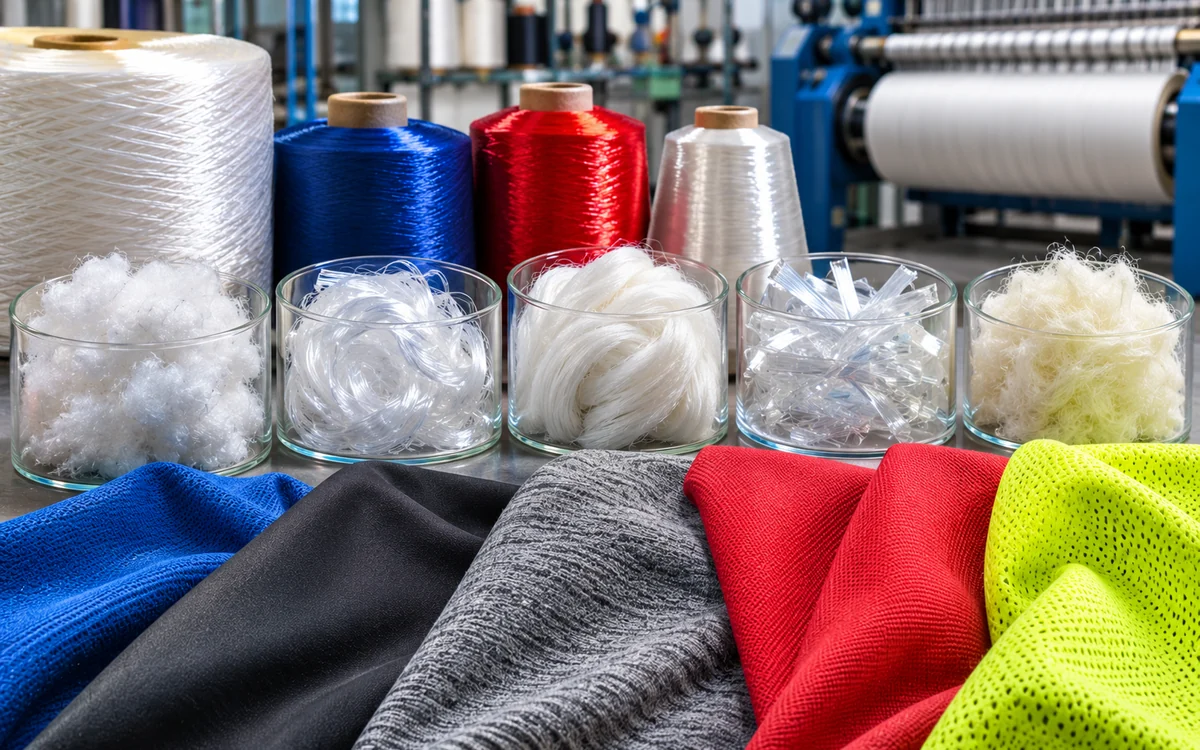
Synthetic fibres are fibres made entirely from chemicals, usually from petroleum or natural gas. Chemists build long chain molecules called polymers. The polymer is melted or dissolved, then pushed through tiny holes in a metal plate called a spinneret. The thin streams harden into continuous filaments. These filaments can be used as they are, or cut into short pieces called staple and spun like cotton.
Because the process is under human control, makers can change the thickness, shine, strength and shape of the fibre. They can make it round, trilobal, hollow or flat. They can add colour while the polymer is still liquid, which is called dope dyeing or solution dyeing.
Synthetic vs man-made fibres
People often mix these terms up.
- Man-made fibres is the wider group. It means any fibre made in a factory, not found as a fibre in nature.
- Regenerated fibres are man-made fibres built from natural material, mostly plant cellulose. Viscose, modal, lyocell and acetate are examples.
- Synthetic fibres are man-made fibres built from chemicals, not from natural cellulose or protein. Polyester and nylon are examples.
So all synthetic fibres are man-made, but not all man-made fibres are synthetic. Viscose is man-made but not synthetic, because it starts from wood pulp.
How synthetic fibres are made
Most synthetic fibres follow one of three spinning methods.
- Melt spinning: The polymer is melted and pushed through the spinneret. The strands cool and harden in air. Polyester, nylon and polypropylene use this.
- Dry spinning: The polymer is dissolved in a solvent and extruded into warm air. The solvent evaporates and leaves the solid fibre. Acetate and some acrylic and elastane use this.
- Wet spinning: The polymer solution is pushed into a liquid bath that makes it solid. Many acrylic fibres are made this way.
After spinning, the filaments are drawn, which means stretched. Drawing lines up the polymer chains and makes the fibre stronger. Fibres can be heat set so they hold their shape.
The main types of synthetic fibres
1. Polyester
Polyester is the most widely used synthetic fibre. It is strong, light, wrinkle resistant and easy to wash. It dries quickly and holds its shape, so it is a staple in shirts, sportswear, uniforms, bedding, curtains and filling. It is often blended with cotton. The downsides are low moisture absorption, static build-up and a tendency to hold odour. Our guide on polyester fibre goes deeper.
2. Nylon (polyamide)
Nylon was one of the first fully synthetic fibres. It is very strong and elastic, and it resists abrasion better than most fibres. Uses include stockings, activewear, swimwear, bags, ropes, parachutes, carpets and tyre cord. It absorbs more moisture than polyester but still much less than cotton. Common types are nylon 6 and nylon 6,6. See our guide to nylon fibre.
3. Acrylic
Acrylic is soft, light and warm, and it feels like wool. It is used for sweaters, blankets, socks and faux fur. It resists sunlight and moths well. It pills easily and can melt under a hot iron. See our guide to acrylic fibre.
4. Polypropylene (olefin)
Polypropylene is the lightest common fibre. It floats on water and does not absorb moisture, so it moves sweat away from the skin. It is used in thermal underwear, carpets, ropes, filters, sacks and geotextiles. It melts at a low temperature, so it cannot be ironed hot, and it is hard to dye unless colour is added during spinning.
5. Elastane (spandex, Lycra)
Elastane can stretch several times its length and snap back. It is rarely used alone. Mills add a small amount, often 2 to 10 percent, to cotton, polyester or nylon to make stretch jeans, leggings, sportswear and underwear. It can yellow and weaken under heat and chlorine.
6. Aramid
Aramid fibres such as Kevlar and Nomex are very strong and resist heat. Uses include bulletproof vests, fire-fighter suits, racing gear and cables. They are expensive and used for protection, not everyday fashion. Our guide on glass fibre and high-performance fibres covers these in more detail.
7. Polyurethane and PU coated fabrics
Polyurethane is used as a coating or foam on fabric, and in some elastic fibres. It gives faux leather, waterproof layers and stretch films.
8. Other synthetic fibres
- Modacrylic: Flame resistant, used in faux fur and protective wear.
- Vinylon (PVA): Used in industrial products and some water-soluble yarns.
- PTFE and fluoropolymer fibres: Used in filters and membranes.
- PLA: A fibre made from plant starch. It is made by chemical processing, so people call it bio-based, but it is still a synthetic polymer.
Properties compared
| Fibre | Strength | Moisture absorption | Feel | Wrinkle | Best for |
|---|---|---|---|---|---|
| Polyester | High | Very low | Smooth to crisp | Resists | Shirts, sportswear, home |
| Nylon | Very high | Low to moderate | Smooth, silky | Resists | Hosiery, activewear, bags |
| Acrylic | Moderate | Low | Soft, wool-like | Resists | Sweaters, blankets |
| Polypropylene | High | Near zero | Waxy | Resists | Thermal wear, carpets |
| Elastane | Moderate | Low | Stretchy | Resists | Stretch blends |
| Aramid | Extremely high | Low | Stiff | Resists | Protective gear |
A worked example: moisture regain and billing weight
Fibres absorb water from the air. This is measured as moisture regain, the water weight as a percentage of the dry weight. Traders use standard regain values to agree on a commercial weight. The common values are roughly: cotton 8.5 percent, nylon 4.5 percent, acrylic 2 percent and polyester 0.4 percent. These are widely used standard figures, but buyers and contracts can set their own.
Commercial weight = dry weight × (1 + regain %)
Say a spinner buys 1,000 kg of dry fibre.
- Cotton: 1,000 × 1.085 = 1,085 kg
- Nylon: 1,000 × 1.045 = 1,045 kg
- Acrylic: 1,000 × 1.02 = 1,020 kg
- Polyester: 1,000 × 1.004 = 1,004 kg
So the same dry weight is billed at different invoice weights. The reverse also holds. If a lot is invoiced at 1,085 kg of cotton, the dry fibre is 1,085 ÷ 1.085 = 1,000 kg. Regain also explains why cotton feels comfortable on the skin and polyester can feel clammy in heat. Polyester holds so little water that it dries very quickly.
Filament and staple forms
Synthetic fibre comes in two forms. Filament is a continuous strand that can be many kilometers long. It is used smooth in satin-like fabrics, linings, sportswear and ropes, or textured to look bulkier. Staple is filament cut into short lengths, usually 38 to 100 mm, so it can be spun on cotton or wool machines. Staple gives a drier, more natural feel and is the form used in blends. Knowing which form you are buying matters, because the same polymer can give very different cloth.
Choosing a synthetic fibre
| If you need | Look at |
|---|---|
| Easy-care shirts and uniforms | Polyester or a cotton blend |
| Hard-wearing socks, hosiery, bags | Nylon |
| A soft, warm knit that is cheap to wash | Acrylic |
| Light thermal underwear or carpets | Polypropylene |
| Comfort stretch in jeans or leggings | Elastane in a blend |
| Protective or cut-resistant gear | Aramid |
A buyer should also ask for the denier or dtex, the cross-section and any finishes. Two polyester fabrics with the same fibre name can feel and perform differently.
Where synthetic fibres are used
- Apparel: Sportswear, outerwear, hosiery, uniforms, underwear and swimwear.
- Home textiles: Carpets, curtains, upholstery, bedding and pillow fill.
- Industrial: Tyre cord, conveyor belts, filters, ropes, nets and sails.
- Medical: Masks, gowns, sutures and bandages.
- Construction and farming: Geotextiles, shade nets and roofing membranes.
Advantages of synthetic fibres
- They are strong and durable.
- They dry fast and wash easily.
- They resist wrinkles, shrinking and moths.
- They are cheaper than many natural fibres at scale.
- Makers can tune shape, shine, stretch and strength.
- They can be produced all year, with no weather risk to the crop.
- They blend well with natural fibres.
Disadvantages of synthetic fibres
- They come mostly from fossil fuels and use energy to make.
- They do not break down easily in nature.
- Washing releases tiny plastic fibres called microfibres into water.
- Low moisture absorption can make them feel hot and sticky.
- They build up static and attract oil, which can hold odour.
- They melt rather than char under high heat.
- They can pill, especially in blends.
Some brands now use recycled polyester or nylon made from bottles, nets and waste textiles. Recycled fibres reduce the use of new oil, but they still shed microfibres, so it is best to avoid absolute claims.
Blends
Blending combines the best of each fibre. A cotton and polyester blend keeps the comfort of cotton and adds the strength and easy care of polyester. Wool and acrylic blends make warm, cheaper knits. Nylon adds durability to socks. Our guide on why blended fibers are so popular explains the logic.
How to identify synthetic fibres
Simple tests help in a mill or shop, but they are rough.
- Burn test: Polyester melts and burns with a black smoke and a hard bead. Nylon melts and smells like celery or sweet chemicals. Acrylic burns with a hard, black lump. Use only a tiny sample and take care.
- Feel test: Synthetic fabrics often feel smooth and slightly slick, though microfibres can feel very soft.
- Label: The care label gives the fibre content by law in many countries.
- Lab test: For exact content, use a lab test with chemical solubility or infrared analysis.
Care tips for synthetic fabrics
- Wash at the temperature on the label. High heat can set wrinkles.
- Use a low heat setting in the dryer or line dry.
- Use a mesh wash bag or a microfibre filter to reduce shedding.
- Avoid high iron heat on acrylic, nylon and polypropylene.
- Treat oily stains early, because synthetic fibres hold oil.
Final thoughts
The types of synthetic fibres are many, but a few do most of the work. Polyester brings strength and easy care. Nylon brings toughness and stretch. Acrylic brings soft warmth. Polypropylene brings light weight, and elastane brings stretch. Match the fibre to the job, check the blend, and remember the trade-offs in comfort and environment. With a clear view of each type, you can buy and design smarter.
Frequently asked questions
Synthetic fibres are fibres made entirely from chemicals, mostly from petroleum. Polyester, nylon, acrylic and elastane are common examples.
The main types are polyester, nylon, acrylic, polypropylene, elastane and aramid. Others include modacrylic, vinylon and PLA.
Man-made fibres include all fibres made in factories. Synthetic fibres are a part of this group made from chemicals. Viscose is man-made but not synthetic, because it comes from wood pulp.
Aramid fibres are the strongest in common use. Among everyday fibres, nylon is the strongest.
They use fossil fuels, do not break down easily and shed microfibres when washed. Recycled versions and better filters help, but they do not remove these issues.
Yes. Polyester is the most widely used synthetic fibre.
They dry quickly, resist wear and can move sweat away from the skin.