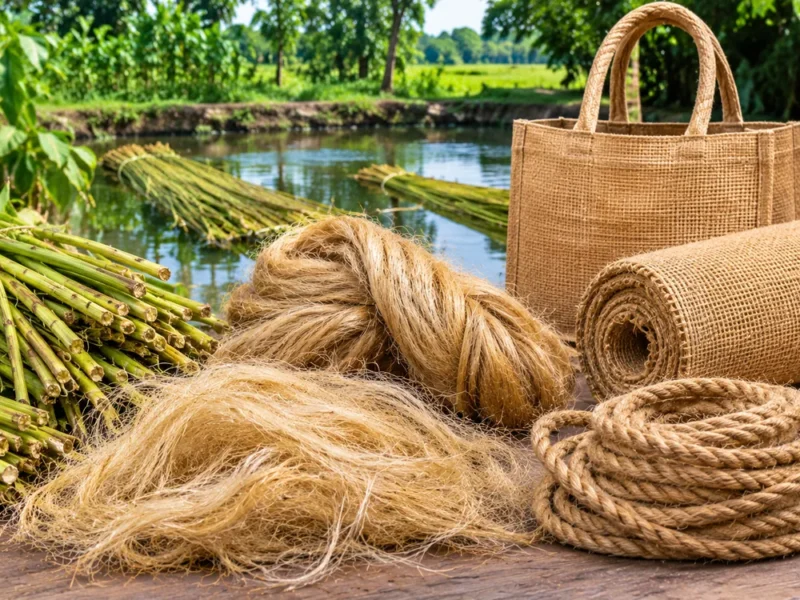
Ask a cat owner what sisal is and you will get an answer at once. It is the rough rope wrapped around the scratching post. Ask a farmer or a rope maker and you will hear a bigger story. Sisal fibre has been used for ropes, twine and sacks for well over a century, and it is now moving into carpets, paper and car parts.
This guide explains what sisal fibre is, where it comes from, how it is taken from the plant and what it can do. It covers properties, uses, how it compares with jute, coir and banana fibre, and the good and bad points. A worked example estimates fibre yield per hectare and rope length. To see where sisal sits among the plant fibres, read our guides on the classification of textile fiber and the different types of textile fibers.
What is sisal fibre
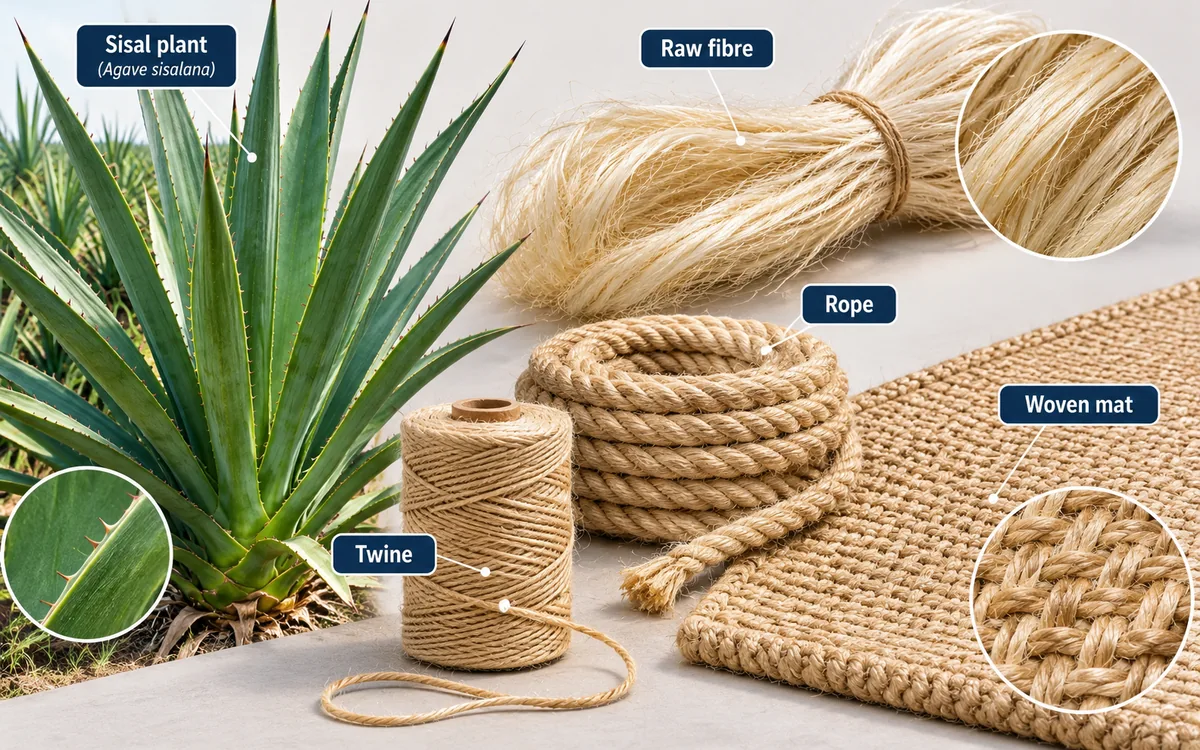
Sisal fibre is a hard, coarse natural fibre taken from the leaves of the sisal plant, Agave sisalana. It belongs to the group of leaf fibres, also called hard fibres, together with abaca and henequen. Soft fibres such as jute and flax come from plant stems, while sisal comes from long, sword-shaped leaves.
The plant looks like a large rosette of stiff, spiky green leaves. Each leaf can grow up to about 1.5 to 2 metres long. Inside each leaf are bundles of long, strong fibres that run from the base to the tip. The name sisal comes from a port in Mexico, though the plant now grows mainly elsewhere.
Where sisal comes from
Sisal grows well in hot, dry areas with poor soil, where many other crops do not do well. Brazil is the largest producer. Tanzania and Kenya in East Africa are other leading sources, and China, Madagascar and Mexico also grow it. In Bangladesh and the nearby region, sisal is not a major crop. Output and rankings change by year, so check a current source if you need numbers.
Because the plant is drought tolerant, it is often grown by small farmers in dry regions as a cash crop. A plant produces leaves for many years, and a sisal field can be harvested for 7 to 10 years or more.
How sisal fibre is made
1. Planting and growing
Sisal is grown from young plants called bulbils or suckers. The first harvest is usually 2 to 4 years after planting, depending on climate. After that, the lower, mature leaves are cut each year while the younger leaves are left to grow.
2. Harvesting
Workers cut mature leaves close to the stem, with a knife. The leaves are tied in bundles and taken to the processing plant on the same day, since the fibre is easier to extract from fresh leaves.
3. Decortication
The leaves are fed into a machine called a decorticator. Rotating drums with blunt blades beat and scrape the leaf while water washes away the pulp. What remains is long fibre. This step is similar to how banana fibre is taken from the pseudostem, as in our guide on banana fibre. Only a small share of the leaf weight is fibre. Most of it is green juice, pulp and water.
4. Washing and drying
The wet fibre is washed again to remove sap, and is dried in the sun on lines or racks for a day or two, or in a drying machine. Good drying gives a pale, clean fibre. Poor drying leaves a dark, weak fibre that can rot.
5. Brushing, grading and baling
Dry fibre is brushed to remove short fibres and dust, then graded by length, colour and cleanliness. It is pressed into bales for transport. Grades commonly describe strength and cleanliness, from clean, long, pale fibre in the top grades to short, dark fibre in the lower grades. The grading system varies by country.
6. Spinning and further processing
For rope and twine, the fibre is spun into yarn on special machines, then twisted into strands and rope. For carpets and fabrics, sisal is spun into yarn and woven or tufted. For a general idea of turning fibre into yarn, see our guide on the yarn making process.
Properties of sisal fibre
| Property | What it means |
|---|---|
| Main chemistry | Cellulose, about two-thirds, plus hemicellulose and lignin |
| Length | About 0.6 to 1.2 m, long enough to spin without cutting |
| Colour | Creamy white to light yellow, darker if poorly dried |
| Feel | Coarse, stiff, rough |
| Strength | High tensile strength for a natural fibre, with low stretch |
| Elongation | Low, about 2 to 3 percent |
| Durability | Resists wear and abrasion well |
| Moisture | Absorbs water readily and can mildew if kept damp |
| Salt water | Resists deterioration in salt water better than many fibres |
| Biodegradable | Yes |
| Dyeing | Takes dyes, though shades are limited and often muted |
| Static | Low, does not build up static |
| Heat | Poor insulator but stable at normal temperatures |
| Sunlight | Some loss of strength after long exposure |
The figures for strength and stiffness change with variety, leaf age and processing. Ask your supplier for test data. Typical published numbers for single fibre tensile strength lie in the range of several hundred megapascals.
Uses of sisal fibre
Rope, twine and cordage
This is the traditional use. Sisal rope is strong, stretches little and holds knots well. It was used for ship ropes, agricultural baler twine and general-purpose cord. Synthetic ropes have replaced sisal in many of these jobs, but sisal remains in use for craft, gardening, packaging, and where a natural, biodegradable product is wanted.
Carpets, rugs and mats
Sisal carpets and rugs are woven or tufted from sisal yarn. They are hard-wearing, have a natural look and resist static and dust. They are used in homes and offices. They stain easily and feel rough underfoot.
Paper
Sisal pulp gives paper with high strength and good tear resistance. It is used for tea bags, filter paper, cigarette paper, currency and specialty papers.
Pet products
Cat scratching posts and toys are wrapped in sisal rope or fabric. Its rough texture suits claws.
Handicrafts and home items
Baskets, mats, bags, hats, wall hangings and decorative items.
Agriculture and garden
Twine for tying plants, nets, mulch mats and sacks.
Composites and industrial uses
- Car parts: Door panels and seat backs reinforced with sisal fibre in plastic.
- Building materials: Boards, plaster reinforcement and cement panels where sisal replaces asbestos or glass fibre.
- Insulation: Sound and heat insulation mats.
- Buffing cloths: Polishing pads for metal.
- Mattresses: Padding in some natural mattresses.
- Dartboards: Compressed sisal is the traditional material for dartboards.
For high-performance synthetic options used in composites, see our guide on glass fibre and high-performance fibres.
Worked example: fibre and rope from one hectare
These are planning assumptions for a worked example. Real values vary by site, variety and season.
- Plants per hectare: 4,000
- Leaves harvested per plant per year: 20
- Average weight of a leaf: 0.5 kg
- Fibre content of a leaf: 3.5 percent
Total leaf weight per year = 4,000 × 20 × 0.5 = 40,000 kg
Fibre per hectare per year = 40,000 × 0.035 = 1,400 kg
Waste = 40,000 − 1,400 = 38,600 kg of pulp and juice. That is 96.5 percent of the leaf weight, so a sisal estate has a large waste stream. Some farms use it for biogas, compost or animal feed, subject to testing.
Rope length. Suppose a rope maker makes a 10 mm sisal rope that weighs 0.070 kg per metre (a typical figure for this size, but check the maker’s data sheet).
- Rope per hectare of fibre = 1,400 ÷ 0.070 = 20,000 m
This ignores the loss in spinning and twisting, which is often 5 to 10 percent. With an 8 percent loss, the net rope length is 20,000 × 0.92 = 18,400 m. So one hectare of sisal in one year could supply around 18 kilometres of 10 mm rope.
Income. If clean fibre sells for 1.2 currency units per kg, the hectare earns 1,400 × 1.2 = 1,680 units before costs. Costs include labour, transport, decorticating and drying. Prices move with the market, so always check current rates.
Sisal vs other natural fibres
| Fibre | Source | Feel | Strength | Best at | Weak at |
|---|---|---|---|---|---|
| Sisal | Agave leaf | Very coarse and stiff | High, low stretch | Rope, carpet, paper, composites | Softness, bright colours |
| Jute | Plant stem | Coarse | Good dry, weak wet | Sacks, hessian. See jute fibre | Wet strength |
| Coir | Coconut husk | Very stiff | Moderate, high stretch | Mats, wet use. See coconut fibre | Fineness |
| Banana | Pseudostem | Medium | Good | Craft, paper, fabrics | Consistency |
| Abaca | Banana relative leaf | Stiff, smooth | Very high | Marine rope, special paper | Cost |
| Cotton | Seed hair | Soft | Moderate | Clothing | Rot and cost |
Sisal is stronger and stiffer than jute and cheaper than abaca. It is rougher than all of the above in the hand, which is why it is rarely used for clothing.
Advantages of sisal fibre
- It is strong, durable and low in stretch.
- It grows in dry land with little water and few inputs.
- It is renewable and biodegradable.
- It gives a long working life from one planting.
- It resists salt water and wear.
- It suits composites as a natural reinforcement.
- It supports rural jobs and small farms.
Limitations of sisal fibre
- It is coarse and not comfortable against the skin.
- It is hard to dye in bright shades.
- It absorbs moisture and can rot or mildew if stored damp.
- The fibre yield from the leaf is low, and the waste stream is large.
- It faces strong competition from synthetic rope and fibres.
- The quality varies with growing area and processing.
- Dust from decorticating and brushing can irritate the lungs.
Environmental points
Sisal needs little water and fertiliser, and holds soil on poor land. It stores carbon in its leaves and roots. But the processing creates a lot of green waste and wastewater that is rich in organic matter. If this runs into streams without treatment, it harms water life. Responsible estates settle and treat the effluent, compost the pulp or use it for biogas. Ask for details on waste handling before you accept a general claim of sustainability. For the treatment process, see our guide on the water treatment plant process in industry.
Care and storage
- Store sisal products in a dry, airy place.
- Keep rope off damp ground and out of long contact with water.
- Vacuum sisal rugs regularly, and blot spills at once, as water can leave marks.
- Do not machine wash sisal carpets. Spot clean with a mild detergent.
- Check twine and ropes for rot and wear before heavy use.
Final thoughts
Sisal fibre is a plain, hard-working material. It does not feel soft and it does not come in bright colours, but it is strong, long-lasting and grows with little water. It has a clear place in rope, carpets, paper and the growing market for natural fibre composites. If you plan to work with it, check the grade, the moisture and the test data, and learn what happens to the waste. A responsible sisal supply chain can offer an honest, low-impact material to makers and buyers who value durability.
Frequently asked questions
Sisal fibre is a strong, coarse natural fibre taken from the leaves of the sisal plant, Agave sisalana. It is used for rope, twine, carpets, paper and composites.
Sisal is a natural plant fibre. It comes from the leaves of the agave plant.
Sisal comes from agave leaves and is stiffer and stronger. Jute comes from the plant stem and is softer, finer and weaker when wet.
Yes. It breaks down naturally at the end of its life.
By beating and scraping fresh leaves in a decorticator while washing away the pulp. The fibre is then dried, brushed, graded and baled.
Its rough, tough texture holds up to claws and does not unravel easily.
Rarely. It is too coarse for the skin, though it is used in bags, hats and craft.