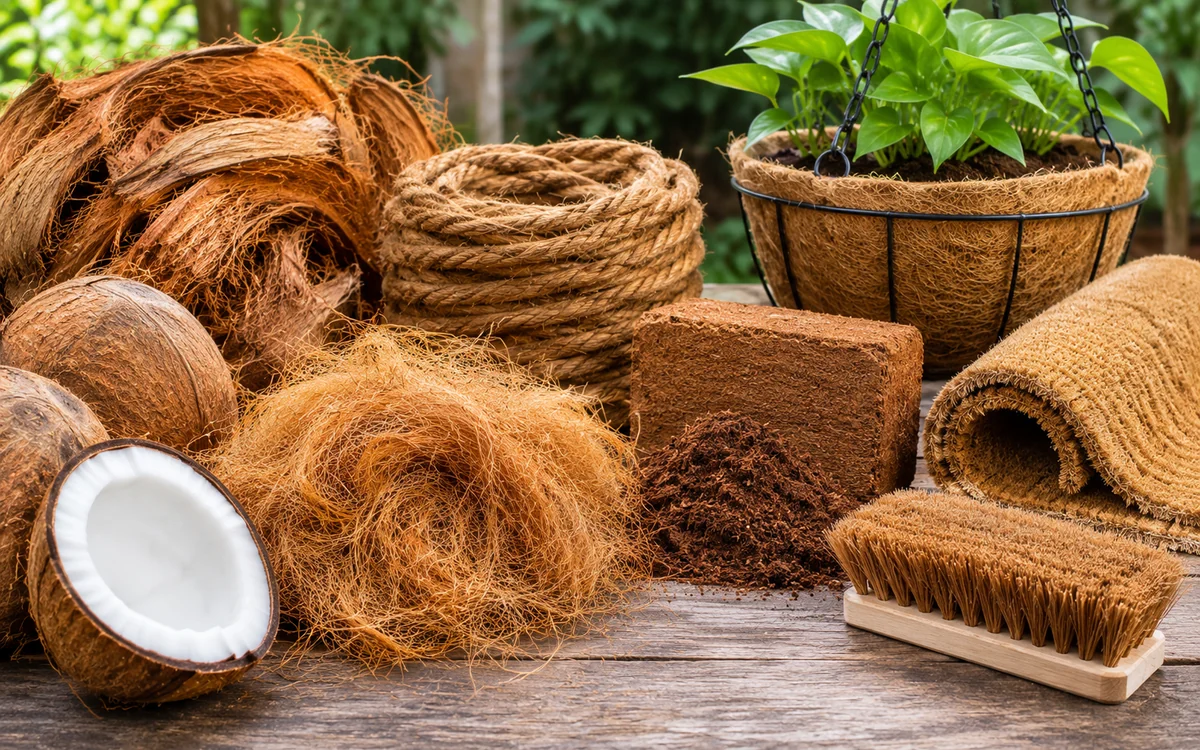
Every coconut that reaches a shop has already lost most of its outer layer. The thick, hairy husk that covers the nut is usually thrown away, but in many parts of the world it is a valuable raw material. From that husk comes coconut fibre, also called coir. It is stiff, tough and springy, and it holds up well in water. That is why people use it to make doormats, ropes, brushes, mattress padding and soil-saving nets.
This guide explains what coconut fibre is, how it is taken out of the husk, the two main types, its properties and its many uses. It includes a worked example on how many husks it takes to make a batch of fibre, and the strengths and limits of coir. To see where coir sits among other plant fibres, read our guides on the classification of textile fiber and the different types of textile fibers.
What is coconut fibre
Coconut fibre is a natural fibre taken from the husk of the coconut, which is the fibrous layer between the hard inner shell and the outer skin. The fibre belongs to the group of seed or fruit fibres, along with cotton and kapok. Unlike cotton, which comes from the seed hair, coir comes from the fruit wall.
A coconut husk has two main parts. About one third of its weight is long, tough fibre. The rest is a soft, spongy material called coir pith, coco peat or coir dust. Both are useful. The fibre goes into rope, mats and brushes. The pith goes into gardening and soil products.
Coir is coarse, stiff and brown in its natural state. It is one of the few natural fibres that stays strong in salt water, which is why it has a long history in ship ropes and fishing nets.
Where coconut fibre comes from
Coconuts grow in tropical coastal areas. India, Sri Lanka, Vietnam, Indonesia, the Philippines and Thailand are leading sources of coir. Coconut-growing regions of Bangladesh, such as the coastal belt, also produce husks that are used locally. Exact rankings change with the year, so check a current trade source if you need exact figures.
How coconut fibre is made
There are two main ways to take fibre from the husk. The path depends on the type of coir wanted.
For brown coir
- Collecting husks: Husks from ripe, mature coconuts are collected after the nut is removed.
- Soaking or retting (optional): Some producers soak the husks in water for a short time to soften them.
- Decorticating: A machine beats and combs the husks to separate the long fibres from the pith.
- Cleaning and drying: The fibre is shaken to remove pith dust, then dried in the sun.
- Grading and baling: Fibres are sorted by length and cleanliness and pressed into bales.
For white coir
- Collecting husks: Husks come from younger, green coconuts.
- Retting: The husks are soaked in slow-moving or tidal water in pits for several months. Microbes soften the husk and loosen the fibres. This long retting can take six to ten months.
- Beating and washing: Workers beat the retted husks with mallets, wash out the pith and separate the fibre.
- Drying and spinning: The fibre is dried and often hand spun into yarn.
Retting in dirty or still water creates a strong smell and can pollute ponds and canals. Cleaner methods and controlled retting tanks are being used in some places to reduce this harm.
Types of coconut fibre
| Type | Source | Features | Typical use |
|---|---|---|---|
| Brown coir | Mature, ripe coconuts | Thick, coarse, strong and long-wearing | Doormats, brushes, mattresses, rope, geotextiles |
| White coir | Young, green coconuts | Finer, lighter, smoother, but weaker | Fine yarn, ropes, string, mats |
| Bristle coir | Longest, best brown fibres | Straight and stiff | Brooms, brushes |
| Mattress coir | Shorter, curled fibres | Springy | Mattress fill and upholstery |
| Coir pith (cocopeat) | The by-product | Soft, holds water | Plant growing medium |
Properties of coconut fibre
| Property | What it means |
|---|---|
| Strength | Strong for its weight, with high elongation before it breaks |
| Stiffness | Coarse and stiff, which is why it feels rough |
| Lignin content | High, which gives it firmness and rot resistance |
| Water | Resists rot in fresh and salt water, though it can mildew if it stays damp |
| Durability | Long lasting when kept in good conditions |
| Insulation | Good thermal and sound insulation |
| Elasticity | Springy and returns to shape |
| Colour | Natural brown or pale tan |
| Biodegradability | Breaks down slowly, which is useful for erosion control |
| Dyeing | Dyes with difficulty and usually only to dark tones |
The high lignin content explains most of the useful behaviour of coir. Lignin makes the fibre firm, slow to rot and hard to dye. It also makes coir stiffer than cotton or jute. Typical numbers for fibre length, diameter and strength vary by source and test method, so ask for test data from your supplier.
Uses of coconut fibre
Household and floor products
- Doormats: Brown coir mats clean shoes well and last for years.
- Rugs and carpets: Woven coir matting for halls and offices.
- Brushes and brooms: Stiff bristle coir sweeps well.
- Mattress and cushion fill: Curled coir keeps shape and lets air pass through, though latex coating is often added.
- Upholstery padding: Used in chairs, car seats and sofas.
Rope and twine
- Coir rope: It floats on water, resists salt and stretches under load. It is used for boats, fishing and farming.
- Twine and string: For packaging and gardening.
Agriculture and gardening
- Coir pith and cocopeat: A growing medium that holds water and air. It is used in pots, nurseries and hydroponics.
- Plant pots and mulch mats: Biodegradable pots and weed control mats.
- Hanging basket liners: Natural, breathable liners.
Civil and environmental uses
- Geotextiles: Coir nets and mats hold soil on slopes, riverbanks and road cuttings while plants take root. They then decay naturally.
- Erosion control logs: Cylinders filled with coir fibre line shorelines and drains.
- Sound and heat insulation: Boards and panels from pressed coir.
Industrial and composite uses
- Automotive: Coir mixed with latex or resin is used in seat cushions and door panels.
- Building boards: Coir mixed with cement or resin makes light boards.
- Filters and padding: In packaging and cushioning.
If you are comparing natural fibres for geotextile and packaging use, our guide on jute fiber is a good next read. Coir lasts longer than jute in wet soil, while jute is finer and softer.
A worked example: husks needed for a batch of fibre
Say a small mill wants to produce 500 kg of brown coir fibre. A mature husk gives roughly 80 to 100 grams of dry fibre, depending on variety and process. This is a common planning range, not a guarantee, so use your own measured yield.
- At 100 g per husk: 500 kg ÷ 0.1 kg = 5,000 husks
- At 80 g per husk: 500 kg ÷ 0.08 kg = 6,250 husks
So the mill needs about 5,000 to 6,250 husks for 500 kg of fibre. If the mill runs 12 working hours and its decorticating machine handles 600 husks an hour, the capacity is 600 × 12 = 7,200 husks a day, which is more than enough for the batch in one shift. The pith that comes out as by-product is about twice the fibre weight, so the same batch yields roughly 1,000 kg of coir pith. That is why mills plan storage and sales for pith as well as fibre.
From fibre to yarn, mats and rubberised coir
Raw fibre needs more steps before it becomes a product.
- Spinning: Fibres are twisted into yarn by hand wheels or machines. Two or more yarns are then twisted into rope.
- Weaving: Coir yarn is woven into mats and matting on handlooms or power looms. Heavy matting for halls uses thick yarn and a tight weave.
- Tufting and backing: For carpets and doormats, coir tufts are set into a backing. A coating of latex or PVC helps hold the tufts in place.
- Needle felting: Loose fibre is pressed into a mat without weaving. This is used for geotextile mats and some filters.
- Rubberised coir: Curled fibre is sprayed with natural latex and cured into sheets or blocks. These make mattresses, seat pads and packing material.
- Dyeing: Coir takes dark dyes better than light ones. Many coloured mats are printed or use dyed yarn in deep shades.
Each step adds cost and changes performance. A woven doormat suits foot traffic. A needle-felted mat suits soil work. A rubberised block suits bedding.
Coir compared with other natural fibres
| Fibre | Stiffness | Strength | Wet performance | Typical use |
|---|---|---|---|---|
| Coir | Very stiff | Moderate, high stretch | Very good, resists rot and salt | Mats, rope, geotextiles |
| Jute | Stiff | High, low stretch | Weak when wet for long | Sacks, hessian, carpet backing |
| Sisal | Stiff | High | Fair | Rope, twine, carpets |
| Cotton | Soft | Moderate | Good, but absorbs water | Clothing, home textiles |
| Banana | Medium | Moderate to high | Fair | Craft, paper, fabrics |
Coir is the best of these for permanent wet contact. Jute is stronger in dry use and softer to handle. Sisal is closer to coir in stiffness and strength.
Environmental points
Coir is often described as green, and there is truth in it. It uses a by-product, needs few chemicals and degrades naturally. But it is wise to avoid sweeping claims. Retting in still water produces smelly effluent that harms fish and ponds. Pith piles can hold water and attract pests when left in the open. Rubberised coir uses latex that may be natural or synthetic, which changes the biodegradable story. Responsible producers use closed retting tanks, treat the water and sell the pith instead of dumping it.
Advantages of coconut fibre
- It is a by-product of the coconut industry, so the raw material is plentiful.
- It is strong, springy and long lasting.
- It resists rot, salt and many pests.
- It is biodegradable and low in processing chemicals.
- It gives local jobs in coastal and rural areas.
- It is good for erosion control and growing media.
Limitations of coconut fibre
- It is coarse and stiff, so it is not comfortable against the skin.
- It is hard to dye in bright colours.
- Traditional retting can pollute water and smell.
- It can mildew if stored damp.
- Quality varies by source and process.
- It is less strong than synthetic ropes for heavy loads.
- Dust from pith can irritate the lungs, so use masks in processing.
Quality checks when buying coir
- Fibre length and thickness: Longer, even fibres make better rope and brushes.
- Cleanliness: Check for pith dust, sand and dirt.
- Moisture: Fibre should be dry. High moisture leads to mold in storage.
- Colour: Even colour suggests good processing.
- Strength: Ask for a tensile test on yarn or rope.
- Salt content (for pith): High salt or electrical conductivity harms plants. Washed and buffered pith is sold for horticulture.
Care of coir products
- Shake or vacuum mats to remove dust.
- Wash coir mats outside with a hose and let them dry fully in the shade.
- Keep coir away from constant moisture, which causes mildew.
- Do not scrub with strong chemicals.
Final thoughts
Coconut fibre turns a throwaway husk into a useful material. Its roughness is the price of its toughness, and that toughness is what makes it good for doormats, ropes and slope protection. If you buy coir, check the type, the cleanliness and the moisture. If you make it, treat the retting water with care and sell the pith as well as the fibre. Used well, coir is a practical, natural fibre with a long future.
Frequently asked questions
Coconut fibre, or coir, is a natural fibre taken from the husk of the coconut. It is coarse, strong and used for mats, ropes, brushes, mattresses and soil-saving nets.
Brown coir comes from mature coconuts and is thick and strong. White coir comes from young coconuts, is retted for months and is finer and smoother but weaker.
Yes. Coir breaks down slowly, which is a benefit for erosion control mats and plant pots.
It is the soft, spongy material between the fibres in the husk. It holds water and is used as a growing medium for plants.
Rarely. Coir is too coarse for clothing, though it is used in some craft items, bags and mats.
Coir lasts longer in wet and salty conditions. Jute is finer, softer and cheaper in many markets. The better choice depends on the use.
Coir rope is strong and elastic, and it floats. It is weaker than steel or modern synthetic rope for very heavy loads.