Velvet fabric is a soft, dense pile cloth with a smooth surface that catches light and changes colour as you move it. Brush a hand across it one way and it feels plush. Brush it back and the shade darkens or lightens. This depth is what makes velvet a favourite for evening wear, upholstery, curtains, jackets and accessories, and it is also what makes velvet one of the harder fabrics to cut, sew and press well.
Many buyers use the word velvet for any soft pile fabric, but in textile terms velvet has a specific construction. This guide explains what velvet is, how it is made, the main types and fibres, the properties a buyer should check, and the handling rules that protect the pile in the cutting room, on the sewing line and in the finishing section. It is written for merchandisers, designers, production staff and students.
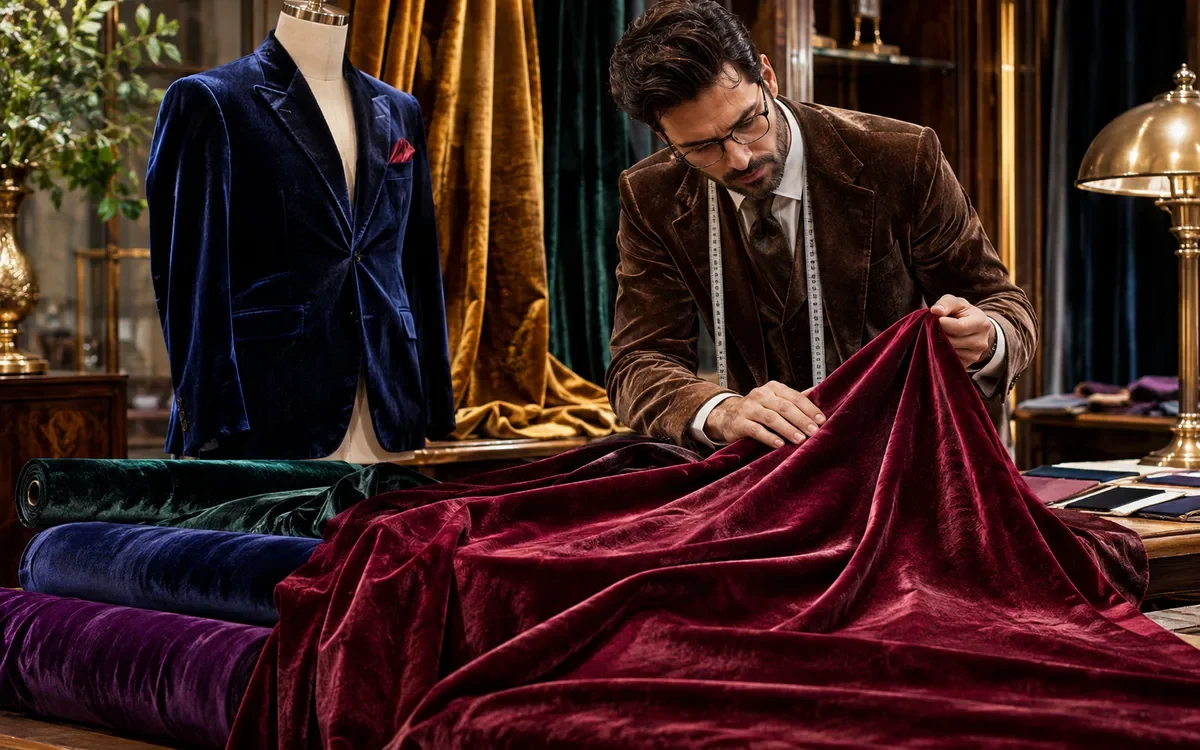
What is velvet fabric?
Velvet is a woven fabric with a short, dense cut pile on one face. The pile is formed by extra yarns that are woven into the base and then cut, so that the tips stand upright and form a smooth, even surface. Because the tufts are so closely packed, the fabric looks like a single soft layer.
Velvet is traditionally made from silk, but today most velvet is made from viscose, polyester, nylon, cotton, acetate or blends. A warp pile construction is the classic method. A weft pile cotton cloth with a similar look is called velveteen. A knitted pile cloth with a similar feel is called velour, and it is not a true velvet because it is not woven.
The sheen of velvet comes from the way light reflects from the cut ends of fibres, which all lean the same way. That direction is called the nap or pile direction, and it matters in every step of garment making.
How velvet fabric is made
Weaving on a double cloth loom
The common method is to weave two cloths face to face at the same time, joined by pile yarns that run between them. Each cloth has its own warp and weft, and an extra set of pile warp zigzags from one cloth to the other. A traversing knife then slices through the pile yarns at the centre, separating the two cloths. This produces two lengths of velvet from one weaving pass, each with a cut pile on its face.
Another method uses wires that are inserted under the pile warp as it is woven. The wires raise loops, and a knife cuts the loops as the wire is withdrawn. This wire method gives more control over pile height and is used for some special velvets.
Pile height, pile density and the base weave affect cost and drape. A taller, denser pile gives a heavier, more luxurious cloth, but it also takes more yarn and more care in finishing.
Finishing
After weaving, velvet goes through several steps.
- Shearing. The pile is trimmed to an even height.
- Brushing. Brushes lift and align the tufts.
- Scouring and dyeing. Many velvets are piece dyed in a jet or a winch. Pile fabric needs a gentle dyeing method that does not crush the surface.
- Pile setting. Steam, heat and brushing set the pile direction.
- Special finishes. Crushing, embossing, printing, burn out or coating.
Because the pile fibres sit at an angle to the base, they catch light unevenly. Producing even colour across a roll is a skill of its own. The guide to shade variation in fabric describes common causes that apply here.
Types of velvet
| Type | Description | Typical use |
|---|---|---|
| Plain or classic velvet | Even upright pile, smooth sheen | Evening wear, jackets, upholstery |
| Silk velvet | Natural silk pile, very soft and costly | Luxury garments, accessories |
| Viscose velvet | Soft and drapey, takes dye deeply | Dresses, scarves, curtains |
| Polyester velvet | Strong and low cost, resists wrinkles | Furnishing, costumes, children’s wear |
| Cotton velvet | Matt, sturdy, softer sheen | Casual jackets, furnishing |
| Panne velvet | Pile pressed flat in one direction, glossy | Evening gowns, costumes |
| Crushed velvet | Pile twisted or pressed in random directions | Fashion wear, drapes |
| Stretch velvet | Includes elastane or a knit base for stretch | Fitted garments, leggings, dancewear |
| Devoré or burnout velvet | Pile chemically removed in a pattern, leaving a sheer design | Scarves, dresses |
| Embossed velvet | Heat and pressure press a pattern into the pile | Fashion, home furnishing |
| Printed velvet | Colour printed on the pile | Fashion, scarves |
| Velveteen | Cotton weft pile, shorter and matt | Casual wear, children’s wear |
| Velour | Knitted pile, soft and stretchy | Tracksuits, loungewear |
Burn out velvet is made by printing a chemical paste on the fabric that destroys the cellulose pile in the printed area. It only works on fabrics where the base and pile react differently, such as viscose pile on a silk or polyester base. The chemical process needs safe handling and proper waste treatment.
Properties of velvet fabric
Strengths
- Luxurious look and hand. Depth of colour and soft feel.
- Good drape. Especially silk and viscose velvet.
- Warmth. The pile traps air, so velvet feels warm.
- Rich colour. Pile absorbs and reflects light in a way that deepens shade.
- Variety. It suits garments, accessories and home furnishing.
Weaknesses
- Pile crushes and marks. Pressure, folding, water drops and pins can leave marks.
- Shade changes with direction. Pieces cut in different directions look different.
- Slippery in sewing. The pile slides against itself, so plies creep.
- Shedding. Loose pile fibres can come off during cutting and sewing.
- Hard to press. Direct iron contact flattens the pile.
- Can be heavy and hot. Some velvets are warm in hot climates.
- Care limits. Many types need dry cleaning or gentle washing, and the care label depends on the fibre and finish.
Velvet compared with similar fabrics
| Feature | Velvet | Velveteen | Corduroy | Velour |
|---|---|---|---|---|
| Structure | Woven, warp pile | Woven, weft pile | Woven, weft pile in ridges | Knitted pile |
| Pile height | Short, dense | Shorter | Varies by wale | Short to medium |
| Sheen | High | Low to medium | Medium | Medium |
| Stretch | Low unless elastane added | Low | Low unless elastane added | High |
| Typical fibre | Silk, viscose, polyester | Cotton | Cotton | Cotton, polyester |
The page on corduroy fabric covers the ribbed cousin of velvet. For other lustrous cloths, the guide to satin fabric types, characteristics and uses shows how a flat float weave creates sheen without pile, and the article on jacquard weave fabric explains how woven patterns are formed.
Fibres used in velvet
- Silk. Natural, soft and strong, with the best drape and a high price. Needs gentle care.
- Viscose. A regenerated cellulose fibre with a silky feel and strong colour take up, but weak when wet. The guide to bamboo fabric and viscose explains its properties.
- Polyester. Strong, wrinkle resistant and economical. The guide to polyester fibre properties and uses covers this in more detail.
- Cotton. Matt and durable, used for velveteen and casual velvet.
- Nylon and acetate. Used in blends for sheen or strength.
- Elastane. Added to some velvets for stretch.
What a buyer should specify
Velvet orders go wrong when the specification is vague. Include these items.
- Fibre content for both pile and base
- Weight, width and pile height, with tolerances
- Pile direction on the roll and in the marker
- Shade standard with a swatch viewed in agreed lighting and direction
- Shrinkage and dimensional stability limits
- Colour fastness to washing, rubbing, perspiration and light. For pile fabrics, rubbing fastness (crocking) deserves close attention. The guide to colour fastness tests goes deeper on this.
- Pile retention and shedding limits
- Defect rules for bare patches, pile streaks and shade bars
- Roll length, packing method and storage instructions
- Fire safety requirements for furnishing and children’s wear, which depend on the market and product, so follow the buyer’s instruction and local rules
Inspect velvet under good light and with the pile direction noted on each roll. The fabric inspection procedure gives general steps, and the 4 point system shows a way to score defects, though pile marks may need extra rules.
Cutting velvet in the garment factory
- Choose a pile direction and keep it. Cut pile up for a deep, rich colour or pile down for a lighter, silvery look. Every piece of a garment must face the same way. The buyer’s specification decides.
- One way marker. The marker cannot flip pieces end to end, so fabric use is lower. The guide to marker making in the cutting room helps with planning.
- Spreading. Use low tension, and spread face to face or all face up in one direction. Because plies slip, fewer plies and tape or clips may help. The guide to fabric spreading methods explains the details.
- Cutting. Use a sharp knife and low lay heights. Some factories cut with a single ply or die for accuracy.
- Pile shedding. Keep the area clean, and brush off fluff before sewing.
- Notches. Use small notches or drill marks that do not show.
- Numbering. Number pieces by roll and ply to prevent shade mixing.
The page on the cutting department in a garment factory covers the basic flow.
Sewing velvet
- Needle. Use a fine, sharp needle suited to the base fabric, and change it often. The guide to sewing needle parts, size and point selection is a useful companion here.
- Thread. Choose a good quality thread that matches the shade of the pile in its normal direction.
- Stitch length. A medium stitch length helps. Very short stitches cut the pile base, and very long stitches pucker.
- Feed. A walking foot, roller foot or a machine with a top feed reduces creep. The notes on presser foot types explain the options.
- Basting. Hand baste or use clips instead of pins where pins leave holes, or place pins in the seam allowance only.
- Seams. Sew in the pile direction when possible, since sewing against the pile pushes the plies apart.
- Finishing seams. Press open, clean finish edges to stop fraying and shedding. Lining the garment can hide inner seams.
- Zips and closures. Use soft zips and avoid heavy interlinings that print through the pile. Fusible interlining must be tested, because heat can flatten pile.
Many faults seen in velvet garments, such as skipped stitches, puckered seams and needle holes, are covered in the guide to sewing defects and root causes.
Pressing and finishing velvet
- Press from the wrong side. Use a velvet board, a needle board or a thick towel to protect the pile.
- Use steam and no pressure. Hover the iron or steamer and let steam relax the pile.
- Never press the pile face against a flat surface.
- Test heat first. Polyester and acetate can melt or glaze, and silk can mark.
- Avoid water spotting. Some velvets show marks from drops of water, so use clean steam.
- Hang finished garments. Folding creases the pile, so hanger packing or soft tissue between folds is often better.
- Pack with care. Do not stack heavy cartons on velvet garments.
General rules for pressing methods are listed on the page about pressing and ironing in garment manufacturing.
Common velvet problems
| Problem | Likely cause | Prevention |
|---|---|---|
| Panels look different in colour | Mixed pile direction or mixed rolls | One way cutting and roll sorting |
| Crushed or pressed marks | Heavy pressing, folding, storage pressure | Press from the back with steam, hang or roll |
| Pile loss at seams | Seam stress, dull needle | Sharp needle, correct stitch length, reinforce seams |
| Plies creep | Slippery pile faces | Walking foot, clips, basting |
| Rub off colour | Poor rubbing fastness | Test and choose better dyes |
| Shedding fluff | Loose pile, cutting | Brush off, clean cutting area, pile lock finish |
| Water marks | Water drops, wrong steam | Use clean steam, protect from spills |
| Bare patches | Weaving or finishing defects | Fabric inspection and defect rules |
| Fabric slips in the marker | Wrong lay up | Control tension, use tape or paper |
Care of velvet garments
Always follow the care label, because the right method depends on the fibre, the finish and the dye.
- Many velvets are labelled dry clean only.
- Some polyester and cotton velvets can be washed gently in cool water, inside out.
- Avoid wringing, rubbing and tumble drying unless the label allows it.
- Hang to dry, away from direct heat.
- Steam to remove creases, using a garment steamer a few centimetres from the surface.
- Store hanging, not folded, and not in plastic for long periods.
Buyers write their own care wording and test it on bulk samples, so confirm it before printing labels.
Choosing velvet for a project
- Evening wear: silk or viscose velvet, with a drapey base and a lining.
- Jackets and blazers: cotton or polyester velvet for structure.
- Upholstery and curtains: heavy polyester or cotton velvet with a good rubbing fastness and, where required, a flame retardant finish. Follow the buyer’s and local standards.
- Stretch garments: stretch velvet with elastane.
- Children’s wear: polyester velvet that is easy to wash, with attention to safety rules.
- Accessories: crushed, embossed or printed velvet for visual effect.
Always make a pre production sample, press and wash test it and approve it before bulk.
Final thoughts
Velvet fabric combines a dense, cut pile with a rich surface that changes under light. That beauty depends on controlling pile direction, shade and pressure at every step from weaving to packing. A mistake at any step can leave a crushed patch, a colour difference or a seam that looks wrong.
To get good results, write a clear specification with fibre, weight, pile height and shade standard, cut all pieces in one direction and sort rolls by shade. Use sharp fine needles and a feed that stops creep, press gently from the back with steam and pack garments hanging. Test care methods on a sample before you promise a wash instruction to a customer.
Frequently asked questions
Velvet can be made from silk, viscose, polyester, nylon, cotton, acetate or blends. The pile is woven into a base cloth and then cut so the tips stand up.
Velvet is usually a warp pile cloth with a short, dense, silky pile. Velveteen is a cotton weft pile cloth with a shorter pile and a more matt look.
No. Velour is a knitted pile fabric with stretch, while velvet is woven.
Use steam from the wrong side over a velvet board or thick towel, with almost no pressure. Never press the pile face down on a hard surface.
The cut pile leans in one direction, so light reflects differently depending on the angle. That is why all pieces in a garment are cut with the pile facing the same way.
It depends on the fibre and finish. Many velvets need dry cleaning, while some polyester and cotton types can be washed gently. Follow the care label and test first.
It is velvet whose pile is twisted or pressed in random directions, giving a rippled, shimmering look. The effect is permanent when set correctly in finishing.