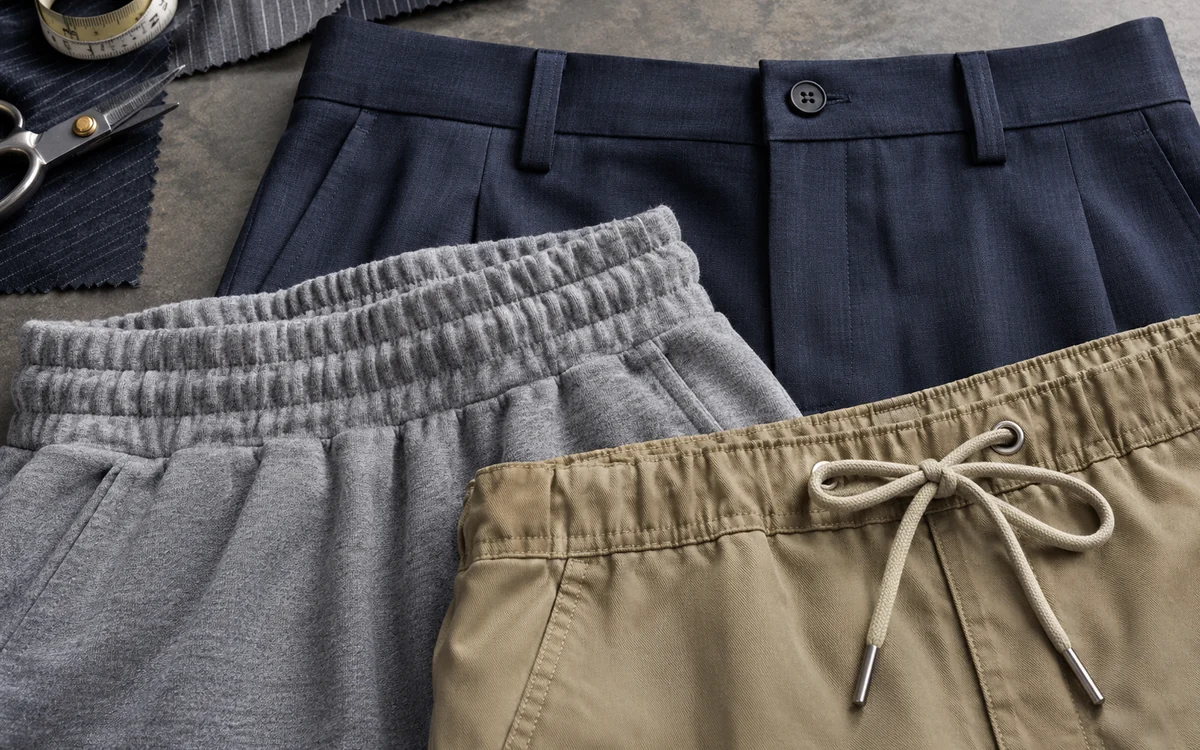
The types of waistbands in garments decide how a pair of trousers, shorts or a skirt sits on the body, how it closes and how long it keeps its shape. A tailored trouser needs a firm straight band with a hook and a button. A jogger needs a soft rib band with a cord. A pair of leggings needs a wide, flat band that does not dig in. Each one uses different materials, different machines and a different sewing order, and each one goes wrong in its own way.
This guide explains what a waistband does, its parts, the main types, how a straight waistband is sewn, how waistbands are measured and specified, and the common defects. It is written for pattern makers, merchandisers and line supervisors.
What a waistband does
- Holds the garment at the waist or hip. It carries the weight of the whole garment.
- Gives the opening a firm edge so the top of the garment does not stretch or fray.
- Carries the closure, such as a button, hook, snap, zipper or cord.
- Carries belt loops, when the style has them.
- Shapes the fit, since a wider, curved or elastic band changes how the garment sits.
- Adds to the design, through height, topstitching, colour and trims.
Parts of a waistband
Names differ between factories, but these parts are common.
- Band (outer band): the visible strip of fabric.
- Inner band, facing or lining: the part inside, often cut from the same fabric or a lighter one, sometimes called a curtain in trouser making.
- Interlining or stay: a fusible or sewn layer that gives the band body. See types of interlining in garments.
- Extension (underlap): the part of the band that extends past the opening to carry the closure.
- Closure: a button, hook and bar, snap or zipper. See types of buttons in garments and types of zippers in garments.
- Belt loops: strips of fabric that hold a belt.
- Elastic or cord: in soft waistbands. See types of elastic in garments.
- Fly and fly shield: the opening below the waistband in trousers, which meets the band at the top.
- Topstitching and tacks: stitching that holds the layers and strengthens stress points.
Types of waistbands
1. Straight (set on) waistband
A straight strip of fabric, cut with the grain, that is sewn to the top edge of the garment. It is the standard on tailored trousers, chinos, jeans and many skirts. It gives a firm, flat finish and a clean line, and it holds a belt well.
- Strengths: neat, firm and easy to cut and sew.
- Limits: the strip is straight, so on a body with a big difference between waist and hip it can stand away from the body at the back.
2. Contoured (curved) waistband
A waistband cut in a curve so that it follows the shape of the body from waist to hip. The top edge is shorter than the bottom edge, so the band sits closer to the body.
- Strengths: better fit on the hip, less gaping at the back, a cleaner look on low rise styles.
- Limits: needs a shaped pattern and a shaped interlining, and takes more skill to sew. The curve is cut on a different grain direction, so the fabric can stretch if it is not handled with care.
3. Extended waistband
A straight or contoured band with an extra length at one end, called the extension or underlap, that carries the hook and button, so the closure sits behind the front edge. It is common on trousers with a fly front.
4. Faced waistband
There is no separate band. The top edge of the garment is finished with a facing, a shaped strip of fabric that is turned to the inside. It gives a smooth, flat edge with no band on the outside.
- Common uses: skirts, dresses, low rise and fashion trousers.
- Limits: needs an understitch or a tack so the facing does not roll out.
5. Elastic waistband in a casing
The top edge is folded over to form a channel, and elastic is threaded through it. A drawcord may be added. See types of elastic in garments for the elastic options.
- Strengths: easy to make, comfortable, flexible in size.
- Limits: the elastic can twist or roll inside the channel, and the casing can look bulky if the fabric is thick.
- Common uses: pyjamas, shorts, casual skirts, kidswear.
6. Elastic sewn on (attached elastic)
Elastic is sewn directly to the top edge of the garment, usually with an overlock or cover stitch, and may be folded and stitched again. It gives a flat band with no channel.
- Common uses: underwear, briefs, leggings, swimwear, sports shorts.
7. Drawcord (drawstring) waistband
A cord runs through a casing and comes out through eyelets or buttonholes at the front. The cord is pulled and tied to adjust the fit. Many drawcord waistbands also contain elastic.
- Common uses: track pants, shorts, swim trunks, loose trousers.
- Safety: buyers often set rules for cord length, ends and stops in children’s wear. Follow the buyer’s requirement.
8. Rib knit waistband
A band of rib fabric, sewn to the top of the garment, which stretches and recovers. See knitted rib fabric types and uses. It is used on joggers, sweat pants and some shorts, often with a drawcord.
9. Fold over (yoga) waistband
A wide band of knit fabric, cut about twice the final height, which is folded over and sewn so the band is double thickness. It sits flat and smooth and has no hard edge.
- Common uses: leggings, yoga pants, sportswear, maternity wear.
10. Stretch insert (comfort) waistband
A woven waistband with an elastic panel or inserts inside the band, which gives a little stretch while keeping the look of a normal waistband. Used on jeans, chinos and workwear.
11. Belted or sash waistband
A separate belt of the same or contrast fabric, closed with a buckle, a D ring or a tie, is added to the waist. Common on dresses, trench coats, wide leg trousers and some shorts.
12. Gathered or paper bag waistband
The fabric is gathered into the band, often with elastic or a tie, giving a ruffled top. It is a fashion style.
Waistband size, shape and measurement
Specify these items in the tech pack.
- Band height (width): the finished height of the band, with tolerance.
- Waist measurement: taken along the top edge of the band, with the garment flat and the closure fastened. For stretch styles, a relaxed and a stretched measurement are both given.
- Extension length: for extended waistbands.
- Curve: the amount of contour, for contoured bands.
- Rise: the front and back rise, which decide how high the band sits.
- Belt loop count, width, length and position.
- Elastic length and stretch ratio, for soft waistbands.
- Closure position and size.
Take tolerances from the buyer’s specification. See garment measurement tolerance.
How a straight waistband is sewn
The order changes between styles, but a typical sequence for a trouser waistband is as follows.
- Fuse the interlining to the outer band, or to the parts of the band the pattern says. Check temperature, pressure and time.
- Prepare the inner band. Press the seam allowance, and attach a curtain or facing if the style has one.
- Make and attach the belt loops to the top of the garment, with the lower end tacked later.
- Attach the band to the garment with the right sides together, matching the centre front, centre back, side seams and notches. See standard seam allowance in garments.
- Close the ends. Sew the ends of the band, turn them and shape the extension.
- Turn and fix the inner band. Stitch in the groove of the seam or topstitch from the outside, to catch the inner band.
- Topstitch the top edge of the band.
- Attach the top of each belt loop with a bartack, and set the lower end.
- Make buttonholes and sew on buttons, hooks and bars, or snaps. See buttonhole, bartack and attaching machines.
- Press and check the measurement.
The full sequence with times appears in our operation breakdowns for a trouser, a jogger and leggings.
Stitches used
Straight and contoured bands are usually sewn with a lockstitch. Elastic bands and knit waistbands need a stitch that stretches with the fabric, such as an overedge or cover stitch. Our guide on ISO 4915 stitch classes lists the stitch families and where each is used.
Closures and belt loops
Closures
The closure holds the waistband shut and takes a lot of strain, so choose it for the garment and the fabric.
- Button and buttonhole: common on jeans, chinos and many trousers. The button is often a metal shank or tack button on denim and a sewn button on dress trousers.
- Hook and bar (or hook and eye): often used with a button on tailored trousers, to take the strain off the button and keep the band flat.
- Snap: used on casual and kidswear.
- Zipper fly: sits below the band. The top of the zipper ends at the band, with a stop and a bartack. See types of zippers in garments.
- Drawcord and elastic: need no hard closure. The cord adjusts the fit.
- Hook and loop tape: used on some uniforms, work wear and adaptive clothing.
The closure position, the extension length and the reinforcement should be written into the tech pack. A weak attachment is one of the quickest ways to get a return.
Belt loops
Belt loops hold a belt in place. They are made from a strip of fabric, folded and stitched, then cut to length.
- Count and position: the number of loops and the spacing come from the style and the buyer. Write the positions in the tech pack.
- Width and length: wide enough for the belt the style is meant to take, and long enough to stand off the band a little.
- Attaching: the loop is usually sewn at the top edge of the garment before the band goes on, and the lower end is fixed with a bartack or a box stitch. Some factories attach both ends with bartacks after the band is closed.
- Care points: the bartack must be strong, since the loops take a pull from the belt. Thick joins at the band seam need care to avoid needle breaks.
Special machines make belt loops in one pass, with folding, stitching and cutting done by the same machine. See buttonhole, bartack and attaching machines.
Interlining, stays and stretch control
The waistband carries the strain of the whole garment, so it must not stretch out of shape.
- Interlining. A firm woven or non woven fusible gives the band body. A weak interlining leads to a band that curls or ripples.
- Waistband stay tape. A tape inside the seam, or a non stretch strip, limits stretch in woven fabrics.
- Grain. A band cut off grain will stretch. Straight bands are cut along the grain, and contoured bands need extra care.
- Elastic ratio. The elastic must be stretched evenly while sewing so the gathers are even.
- Tacks and stitching. Bartack or box stitch at the ends of the band and at the belt loops gives strength.
Choosing a waistband for a garment
| Garment | Common waistband choices |
|---|---|
| Tailored trousers | Extended straight or contoured band, interlining, hook and bar, button |
| Jeans and chinos | Straight band, metal button, zipper fly, belt loops, optionally stretch inserts |
| Skirts and dresses | Faced, contoured or straight band with an invisible zipper |
| Joggers and sweat pants | Rib band or elastic in a casing, with a drawcord |
| Shorts | Straight band, elastic casing, or drawcord, depending on style |
| Leggings and sportswear | Fold over knit band or attached wide elastic |
| Underwear | Attached plush or jacquard elastic |
| Pyjamas | Elastic in a casing, soft knit band |
| Kidswear | Soft elastic in a casing, with simple closures and safe cords |
| Fashion pieces | Belted, gathered or paper bag styles |
Common waistband defects and causes
| Defect | Likely causes |
|---|---|
| Rippled or wavy band | Band stretched while sewing, weak interlining, uneven feed |
| Twisted band | Uneven feeding, cut off grain, mismatch of notches |
| Uneven band height | No guide, poor pressing, operator variation |
| Gaping at the back | Straight band on a style that needs a contour, loose fit at the back rise |
| Band too tight or too loose after wash | Shrinkage in the fabric or elastic, wrong cut length |
| Elastic twisted or rolled in casing | Narrow braided elastic in a wide channel, wrong type |
| Bubbles in the band | Poor fusing, wrong temperature or glue |
| Skipped stitches in the seam | Needle problem, thick junctions, wrong stitch length |
| Belt loops uneven or loose | No template, weak bartack |
| Closure out of alignment | Marking error, extension cut wrong |
| Loose button or hook | Weak attachment, no reinforcement |
| Drawcord pulls out | No stopper, weak buttonhole or eyelet |
| Band edge shows the inner band | Poor turning, wrong seam allowance |
See sewing defects and their root causes for many of these causes in more detail.
Quality tips
- Fuse and test. Check the bond strength, and look for bubbles and strike through.
- Use templates and folders for band height, belt loop size and extension shape, to keep operators consistent.
- Mark the centre points and notches and match them while sewing.
- Check shrinkage of the fabric, interlining, elastic and tape together, since they must shrink in a similar way.
- Check the first piece of every style, and measure the waist, the band height and the stretch.
- Control thick spots. Where seams cross at the band, trim and grade seams to avoid needle breaks and skipped stitches.
- Press with care. Too much heat can damage elastic and fusing.
- Test the closure, with a pull test on the button or hook. See button pull test SOP.
- Place pockets and the waistband together in the plan. See types of pockets in garments.
Final thoughts
The types of waistbands in garments include straight, contoured and extended woven bands, faced tops, elastic casings, attached elastic, drawcord bands, rib knit bands, fold over bands, stretch insert bands and belted or gathered fashion styles. Each combines a shape, a stretch method and a closure.
Choose by garment and fabric, write the band height, waist measurement, stretch and closure into the tech pack, use an interlining that suits the fabric, and check the first piece before the bulk run. A waistband carries the whole garment, so a small error there shows up in every wear.
Frequently asked questions
Straight, contoured, extended, faced, elastic in a casing, attached elastic, drawcord, rib knit, fold over, stretch insert, belted and gathered waistbands.
A straight band is a flat strip, cut on the grain. A contoured band is cut in a curve so it follows the body from waist to hip and sits closer.
A wide fold over knit band or an attached wide elastic, because it sits flat and does not dig in.
Usually the band was stretched while sewing, the interlining is too weak, or the feeding was uneven. Use a firm interlining and a guide or folder.
A waistband with no separate outer band. The top edge is finished with a shaped facing that is turned to the inside.
Because it is narrow or soft for the width of the channel. A wider, flatter elastic or a non roll elastic stays flat.
Along the top edge of the band, with the garment laid flat and the closure fastened. For stretch styles, both the relaxed and the stretched measurements are given.