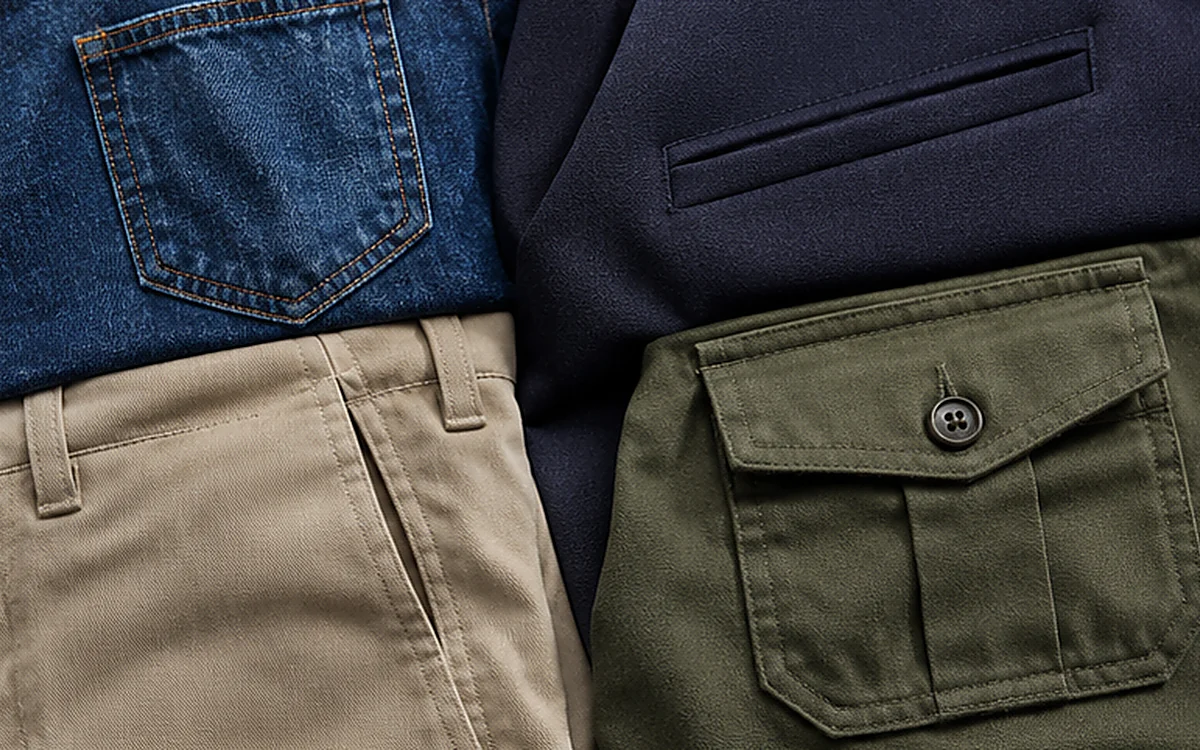
The types of pockets in garments look simple from the outside, but each one is built in a different way. A patch pocket is a piece of fabric sewn on top. A welt pocket is a slit cut into the garment with a hidden bag behind it. A kangaroo pocket is a large pouch on a hoodie. Each type needs its own marking, its own sewing order and its own checks, and each one fails in its own way.
This guide explains what a pocket is made of, walks through the main types, and shows how pocket bags are made and reinforced. It also covers how pockets are specified and the common defects. It is written for pattern makers, merchandisers, line supervisors and quality staff. For the names of the pocket parts, see our page on the parts of a pocket.
What a pocket is and what it is made of
A pocket is a small space on or in a garment that holds the hand or small items. It has two jobs. It must work, which means it holds things and does not tear. It must also look right, because pockets are some of the most visible details on a garment.
Most pockets have these parts:
- Pocket opening (mouth): where the hand goes in.
- Pocket bag: the inside space. It is often made from a separate fabric called pocketing.
- Facing or welt: the strip that finishes the opening.
- Flap: a cover over the opening, found on some styles.
- Reinforcement: bartacks, rivets, tape or interlining at stress points.
- Closure: a button, snap, zipper or hook and loop tape on some pockets.
The pocket is cut from the shell fabric, the pocketing fabric, or both. Pocketing is usually a light, strong plain weave or twill, such as a polyester cotton blend, so the bag is thin and does not add bulk.
Patch pockets
A patch pocket is a piece of fabric sewn onto the outside of the garment. It is the easiest pocket to make and the most common on shirts, work wear, jeans back pockets and casual jackets.
- How it is made: the edges of the patch are folded and pressed, the top edge is hemmed, and the patch is stitched to the garment on three sides. The corners are usually reinforced with a bartack or a triangle of stitches.
- Shapes: square, rounded, pointed or any shape the design asks for.
- Variants: a patch pocket can have a flap, a pleat, a button, a lining or a topstitched edge.
- Strengths: simple, strong and easy to place.
- Limits: it adds a visible layer on the outside, so it can pucker if the corners are not pressed well, and it can twist if the fabric is cut off grain.
A pocket template or folder helps keep the shape, size and stitch margin the same on every piece. Many factories use a template machine or a press for shaping the patch before it is sewn.
In seam pockets
An in seam pocket sits inside a seam, usually the side seam, so the opening is hidden. It is common on skirts, dresses, chinos, dress trousers and jackets.
- How it is made: two pocket bag pieces are attached to the seam allowance of the front and back panels, and then the side seam is sewn, with a gap left open for the pocket mouth. The bag is closed around the edges.
- Strengths: clean look, no visible stitches on the outside except at the ends of the opening.
- Limits: the opening can gape or stretch if the seam is not stabilised. A small tape or strip of interlining along the opening is often used to stop it.
A related type is the pocket cut into a seam, such as a princess seam or a style line. It works in the same way, with the opening hidden in the seam.
Slant and front pockets
A slant pocket has an opening that is cut at an angle from the waistband to the side seam. It is the standard front pocket on trousers and jeans.
- Jeans front pocket (scoop or jeans pocket): a curved opening, with the pocket bag attached to the front panel and the waistband. The shape of the curve is part of the style. Jeans often also carry a small coin pocket inside it. Our operation breakdown of a 5 pocket long pant shows the pocket operations step by step.
- Dress trouser slant pocket: a straighter angled opening, with the facing and bag sewn in to give a smooth line. Our guide to tailored trouser pockets for men covers the common styles.
- How it is made: the pocket facing is sewn to the front panel along the opening, turned and pressed, and topstitched. The pocket bag is then sewn to the facing, closed and tacked at the waistband and side seam.
The angle and depth decide how easily the hand goes in and whether the pocket gapes when the wearer sits. The buyer usually sets the opening length and the pocket depth in the tech pack.
Welt and besom pockets
A welt pocket is a slit cut into the garment, with a strip of fabric called a welt or a lip along the edge of the slit, and a pocket bag hidden behind it. It is a neat, tailored pocket seen on suits, blazers, dress trousers and back pockets of formal trousers.
- Single welt: one welt strip, either along the top or the bottom edge of the slit.
- Double welt (besom or jetted pocket): two narrow welts, one on each side of the slit, so they meet in the middle and look like two thin lips.
- Flap welt: a flap sits over the slit, often with a welt below it.
- How it is made: the opening is marked, the welts are sewn on either side of the line, the slit is cut between the stitch lines, the welts and bag are turned to the inside, and the ends are tacked or stitched down. The corners of the slit are cut to a tiny triangle, so the welts lie flat.
- Strengths: a flat, formal look.
- Limits: a welt pocket needs accurate marking and cutting. A small error at the corner shows as a pucker, a fray or a hole. Interlining behind the opening gives the cut edges support.
Factories often use a special pocket setting machine for welt pockets, and some use a hand operation for fine tailoring.
Kangaroo, cargo and bellows pockets
These are larger, more functional pockets.
Kangaroo pocket
A kangaroo pocket is a large pouch on the front of a hoodie or sweatshirt, with an opening on each side so both hands can go in. It is a patch type of pocket, sewn on the front and open at the sides, often with rib trim or topstitching along the openings. See parts of a hoodie for where it sits on the garment.
- Care points: the stress at the openings is high, so a bartack or a box stitch at each end is common. The pouch must lie flat without twisting the front panel.
Cargo pocket
A cargo pocket is a large patch pocket on the side of the trouser leg or on a jacket, usually with a flap and a closure. It holds bigger items. It often has a pleat or a gusset so the pocket can expand.
Bellows pocket
A bellows pocket is a patch pocket with a fold or pleat on the sides and sometimes the bottom, so it can expand when filled. It is used on cargo trousers, field jackets and work wear. Our operation breakdown of a cargo short pant with bone pocket shows how many operations such a pocket needs.
- Care points: the pleats must be pressed and the folded edges stitched evenly. Bulk at the corners can cause skipped stitches and needle breaks.
Zipper pockets
A zipper pocket has a zipper along the opening. It keeps the contents safe and is common on jackets, sportswear, outdoor wear, cargo pants and bags.
- Welt zipper pocket: the zipper sits in a slit, like a welt pocket, with the zipper tape hidden behind or showing in the opening. It gives a sleek look.
- Vertical or side zipper pocket: the zipper runs along the side of a pocket on the chest or sleeve.
- Patch zipper pocket: a patch pocket with the zipper in the top edge.
- Concealed zipper pocket: a zipper covered by a flap or a seam, so it does not show.
The choice of zipper, its length and its tape colour should be written into the order. See types of zippers in garments. A zipper pocket in a thin fabric may need interlining so the opening does not wave or ripple.
Small pockets: coin, watch and chest
- Coin pocket (watch pocket): a small pocket set inside the front pocket of jeans. It is said to have started as a place for a pocket watch, and many people now use it for coins or small items.
- Chest pocket: a small pocket on the upper front of a shirt, jacket or work wear. It may be a patch or a welt type, with or without a flap.
- Ticket pocket: a small extra pocket, often set above the right hip pocket of tailored jackets.
- Pen or phone pocket: a small pocket added to a sleeve or chest of uniforms and work wear, often with a stitched divider.
Small pockets need exact placement. A pocket that is half a centimetre out of line on a shirt is easy to see.
Pocket bag fabric and reinforcement
Pocket bag fabric
The pocket bag takes the weight of the contents and rubs against the body, so the fabric should be:
- strong enough not to tear at the corners,
- smooth, so it does not catch on the hand or on other layers,
- thin, so it does not show through or add bulk,
- colourfast, so it does not mark light shell fabrics,
- shrink matched to the shell, so the pocket does not pull after wash.
Common choices are polyester cotton plain weave or twill pocketing. Some styles use shell fabric for the pocket bag. Others use a mix, where the part near the opening is shell fabric (so a flash of lining does not show) and the rest is pocketing.
Reinforcement
Stress points need strengthening. Common methods:
- Bartack or box stitch at the ends of the opening.
- Rivets at the corners of jeans pockets.
- Tape or stay along the opening, to stop it stretching. See types of interlining in garments.
- Double stitching or a French seam on the bag, so fine items do not escape through the corners.
- Interlining behind welt and zipper openings.
See buttonhole, bartack and attaching machines for the machines used.
Placement, size and specification
Write the pocket details into the tech pack so the pattern maker, the cutter and the sewing line all work to the same information.
- Pocket type and style name.
- Opening length and angle.
- Pocket depth and width.
- Position: measured from a fixed point, such as the high point shoulder, the waistband, the side seam or the centre front. The distance should be given from at least two points.
- Pocket bag material and size.
- Flap size, shape and closure.
- Topstitch width and stitch count per inch.
- Reinforcement type and position.
- Matching for stripes and checks, when the fabric has a pattern.
Take tolerances from the buyer’s specification. See garment measurement tolerance. For seams that join the pocket to the garment, see standard seam allowance in garments.
Many factories use a position template or a laser or light guide on the machine, so every pocket sits in the same place.
Common pocket defects and causes
| Defect | Likely causes |
|---|---|
| Pocket not in the right place | No template, marking error, wrong reference point |
| Left and right pockets uneven | No matching check, operator variation |
| Puckered corners | Corner not pressed, thick fabric, heavy stitching, wrong thread tension |
| Twisted or tilted patch pocket | Cut off grain, uneven feed, weak folder |
| Pocket opening gapes or stretches | No tape or interlining, bias cut at the opening |
| Pocket bag shows through | Bag too light in colour, thin shell fabric, wrong size |
| Hole or fray at the welt corner | Cut too long, cut past the stitch line, no reinforcement |
| Pocket pulls the panel | Bag sewn tight, shrinkage mismatch, uneven tension |
| Loose pocket corner or rivet | Weak bartack, wrong rivet size |
| Uneven topstitch | Needle deflection, poor guide, thick junctions |
| Flap does not lie flat | Interlining too stiff or too soft, uneven pressing |
| Stripes or checks do not match | Cutting error, no marking for pattern match |
| Zipper wave or ripple | Zipper longer than the opening, no stay, stretched during sewing |
For more on common stitching faults, see sewing defects and their root causes.
Quality tips
- Use templates and folders. They keep the shape and size of patch pockets the same across the lot.
- Mark position points and check the first piece against the spec before bulk sewing.
- Press the pocket pieces before sewing, since a well pressed patch sews with fewer errors.
- Check the corners. Look for tiny holes, loose stitches and puckers.
- Check left against right. Pockets on both sides should be at the same height and angle.
- Try a hand in. The opening should be easy to enter and the bag should hold the contents without pulling.
- Check the bag edges after sewing, since a thin seam allowance can open in wear.
- Match shrinkage of the shell, the pocketing and the interlining.
- Check the closure, and for buttons see types of buttons in garments.
- Take care at the waistband, where pocket bags meet the band. See types of waistbands in garments.
Final thoughts
The main types of pockets in garments are patch, in seam, slant and front, welt and besom, kangaroo, cargo and bellows, zipper, and small pockets such as coin, chest and ticket pockets. Each has its own build, its own risks and its own place on a garment.
Choose the type for the style and the use, pick a pocket bag fabric that suits the shell, reinforce the stress points, and write the size and position into the tech pack. Check the first piece, compare left and right, and test the opening with a hand. A pocket gets used all day, so small faults show up fast in wear.
Frequently asked questions
Patch, in seam, slant, welt (single and double), kangaroo, cargo, bellows and zipper pockets, plus small ones such as the coin and chest pocket.
A pocket made from a slit cut into the garment, with a strip of fabric (the welt) along the edge and a bag hidden behind. A double welt is also called a besom or jetted pocket.
A patch pocket is sewn on the outside of the garment. An in seam pocket is hidden inside a seam, usually the side seam.
A large pouch on the front of a hoodie or sweatshirt, with an opening on each side so both hands can go in.
Common causes are corners that were not pressed, thick fabric at the turn, heavy stitching, or uneven thread tension. Press the corners and use a template.
Usually a light, strong plain weave or twill pocketing, often a polyester cotton blend. Some styles use the shell fabric for part or all of the bag.
In the tech pack, by measuring from fixed points such as the waistband, side seam or shoulder. A template or a guide on the machine keeps every piece the same.