Pressing and ironing in garments is the use of heat, steam and pressure to shape cloth, set seams and remove creases, and it happens at several points between cutting and packing. A flat seam on a shirt, a crisp collar, a trouser crease that stays, a folded polo ready for the polybag: each depends on a pressing step done with the right setting. Done well, pressing is almost invisible. Done badly, it leaves shine, scorch marks, stretched panels or a garment that has shrunk out of size.
This guide explains the difference between pressing and ironing, the main types of pressing in a garment factory, the four settings that control the result, the machines used, how to match heat to fabric, and the common faults and how to avoid them. It is written for finishing managers, quality staff and industrial engineers.
Pressing and ironing: the difference
The two words are often used for the same thing, but in a factory they have slightly different meanings.
- Ironing is done with a hand iron that is moved across the fabric. The operator slides the iron and uses some pressure.
- Pressing is done by pressing down a heated surface onto the fabric, without sliding. Press machines and pressing buck machines do this. Pressing gives a more even result and suits shaping and setting.
In practice, a garment factory uses both, and many people call everything pressing. What matters is the control of heat, moisture, pressure and time.
Why garments are pressed
- To set seams. Pressing a seam flat, or open, before it is crossed by another seam, gives a flat and even result.
- To shape parts. Collars, cuffs, plackets, pockets and facings are pressed into shape.
- To remove creases from fabric and from handling during sewing.
- To set the size and the shape of the finished garment.
- To improve the look of the final garment, with a smooth surface and a sharp edge.
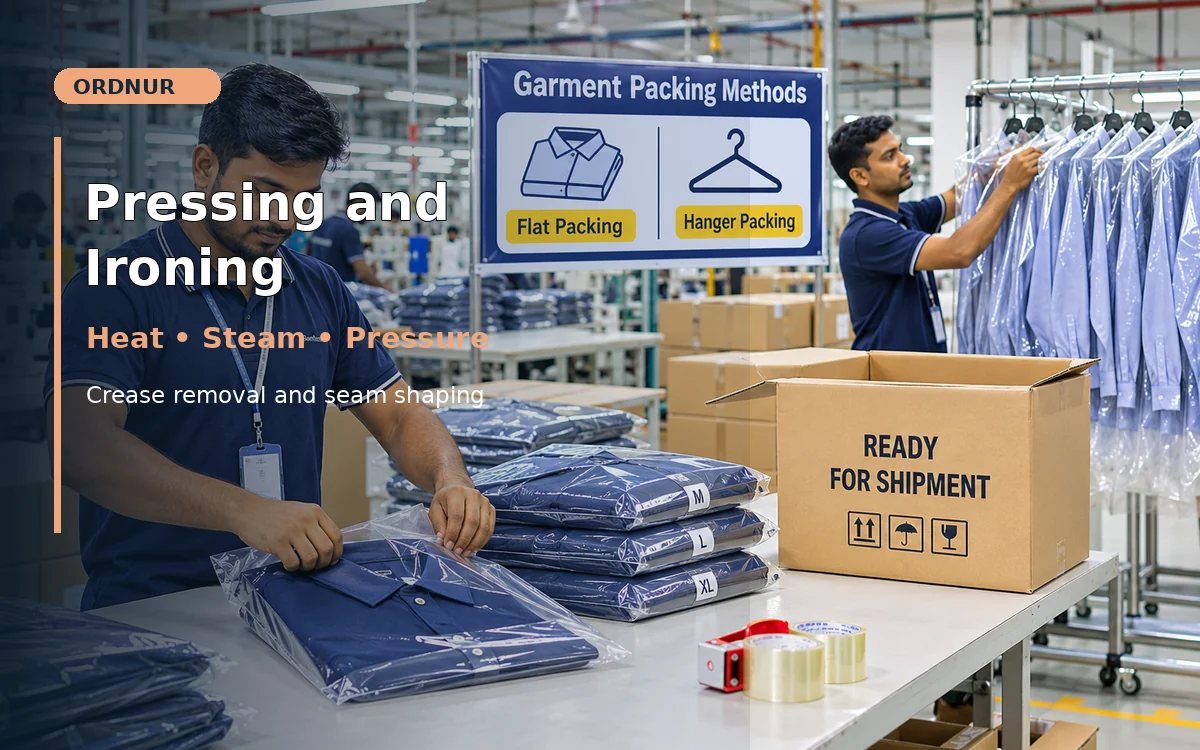
- To prepare for folding and packing, so that the garment looks good in the polybag.
- To fix a pleat or a crease in trousers or skirts, using heat and moisture.
Types of pressing in garment production
1. Under pressing (in process pressing)
Pressing done while the garment is still being made, between sewing operations. It includes pressing seams open or to one side, pressing the turned edge of a collar, creasing a placket, folding a hem or pocket opening, and flattening a seam before topstitching.
Under pressing makes later operations easier and gives a better look that cannot be added after the garment is closed. It is done at the line, at small pressing tables or with small presses, often by dedicated operators.
2. Top pressing (final pressing)
Pressing done on the finished garment, to remove wrinkles and give the final shape. It is done in the finishing section, with irons, steam presses, vacuum tables or finishing machines.
3. Pressing for shaping and setting
Some garments need heat and pressure to set a permanent shape or crease. Trousers get a crease, pleated skirts are set, and some fabrics are pressed to fix the collar shape. For permanent press fabrics, a curing step may be used, as the finish requires.
4. Steam finishing
For some knitwear and soft garments, steam alone is used, with little or no pressure. The garment is put on a form and steamed, then dried with air. This relaxes the fabric and removes creases without flattening the surface.
The four settings that control the result
Every pressing step depends on four settings. Change one and the others may need to change too.
| Setting | What it does | Too little | Too much |
|---|---|---|---|
| Temperature | Softens the fibre so it can be shaped | Creases stay, no set | Shine, scorch, melting, colour change |
| Steam and moisture | Relaxes the fibre and helps set | Dry, harsh finish | Water marks, shrinkage, long drying |
| Pressure | Flattens and sets the shape | Weak shape | Flat, shiny, marked seams |
| Time | Lets heat and moisture work | Poor set | Burn, shine, shrinkage |
Cooling matters too. Many fabrics set only as they cool, so the garment should not be moved or folded when it is hot. Vacuum on a pressing table helps by pulling steam through and cooling the cloth quickly.
Machines and equipment
Hand steam iron
A hand iron with a steam supply from a boiler, or a self contained steam iron. It is flexible and used for spot pressing, touch up and small batches. It depends on operator skill. See how to use a steam iron.
Ironing table with vacuum and blower
A table with a perforated top that pulls air down, holding the garment flat and drawing steam through. Some have blowers that float the garment or air that dries it. It is widely used for shirts, trousers and light garments.
Steam press (flat bed press)
A press with a heated top and a padded bottom plate. The plates close on the garment with set pressure and time. It is used for flat parts, collars and cuffs, plackets, trouser parts and some finished garments. Presses give good repeatability.
Pressing machines for specific parts
Special presses exist for collars, cuffs, sleeves, trouser legs, plackets and shirt bodies, with shaped plates and set cycles. They cut time and give the same result on each garment.
Form finisher (steam dolly)
A machine with an inflatable form in the shape of the garment. The garment is put on the form, steamed and dried with hot air. It is used for shirts, jackets and knitwear, and gives a smooth finish with no flat pressing marks.
Steam tunnel
A tunnel through which garments on hangers pass on a conveyor, with steam and drying. It removes wrinkles from large volumes of hanging garments, such as T shirts, shirts and dresses, but gives a lighter finish than a press.
Fusing press
A press used to bond fusible interlining to fabric parts. It follows similar principles of heat, pressure and time but is a separate process. See types of interlining in garments, fusing machine in the garment industry and the fusing process quality inspection.
Supporting equipment
- Boiler and steam lines, which supply dry, steady steam at the right pressure.
- Steam traps and condensate return, which remove water so only dry steam reaches the iron. Wet steam spits water and marks the garment. See conducting a steam trap audit.
- Compressed air for press cylinders and form finishers.
- Pressing cloths and silicone pads, which protect delicate fabrics.
- Temperature gauges, to check plate and iron temperature.
Matching heat to fabric
The right temperature depends on the fibre and the finish. The ranges below are typical for a pressing iron or plate. They are a starting point, not a rule, and must be tested on the actual fabric.
| Fibre | Typical pressing temperature | Notes |
|---|---|---|
| Cotton, linen | Up to about 200 °C | Takes heat and moisture well. Scorch if too long. |
| Viscose, modal, lyocell | About 150 °C | Water can mark, press with care. |
| Wool and wool blends | About 150 °C with steam | Use a pressing cloth to avoid shine. |
| Silk | About 110 to 150 °C | Test for water marks. |
| Polyester | About 110 to 150 °C | Melts or shines at high heat. |
| Nylon | About 110 to 150 °C | Sensitive to heat. |
| Acrylic | About 110 to 130 °C | Easily crushed or stretched when hot. |
| Elastane blends | Low heat | Heat damages the stretch. |
The iron symbol on a care label uses dots to show the highest safe ironing temperature: one dot for up to about 110 °C, two dots for up to about 150 °C and three dots for up to about 200 °C. Read the label together with the buyer’s finishing instructions. For the other symbols, see our care labels and wash symbols guide.
Blends take the limit of the most sensitive fibre. Printed, coated, foil and embellished areas often need lower heat or a pressing cloth. Always test on a spare piece of the same fabric, and on the same trims, before the bulk run.
Pressing by garment type
- Woven shirts: collar and cuff pressed in a shaping press, placket and yoke pressed in process, body and sleeves pressed on a pressing machine or finished on a form. See types of plackets in garments.
- Trousers: seams pressed open in process, pocket bags pressed, waistband shaped, and legs pressed on a leg press or with a crease set at the end.
- Knit T shirts and polos: light steam finishing, with care to avoid stretching. Polo plackets and collars may need a press.
- Jackets and tailored wear: heavy under pressing, shaping on a form, special pads for the shoulder and lapel.
- Denim: often pressed after washing to set shape and remove creases. Heavy fabric needs high heat and pressure.
- Dresses and skirts: pleat setting and hem pressing, with care for delicate or lined fabric.
- Knitwear: steam only, on a form, with no flat pressing so as to protect the structure.
Pressing and fabric behaviour
- Shrinkage. Heat and moisture can shrink fabric. If the fabric was not relaxed or pre shrunk, the garment may lose size in pressing. See knit fabric relaxation before cutting and garment pattern making based on fabric shrinkage.
- Stretching. Pulling a hot knit while ironing can stretch it out of shape.
- Shine. Pressing the right side of dark or textured fabric flattens the pile and gives a shine. Press from the wrong side or use a cloth.
- Seam impression. The edge of a seam or a pocket shows as a ridge on the outside. Pad the seam allowance with paper strips, or press over a rounded surface.
- Fused parts. Too much heat can loosen the bond and cause bubbles or strike through.
- Trims. Buttons, zips, plastic parts, prints and labels may melt or mark. Press around them, use a cloth or press from the back.
Common pressing faults and causes
| Fault | Likely causes |
|---|---|
| Shine or glaze | Temperature or pressure too high, pressed on the right side with no cloth |
| Scorch or burn mark | Temperature too high, too long, dirty plate |
| Water spots | Wet steam, poor traps, spitting iron, water on delicate fabric |
| Shrinkage, size out of tolerance | Heat and moisture on fabric that was not relaxed |
| Stretched panels | Pulled while hot, wrong form, too much pressure on bias edges |
| Creases pressed in | Garment not laid flat, folded wrongly, press closed on a fold |
| Seam ridge or imprint | Seam allowances pressed through to the face |
| Fusing bubbles or strike through | Temperature too high, wrong interlining |
| Melted or marked trims | Heat on plastic, foil or printed areas |
| Colour change | Heat sensitive dye, overpressing |
| Unpressed garments in the lot | Missed in the flow or poor checking |
| Wet garments packed | Not dried or cooled before folding, moisture in the carton |
Check pressing quality as part of finishing inspection. See finishing quality control SOP of the apparel industry and cutting, sewing, washing and finishing defects in garments.
Good practice for the pressing section
- Write a pressing instruction for each style, with temperature, steam, pressure, time and the machine to use, and have it approved with the sample.
- Test on the actual fabric and trims, and approve the settings with a pressed sample.
- Check the equipment each day: plate temperature with a gauge, steam pressure, steam quality, pad condition, clean plates.
- Keep plates and soleplates clean, since dirt marks the garments.
- Train operators on the settings, the method and what a good finish looks like. Use a standard sample at each table.
- Use the right pad and cloth for dark, delicate and textured fabrics.
- Press in the right order, parts first, then the body, then the whole garment.
- Cool before folding. Allow the garment to cool and dry before it goes to the folding table.
- Check measurements of the first pressed pieces against the spec. See garment measurement tolerance.
- Include safety. Guard hot surfaces, give gloves and a rest schedule, and keep the floor dry. Plan seating and work height. See ergonomics in sewing operations, which applies to pressing tables too.
Layout and flow in finishing
Pressing is often a bottleneck in finishing, because the garments queue for a limited number of tables or presses. Plan the number of pressing stations from the SMV of the pressing operations and the daily target, and place them to keep a straight flow from sewing to checking to folding. See our guides on the layout, SMV and operation breakdown of the garments finishing process, the rail line layout system in a garments finishing unit and the bottleneck in a sewing line, which applies the same method to any operation.
Energy and steam
Steam is a major energy cost in finishing. Leaking pipes, failed steam traps, bare pipes and idle irons waste fuel. Insulate pipes, repair leaks, turn off irons not in use, and return condensate. Our energy guides, such as the steam trap survey for a textile mill, show how to find these losses.
Final thoughts
Pressing and ironing in garments covers under pressing during sewing, top pressing on the finished garment and steam finishing for soft items. The result depends on four settings: temperature, steam, pressure and time, matched to the fibre, the fabric structure and the trims.
Write an instruction for each style, test it on the real fabric, keep the equipment and steam in good condition, and check the first pressed pieces for size and finish. A good press makes a garment look right and fit right. A bad one can ruin work done in cutting and sewing.
Frequently asked questions
Ironing slides a hot iron over the fabric. Pressing holds a heated surface down on the fabric with no sliding, and gives a more even result.
It is pressing done during sewing, between operations, such as opening seams, shaping collars and plackets and flattening hems.
Temperature, steam or moisture, pressure and time. Cooling also affects the result.
Cotton and linen take up to about 200 °C. Polyester is usually pressed at about 110 to 150 °C. Always test on the actual fabric and follow the care label and buyer instruction.
Too much heat or pressure, or pressing the right side of the fabric without a cloth. Press from the wrong side or use a pressing cloth.
It is a machine with an inflatable form in the shape of a garment. Steam and hot air smooth the garment on the form without flat pressing.
Heat and moisture release stress in the fabric. If the fabric has not been relaxed or pre shrunk, it can shrink when pressed.