A steam trap failing open doesn’t trip an alarm or show up as an obvious fault anywhere on a control panel. It just sits there, quietly venting live steam into the atmosphere or into a condensate return line where it shouldn’t be, and unless someone is actively checking traps on a schedule, a mill can operate for months with a meaningful number of them failed without anyone noticing the fuel cost quietly climbing to pay for it.
What a Steam Trap Actually Does
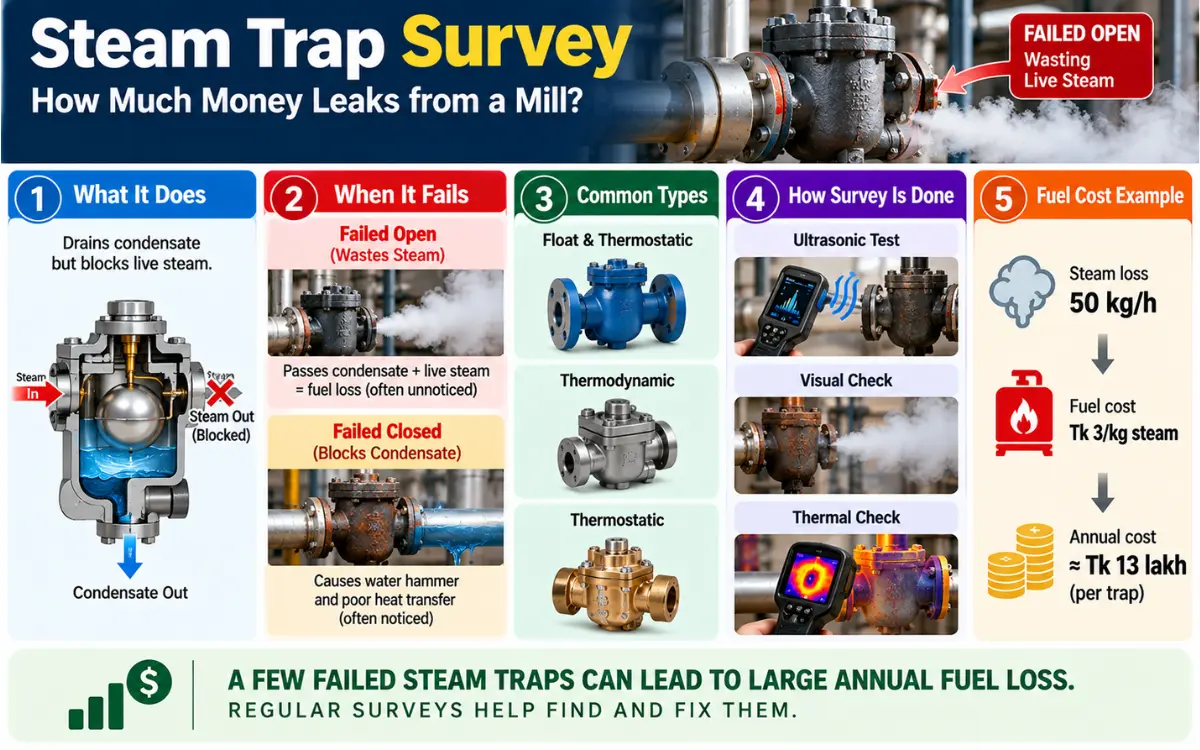
Steam traps sit throughout a mill’s steam distribution system with a specific job: allow condensate (water that’s formed as steam gives up its heat) to drain from the system while blocking live steam from escaping along with it. This function matters because condensate left sitting in steam lines and equipment reduces heat transfer efficiency and can cause water hammer, a genuinely damaging mechanical shock as pockets of condensate get suddenly displaced by fast-moving steam. A properly functioning trap solves this without wasting the steam itself.
How Steam Traps Fail
Traps fail in two directions, and both cost money in different ways. A trap that fails closed stops draining condensate entirely, which causes the water hammer and heat transfer problems described above, generally a more immediately disruptive failure that tends to get noticed and addressed relatively quickly since it interferes with process performance directly. A trap that fails open is the more insidious failure, since it continues to pass condensate but also allows live steam to escape continuously alongside it, and this failure mode often runs for extended periods without detection precisely because it doesn’t cause an obvious process disruption, it just quietly burns fuel.
Common Steam Trap Types and Their Failure Patterns
Different trap designs, mechanical (float and thermostatic types among them), thermodynamic, and thermostatic traps, have different typical failure patterns and expected working lives, and a mill’s actual trap population, often a mix of types installed at different times, benefits from understanding which types are in use where, since a systematic survey approach differs somewhat depending on trap type. Thermodynamic traps, common for their simplicity and relatively low cost, are generally more prone to wear-related failure over time than some mechanical designs, which is worth factoring into how frequently a given trap population should be re-surveyed.
How a Steam Trap Survey Is Run
A proper trap survey physically inspects every trap in the system on a defined schedule, checking each one’s actual operating condition rather than assuming traps are functioning correctly simply because the overall system seems to be working. Ultrasonic testing, listening for the specific acoustic signature of steam passing continuously through a failed-open trap, is a common non-invasive method that lets a technician assess trap condition without disassembly. Visual and thermal inspection, checking for visible steam venting at trap discharge points or unusual temperature patterns, supplements ultrasonic testing, particularly for traps in accessible locations where a direct check is straightforward.
Every trap surveyed should be logged, with its condition (passing, failed open, failed closed, or uncertain and requiring further investigation) recorded against its specific location and type, building a trap population record that makes each subsequent survey faster and more targeted, since a mill with a maintained trap log can prioritize checking traps with a history of prior issues or traps of a type and age known to fail more frequently.
Pricing a Steam Leak in Fuel Terms
The genuinely useful output of a trap survey isn’t just a list of failed traps, it’s a fuel cost figure that makes the case for fixing them concrete rather than abstract. A failed-open trap’s steam loss can be estimated from the trap’s orifice size and the system’s operating pressure, using standard steam loss tables or calculation methods that relate orifice size and pressure differential to steam mass flow rate. Converting that steam loss to a fuel cost requires knowing the boiler’s fuel consumption per unit of steam generated (itself a function of the operating efficiency figures covered in the boiler selection article) and current fuel price.
A single failed-open trap on a moderate-pressure system can represent a genuinely large annual fuel cost on its own, and a mill with even a modest number of failed traps across its full steam distribution system, a common finding in mills without a disciplined ongoing survey program, can be looking at a combined annual fuel loss substantial enough to fund a considerably more aggressive maintenance program many times over, which is exactly the argument a properly priced survey result makes far more persuasively than a general statement that “some traps probably need attention.”
A Worked Fuel Cost Example
Here’s how a single failed trap translates into an actual annual fuel cost figure, using illustrative numbers to replace with your own system’s operating pressure and current fuel price. Say a failed-open trap has an orifice size that, at the system’s operating pressure of 7 bar, loses steam at an estimated rate of 15 kg per hour continuously, based on standard steam loss tables for that orifice size and pressure.
Annual steam loss: 15 kg/hour × 24 hours × 300 operating days = 108,000 kg of steam lost per year from this single trap.
Fuel required to generate that steam: Assuming the boiler consumes roughly 0.075 cubic meters of natural gas per kilogram of steam generated at a realistic operating efficiency (a figure that connects directly to the boiler efficiency considerations in our boiler selection guide), that’s 108,000 × 0.075 = 8,100 cubic meters of gas wasted annually.
Annual cost: At an illustrative gas price of $0.35 per cubic meter, that’s 8,100 × $0.35 = $2,835 per year, from a single failed trap.
Now scale that to a realistic survey finding. A mill with, say, 150 traps across its distribution system, where a survey finds 12 traps failed open (an 8 percent failure rate, not unusual for a system that hasn’t been surveyed in some time), and even if those 12 traps average a more modest 8 kg/hour loss rather than the 15 kg/hour example above, the combined annual cost works out to roughly 12 × (8/15) × $2,835 ≈ $18,144 a year in wasted fuel, from traps that, individually, look like a minor maintenance item easy to deprioritize against more visible production concerns. This is the number that belongs in front of whoever approves the maintenance budget, not a general statement that some traps probably need attention.
Insulation Loss: The Companion Problem
Steam trap failure isn’t the only silent loss along a distribution system. Damaged, missing, or degraded insulation on steam lines and equipment loses heat continuously through radiation and convection, a loss that, like a failed trap, doesn’t interrupt process performance and therefore doesn’t get noticed without deliberate inspection. A thermal imaging survey of steam line insulation, run alongside or as a complement to a trap survey, catches this related but distinct loss category, and mills running a trap survey program often find real value in extending the same survey discipline to insulation condition, since both losses share the same fundamental characteristic of being expensive but invisible without deliberate checking.
Condensate Recovery: Capturing What’s Already Been Paid For
Beyond fixing failed traps, condensate recovery, returning condensate to the boiler feedwater system rather than discarding it, captures both the water itself and a meaningful portion of the heat energy still present in that condensate, reducing the fuel needed to bring fresh feedwater up to steam temperature. A mill without an effective condensate recovery system is effectively paying twice, once to heat the water originally, and again to heat replacement feedwater from a colder starting temperature, and evaluating condensate recovery system investment alongside trap survey findings often reveals a combined efficiency opportunity larger than either measure would show on its own.
In-House Capability Versus Outsourced Surveys
Mills face a genuine choice between training internal staff to run ultrasonic trap surveys and other diagnostic work covered in this article, or contracting a specialist firm to run periodic surveys. In-house capability offers the advantage of more frequent, lower-marginal-cost checks once the initial equipment and training investment is made, well suited to mills large enough to justify a dedicated utility maintenance function. Outsourced surveys, run by firms specializing in industrial steam system audits, often bring more specialized equipment and cross-mill experience recognizing failure patterns than an internal team developing this capability for the first time, which can make an initial outsourced survey a reasonable way to establish a baseline and train internal staff alongside the specialist team, before deciding whether to build fully in-house capability or continue with periodic outsourced surveys going forward. Neither path is universally correct. The right choice depends on mill size, how many traps and how much distribution piping actually need surveying, and how quickly a mill wants to build genuine internal expertise versus relying on external verification.
Building an Ongoing Survey Program
A one-time trap survey identifies a snapshot of current failures, but traps continue to fail over time at a rate that depends on trap type, age, and operating conditions, which means a single survey without a follow-up schedule leaves a mill back in the same undetected-loss position within a relatively short period. A properly maintained program surveys the full trap population on a regular schedule, repairs or replaces traps identified as failed promptly rather than deferring fixes, and tracks failure rate over time by trap type and location to identify whether specific trap types or specific sections of the distribution system are showing a pattern worth addressing more fundamentally than trap-by-trap replacement alone would solve.
Frequently Asked Questions
How much can a single failed steam trap actually cost a mill per year?
The worked example in this article shows a single failed-open trap can waste over two thousand dollars a year in fuel, and a modest failure rate across a mill’s full trap population can scale that into tens of thousands annually.
Why don’t failed-open steam traps get noticed quickly?
They continue passing condensate while also leaking live steam, which doesn’t interrupt process performance the way a failed-closed trap does, so the loss runs quietly in the fuel bill rather than announcing itself as a production problem.
How is a steam trap survey actually performed?
Ultrasonic testing, listening for the acoustic signature of steam passing continuously through a failed trap, combined with visual and thermal inspection at accessible trap locations, logged against each trap’s location and condition.
Is a one-time steam trap survey enough?
No. Traps continue failing over time at a rate depending on type and age, so a survey without an ongoing schedule leaves a mill back in the same undetected-loss position within a relatively short period.