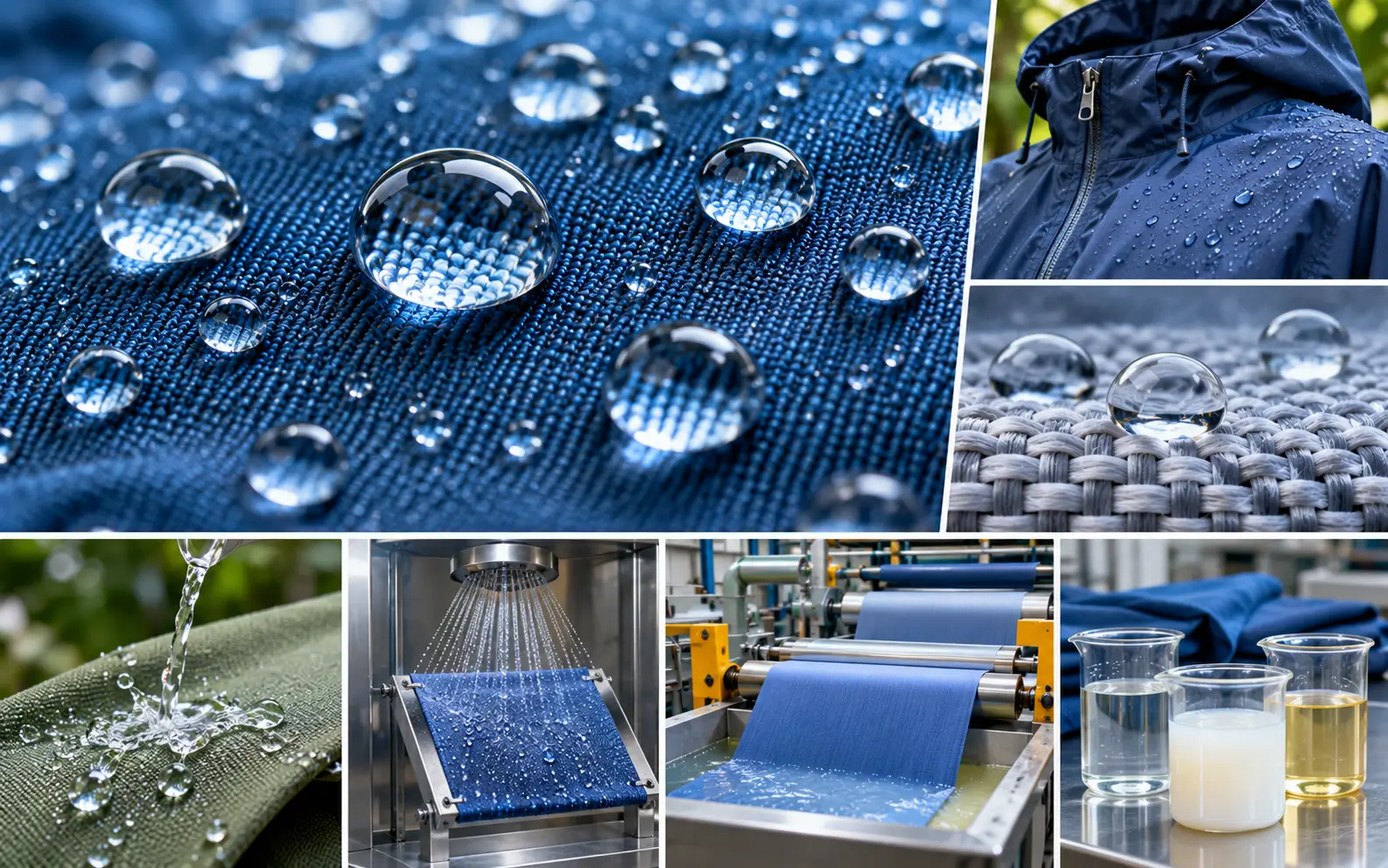
A drop of rain lands on a good jacket and rolls off like a pearl. On another jacket, it soaks in and leaves a dark patch. The difference is water repellency, a property that can be built into a fabric through the right fibre, construction and finish. It matters for raincoats, school uniforms, workwear, tents, bags and even tablecloths.
This guide explains water repellency in simple words. You will see how it differs from waterproofing, what causes it, the main types of finishes, how a finish is applied in a mill with a worked recipe, and how the result is tested. We also cover care and common problems. For a closer look at the chemical side and the shift away from certain finishes, see our guide on PFAS-free water-repellent textile finishes.
What is water repellency
Water repellency is the ability of a fabric to resist wetting by water. Water drops stay on the surface as beads and roll off, instead of spreading and soaking in. The fabric itself is still porous, so air and vapour can pass through. This makes it breathable and comfortable.
Water repellent, water resistant and waterproof
These words are often mixed up. They describe different levels of protection.
| Term | Meaning | How it is made | Breathability |
|---|---|---|---|
| Water repellent | Surface resists wetting. Light rain beads off | Chemical finish on a normal fabric | Good |
| Water resistant | Fabric slows water, through tight weave or finish | Dense weave, finish, or both | Medium to good |
| Waterproof | Blocks water, even under pressure | Coating, laminate or membrane | Low to medium, depends on membrane |
A water-repellent jacket may let water through in a heavy storm or if you sit on a wet bench. A waterproof jacket should hold out water under pressure. Always check the stated rating, not just the word on the label.
Why does a fabric repel water
The answer is surface energy. Water has a high surface tension, so it forms drops. A surface with low energy, such as wax or silicone, will not let the drop spread. Wetting depends on two things:
- Surface chemistry. A finish with a low surface energy keeps drops from spreading.
- Surface structure. A rough, tightly woven surface traps air between yarns and lifts the drop.
The contact angle measures this. It is the angle between the drop and the surface. An angle above 90 degrees is generally called hydrophobic. Above 150 degrees is called superhydrophobic, and that is seen in nature on lotus leaves. Most commercial finishes give angles of about 100 to 140 degrees on fabric.
Fibres and fabric construction
- Polyester and nylon are naturally hydrophobic, with very low moisture regain. They take a finish well and dry fast.
- Cotton, linen and viscose absorb water, so they need a stronger finish.
- Tightly woven fabrics, such as poplin, ripstop and microfibre, resist water better because there are fewer gaps between yarns.
- A fine, smooth yarn gives a smoother surface, so drops roll off.
- Brushed or hairy surfaces hold water and are harder to finish.
Types of water-repellent finishes
| Finish type | How it works | Strengths | Limits |
|---|---|---|---|
| Fluorocarbon (C8, C6, C4 chemistry) | Fluorinated chains create very low surface energy, repel water and oil | High performance, oil and stain repellency | Concerns about persistence in the environment. Long-chain types are restricted, and rules on the wider PFAS group are tightening in many regions |
| Silicone | Polysiloxane forms a water-repellent film and gives a soft feel | Soft handle, durable on synthetics | No oil repellency, can affect sewing and dyeing |
| Wax and paraffin | Wax coats the fibre surface | Low cost, easy | Poor wash durability, can leave a waxy feel |
| Hydrocarbon (dendrimer or polyurethane based) | Branched hydrocarbon chains build a repellent layer | Fluorine-free, good water repellency | No oil repellency, durability depends on the product |
| Metal-salt and stearic types | Metal-fatty acid compounds | Cheap, simple | Low durability |
| Nanostructured or plasma treatments | Change the surface structure | High repellency, thin | Cost and process control |
Mills now often choose fluorine-free (PFAS-free) finishes where oil repellency is not needed. Where it is needed, they ask suppliers for the latest options and check the rules in the buyer’s market.
How a finish is applied: pad-dry-cure
The most common route is the pad-dry-cure method on a stenter or a pad-dry-cure range.
- Prepare the fabric. It must be clean and free of size, oil and soap residues, which block the finish. Scour and wash well. See our guide on scouring and the notes on pretreatment chemicals.
- Prepare the bath. Mix the water-repellent finish with water. Add a cross-linker or extender if the supplier advises. Adjust the pH.
- Pad. Pass the fabric through the bath, then through nip rollers that squeeze out the extra liquor. The amount of liquor left on the fabric is called the pick-up.
- Dry. Remove the water in the stenter or dryer, usually at 100 to 130 degrees Celsius.
- Cure. Heat the fabric to the temperature in the product data sheet, commonly 150 to 170 degrees Celsius for 30 seconds to 3 minutes, so the finish bonds to the fibre. Some fluorine-free finishes need lower or higher temperatures, so follow the data sheet.
- Cool and check. Test the finish before the lot moves on.
For the machine side, see our guides on the stenter machine and stenter machines for textile finishing.
Worked example: padding recipe for a lot of polyester fabric
A mill finishes 2,000 metres of polyester ripstop. The fabric is 1.5 m wide and weighs 120 GSM.
Step 1: weight of fabric
- Area = 2,000 × 1.5 = 3,000 m²
- Weight = 3,000 × 0.120 = 360 kg
Step 2: liquor needed
- Pick-up: 65 percent
- Liquor taken up = 360 × 0.65 = 234 litres
Prepare about 10 percent extra to fill the trough and lines, so mix about 260 litres.
Step 3: recipe
- Water-repellent finish: 40 g/L
- Cross-linker: 10 g/L
- Wetting agent: 1 g/L
- Acetic acid to adjust pH to 5 to 6
Step 4: chemicals for 260 litres
- Finish = 260 × 40 = 10,400 g = 10.4 kg
- Cross-linker = 260 × 10 = 2,600 g = 2.6 kg
- Wetting agent = 260 × 1 = 260 g
Step 5: finish on the fabric
- Finish applied per kg of fabric = 40 g/L × 0.65 L/kg = 26 g per kg, or 2.6 percent on weight of fabric (owf)
Step 6: line speed
If the stenter oven is 24 metres long and the fabric needs 90 seconds to dry and cure:
- Speed = 24 m ÷ 90 s = 0.267 m/s = 16 m/min
- Time to run 2,000 m = 2,000 ÷ 16 = 125 minutes
This is a starting point for trials. The data sheet from the chemical supplier gives the actual limits for the product.
Testing water repellency
Test methods are described in standards from AATCC and ISO. The most common tests are:
| Test | Standard (examples) | What it measures |
|---|---|---|
| Spray test | AATCC 22, ISO 4920 | Resistance to wetting of the surface when sprayed with water |
| Water drop test | AATCC 193 and others, in-house | Time for a drop to soak in |
| Oil repellency | AATCC 118, ISO 14419 | Resistance to oils of different surface tensions |
| Hydrostatic head | AATCC 127, ISO 811 | Water pressure the fabric resists before leaking |
| Bundesmann rain test | ISO 9865 | Resistance to simulated rain, water uptake and penetration |
| Contact angle | Lab instrument | Angle of a drop on the fabric |
| Wash durability | AATCC 135, ISO 6330 and others | Whether the finish survives repeated washing |
Reading the spray test
The test sprays a set amount of water onto the stretched fabric. The wetting pattern is compared with a chart.
| ISO rating | AATCC rating | Description |
|---|---|---|
| 5 | 100 | No sticking or wetting of the surface |
| 4 | 90 | Slight random sticking or wetting |
| 3 | 80 | Wetting of the spray points |
| 2 | 70 | Partial wetting of the whole surface |
| 1 | 50 | Complete wetting of the whole upper surface |
| 0 | 0 | Complete wetting of the whole upper and lower surfaces |
A common target for outerwear is a rating of 4 or 5 (90 to 100) when new, and at least 3 (80) after a set number of washes. Check your buyer’s specification.
Hydrostatic head example
The hydrostatic head test measures the height of a water column the fabric can hold. 1 millimetre of water exerts about 9.81 pascals of pressure.
- A fabric that holds 1,500 mm of water resists a pressure of 1,500 × 9.81 = 14,715 Pa, or about 14.7 kPa.
- A fabric that holds 10,000 mm resists about 98 kPa, close to 1 bar.
Many standards for rainwear say a fabric can be called waterproof when it resists about 1,000 to 1,500 mm and above, but the exact limit depends on the product and the buyer. Heavy-duty tents and technical shells may require 3,000 mm or more. Treat these as typical guides, not rules for every country.
Colour and fastness
Finishing can change the shade, usually slightly, especially on dark colours and with some silicones. Check the shade after finishing. Test the colour fastness of the dyed fabric before applying the finish, because heat curing can make some disperse dyes migrate to the surface. See our guide on colour fastness tests.
Common problems and fixes
| Problem | Likely cause | Fix |
|---|---|---|
| Poor spray rating | Dirty fabric, wrong pH, low finish level, under-curing | Wash fabric well, check pH, raise add-on, cure properly |
| Patchy repellency | Uneven padding or drying | Check pad pressure and dryer airflow |
| Finish washes off fast | Weak bonding, no cross-linker | Use cross-linker, cure at the right temperature |
| Water soaks in after wear | Surface contamination, abrasion | Re-treat, clean the garment |
| Stiff or waxy feel | Too much finish | Reduce concentration, add softener if compatible |
| Dye migration or shade change | High curing temperature | Choose a dye with better thermal stability |
| Sewing problems | Silicone or wax on the fabric | Use a suitable needle and test seams |
| Seam leakage | Needle holes | Use taped seams for waterproof products |
| Yellowing | Over-curing or contamination | Control the temperature and clean the oven |
Care of water-repellent garments
Home washing can reduce repellency, because detergent residues and dirt coat the surface. A few habits help.
- Wash only when needed, using a mild detergent made for technical wear. Avoid fabric softener, which can block the finish.
- Rinse well.
- Dry on low heat if the label allows. A short warm tumble dry or ironing on low heat with a cloth can reactivate many finishes.
- When water starts to soak in, use a wash-in or spray-on re-proofing product made for the fabric. Follow its directions.
- Store the garment clean and dry.
For general care ideas, see our guide on how to prevent clothes from shrinking.
Choosing a finish: a simple guide
| Need | Suggested direction |
|---|---|
| Light rain protection, soft handle | Silicone or hydrocarbon finish |
| Water and oil repellency | Fluorinated finish, where the market allows, or newer alternatives. Check the regulations |
| Low cost, short life | Wax-based finish |
| Workwear that is washed often | Durable finish with cross-linker, tested after washing |
| Children’s wear and skin-contact items | Choose finishes with test reports for restricted substances |
| Brand that wants PFAS-free claims | Fluorine-free finish with supplier proof |
Always ask the supplier for a safety data sheet, a restricted substance statement and test results. Then run your own trial on your own fabric.
Final thoughts
Water repellency starts with a clean fabric, a suitable finish and good curing, and it is proven by tests rather than by claims. Know the difference between repellent, resistant and waterproof, choose the finish for the real use and the market, and test it new and after washing. A well-chosen finish keeps wearers dry and comfortable, and keeps your product on the right side of the rules.
Frequently asked questions
It is the property of a fabric that makes water form beads and roll off the surface instead of soaking in.
No. Water repellent fabrics resist light rain through a surface finish. Waterproof fabrics block water under pressure, using a coating or membrane.
It is a standard test where water is sprayed onto the stretched fabric and the wetting pattern is rated from 0 to 100 (AATCC) or 0 to 5 (ISO).
By applying a finish, usually through padding, drying and curing. The finish could be fluorocarbon, silicone, wax or a hydrocarbon product.
They can wear off over time. Gentle washing, no fabric softener and a low-heat dry help to renew them. Re-proofing products can restore the effect.
It is the height of a water column a fabric can hold before leaking. It is measured in millimetres.
They can give good water repellency, but they do not repel oils. For many everyday uses, that is enough. Check performance on your fabric.