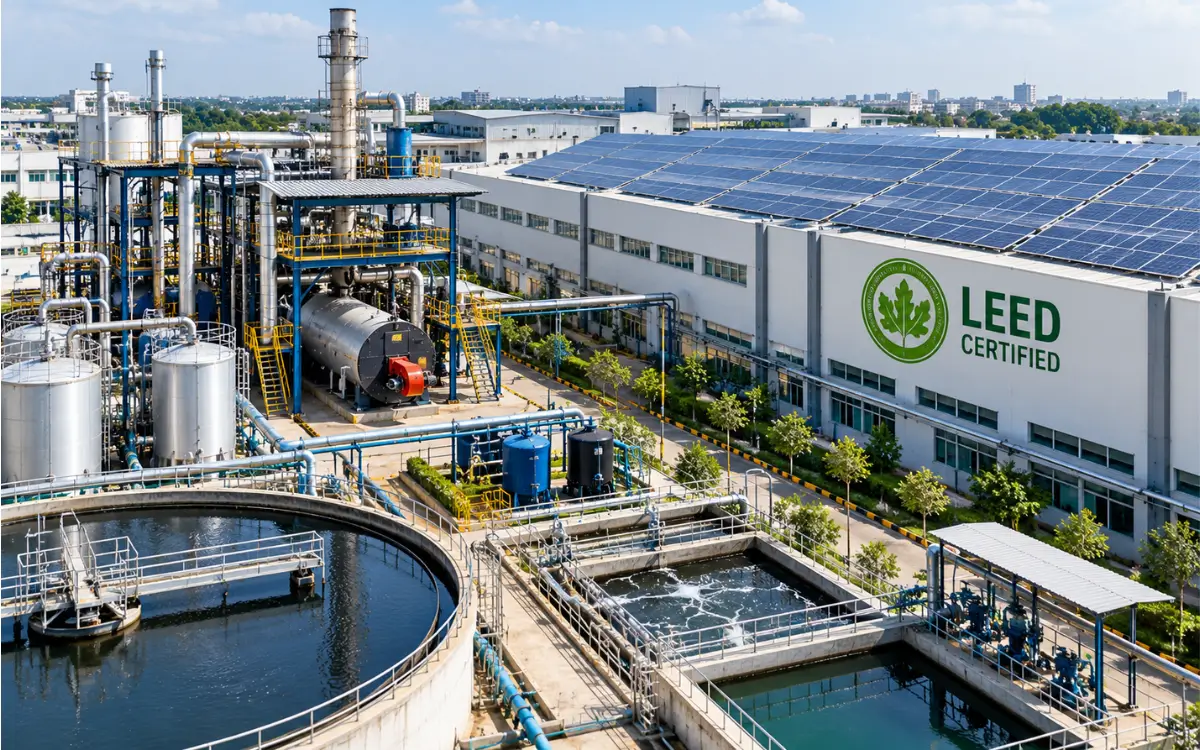
Bangladesh has more LEED-certified garment factories than any other country, a fact that surprises people outside the industry given how the certification is more commonly associated with office buildings and commercial real estate in most public conversation about green building standards. For garment and textile manufacturers, LEED certification has become a genuine commercial differentiator with major buyers, and the utility systems covered throughout these guides turn out to be central to actually earning it, not a peripheral consideration.
What LEED Certification Actually Evaluates
LEED (Leadership in Energy and Environmental Design), administered by the US Green Building Council (USGBC), certifies buildings against a points-based system covering multiple credit categories, energy, water, materials, indoor environmental quality, and site considerations among them, with certification levels (Certified, Silver, Gold, and Platinum) determined by total points achieved. For a textile or garment manufacturing facility, the energy and water credit categories connect most directly to the utility systems covered across these related guides, making utility performance a genuinely load-bearing part of a facility’s certification strategy rather than a minor contributing factor.
Energy Credits
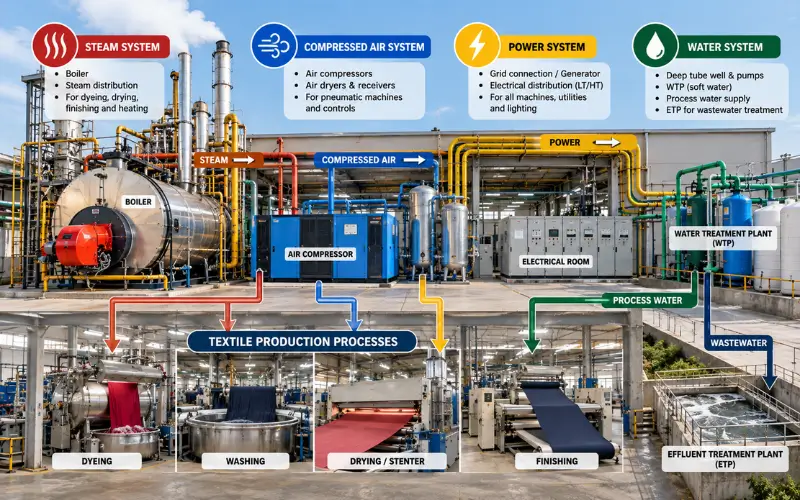
LEED’s energy credit category rewards demonstrated energy efficiency relative to a baseline building performance standard, along with credits for renewable energy generation and energy performance measurement and verification. This connects directly to nearly everything covered elsewhere on the site: boiler efficiency and correct sizing, compressed air system efficiency, steam distribution losses from failed traps and poor insulation, and on-site solar generation all factor into a facility’s actual energy performance relative to the baseline LEED measures it against.
A facility pursuing meaningful energy credit achievement generally needs to address the same maintenance-layer losses, steam traps, insulation, compressed air leaks, that a well-run utility program addresses as cost-saving measures in their own right, since LEED’s energy credits reward actual measured performance improvement, not just the presence of efficient equipment on paper. A facility with an efficient boiler but a steam distribution system riddled with failed traps won’t show the energy performance its equipment specifications alone would suggest, and that gap shows up directly in LEED energy credit scoring.
Water Efficiency Credits
LEED’s water efficiency credits reward reduced water consumption relative to a baseline, covering both process water use and, depending on the specific credit and rating system version, water used in restroom fixtures and other building water demand. For a textile wet processing facility specifically, process water consumption, driven heavily by liquor ratio and machine technology as covered in our Processing Machinery guide, represents a much larger share of total water demand than fixture water use, making machinery choices made for entirely separate reasons, running cost reduction primarily, directly relevant to a facility’s water credit achievement under LEED.
Water reuse and recycling, including the kind of condensate and effluent heat recovery covered elsewhere where it also captures water for reuse rather than just heat, can contribute meaningfully to water efficiency credit achievement, connecting a facility’s utility efficiency investments made on pure cost grounds to genuine certification benefit as a secondary outcome.
Measurement and Verification Requirements
LEED certification generally requires actual measured performance data, not just design specifications or equipment ratings, which means a facility pursuing certification needs functioning metering and monitoring infrastructure across its major utility systems, separately metered electricity, gas, and water consumption at a level of granularity sufficient to demonstrate actual performance against the credit requirements being pursued. A facility without this metering infrastructure in place faces a real, sometimes underestimated cost and lead time to install proper metering before certification documentation can even be assembled, which is worth factoring into certification project planning from the outset rather than discovering partway through the certification process.
Which LEED Rating System Applies
LEED offers different rating systems tailored to different building types, and a textile or garment manufacturing facility typically pursues certification under LEED for Building Design and Construction (BD+C) for new facilities, or LEED for Existing Buildings: Operations and Maintenance (O+M) for facilities already in operation seeking certification based on ongoing performance rather than original design and construction. This distinction matters directly for how utility performance gets evaluated: a new-construction certification under BD+C evaluates designed and modeled performance against baseline standards at the point of construction, while an existing-building certification under O+M evaluates actual measured operating performance over a defined performance period, which is exactly why the metering and monitoring infrastructure covered above matters even more directly for a facility pursuing O+M certification on an already-operating plant, since there’s no design model to fall back on, only real measured data.
What LEED Credits Actually Cost to Meet
The cost of achieving specific LEED energy and water credits varies enormously depending on a facility’s starting condition. A facility that’s already invested in the efficiency measures covered in related guides, low liquor ratio dyeing machines, a disciplined steam trap and insulation maintenance program, VSD compressed air technology, rooftop solar, is starting from a position where meaningful credit achievement may require primarily documentation and metering investment rather than major capital upgrades. A facility starting from older, less efficient equipment and no established efficiency program faces a considerably larger combined cost, since the underlying efficiency improvements themselves, not just the certification documentation process, need to happen first.
This is worth stating plainly for any facility owner evaluating whether to pursue LEED certification: the certification process itself has real cost, registration, documentation, and third-party review fees among them, but for most textile and garment facilities, the larger cost is the underlying efficiency and water performance improvement needed to actually earn the credits being pursued, not the certification administration itself.
Certification Level and Strategic Positioning
Higher certification levels, Gold and Platinum particularly, require deeper credit achievement across multiple categories, and a facility targeting Platinum certification specifically is committing to a considerably broader efficiency program than one targeting baseline Certified status. Given how directly major buyers increasingly reference LEED certification level in sourcing decisions and public sustainability reporting, the choice of target certification level is as much a commercial positioning decision as a technical one, worth making deliberately with input from both the facility’s own operations team and its sales or account management function that understands what level of certification actually moves the needle with the specific buyers the factory serves or wants to serve.
Communicating the Business Case Internally
Pursuing LEED certification requires investment from operations, finance, and often sales or account management functions simultaneously, and getting genuine buy-in across those functions matters as much as the technical certification work itself. Operations teams need to understand that certification-driven efficiency investment isn’t a compliance burden layered on top of their existing responsibilities, it’s largely the same efficiency work covered elsewhere that reduces their own operating costs directly. Finance teams evaluating the capital request benefit from seeing the certification cost framed against both the direct utility savings the underlying investments deliver and the commercial value of certification itself in retaining or winning buyer business. And sales or account management functions need to actually understand what certification level moves the needle with specific buyers, so the certification target being pursued reflects genuine commercial priority rather than an arbitrary internal goal disconnected from what buyers actually care about.
A LEED certification project that’s positioned internally as “the environmental team’s initiative” rather than a genuine cross-functional business investment tends to struggle for sustained budget and attention compared to one where every relevant function understands and supports the actual case being made for it.
Approaching LEED as an Extension of Good Utility Management
The practical takeaway across this article is that LEED certification for a textile or garment facility isn’t a separate initiative running parallel to good utility management, it’s largely the same set of investments and disciplines covered in related guides, correctly sized boilers, well-maintained steam and compressed air distribution, efficient dyeing machinery, on-site renewable generation, formalized into a certification framework with its own documentation and measurement requirements layered on top. A facility that’s genuinely invested in the utility efficiency measures covered elsewhere for their direct cost-saving value is already most of the way toward a credible LEED certification case, which is worth recognizing as a reason to prioritize those underlying investments even before a specific certification project is formally underway.
Frequently Asked Questions
Why does Bangladesh have so many LEED-certified garment factories?
LEED certification has become a genuine commercial differentiator with major apparel buyers, and Bangladesh leads all countries in LEED-certified garment facilities as a result of that sourcing pressure combined with real efficiency investment.
Does LEED certification require new capital investment beyond normal utility efficiency work?
For a facility that’s already invested in efficient machinery, disciplined maintenance, and renewable generation, certification may require mainly documentation and metering investment rather than major new capital upgrades.
What’s the difference between LEED BD+C and LEED O+M for a factory?
BD+C applies to new construction and evaluates designed performance, while O+M applies to existing buildings and evaluates actual measured operating performance over a defined period, which matters for what documentation is required.
What metering infrastructure does LEED certification actually require?
Separately metered electricity, gas, and water consumption at a level of granularity sufficient to demonstrate actual performance against specific credits, not just a single facility-wide utility bill.