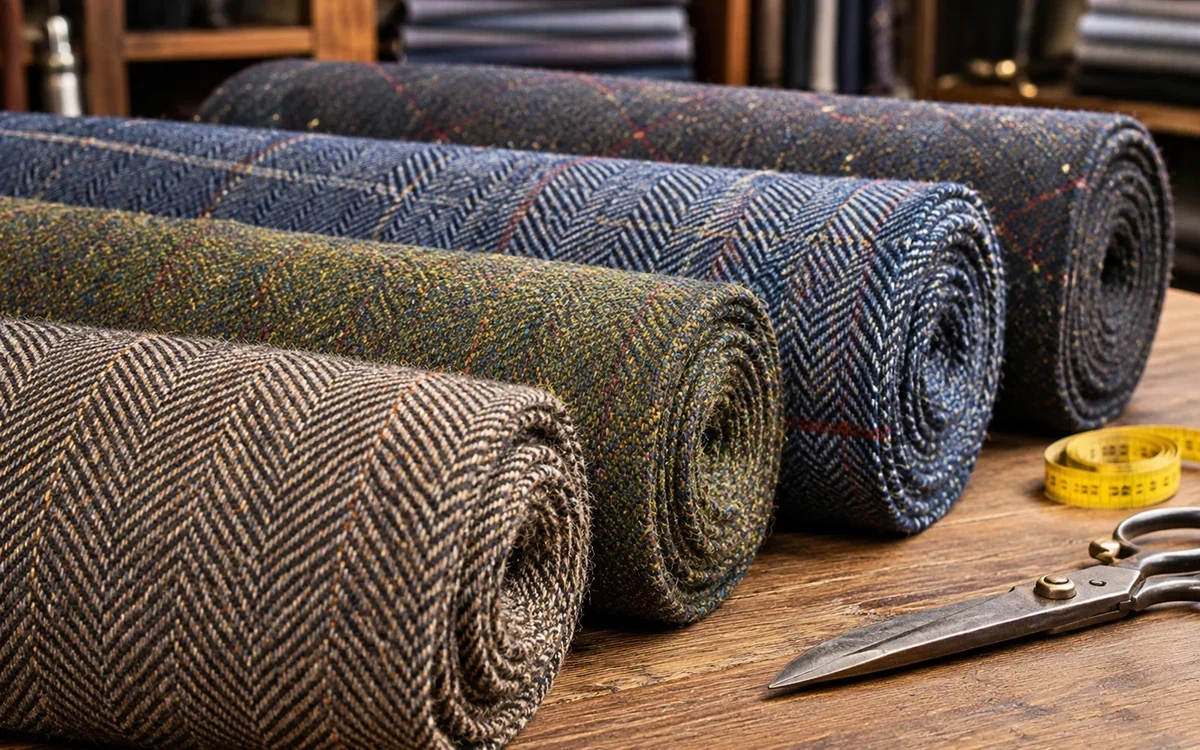
Tweed fabric is a rough, sturdy, textured woollen cloth, traditionally woven in twill or herringbone patterns in muted, flecked colours. Run your hand across a tweed jacket and you feel a slightly hairy, springy surface with a firm body underneath. It is warm, hard wearing and weather resistant, and it has been the cloth of country jackets, caps, waistcoats, skirts and coats for generations. In recent years tweed has also become a fashion fabric in lighter, softer forms, including bouclé style suiting in designer jackets.
Tweed is simple to describe but hard to sew well. The loose, bulky structure frays, the patterns demand matching, and the surface can shine or flatten if it is pressed wrongly. This guide explains what tweed is, how it is spun, woven and finished, the main types and patterns, how it compares with other wool cloths, and how to cut, sew, press and care for it. It is written for merchandisers, designers, production staff and students.
What is tweed fabric?
Tweed is a medium to heavy woollen fabric made from woollen spun yarn, usually in a plain, twill or herringbone weave. The yarns are bulky and slightly uneven, so the cloth has a rustic texture. Many tweeds are woven from yarns of several colours twisted or blended together, which gives the speckled, heathered look that tweed is known for.
Tweed originated in Scotland and Ireland, where it served as a weatherproof cloth for outdoor work and sport. The word is often traced to a trade name that came from a misreading of the word tweel, the Scots word for twill, in association with the River Tweed. Whatever its exact origin, the cloth has a strong link to the British Isles.
Most tweed is made from sheep wool. Modern tweed can include blends with polyester, acrylic, viscose, nylon or cotton, and some fashion tweeds use fancy yarns, ribbons and metallic threads.
Wool is explained in the guides on protein fibres, wool and silk properties and why we wear woollen clothes in winter.
How tweed is made
Woollen spun yarn
Tweed uses woollen spun yarn and not worsted yarn. In woollen spinning, the wool is carded and the fibres are left lying in many directions. The yarn is bulky, hairy and soft, with trapped air. This gives tweed its warmth and rough texture. Worsted yarn, by contrast, is combed so that the fibres lie parallel, which gives a smooth, thin, strong yarn used for suiting and gabardine. For the preparation steps, the guides on wool processing and wool from sheep to yarn are helpful.
Many tweeds are made from fibre dyed in several colours before carding. The dyed fibres are blended in the carding step to create flecks and heathers in the yarn. The same technique is used in melange yarns, which are explained in the page on melange yarn and how it is made.
Weaving
Tweed is woven in several structures.
- Plain weave. Used for lighter and fancy tweeds.
- Twill weave. The most common, giving diagonal ribs. See twill weave types, structure and uses.
- Herringbone. A twill that reverses direction in stripes, giving a zigzag pattern like fish bones.
- Houndstooth or dogtooth. A broken check built from a twill with two colours.
- Checks and windowpane. Overchecks in contrasting colour.
- Plaid and tartan like patterns. Mixed colour checks.
- Basket weaves and fancy structures. Used in fashion tweeds.
Finishing
After weaving, tweed is finished to make it firm and stable.
- Burling and mending. Removing knots and small flaws by hand.
- Scouring. Removing oils and impurities from the wool.
- Milling or fulling. The cloth is worked in warm soapy water under pressure, so the wool fibres felt together slightly. This makes the fabric denser and shrinks it to its final width.
- Raising or brushing. In some tweeds, a light nap is raised, similar to the process used in flannel fabric.
- Cropping and pressing. To set the surface.
- Decatising or steaming. To stabilise the cloth and improve dimensional stability.
- Optional treatments. Water repellent, moth proofing or shrink resist.
Types of tweed
| Type | Description | Typical use |
|---|---|---|
| Harris tweed | A protected name, legally defined as tweed handwoven by islanders in their homes in the Outer Hebrides of Scotland, from pure virgin wool dyed and spun there | Jackets, bags, caps, premium garments |
| Donegal tweed | Irish tweed with coloured slubs or flecks in the weave | Jackets, coats, trousers |
| Shetland tweed | Lighter and softer, made from Shetland wool | Jackets, skirts, scarves |
| Saxony tweed | Fine, soft merino wool tweed | Women’s tailoring, lighter jackets |
| Cheviot tweed | Rougher, harder wearing, from Cheviot wool | Outdoor wear, coats |
| Herringbone tweed | Zigzag twill pattern | Jackets, overcoats |
| Houndstooth tweed | Broken check pattern | Jackets, skirts, caps |
| Windowpane and overcheck tweed | Wide check lines | Country jackets, trousers |
| Fashion or bouclé tweed | Loose weave with fancy yarns, often with ribbons or metallic threads | Designer jackets, dresses |
| Wool blend tweed | Wool with polyester, acrylic or viscose | Lower cost garments |
| Cotton or synthetic tweed look | Imitation tweed in other fibres | Light jackets, home textiles |
Harris tweed is a legally protected term, and its definition is set by an Act of Parliament. If a buyer asks for it, confirm the current rules and certification with the Harris Tweed Authority, and do not use the name for ordinary wool tweed.
Properties of tweed fabric
Advantages
- Warm. The bulky woollen yarn traps air and insulates well.
- Hard wearing. Dense cloth resists abrasion and snags.
- Weather resistant. Wool naturally sheds light moisture, and milling makes the cloth dense.
- Breathable. Wool absorbs and releases moisture.
- Good body and shape. Holds structure in tailored garments.
- Rich texture and colour. Flecked, heathered colours hide dirt and wear.
- Long life. A well made tweed jacket can last decades.
- Biodegradable fibre. Wool is a natural fibre, though finishes and blends affect this.
Limitations
- Heavy and bulky. Thick seams and layers are hard to handle.
- Frays easily. Loose weaves unravel quickly at cut edges.
- Scratchy in coarse grades. Some tweeds irritate sensitive skin, so lining is often used.
- Shrinkage and felting. Wool can shrink in water and heat.
- Moth damage. Wool is attractive to moths and carpet beetles.
- Shine from pressing. Hot, dry pressing flattens the surface.
- Costly. Quality wool tweed is expensive.
- Pattern matching is demanding. Checks and herringbones need careful cutting and sewing.
Typical weights
Weights vary widely. These figures are rough guides.
| Type | Rough GSM |
|---|---|
| Light fashion tweed | About 250 to 350 |
| Standard jacket tweed | About 350 to 500 |
| Heavy outdoor tweed | About 450 to 650 |
| Skirt and trouser tweed | About 300 to 450 |
For measuring weight and comparing cloths, see the guide to GSM, its meaning and calculation and the page on fabric types, names, GSM and best uses.
Uses of tweed fabric
- Jackets and blazers. The classic use. See parts of a jacket and parts of a blazer.
- Coats. Overcoats and short coats. See parts of a coat.
- Waistcoats and vests.
- Trousers and skirts.
- Caps and hats. Flat caps and similar styles.
- Bags and accessories.
- Upholstery and home textiles. Cushions, throws and chair covers.
- Fashion jackets and dresses. Light and fancy tweeds in modern collections.
What a buyer should specify
- Fibre content and blend ratio
- Weave, such as twill, herringbone or houndstooth, and pattern repeat size
- Yarn type, woollen spun, and yarn count
- Fabric weight and finished width, with tolerance
- Finish, such as milled, brushed, decatised, water repellent, moth proofed
- Shrinkage limits and the care method, usually dry clean
- Colour fastness to dry cleaning, rubbing, perspiration and light. See colour fastness tests.
- Pilling and abrasion grades, as agreed
- Shade standard with a swatch, and tolerance for flecked colour across rolls
- Defect limits and inspection method, such as the 4 point system
- Roll length and packing, using protective wrapping
Tweed has many natural variations in the yarn. A good specification states which variations, such as slubs and flecks, are part of the design and which are faults.
Cutting tweed
- Relax the fabric. Allow the roll to rest, since wool can spring back after tension.
- Check skew and bow. In check and herringbone patterns, skew shows clearly. See bowing and skewing in fabric.
- Test shrinkage. Allow in the pattern. See pattern making based on fabric shrinkage.
- Pattern matching. Match checks and herringbone lines across centre front, pockets, collar, sleeves and side seams. This calls for a marker made with the pattern in mind and extra fabric. The guides to marker making and marker efficiency explain the planning.
- One direction cutting. Tweed may have a slight nap or shade difference with direction. Cut all pieces in one direction.
- Single ply or low lays. For accurate pattern matching, many factories cut tweed in few plies, sometimes single ply, using sharp shears or a cutter.
- Sharp knives and clean edges. Fraying starts at the cut, so handle pieces gently. See knife cutting machines.
- Interlining and canvas. Tailored garments use interlining and canvas. See types of interlining in garments.
- Spreading. Use low tension. See fabric spreading methods.
Sewing tweed
- Needle. A sharp needle in a medium to heavy size, suited to the weight and the number of layers. Change often. See sewing needle parts, size and point selection.
- Thread. Strong thread in a colour that matches the dominant shade of the cloth. See types of sewing thread.
- Stitch length. Use a slightly longer stitch than for light fabric, since short stitches cut and bulk the seam.
- Seams. Press open, trim and grade seam allowances, and finish raw edges with overlock, binding or a lining. See binding and piping in garments for a neat way to finish edges.
- Lining. Many tweed garments are lined to reduce scratchiness and hide raw seams.
- Stabilise key seams. Use tape on shoulders, necklines and pocket mouths, and stay stitch curves. See types of tapes in garments.
- Buttons and buttonholes. Use strong, sized buttonholes and reinforce with thread or interfacing. See types of buttons in garments.
- Bulk control. Trim corners, press carefully and avoid stacking seams where possible.
- Machine speed. Moderate speed for thick layers. See sewing machine speed.
For the line layout of a tailored garment, the page on the operation breakdown, SMV and layout of jacket manufacturing and the article on blazer manufacturing show a typical sequence.
Pressing tweed
- Use steam, not a hot dry iron. Steam relaxes wool and lifts the surface.
- Use a pressing cloth. A cloth of wool or cotton prevents shine.
- Press from the wrong side where possible.
- Use a tailor’s ham or sleeve board for shaping.
- Do not press flat the texture. Lift the iron and press lightly, and let the cloth cool and dry on the board.
- Test on scrap. Settings depend on fibre and finish.
The guide to pressing and ironing in garment manufacturing covers general methods.
Common tweed problems
| Problem | Likely cause | Prevention |
|---|---|---|
| Pattern mismatch at seams | Poor marker, skew, cutting without match plan | Check skew, plan marker, match at key points |
| Fraying | Loose weave | Overlock, bind or line seams, handle gently |
| Shiny patches | Hot, dry pressing | Use steam, pressing cloth, lower heat |
| Shrinkage | Wool relaxing or felting | Test, decatise, allow in pattern |
| Bulky seams | Thick fabric | Grade seam allowances, trim, press open |
| Needle breaks | Thick layers, wrong needle | Use suitable size, reduce speed |
| Shade variation | Fleck colour variation across rolls | Shade sort, cut sets from the same roll |
| Scratchy feel | Coarse wool | Line the garment, select softer wool |
| Moth damage | Poor storage | Store clean, use moth control, advise customers |
| Seam slippage | Loose weave | Test slippage, add stitching, use stay tape |
| Pilling | Short fibres and friction | Better yarn and finishing, test |
Care of tweed garments
- Most tweed garments are dry cleaned, following the care label.
- Brush gently with a soft clothes brush to remove dust.
- Air garments between wears, and avoid frequent cleaning.
- Hang on a well shaped hanger.
- Store with moth protection, and keep clean and dry.
- Steam wrinkles from the wrong side, and avoid direct hot ironing.
- Avoid hot tumble drying, which can felt and shrink wool.
Care wording should follow the buyer’s tests, and the guide on care labels and wash symbols shows how symbols are used.
Final thoughts
Tweed fabric is a woollen cloth with rustic texture, flecked colour and strong weather performance. It stays popular in country wear, tailoring and designer jackets because it is warm, durable and distinctive. It is also a cloth that rewards care, since its loose structure frays, its patterns need matching and its surface can shine if mishandled.
For good results, write a clear specification for fibre, weave, weight and finish, check skew and shrinkage before cutting, match patterns at key seams, use suitable needles and finished seams, press with steam and a cloth, and test a sample through dry cleaning or the buyer’s chosen care method before bulk.
Frequently asked questions
Traditionally wool, spun as woollen yarn and woven in twill, herringbone or check patterns. Modern tweeds also use blends with polyester, acrylic, viscose or cotton.
Wool is the fibre. Tweed is a type of fabric, usually made from woollen spun yarn, with a rough, flecked, durable texture.
Harris tweed is a protected name for tweed woven by hand by islanders in their homes in the Outer Hebrides from locally dyed and spun pure virgin wool. Confirm the current legal definition before using the name.
Coarser tweeds can feel scratchy, which is why many garments are lined. Softer wools such as merino or Shetland give gentler cloth.
Use steam and a pressing cloth, from the wrong side, with light pressure, and let the fabric cool on the board.
Yes. The loose, bulky yarns unravel at cut edges, so seams need overlock, binding or lining.
Most tweed garments should be dry cleaned. Washing can shrink or felt the wool, so follow the care label.