
Look at a grey sweatshirt closely. The colour is not flat. If you bring it close to your eyes, you will see tiny flecks of white, dark grey and sometimes charcoal, all mixed together like salt and pepper. That soft, heathered look comes from melange yarn. It is one of the most common yarn types in casual wear, and it is also one of the most misunderstood, because the colour is made before the yarn exists.
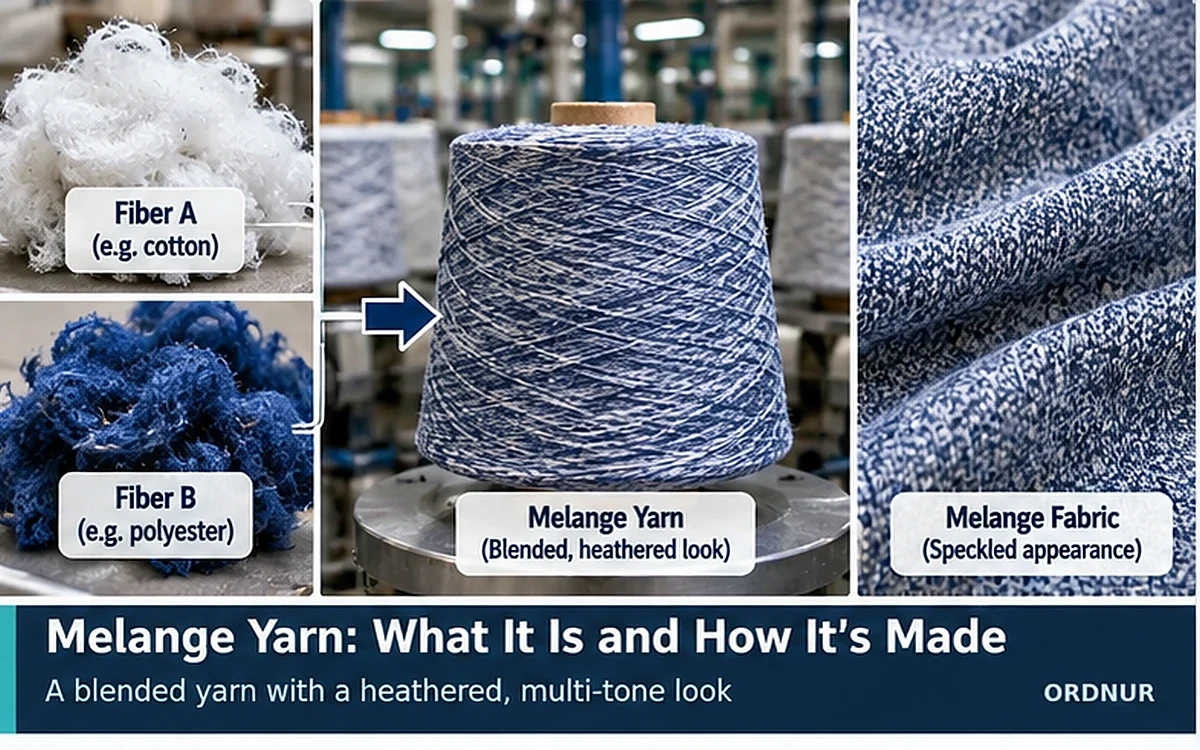
This guide explains what melange yarn is, how it differs from other coloured yarns, the main ways to make it, where it is used and what quality problems to watch. There is a worked example for a grey melange blend, including fibre quantities and a draw frame blend with real numbers. If you want to see how yarn is made from fibre in general, our guide on making yarn from fibre gives the full flow.
What is melange yarn?
Melange (from the French word for “mixture”) is yarn spun from a blend of fibres of different colours. The fibres are coloured first, mixed second and spun third. The final yarn shows a mix of tones, which gives a heathered or marled surface.
The most familiar example is grey melange: white (undyed) cotton blended with a small share of black or dark grey fibre. Other common versions are blue melange, green melange and charcoal melange. In the United States, the same look is called heather, as in “heather grey.” In the United Kingdom, similar yarns are sometimes called marl.
A melange yarn is different from a dyed yarn in one important way. A dyed yarn has one colour all over. A melange yarn has several colours in the same strand.
How melange differs from similar yarns
| Yarn | How the effect is made | Look |
|---|---|---|
| Melange | Different-coloured fibres blended before spinning | Soft, speckled, heathered |
| Twist or marl yarn | Two coloured yarns twisted together | Stripy, spiral look |
| Space-dyed yarn | Colour applied in sections along the yarn | Long colour changes |
| Slub yarn | Thick and thin places made by varying draft | Textured, same colour |
| Solid dyed yarn | One dye bath | Flat colour |
| Ombre | Gradual colour change in the fabric | Gradient |
Melange yarns are sometimes confused with slub yarns, which are about texture and not colour. For slub, see our guide to fancy yarns.
Why melange is popular
- Hides dirt and wear. The mixed colour hides small stains and fading better than a flat colour.
- Soft, natural look. It looks casual, lived-in and warm.
- Fits many markets. Sportswear, basics, hoodies and kidswear use it widely.
- Lower dye cost in some cases. A grey melange T-shirt needs no dyeing of the final fabric, because the colour is already in the fibre. Only a small share of fibre is dyed.
- Easy to repeat. Once the blend is set, many lots look the same.
How melange yarn is made
There are three main routes. The best choice depends on the colour, the fibre and the quantity.
Route 1: Fibre dyeing, then blending (classic melange)
- Dye the fibre. A part of the fibre is dyed in loose form (stock dyeing). For grey melange, black or dark-grey fibre is dyed.
- Blend in the blow room or at the draw frame. The dyed fibre is mixed with undyed fibre in a set ratio.
- Card, draw and spin. The mix is carded into sliver, drawn out on draw frames to even it, then spun on a ring frame, rotor or other spinning system.
Two places to blend:
- Blow room blending. Bales or lots of different fibre are fed together into the opening line. It is simple but less accurate. Small shifts in feed can change the shade.
- Draw frame (sliver) blending. Slivers of different colours are fed together into the draw frame. This gives better control of the ratio and is the preferred route for tight shade matching.
Our articles on blending in a spinning mill and mixing in the spinning mill explain these steps in detail.
Route 2: Blending different fibres that take dye differently
Here the mix of fibres is made on purpose, and then the yarn or fabric is dyed in one bath. Because each fibre reacts in its own way, a two-tone effect appears.
- Cotton and polyester. If you dye with reactive dye only, the cotton takes colour and the polyester stays white. The result is a heather look.
- Cationic dyeable polyester (CDP). A special polyester that takes dye in a different way from regular polyester allows two-tone effects in one dye bath.
- Cotton and viscose. These differ slightly in dye affinity and can give a light variation.
This is common in “athletic heather” fabrics, such as 90 percent cotton and 10 percent polyester.
Route 3: Tops of different colours (wool and worsted)
In wool spinning, dyed tops are blended in gilling and drawing, to make the yarns used in tweeds and heathers. The idea is the same as route 1.
Typical melange recipes
| Name | Typical blend | Notes |
|---|---|---|
| Light grey melange | About 97 to 98% white cotton, 2 to 3% black cotton | Very light speckle |
| Grey melange | About 90% white cotton, 10% black viscose or cotton | Common basic grey |
| Dark grey or charcoal melange | About 60 to 70% white, 30 to 40% black | Heavy speckle |
| Athletic heather | About 90% cotton, 10% polyester (dyed in one bath) | Soft, sporty |
| Anthracite melange | About 30% white, 70% black | Very dark with light flecks |
These are rough guides. Every mill and buyer sets its own recipes and standards, and the proportions are often by weight. Viscose is often used for the dark portion because it takes dark shades well, but cotton can also be used.
A worked example: grey melange at the draw frame
Let us calculate the fibre needed and a draw frame blend for a grey melange yarn.
Part 1: Fibre quantity
Given
- Target: 1,000 kg of finished yarn
- Blend: 90 percent white cotton, 10 percent black-dyed viscose by weight
- Total waste in the blow room and card: 6 percent of the input weight (so 94 percent becomes sliver)
Step 1: Fibre input needed.
Input = 1,000 ÷ 0.94 = 1,063.8 kg
Step 2: Split by blend.
- White cotton = 1,063.8 × 0.90 = 957.4 kg
- Black viscose = 1,063.8 × 0.10 = 106.4 kg
Step 3: Dye for the black viscose.
A deep black on viscose may use about 4 percent dye on weight of fibre (this varies with dye and shade).
Dye = 106.4 × 0.04 = 4.26 kg
Stock dyeing costs more per kg than the cotton, but only about 10 percent of the mix is dyed, so the cost per kg of yarn stays low.
Part 2: Draw frame blending
Another way to blend is to put dyed and undyed slivers together at the draw frame. The blend ratio depends on the number of slivers of each type, and their weight per metre.
Given
- Feed: 10 slivers in total at the draw frame
- 9 white cotton slivers and 1 black viscose sliver
- Each sliver weighs 5 g per metre (5 ktex)
Step 1: Weight of the feed per metre.
10 slivers × 5 g/m = 50 g/m
Step 2: Blend ratio.
- White = 9 × 5 = 45 g/m, which is 45 ÷ 50 = 90 percent
- Black = 1 × 5 = 5 g/m, which is 5 ÷ 50 = 10 percent
The blend is exactly 90:10 by weight.
Step 3: Draft.
If the delivered sliver weighs 5 g/m, the draft is feed weight ÷ delivered weight = 50 ÷ 5 = 10. The machine delivers 10 metres of sliver for each metre of feed.
If the black sliver is slightly heavier, say 5.4 g/m, then the feed is 45 + 5.4 = 50.4 g/m and the black share is 5.4 ÷ 50.4 = 10.7 percent. A shift of 0.4 g/m moves the black share by 0.7 points. That small change can produce a visible shade difference between lots, which is why draw frame sliver weights are controlled closely.
Most mills pass the sliver through two draw frame passages to improve mixing. Because two passages are used, each dyed fibre is spread through the sliver evenly rather than clumped.
Quality issues in melange yarn
| Problem | Cause | Fix |
|---|---|---|
| Shade differences between lots | Uneven blend ratio, dye lot differences | Weigh slivers, standard recipes, keep records |
| Streaks or patches of dark fibre | Poor mixing | Extra draw frame passage, check feed |
| Barre (stripes in fabric) | Mixed lots of yarn or varying count | Use one lot per garment, control count |
| Colour fading or crocking | Weak dye fastness of the dyed fibre | Use fast dyes, test colour fastness |
| Fibre damage | Heavy stock dyeing | Gentle dyeing, correct process |
| Different shrinkage of fibres | Cotton and viscose behave differently | Pre-shrink, test blends |
| Neps and white specks | Short, immature cotton | Combed cotton, good fibre quality |
Shade variation is the biggest headache. Our article on shade variation in fabric covers the common causes, and our page on colour fastness tests shows how mills check colour stability.
Where melange yarn is used
- T-shirts and tops. Grey melange tees are a staple. See our guide to cotton fabric for T shirts for yarn and GSM choices.
- Sweatshirts and hoodies. Fleece in grey melange is a classic.
- Sportswear. Athletic heather tops and joggers.
- Knitwear. Sweaters, cardigans and scarves.
- Socks. Mixed colour yarn hides wear.
- Kidswear. Practical colours that hide stains.
- Home textiles. Throws, cushions and upholstery.
How to specify melange yarn
When you buy or order melange yarn, give clear information.
- Fibre content. For example, 90 percent cotton and 10 percent viscose.
- Count. For example, 30s Ne.
- Spinning system. Ring, compact, rotor.
- Colour. A reference such as “grey melange, light” with a physical standard or Pantone code.
- Percentage of dyed fibre. If the buyer needs it.
- Quality targets. Strength, evenness and imperfections.
- Test requirements. Colour fastness to washing, rubbing and perspiration.
For the count itself, see our guide on calculating English yarn count.
Care of melange fabrics
- Wash at the temperature on the label, usually cool or warm.
- Wash dark and light melanges separately for the first washes.
- Avoid strong bleach, which can lighten the dyed fibres unevenly.
- Dry in the shade to protect dyed fibres from fading.
Final thoughts
Melange yarn gets its colour before it is a yarn. Coloured fibres are blended in a set ratio, then carded, drawn and spun, so each strand shows a soft mix of tones. Grey melange is the best-known case, but the idea works for any colour. The strengths of melange are its look, its stain-hiding quality and, in many cases, its lower dyeing cost. The challenge is control. Small shifts in blend ratio can change the shade from lot to lot.
Our worked example showed how a 90:10 blend is built from 10 slivers, and how a tiny change in sliver weight shifts the black share by nearly a full point. If you buy or make melange yarn, keep the recipe fixed, weigh the slivers and record every lot.
Frequently asked questions
Melange yarn is yarn spun from a mix of fibres of different colours, blended before spinning. It gives a soft, speckled, heathered look.
They describe the same type of look. Melange is the term used in many parts of the world. Heather is the usual term in the United States.
Mostly white cotton is blended with a small share of black or dark grey fibre, often about 10 percent, then carded, drawn and spun together. No dyeing of the final fabric is needed for the grey.
Usually before. The fibres are dyed in loose form, then blended and spun. Some heather effects are made after spinning by dyeing a blend of fibres that take dye differently.
Small changes in the blend ratio, the dye lot or the mixing can alter the shade. Strict control of sliver weights and recipes keeps lots matching.
It can cost more per kilogram than plain white yarn, but it saves the cost of dyeing the whole fabric. The total cost depends on the shade, the blend and the volume.
Melange is about colour, from mixed fibres. Slub is about texture, from thick and thin places in the yarn. A yarn can be both.