Slide your hand over a good cotton bed sheet and you may notice that it feels smoother than a crisp shirt. The soft glow on the surface is no accident. It comes from the sateen weave, a way of interlacing threads so that long floats of yarn sit on the face of the cloth. Few people know the word, yet most have slept on it. Here is the difference between sateen weave and satin in practice.
This guide explains what the sateen weave is, how its structure works, how it differs from satin and from plain weave, what it is used for and how to care for it. A worked example draws the weave pattern thread by thread, counts the float length and calculates the cut size of a sheet that has to survive shrinkage. If you want to see the other basic weaves first, our page on identifying twill, satin and plain weave is a good companion.
What is sateen?
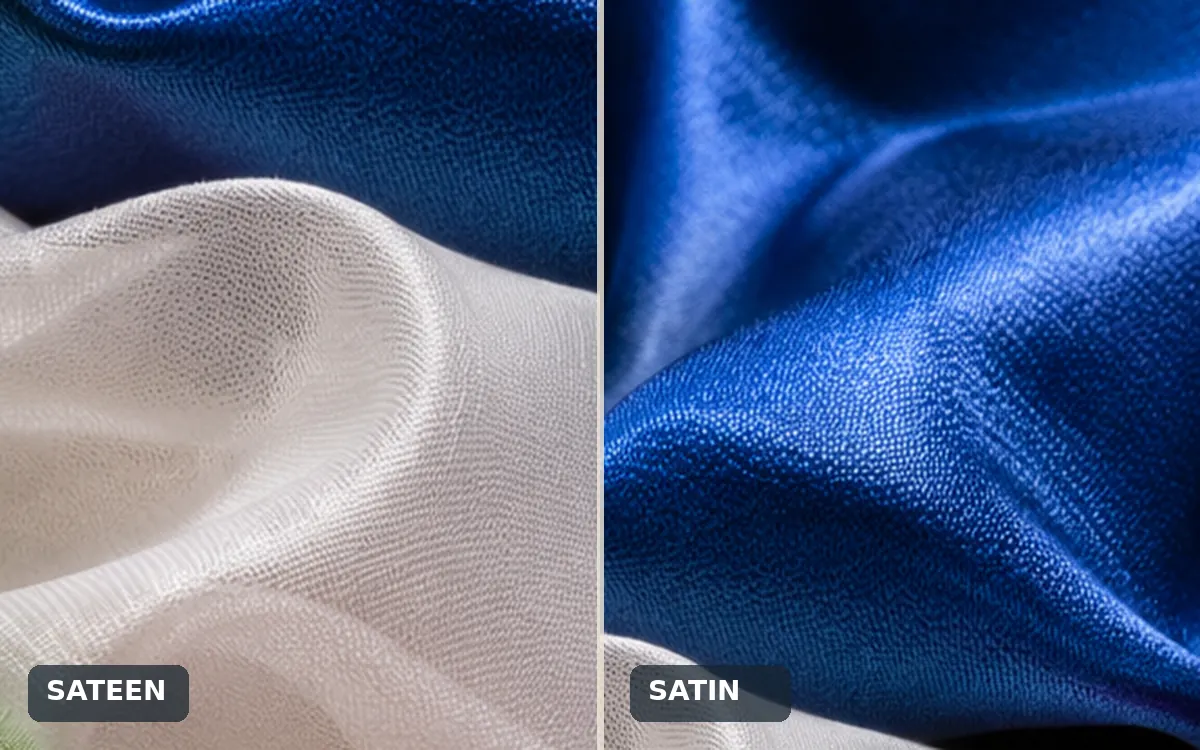
Sateen is a cloth woven in a satin structure, but with the weft yarns floating on the surface instead of the warp. In simple words, the weft (the crosswise threads) passes over most of the warp threads before going under one. One source puts it this way: the surface of satin is mostly warp threads, while the surface of sateen is mostly weft threads. Both are built from “floats”, which are long stretches of yarn that skip over many crossing threads at a time.
Sateen is made from cotton. Satin was traditionally silk and is now also made from polyester, nylon, rayon and acetate. Sateen is most often used for bed sheets or for lining jackets.
The result is a fabric with a shiny appearance and a very soft hand. You can read about the warp-faced cousin in our guide to satin fabric types, characteristics and uses.
How the sateen weave works
Every woven cloth is made of two sets of threads that cross at right angles. The warp runs lengthwise and the weft (or filling) runs across. You can see the basic loom action in our guide to the weaving process from yarn to fabric.
In a plain weave, every thread goes over one and under one. The threads lock together at every crossing, so the surface is flat and slightly textured, and the light scatters in many directions. In a twill, the interlacing steps diagonally. You can read about it in our guide to twill weave types, structure and uses.
In a sateen, the interlacing points are spaced out so that they are never next to each other. Each weft thread floats over several warp threads and then dips under just one. Floats from neighbouring weft threads line up side by side, and they lie smooth and parallel. Light reflects evenly from the long floats, which creates the glow.
The usual structures are written as a number of “ends” in one repeat. A 5-end sateen repeats every five warp threads and five weft threads. An 8-end version repeats every eight. The more ends in the repeat, the longer the floats and the smoother the face.
A weave pattern you can read
Here is a 5-end sateen repeat. Each row is one weft thread (pick). Each column is one warp thread (end). A “W” means the weft is on the surface at that crossing. An “o” means the warp is on top there, which is the interlacing point.
| Pick | End 1 | End 2 | End 3 | End 4 | End 5 |
|---|---|---|---|---|---|
| 1 | o | W | W | W | W |
| 2 | W | W | o | W | W |
| 3 | W | W | W | W | o |
| 4 | W | o | W | W | W |
| 5 | W | W | W | o | W |
Read across row 1. The weft goes under end 1, then floats over ends 2, 3, 4 and 5. That is a float of four. On row 2 the single interlacing point moves to end 3. On row 3 it moves to end 5. Row 4 puts it on end 2, and row 5 puts it on end 4. The point moves two steps each time, and no two points ever touch. This jump of two is sometimes called the move number.
Turn the same grid inside out, with the warp on top and the weft hidden, and you get a warp-faced satin. That is the structural link between the two cloths.
Sateen vs satin vs plain weave
| Feature | Sateen | Satin | Plain weave (e.g. percale) |
|---|---|---|---|
| Surface floats | Weft | Warp | None, over one under one |
| Usual fibre | Cotton | Silk, polyester, nylon, rayon, acetate | Cotton, linen, polyester, blends |
| Surface look | Soft glow | Strong shine | Matte |
| Hand feel | Smooth, soft | Slippery, silky | Crisp |
| Typical use | Sheets, linings | Eveningwear, lingerie, ties | Shirts, sheets, general use |
| Snagging risk | Higher | Higher | Lower |
You will also see the two words mixed up in shops. “Satin sheets” sometimes means a polyester satin and sometimes a sateen cotton weave. The label should tell you the fibre. Check it before you buy.
Why sateen feels the way it does
Several things come together.
- Long floats. Because threads are not locked down at every crossing, they can lie flat and move a little. That makes the cloth drape well and feel supple.
- Cotton fibre. A combed, long-staple cotton yarn is smooth and strong, which supports the soft face. You can read about the spinning side in our guide to combed yarn manufacturing.
- Finishing. Mills often treat sateen with mercerising or similar finishes to raise lustre. The details depend on the mill.
- High thread density. The structure lets weavers pack more threads together than a plain weave can hold, so the face stays tight.
Benefits of the sateen weave
- A soft, smooth hand feel
- A gentle sheen that looks luxurious
- Good drape, which is helpful in curtains, sheets and linings
- Usually a little warmer to the touch than crisp percale, as many shoppers describe it
- A wide choice in weights and colours
Limits of the sateen weave
- Snagging. Floats are long, and a rough surface, a ring or a pet claw can pull a thread loose.
- Pilling. Loose surface fibres can form small balls with friction. Better yarn lowers this.
- Less crisp. If you want a cool, airy feel, a plain weave may suit you better.
- Wrinkles. Many sateens crease, though some are finished to resist it.
- Price. A good sateen with fine combed yarn costs more than a basic plain weave.
None of these makes sateen a poor choice. They simply show where it fits and where it does not.
Common uses
| Use | Why sateen works |
|---|---|
| Bed sheets and duvet covers | Smooth feel against skin, nice sheen |
| Pillowcases | Soft face with a bright look |
| Jacket and coat linings | Slides easily over other clothes |
| Dresses and skirts | Fluid drape, soft glow |
| Curtains and drapes | Hangs well, reflects light |
| Trousers and workwear | Cotton sateen is used in some smooth chino-type fabrics |
| Upholstery and cushions | A formal look for accent pieces |
Some jeans fabrics are also sateen weaves. They have a smooth face and a softer feel than regular twill denim. If you want to compare, see our guide to types of denim fabric.
Thread count: a word of caution
Sateen is often sold with a high thread count. Thread count is the number of warp and weft threads per square inch. Higher numbers can mean a finer, denser cloth, but not always. Some sellers count each ply of a multi-ply yarn as a separate thread, which inflates the number without making the cloth better. A good cloth with fewer, better yarns can feel nicer than a cheap one with a huge count.
A fairer way to compare is to look at three things together: the fibre quality (combed, long-staple cotton is a good sign), the weight in grams per square metre, and the finish. Our guide to GSM meaning and calculation shows how to use weight in your comparison.
How to care for sateen
- Read the care label. Different finishes need different care.
- Wash in warm or cool water on a gentle or normal cycle with a mild detergent.
- Skip strong bleach and harsh fabric softeners. They can dull the finish.
- Do not overload the machine. Crowded washing rubs the surface and raises pills.
- Dry on low or medium heat, or hang to dry. Take sheets out slightly damp to limit creases.
- Iron on a medium setting if needed, ideally while slightly damp or with steam.
- Wash new sets before first use. Cotton can shrink a little.
For the shrinkage side, see our guide to checking fabric shrinkage and our care label and wash symbols guide.
A worked example: reading the weave and sizing a sheet
Let us do three small calculations. The numbers are examples.
Part 1: How long is the float?
In the 5-end sateen above, each weft thread goes under one warp thread and over the other four. Float length = 5 − 1 = 4 threads.
For an 8-end sateen, the float would be 8 − 1 = 7 threads.
Part 2: How often do threads interlace?
In a 5-end sateen, one interlacing point appears in each pick, and each pick has 5 positions. So interlacing frequency = 1 ÷ 5 = 20 percent of crossing points.
In a plain weave, the threads alternate at every crossing, so about 50 percent of crossing points show a warp-over position. Fewer interlacing points means longer floats, a smoother surface and a less crisp feel. It also means the cloth can be less stable and more open to snags.
For the 8-end version, frequency = 1 ÷ 8 = 12.5 percent.
Part 3: Cutting a flat sheet that will shrink
Suppose you want a finished flat sheet of 180 cm × 260 cm after washing. The fabric has a length shrinkage of 3 percent in washing, and width shrinkage of 2 percent.
- Cut length = 260 ÷ (1 − 0.03) = 260 ÷ 0.97 = 268.0 cm
- Cut width = 180 ÷ (1 − 0.02) = 180 ÷ 0.98 = 183.7 cm
Add the hem allowance on top of these cut sizes, say 5 cm at each end, or whatever your spec calls for.
Now check the weight. If the fabric weighs 125 GSM, the finished sheet area is 1.80 × 2.60 = 4.68 m².
Weight = 4.68 × 125 = 585 g of fabric in the finished sheet, before hems.
A heavier 150 GSM sateen would weigh 4.68 × 150 = 702 g. That is 20 percent more cloth (150 ÷ 125 = 1.2), and the price rises with it.
Sateen in a mill and in a factory
For a weaver, sateen needs a loom that can lift the right warp threads in the right order. A dobby or jacquard mechanism handles this, and a loom with enough heald frames (five or eight, in these examples) can weave the pattern. Our guide to jacquard weave fabric explains the more complex end of this family.
For a garment maker, sateen needs a few cautions:
- Use sharp needles to avoid pulling floats.
- Choose a fine thread and a moderate stitch length.
- Keep seam pressure light, so the surface does not mark.
- Test shrinkage before cutting.
- Treat edges well, since floats can fray.
Choosing the right sateen
- Decide the use first. Sheets and linings suit sateen well, while hard-wearing work trousers may need a twill.
- Check the fibre. Cotton sateen and polyester satin look alike but behave differently.
- Look at weight. A light sateen drapes, while a heavy one feels solid.
- Feel it. The face should be smooth and the cloth should not feel stiff or papery.
- Read the care label before you buy, so you know the upkeep.
Final thoughts
The sateen weave puts long weft floats on the face of the cloth, and that is where its smooth feel and soft glow come from. It is made from cotton, it is mostly seen in sheets and linings, and it is the weft-faced partner of satin. The same long floats that make it pleasant also make it more open to snags.
Our worked example showed a 5-end sateen with four-thread floats and only 20 percent interlacing, and it showed that a finished 180 × 260 cm sheet must be cut at about 183.7 × 268 cm to allow for shrinkage. Read the label, compare weight and fibre and pick the weave that matches the way you will use the cloth.
Frequently asked questions
It is a satin-type weave in which long weft floats sit on the surface of the cloth. It is usually made of cotton and has a soft, smooth, slightly shiny face.
Satin has mostly warp threads on the surface and is traditionally silk, though polyester, nylon, rayon and acetate are also used. Sateen has mostly weft threads on the surface and is made of cotton.
It depends on what you like. Sateen feels smoother and softer, while percale (a plain weave) feels crisper and cooler. Neither is better in every case.
It can, because the floats are long and not locked down at every crossing. Use gentle washing and avoid rough hands, rings and sharp edges.
Many people like it for bed sheets because of its smooth feel. It is one of the most common uses of the weave, along with jacket linings.
Cotton sateen can shrink in the first washes. Wash it as the label says and allow for shrinkage if you are cutting your own sheets.
Not always. Counts can be inflated by multi-ply yarns. Look at the fibre quality, weight and finish as well as the number.