Look closely at a washed denim shirt, a textured T-shirt or a rustic cushion cover. You will often see small lumps and uneven thick places along the threads, spaced here and there like knots on a string. This is not a mistake. It is slub yarn, a yarn made with planned thick and thin places that give the fabric a hand-made, textured look. This guide shows how slub yarn is made on a ring frame, step by step.
Slub yarn is one of the most popular fancy yarns in the world. It looks casual, it hides small flaws and it adds interest to plain colours. But it is also a yarn where numbers matter. The thick places change the true count and the weight of the fabric, and a buyer who does not understand this can end up with a cloth that does not match the sample. This guide explains what slub yarn is, how a ring frame makes it, which settings shape the pattern, what it is used for and how to calculate its average count. A worked example is included, with every step checked.
What is slub yarn?
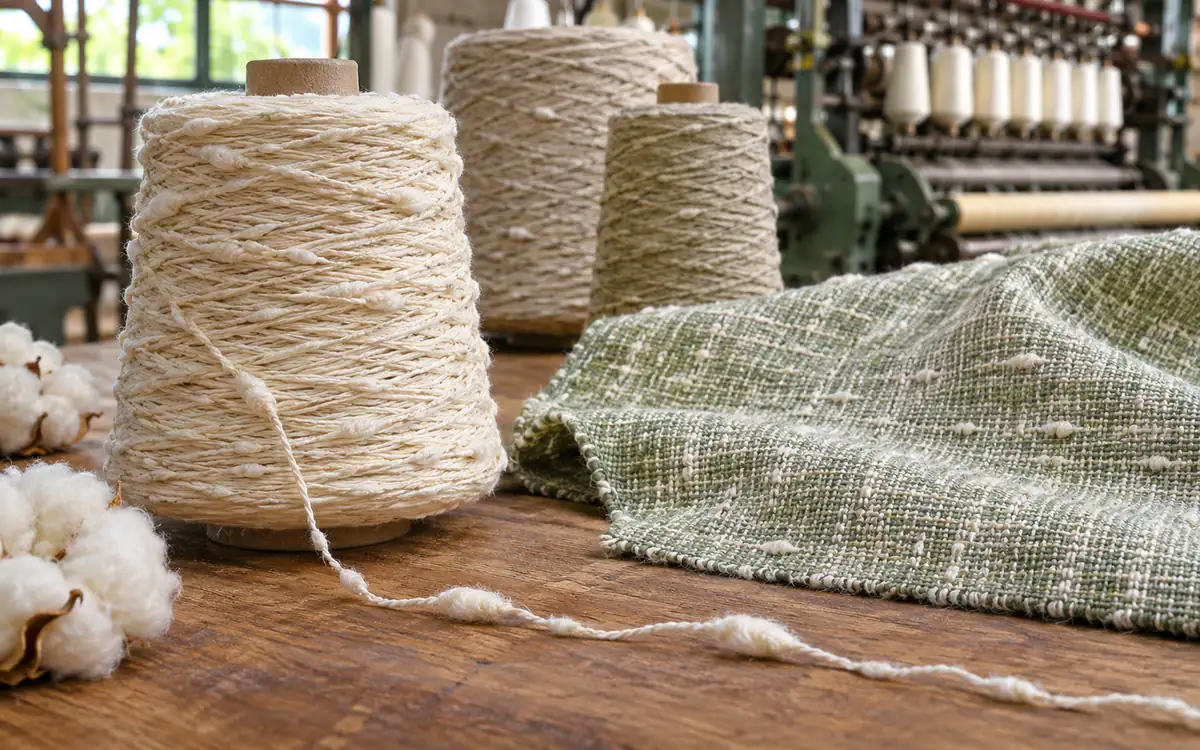
A normal yarn aims to be as even as possible. Slub yarn does the opposite on purpose. It has short, thick sections (the slubs) that appear at regular or random intervals, separated by thinner sections of the base yarn. The thick places are softer and less twisted than the rest, which gives them a slightly puffy, flame-like look.
Slub yarn belongs to the family of fancy yarns. Our guide to fancy yarns, their types and uses shows where slub sits next to bouclé, chenille, flake and others. The difference between a slub and a defect is intent. A thick place that the spinner planned is a design feature. A thick place that nobody planned is a fault. In the mill, the two are checked and sold in very different ways.
How is slub yarn made?
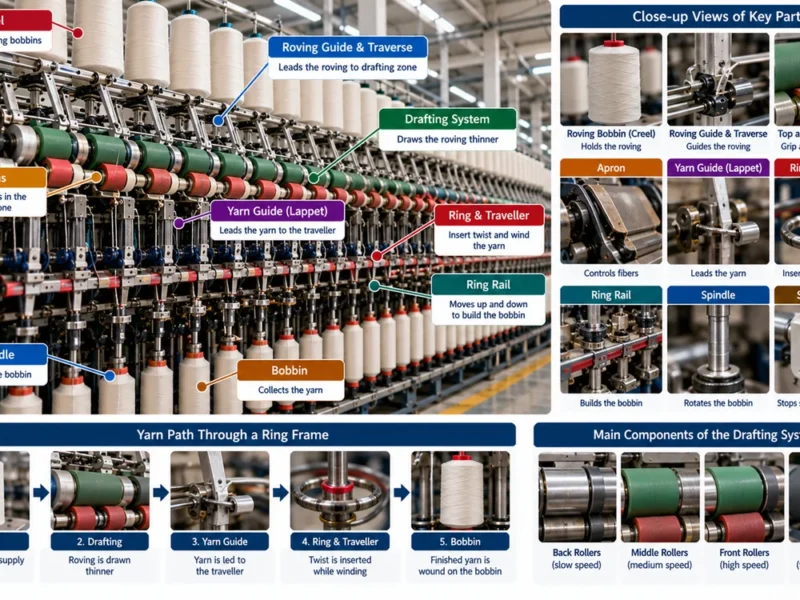
Most slub yarn is spun on a ring frame. In a normal ring frame, a drafting system pulls the roving thinner by a fixed amount, called the draft. In slub spinning, the draft changes in a planned way.
One equipment maker describes it like this: slub yarn is made on ring frames by changing the draft, with the middle and back roller speeds varied to create the required thickness and intervals. When the rollers run faster for a short time, extra roving passes through without being drafted fully, and that extra material forms the slub. In a modern slub attachment, servo motors drive the second and third bottom rollers through a gearbox, a motion controller runs the pattern and encoders watch the roller speeds.
Think of it simply. The ring frame normally pulls out a roving at a steady rate. For a slub, it lets a bit more roving through, without stretching it as much. After a moment it goes back to normal. This repeats along the length.
You can see the machine parts in our guide to the parts of a ring frame, and the full production route in spinning of cotton from bale to yarn.
What controls the slub pattern?
On a modern machine, the operator enters the pattern on a panel. The same maker lists these settings:
| Setting | What it controls |
|---|---|
| Slub diameter (thickness) | How thick each slub is compared with the base yarn |
| Slub length | How long each slub is |
| Yarn length (spacing) | How much base yarn runs between slubs |
| Speed | The accuracy of slub length and the gaps |
| Acceleration and deceleration | The strength and look of each slub |
| Torque | Smooth running without overload or underload |
Slubs may be introduced regularly or at random. A regular pattern looks tidy and repeats. A random pattern looks more natural and hides the repeat in the cloth. Many designers like the random version for denim and knitwear.
Slub yarn and twist
Twist holds a yarn together. In a normal yarn, twist is even. In a slub yarn, the thick places get less twist per unit of length than the thin places, because twist tends to run into the thinner, easier parts of a strand. A thick slub with low twist is softer, but also weaker. That is why slub yarns can break at the slub if the spinner is not careful.
The mill sets the twist of the base yarn using the standard formula:
TPI = TM × √Ne
Our page on twist in yarn, TPI and twist multiplier explains the choice of twist multiplier. For slub yarn, many mills use a little extra twist on the base to protect strength, but the right amount depends on the cotton and the pattern.
Base count, slub count and average count
This is the part that surprises many buyers. A slub yarn has more than one count in it. There is the count of the base yarn, the count of the slub section and the average count of the whole yarn. The average is always coarser than the base, because the slubs add extra mass.
- Base count. The count of the thin sections between slubs.
- Slub count. The count of the thick sections.
- Average (or overall) count. The count you would get if you weighed a long length of the yarn and calculated it.
If you want to learn the count systems, read our guide to yarn count and the page on the indirect yarn count system. The English count (Ne) is an indirect system, so a higher number means a finer yarn.
A worked example: finding the average count of a slub yarn
Let us design a cotton slub yarn and work out its real numbers. The pattern is an example. Real patterns come from the machine settings.
Given
- Base yarn count: Ne 20
- Roving count: Ne 1.0 (an assumed figure, chosen to keep the arithmetic simple)
- Slub mass: 3 times the base yarn in the slub section
- Slub length: 50 mm
- Base yarn between slubs: 200 mm
Step 1: Base yarn thickness in tex
Tex = 590.5 ÷ Ne = 590.5 ÷ 20 = 29.5 tex
Step 2: Normal draft
Draft = roving tex ÷ yarn tex.
Roving tex = 590.5 ÷ 1.0 = 590.5 tex
Normal draft = 590.5 ÷ 29.5 = 20
Step 3: Draft in the slub section
A slub with 3 times the mass needs the draft cut to one third:
Slub draft = 20 ÷ 3 = 6.67
Slub tex = 590.5 ÷ 6.67 = 88.6 tex, which is 3 × 29.5 as planned. The slub count is Ne 590.5 ÷ 88.6 = Ne 6.67.
Step 4: Average tex over one cycle
One cycle is 200 mm of base plus 50 mm of slub = 250 mm.
Average tex = (200 × 29.5 + 50 × 88.6) ÷ 250 = (5,900 + 4,430) ÷ 250 = 10,330 ÷ 250 = 41.3 tex
Step 5: Average count
Average Ne = 590.5 ÷ 41.3 = Ne 14.3
So a yarn made from a “Ne 20 base” is really an Ne 14.3 yarn when you weigh it. That is about 40 percent coarser than the base (41.3 ÷ 29.5 = 1.40).
Step 6: What this means for length per kilogram
The length of yarn in 1 kg = 1,693 × Ne metres (a standard conversion for the English cotton count).
- Ne 20 plain yarn: 1,693 × 20 = 33,860 m per kg
- This slub yarn at Ne 14.3: 1,693 × 14.29 = 24,190 m per kg
You get about 29 percent less length from every kilogram (24,190 ÷ 33,860 = 0.714). This is why a slub fabric of the same knit or weave structure is heavier than one in plain Ne 20 yarn, and why a buyer and a mill must write down how the count is defined: base, slub, or average. A misunderstanding here can mean a fabric that is far from the target weight.
Step 7: Slubs per metre
One cycle is 250 mm, so slubs per metre = 1,000 ÷ 250 = 4. Slub coverage of the length = 50 ÷ 250 = 20 percent.
If the slub mass were 2 times the base instead of 3, the average tex would be (200 × 29.5 + 50 × 59.05) ÷ 250 = 35.4 tex, or Ne 16.7. The pattern is easy to change on the machine, and every change moves the average count.
What fabrics use slub yarn?
| Fabric | Why slub yarn is used |
|---|---|
| Slub jersey T-shirts | Casual, textured look. The unevenness hides small marks |
| Denim | Gives the vintage, uneven fade many buyers want. See types of denim fabric |
| Shirting and linen-look fabrics | Mimics the slubs of natural flax |
| Knitwear and sweaters | Adds visual depth |
| Home textiles | Cushions, curtains and throws with a rustic look |
| Dress fabrics | Texture without a printed pattern |
Slub yarn is also used to give cotton a “linen look”, since linen’s natural slubs are part of its charm. Our guide to cotton fabric for T-shirts covers common T-shirt cloths, and many of them come in slub versions.
Advantages of slub yarn
- A distinct look. Each fabric appears to have its own character.
- Hides small flaws. Uneven dye shade and small marks are less visible on a textured face.
- Added value. One Indian equipment maker reported in 2019 that fancy yarn made up about 5 to 7 percent of India’s yarn output and could fetch prices 5 to 25 percent above conventional yarn. Those numbers are from one company, for one country and one year, so treat them as a rough sign of the premium, not a rule.
- Soft feel. The slubs are lightly twisted and feel soft against the skin.
- Design range. A mill can change the pattern at the panel, so it can make many looks from the same cotton.
Drawbacks of slub yarn
- Weaker places. Low-twist slubs can break more easily than the base yarn.
- Count confusion. The base, slub and average counts differ.
- Fabric weight surprises. The extra mass raises the weight.
- Dye variation. Thick, soft places can take dye slightly differently. See our page on shade variation in fabric.
- Machine cost. A slub attachment adds equipment and training needs.
- Fabric faults. A badly set pattern can show as streaks or barre in the fabric.
Quality checks for slub yarn
A mill cannot judge slub yarn by the usual evenness numbers, because the unevenness is intended. Instead, check:
- The pattern. Measure slub length, spacing and thickness on samples and compare them with the target.
- The average count. Weigh a known length of yarn and compare it with the agreed figure.
- Strength at the slub. Test whether breaks cluster in the slubs.
- Repeatability. Compare cops from different spindles and different days.
- Unplanned faults. Look for extra thick places, neps and snarls, which are not part of the design.
- Fabric trial. Knit or weave a swatch and see how the pattern shows up in the cloth.
Tips for buyers and designers
- Say which count you mean in the order: base, slub or average.
- Ask for slub length, spacing and thickness in numbers, not words like “medium slub”.
- Approve a knitted or woven swatch, since the same yarn looks different in different fabrics.
- Check the weight of the final fabric against the target and plan for the extra mass.
- Ask for a strength test, especially for woven warp yarns.
- Wash-test the fabric. Slubs can pill or fuzz more than smooth yarn.
Slub yarn and other fancy yarns
Slub yarn is simple compared with other fancy yarns. It is a single yarn with a changing thickness. Bouclé, chenille and loop yarns are built from several components. Melange yarns, which mix coloured fibres, give a different kind of interest. Our guide on melange yarn and how it is made shows an option that adds depth through colour rather than texture. Some designers combine them, with a melange slub for a heathered, textured look.
Final thoughts
Slub yarn is made on a ring frame by changing the draft in a planned way so that short thick sections appear along the yarn. Slub length, thickness and spacing control the pattern. The result is a textured, casual look used in denim, T-shirts, knitwear and home textiles. The catch is the count: the average count is coarser than the base count, and the fabric is heavier than the base count suggests.
Our worked example showed an Ne 20 base with 3× slubs coming out at an average of about Ne 14.3, and about 29 percent less yarn length per kilogram. State clearly which count you mean, approve a fabric swatch and test the strength. That is how a charming texture stays a design choice and not a surprise.
Frequently asked questions
Slub yarn is a yarn with planned thick and thin places along its length. The thick sections, called slubs, give fabric a textured, hand-made look.
On a ring frame, the draft is changed in a planned way. When the rollers let extra roving through without drafting it fully, the extra material forms a slub. Modern machines use servo motors to control the pattern.
A slub is a thick place the spinner planned. A fault is an unplanned thick place, such as a neps cluster or a drafting error. Slubs are part of the design, while faults are quality defects.
Slub diameter, slub length and the length of base yarn between slubs. Machine speed, acceleration and torque also affect how accurate the pattern is.
Find the average tex over one cycle by weighting the base and slub tex by their lengths, then convert with Ne = 590.5 ÷ tex. In our example, an Ne 20 base with 3× slubs gives an average of about Ne 14.3.
It can be weaker at the slubs, because the thick places carry less twist per unit length. Good spinning and enough base twist keep this under control.
It is common in slub jersey T-shirts, denim, linen-look shirting, knitwear and home textiles such as cushions and curtains.