A hoodie is one of the most worn garments in the world. It is warm, soft and easy to wear. Yet when something goes wrong, most people cannot say what part has failed. The cord is pulling out, the cuffs are loose, the pocket is sagging. Knowing the parts of a hoodie gives you the right words for each problem.
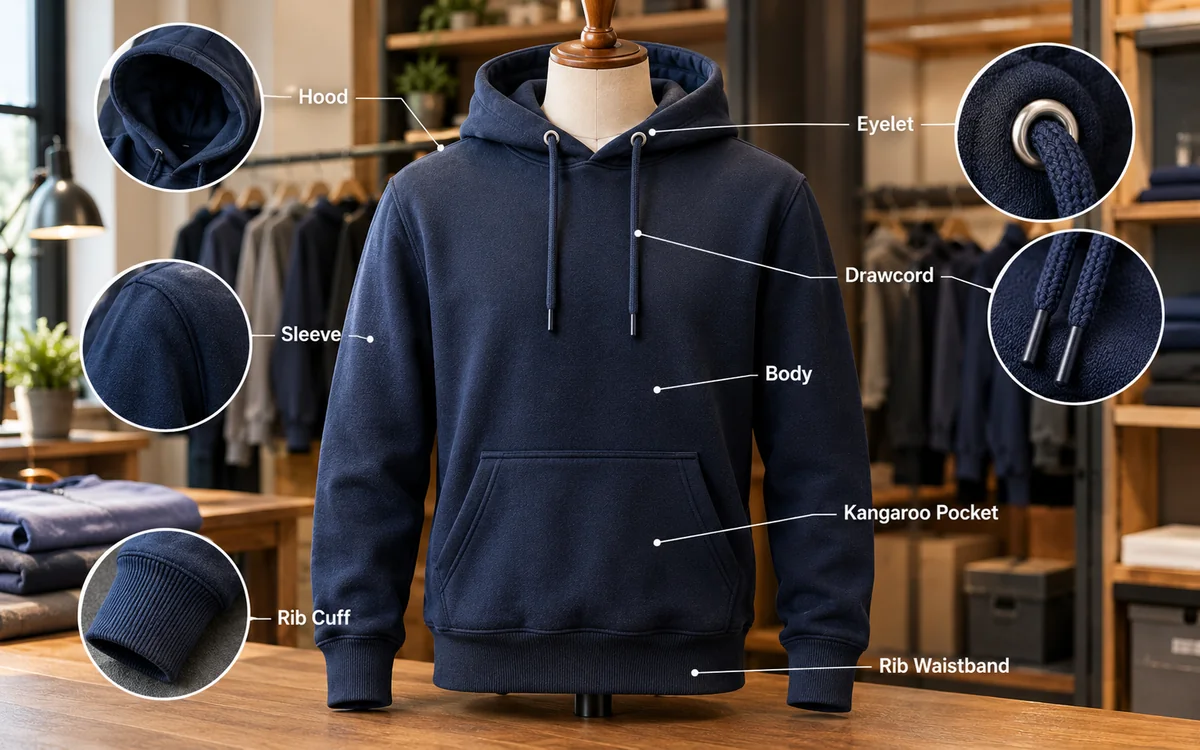
This guide walks through every part from top to bottom. You will see what each part does, what it is made from and how a factory sews it. If you work in apparel, the notes on faults will help at the inspection table. If you simply shop, the checklist near the end will help you pick a hoodie that lasts.
What is a hoodie
A hoodie is a sweatshirt with a hood. It is usually made from knitted fleece or French terry, which are thick, soft knit fabrics. Fleece has a brushed inside surface. French terry has small loops inside. Both hold warm air next to the body.
There are two main styles. A pullover hoodie goes on over the head and has a front pocket. A zip hoodie opens at the front with a zipper and has two side pockets. Most of the parts are the same in both styles. The front opening and the pockets are the main differences.
Parts of a hoodie at a glance
| Part | Location | Job |
|---|---|---|
| Hood | Neck | Covers the head |
| Drawcord | Around the hood opening | Tightens the hood |
| Eyelets | On the hood front | Let the cord pass through |
| Neck tape | Back of neck | Covers and reinforces the seam |
| Yoke | Upper back | Joins shoulders to body |
| Body | Chest and back | Main part of the garment |
| Sleeves | Arms | Cover the arms |
| Cuffs | Wrist | Hold the sleeve close to the arm |
| Waistband | Hem | Holds the body close at the waist |
| Kangaroo pocket | Front belly | Warms the hands |
| Zipper | Center front | Opens the zip style |
| Label | Back neck or side | Shows brand, size and care |
The hood
Hood panels
Most hoods are made from two side pieces joined by a seam running over the top and down the back. Some are made from three pieces, with a center panel. A three-piece hood has a more rounded shape and fits better over the head. A two-piece hood is faster and cheaper to sew.
Hood lining
Many hoods have a second layer inside. A double-layer hood is warmer and holds its shape better. It also hides the seams inside. Some brands use a contrast color for the inner layer. A single-layer hood is lighter and cheaper but can look limp.
Hood opening and binding
The front edge of the hood, around the face, is the hood opening. In a single-layer hood it is finished with a hem or a binding strip. In a double-layer hood it is turned and stitched. A good opening lies flat. A poor one rolls, twists or pulls at the corners.
Drawcord and channel
The drawcord is the cord you pull to tighten the hood. It runs through a tunnel in the fabric, called the channel. The channel is formed by folding the hood edge and stitching it down. Cords come in flat or round styles and are often made from cotton or polyester. Tips of the cord are fixed with metal or plastic ends called aglets. These stop the cord from fraying and make it easier to pull through the channel.
Eyelets
Eyelets are small metal or plastic rings placed at the front of the hood. They are the holes where the cord comes out. They are punched through a reinforced area. The reinforcement matters because the cord pulls on the fabric all day. If the eyelet tears out, the hoodie looks worn very quickly. In some hoodies, the eyelets are replaced by stitched slots called buttonhole openings.
Cord stopper
On sporty hoodies, a small spring-loaded stopper sits on the cord. It lets the wearer lock the cord at the right length. It is more common on jackets, but some premium hoodies use it too.
The neck and back
Neck tape
Neck tape is a narrow strip of fabric sewn over the seam where the hood joins the body. It covers the raw edges and makes the seam more comfortable. It also adds strength. Many brands print their logo or care information on this tape.
Shoulder tape
Some hoodies have a tape sewn over the shoulder seam. It stops the seam from stretching under the weight of the hood. It is a simple detail that helps the hoodie keep its shape for years.
Yoke
The yoke is a panel across the upper back and shoulders. In a hoodie it often blends into the body and may not be easy to see. Its job is to carry the weight of the hood and distribute it across the shoulders.
The body
Front and back panels
The body is made of a front and back panel, joined at the shoulders and sides. Because the fabric is a knit, it stretches. Pattern makers use this stretch to give a relaxed fit without extra darts or shaping.
Side seams
Side seams join the front and back. Some hoodies use a tubular body, where the fabric is knitted as a tube and has no side seams. Tubular bodies are rare in hoodies. Most have side seams so that the pattern can be shaped.
Raglan and set-in sleeves
How the sleeve joins the body decides the shoulder shape. A set-in sleeve is joined at the natural shoulder point, which gives a neat line. A raglan sleeve runs diagonally from the neck to the underarm, which gives a softer look and more freedom of movement. A drop shoulder sits lower on the arm, which gives a loose, streetwear look.
Sleeves and cuffs
Sleeves
Sleeves are tubes of fabric that cover the arms. They are cut with a slight curve so that they hang naturally. Sleeve length is tricky on hoodies because cuffs pull the fabric up. Pattern makers add extra length to allow for this blousing effect.
Armhole
The armhole is the opening where the sleeve is joined. In hoodies it is cut loosely. A tight armhole would feel uncomfortable, especially when moving.
Rib cuffs
The cuffs on most hoodies are made of rib knit. Rib is a stretchy fabric with vertical ridges. It grips the wrist without feeling tight and springs back when released. A good rib recovers fully after you stretch it. A weak one stays loose and looks baggy.
A common rib mix is cotton with a small amount of spandex, often a few percent. Without spandex, the rib relaxes after repeated washes.
Thumb holes
Some hoodies include thumb holes in the cuffs. These are small slits that let you pull the cuff over the back of your hand. They are reinforced with stitching so that they do not tear.
The waist and hem
Waistband
Most hoodies end in a rib waistband. It gives the hoodie its blousy shape, because the body is wider than the band. The band is usually cut shorter than the body and stretched as it is sewn on. A band that is stretched too much causes wavy seams. A band that is not stretched enough hangs loose.
Plain hem
Some modern hoodies skip the rib and use a plain hem with a cover stitch. This gives a longer, boxier look. These hoodies often have a straight, clean edge.
Pockets
Kangaroo pocket
The kangaroo pocket is the large front pocket on pullover hoodies. It is a rectangle with openings on both sides so you can put both hands in from the left or right. It is named after the pouch of a kangaroo. It is usually sewn to the body along the bottom and the edges, leaving the openings at the sides. The openings are strengthened by a bar tack, a small dense patch of stitching that stops the corners from tearing.
Side seam pockets
Zip hoodies usually have two side pockets, either seam pockets or welt pockets with a zipper. Seam pockets are cut into the side seams. They are hidden and neat.
Hidden pockets
Some hoodies have a small hidden pocket inside, for a phone or card. These show up on sports and travel hoodies.
The front opening
Zipper
On a zip hoodie, the zipper runs the full front. Plastic and metal zippers are both common. Metal ones look sturdier. Plastic ones are lighter and do not scratch. See our guide to the different parts of a zipper for the slider, teeth, stops and tape.
Placket and zipper guard
Behind the zipper there is often a strip of fabric, called a zipper guard or garage. It sits at the top of the zipper and stops the slider from rubbing the chin. A small zipper garage is a sign of careful design.
Front tape
Fabric tape or binding is sewn along the front edge of the zip opening. It supports the zipper and keeps the edge from stretching.
Labels and small details
- Main label: The brand name, often sewn at the back neck.
- Care label: Tells you how to wash the hoodie. It is usually sewn into the side seam to avoid scratching.
- Size label: Shows the size.
- Neck print: Some brands print size and care directly on the neck tape, which avoids itchy tags.
- Chain stitch cord end: Thread that closes the end of the drawcord.
- Bar tacks: Small reinforced stitches at stress points.
For more information on how labels are checked in a factory, read our guide on trims and accessories inspection.
Fabric choices
The fabric affects every part of a hoodie. These are the most common.
- Fleece: A brushed back gives a warm, soft feel. It is the usual choice for cold climates.
- French terry: A looped back is lighter than fleece and breathes better. It is popular for spring and all-season hoodies.
- Cotton polyester blend: Cotton adds softness. Polyester adds shape and helps stop shrinking.
- 100 percent cotton: Very soft but may shrink more and take longer to dry.
Fabric weight is described in grams per square meter, or GSM. A light hoodie may be around 250 GSM. A heavy hoodie can pass 400 GSM. Heavier fabric costs more and feels warmer.
How a hoodie is made in the factory
Here is the usual sequence.
- Fabric inspection and relaxing: Knit fabric is relaxed so it stops shrinking later.
- Cutting: Panels are cut using a pattern and a cutting table.
- Small parts: The hood, pocket, cuffs and waistband are made.
- Joining shoulders: The front and back are joined.
- Setting the hood: The hood is attached to the neckline.
- Setting sleeves: Sleeves are joined to the body.
- Side seams and underarms: Sleeve and body are closed in one pass.
- Cuffs and waistband: Rib is attached.
- Pocket attach: The kangaroo pocket is sewn on.
- Finishing: Threads trimmed, pressed and packed.
You can see the real operation list and timing in our guide to the operation breakdown, SMV and layout of hoodie manufacturing.
Common faults
- Twisted side seams: The knit fabric was cut off grain. After washing, the seams spiral around the body.
- Uneven hood: The two sides are not the same height or width.
- Wavy waistband: The rib was stretched too much or too little while sewing.
- Loose cord ends: Aglets fall off or threads unravel.
- Eyelet tear: The eyelet was punched in a weak area.
- Pilling: Small balls of fiber form on the surface after wear and washing.
- Shrinkage: The garment shrinks after the first wash.
- Stitch skipping: Skipped stitches on stretch fabric are common if the wrong needle is used.
Many of these links back to sewing settings. Our guide to sewing defects and root causes explains the usual fixes.
How to choose a good hoodie
A few quick checks tell you more than the price tag.
- Pull the hood. The seam should not stretch or twist.
- Check the cord. Pull each side. Both should slide smoothly.
- Stretch the cuff. It should spring back.
- Look at the seams. Stitches should be even with no skipped stitches.
- Feel the inside. Brushed fleece should feel soft and even.
- Fold it. Heavy fabric should feel dense and not thin.
- Check the stitching at pocket corners. Bar tacks should be tight and neat.
Final thoughts
A hoodie may look basic, but each part has a clear job. The hood keeps your head warm, the cord shapes it, the cuffs lock in heat and the pocket warms your hands. Once you can name each part, it is easier to buy well, order well and fix problems before they spread. Start by checking the hood seam, the eyelets, the cuffs and the waistband. These four places show the quality of the whole garment.
Frequently asked questions
The main parts are the hood, drawcord, eyelets, body, sleeves, cuffs, waistband and kangaroo pocket. Zip hoodies also have a zipper and side pockets.
It is called a drawcord or drawstring. It runs through a channel around the hood opening so you can tighten it.
They are called eyelets. They are metal or plastic rings that reinforce the small holes at the front of the hood.
It is called a kangaroo pocket. It is a large pouch that sits across the belly and lets you slide both hands in from either side.
Fleece is warmest and French terry is lighter. A cotton polyester blend is a good middle choice that resists shrinking.
Rib stretches and springs back. That helps it hold the cuff against your wrist and the waistband against your waist.
A light hoodie is around 250 GSM. A medium hoodie is around 300 to 350 GSM. A heavy one is 400 GSM or more.