
A dress is one garment, but it is built from many small parts. Each one has a name, and each name tells you something about fit, style or construction. If you have ever wondered what a sweetheart neckline is, or why a dress has a princess seam, learning the parts of a dress will clear it up fast.
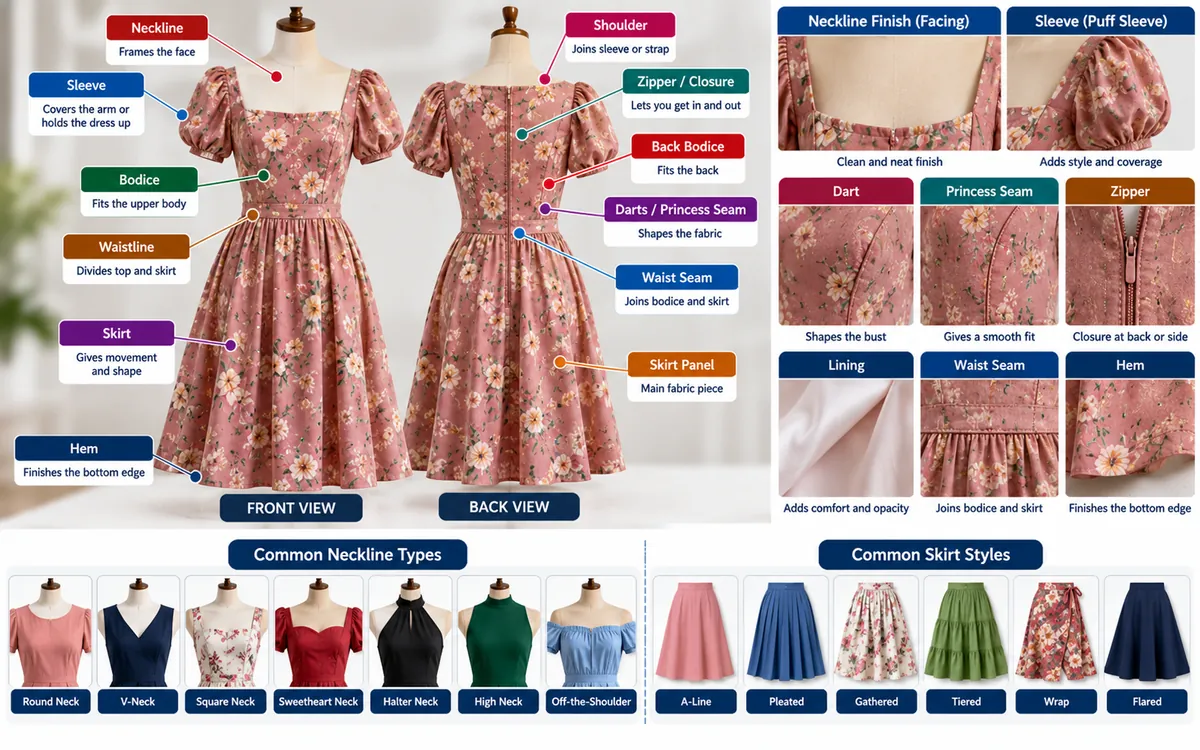
This guide walks from the top of a dress to the hem. It is useful for shoppers who want to describe what they like, for students who study fashion, and for factory teams who read tech packs. Where a part is built in a certain way, I explain how the factory does it.
The three big sections of a dress
Almost every dress can be split into three zones.
- The bodice: The upper part, from the shoulders to the waist.
- The waistline: The seam or area where the top and skirt meet.
- The skirt: The part that hangs below the waist.
Some dresses blur these lines. A shift dress falls straight from shoulder to hem, so it has no clear waist. A wrap dress has a bodice and skirt that wrap together. Even so, the three-zone idea helps when you describe what you see.
Parts of a dress at a glance
| Part | Location | Job |
|---|---|---|
| Neckline | Top front | Frames the face |
| Straps or sleeves | Shoulders | Hold the dress up or cover arms |
| Bodice | Chest to waist | Fits the upper body |
| Darts | Bust and waist | Shape the fabric |
| Waistline | Middle | Divides top and skirt |
| Skirt | Below waist | Gives movement |
| Zipper or closure | Back or side | Lets you get in and out |
| Lining | Inside | Comfort and opacity |
| Hem | Bottom | Finishes the edge |
The bodice
Neckline
The neckline is the shape of the opening around the neck and chest. It can change the whole mood of a dress. Common types include:
- Round or jewel neck: A simple circle that sits at the base of the neck.
- V-neck: The neck dips into a V shape.
- Square neck: A straight, boxy cut across the chest.
- Sweetheart neck: Two curves that meet at a point, like the top of a heart.
- Scoop neck: A deep U-shaped curve.
- Boat or bateau neck: A wide neckline that runs across the collarbones.
- Halter neck: Straps go around the back of the neck, leaving the shoulders bare.
- High neck: A neckline that covers most of the neck.
- Off-the-shoulder: The neckline sits below the shoulders.
Neckline finishes
The edge of the neckline is finished in one of three common ways. A facing is a shaped piece of fabric sewn on the inside and turned. A binding is a narrow strip that wraps over the raw edge. A lining is sewn into the neckline and turned inside. A tidy finish lies flat and does not roll out.
Straps and sleeves
Dresses can be strapless, have thin straps, wide straps or sleeves. Spaghetti straps are very thin. Tank straps are wide. Sleeve styles include cap sleeves, short sleeves, three-quarter sleeves and full sleeves. Some dresses have unusual styles like bishop sleeves or puff sleeves.
Armhole
The armhole is the opening for the arm. In a sleeveless dress, it is finished with a binding or facing. If the armhole gapes at the front, the dress may be cut too wide or the strap may be set too far apart.
Bust darts
A dart is a triangle of fabric that is folded and stitched to give shape. Bust darts allow flat fabric to fit around the curve of the chest. They point toward the fullest part of the bust. Darts can also be placed at the waist and back.
Princess seams
A princess seam is a long curved seam that runs from the shoulder or armhole down through the bust to the waist. It does the work of a dart but looks cleaner. Many fitted dresses use princess seams because they give a smooth shape.
Boning
Strapless and fitted dresses sometimes have thin plastic or metal strips, called boning, sewn into the seams. Boning keeps the bodice upright and stops it from folding down.
Bust cups
Some dresses have built-in cups or padding in the bodice. They give shape without a separate bra.
The waistline
Natural waist
The natural waist sits at the narrowest part of your torso, usually just above the belly button. Many dresses follow it.
Empire waist
An empire waist sits just below the bust. The skirt falls from there. It is a flattering style because it nips in under the chest and skims over the middle.
Drop waist
A drop waist sits at the hips. It gives the dress a long, relaxed upper body and a short, flared skirt.
Waist seam and waist stay
The waist seam joins the bodice to the skirt. In well-made dresses, a narrow strip of tape or ribbon, called a waist stay, is sewn along it inside. The stay takes the weight of the skirt so the seam does not stretch.
Belt loops and sashes
Some dresses include loops for a belt or a sash that ties at the waist. These let the wearer adjust the fit.
The skirt
The skirt can change the whole character of a dress. Here are the main shapes.
- A-line: Fitted at the waist and flaring gently outwards, like the letter A.
- Circle: Cut in a full circle so it flares widely and swirls when you move.
- Pencil or sheath: Fitted closely through hips and thighs.
- Mermaid or fishtail: Fitted to the knee and then flaring.
- Ball gown: A very full skirt, often held out by layers underneath.
- Tiered: Made of several gathered layers stacked down the skirt.
- Pleated: Folds of fabric are pressed in.
- Wrap: The skirt crosses over and ties at the side.
- Shift: Falls straight with no waist seam.
Gathers and pleats
Gathers are small folds made by pulling a thread along the fabric edge. They add fullness at the waist. Pleats are sharper folds pressed or stitched into place. Box pleats are folds going in both directions. Knife pleats all face one way.
Slit
A slit is an opening at the hem. It allows ease of movement and adds style. It can be at the front, side or back.
Panels and gores
A gore is a long, tapering panel in a skirt. Several gores sewn together create flare without the bulk of gathers.
Closures
A dress needs some way to open so that you can get in and out.
- Back zipper: The most common. It runs from the neck or upper back down to the waist or hip.
- Side zipper: Hidden in the side seam. It keeps the back clean.
- Invisible zipper: A zipper where the teeth are hidden behind the seam. It gives a smooth look.
- Button placket: A line of buttons down the front or back.
- Hooks and eyes: Tiny metal fasteners, often used above a zipper.
- Tie closures: Wrap and tie dresses use ribbons.
- No closure: Stretch knit dresses can slide over the head.
A zipper that is sewn badly can wave and ripple. Our guide to the different parts of a zipper explains what each piece does.
Lining and layers
Lining
The lining is an inner layer of lightweight fabric. It stops the dress from being see-through and helps it hang better. It also feels smoother on the skin. Common lining fabrics are polyester, viscose and cotton voile.
Underlining
Underlining is a layer sewn to the back of each fabric piece before assembly. It adds body, hides seams and supports delicate fabrics like lace.
Petticoat or underskirt
A petticoat is a separate skirt worn under the dress. It gives fullness. Some dresses have it attached.
Interfacing
Interfacing is a thin fabric layer used inside areas like necklines and waistbands to stop them stretching. It is often fusible, meaning it sticks with heat. You can see how interfacing is applied and checked in our guide on the fusing process and quality inspection.
The hem
The hem is the bottom edge. Dress length is measured from the shoulder, or from the waist, down to the hem. Common lengths are mini, knee, midi and maxi.
Hem finishes
- Turned and stitched hem: The edge is folded twice and stitched. The most common finish.
- Blind hem: The stitches are nearly invisible from the outside.
- Rolled hem: A very narrow hem, used on light fabrics.
- Faced hem: A shaped strip of fabric is sewn to the inside.
- Raw edge: Left unfinished on purpose for style.
- Horsehair braid: A stiff braid sewn into the hem of a full skirt to keep the shape.
Small details
- Seam allowance: The extra fabric between the seam line and the cut edge.
- Care label: Tells you how to wash the dress.
- Hanger loops: Small loops at the shoulder to hang the dress.
- Pockets: Hidden in side seams or visible on the front. People love dresses with pockets.
- Belt carriers: Loops for a belt.
- Trims: Lace, ribbon, piping and beads on the neckline and hem.
For more on labels and trims, see our list of trimmings and accessories used in garments.
Fabric choices
The fabric changes how each part behaves.
- Cotton: Breathable and easy to sew. It can wrinkle.
- Linen: Cool and crisp. It wrinkles easily.
- Silk: Smooth and soft with a beautiful drape. Needs delicate care.
- Satin: Shiny and elegant. Shows needle marks.
- Chiffon: Light and sheer. Needs lining.
- Jersey knit: Stretchy and comfortable. Needs a stretch needle.
- Crepe: Textured and drapes well.
- Lace: Delicate and decorative. Needs lining.
How a dress is made
Here is the usual order in a factory.
- Pattern and cutting: The pieces are cut from the fabric.
- Darts and seams: Darts and princess seams are sewn.
- Bodice assembly: The front and back are joined.
- Skirt assembly: The skirt panels are sewn together.
- Waist join: The bodice and skirt are joined at the waist.
- Closure: The zipper or buttons are set.
- Neckline and armholes: Facings or bindings are added.
- Lining: The lining is attached.
- Hemming: The bottom edge is finished.
- Pressing and packing: The dress is pressed and folded.
Our guide on the operation breakdown, SMV and layout of blouse manufacturing shows how upper-body operations are broken into steps and timed.
Common faults in dresses
- Gaping neckline: The edge was stretched during sewing.
- Waistline puckering: Uneven tension or an unstable fabric.
- Visible lining: The lining is longer than the shell.
- Rippled zipper: The zipper was sewn under tension.
- Uneven hem: The hem hangs lower on one side.
- Twisting seams: The fabric was cut off grain.
- Shade difference: Panels come from different dye lots.
- Weak seam at stress points: Seams at the underarm and waist split.
Final thoughts
A dress is easier to understand once you break it into parts. The neckline sets the mood, the bodice decides the fit, the waistline sets proportion and the skirt gives movement. When you shop or design, say what you want in those four words and you will be understood quickly. Check the neckline edge, the waist seam, the zipper and the hem before you decide. Those four places show if the dress was made with care.
Frequently asked questions
The main parts are the neckline, bodice, waistline, skirt, closure, lining and hem. Many dresses also have sleeves or straps, darts and pockets.
The top part is called the bodice. It runs from the shoulders to the waist.
A princess seam is a long curved seam that runs from the shoulder or armhole down through the bust to the waist. It shapes the dress without needing separate darts.
An empire waist sits just below the bust, and the skirt falls straight or flares from that point.
The lining hides seams, stops the dress from being see-through, helps it hang well and feels smoother against the skin.
An A-line dress fits at the waist and flares out toward the hem. A sheath dress hugs the body from shoulder to knee in a straight line.
Measure from the highest point of the shoulder, beside the neck, straight down to the hem. Mini, knee, midi and maxi are common length names.
