
Fabric is the main material in a garment, but it is never the only one. A shirt also needs thread, buttons, labels, interlining and a polybag. A pair of jeans needs rivets, a zipper and a leather patch. This garments trims and accessories list covers all of these items in plain words. For each one you will see what it is, what it does and where it is used. Near the end there is a worked example that shows how a merchandiser turns the list into quantities and cost.
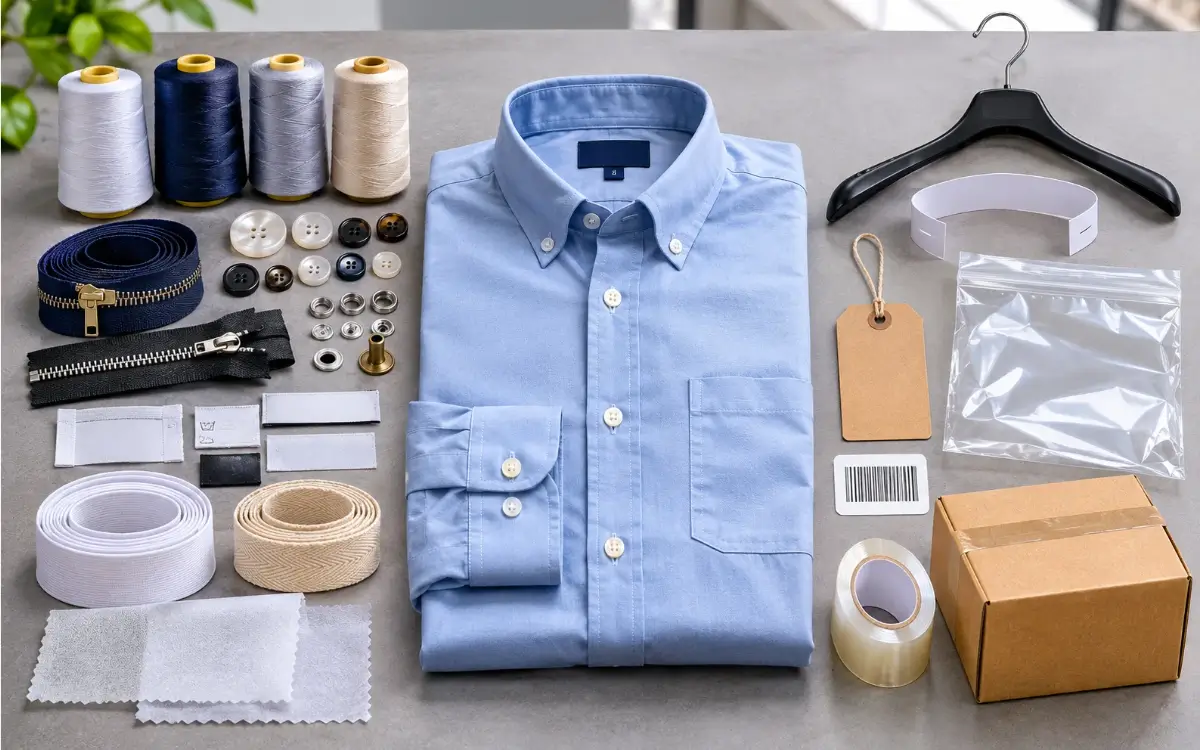
If you work in a factory, buying house or sourcing office, this list is close to what you will see in a bill of materials. If you are a student, it gives you the names and uses you need for exams and interviews.
What are trims and accessories in garments?
Trims and accessories are the materials used in a garment other than the main (shell) fabric. That is the one point on which most sources agree. After that, the words get used in different ways.
- One textbook definition says trims are materials used to ornament or enhance garments, and accessories are items that enhance the appearance or function of a garment.
- Some guides say trims are the items you can see or that are sewn into the garment, and accessories are the items added for finishing, pricing and packing.
- Other guides, and many factory documents, use the two words as if they mean the same thing.
In practice, many factories follow a simple working rule:
- Trims are the components that go inside or on the garment: thread, buttons, zippers, labels, lining, interlining, elastic and similar items.
- Accessories are the finishing and packing items added at the end: hangers, hangtags, polybags, cartons, stickers and so on.
The line is not strict. Sewing thread and labels, for example, appear on both kinds of list in different guides. So always follow the way your buyer’s tech pack or trim card names an item. That document decides what is a trim and what is an accessory for your order.
Trims vs accessories at a glance
| Point | Trims | Accessories |
|---|---|---|
| Where they go | Sewn into or attached to the garment | Added at finishing and packing |
| Main job | Build, fasten, shape or decorate the garment | Finish, protect, display and pack it |
| Examples | Thread, button, zipper, lining, elastic | Hanger, hangtag, polybag, carton |
| Seen by the buyer | Often visible, sometimes hidden inside | Mostly seen at the shelf or in the carton |
| Booked by | Merchandiser, from the bill of materials | Merchandiser, from the packing and trim card |
One useful way to sort trims is by whether the customer can see them.
- Visible trims show on the outside or are easy to find: buttons, labels, zippers, hook and loop tape, motifs and lace.
- Hidden trims sit inside the garment: interlining, lining, wadding and shoulder pads.
Both kinds matter. A hidden interlining that is the wrong weight can spoil the look of a collar even though nobody sees it.
List of trims used in garments
The table below keeps the items from the original list and adds a few common ones.
| Trim | What it is and what it does | Common use |
|---|---|---|
| Sewing thread | Joins fabric pieces and secures seams | Every sewn garment |
| Button | Fastens through a buttonhole or loop and can be decorative | Shirts, trousers, coats |
| Rivet | A metal fastener that strengthens stress points | Jeans pockets, workwear |
| Lining | An inner layer that gives a smooth inside finish | Jackets, coats, skirts |
| Interlining | A middle layer that adds shape, support and sometimes warmth | Collars, cuffs, plackets, blazers |
| Stopper (cord lock) | Slides along a cord to hold or adjust its length | Hoodies, jackets, bags |
| Lace | An open decorative fabric trim | Dresses, lingerie, blouses |
| Braid | A woven or plaited decorative strip | Uniforms, ethnic wear, home textiles |
| Elastic | Gives stretch and a snug fit | Waistbands, cuffs, underwear |
| Labels | Carry brand, size, care and origin details | Almost all garments |
| Zipper | Opens and closes garment parts with two rows of teeth | Jeans, jackets, dresses |
| Motif | A small decorative design or patch | T-shirts, kidswear |
| Shoulder pad | Adds structure at the shoulder line | Blazers, coats, dresses |
| Hook and loop tape | A two-sided fastener, often called Velcro | Sportswear, kidswear, shoes |
| Twill tape | A strong woven tape that reinforces seams and edges | Seams, necklines, drawcords |
| Pom pom | A soft ball used for decoration | Knit hats, kidswear |
| Wadding | A soft fill layer for warmth | Quilted jackets |
| Ribbon | A narrow decorative strip | Dresses, gift items |
| Drawcord | A cord that tightens a waist or hem | Hoodies, track pants |
| Eyelet | A small metal or plastic ring that reinforces a hole | Drawcord openings, belts |
| Hook and eye | A small two-part closure | Waistbands, bras, dresses |
| Snap button | Two interlocking discs that grip the fabric | Kidswear, jackets, rompers |
| Patch | A fabric or leather piece sewn on for branding or repair | Jeans, caps, jackets |
Note: “Velcro” is a brand name. The general term for the product is hook and loop tape, so the old list that showed both “hook and loop” and “Velcro tape” was really naming one item twice.
Types of sewing thread
The original list named four kinds of sewing thread. In simple terms:
- Monofilament thread is a single smooth strand. It is nearly invisible and is used for jobs such as blind stitching.
- Multifilament thread is made of several continuous strands twisted together. It is strong and smooth.
- Textured thread has bulked, curly filaments, so it is soft and stretchy. It is common in overlock seams on knits.
- Core spun thread has a polyester core wrapped in cotton or polyester fibre. It combines the strength of the core with the feel of the outer fibre.
Our guide to sewing thread size, Tex and ticket number explains how thread thickness is stated.
Types of zippers
- Nylon (coil) zippers use a spiral of nylon filament. They are light and flexible.
- Metal zippers use individual metal teeth. They are strong and common on jeans.
- Plastic (molded) zippers use molded plastic teeth. They are used on jackets and sportswear.
Read more about the pieces of a zipper in our guide to the parts of a zipper.
Types of labels
- Main label shows the brand.
- Size label shows the size.
- Care label shows washing and care symbols and fibre content. Our guide to care labels and wash symbols explains the symbols.
Buttons
Buttons come in many materials and styles, such as plastic, metal, shell and wood. See our guides to the parts of a button and the different types of buttons for clothes.
List of accessories used in garments
These are mostly finishing and packing items. Sources use slightly different names for some of them, so the names below follow the most common usage.
| Accessory | What it does |
|---|---|
| Hanger | Stores and displays the garment |
| Hangtag | A tag on a string or plastic loop that shows brand, price or care details |
| Tissue paper | Wraps the garment to cut down on wrinkles and protect it |
| Backboard | Keeps a folded garment flat in the pack |
| Neck board | Keeps a shirt collar in shape inside the pack |
| Collar stand or collar stay | Holds the collar upright or stiff |
| Paper band | A printed paper strip around a folded garment or a pair of socks |
| Pin or clip | Holds the folded garment or the pack together |
| Tag pin | Attaches a label or price tag |
| Polybag | Protects the garment from dust and moisture during storage and transport |
| Mini polybag | A small bag for spare buttons or small items |
| Gum tape | Seals cartons |
| Scotch tape | Holds stickers, notes and wrapping |
| PP band (polypropylene strap) | A plastic strap that holds cartons shut for transport |
| Inner carton | A small box that holds a set number of pieces |
| Outer (master) carton | The large box used for shipping |
| Carton sticker | Shows the contents, such as style, size and quantity |
| Safety sticker | A warning sticker, often required on polybags for baby and kids items |
| Arrow sticker | Shows which side of a carton should face up |
| Butterfly | A small clip or card that holds the front of a folded shirt |
| Both side tape | Double-sided tape that holds items in place during production |
| Plastic staple | A plastic fastener that attaches tags |
| Barcode or UPC sticker | Carries the code used for scanning and stock tracking |
Trims and accessories by garment type
The same garment needs different items. Here is a short guide, based on common practice.
| Garment | Typical trims | Typical accessories |
|---|---|---|
| Shirt | Thread, buttons, interlining, labels | Neck board, collar stays, hangtag, tissue paper, polybag, carton |
| T-shirt | Thread, labels, neck tape, motif or embroidery | Hanger, butterfly, hangtag, polybag, carton |
| Trousers | Thread, buttons, zipper, hook and eye, belt loops, interlining | Hanger, hangtag, polybag, carton |
| Jeans | Thread, rivets, buttons, zipper, leather patch | Hangtag, polybag, carton |
| Jacket | Lining, zipper, wadding, drawcord, stoppers | Hanger, polybag, carton |
How a merchandiser uses the list
The merchandiser turns the list into a bill of materials, often called the BOM, and a trim card. The trim card shows each item with its code, colour, size, supplier and the quantity per garment. Our page on the bill of materials in garments explains this document, and our guide to the garment spec sheet shows where trim details sit in the tech pack.
The steps are simple:
- Read the tech pack and list every trim and accessory.
- Write the quantity per garment for each.
- Add a wastage allowance, since some items are lost or damaged.
- Multiply by the order quantity.
- Convert to the unit the supplier sells in, such as gross, rolls or cartons.
- Multiply by price to find the cost.
A worked example: trim and accessory cost for 10,000 shirts
All numbers here are assumed for the example. Your own prices and wastage will differ. Please use your buyer’s figures.
Order: 10,000 men’s shirts.
Buttons. Each shirt has 7 on the front and 2 on the cuffs, plus 1 spare in a mini polybag. That is 10 per shirt.
- Needed = 10,000 × 10 = 100,000
- Add 3 percent wastage = 100,000 × 1.03 = 103,000
- One gross is 144 buttons, so 103,000 ÷ 144 = 715.3, which rounds up to 716 gross
- At an assumed 1.80 USD per gross, cost = 716 × 1.80 = 1,288.80 USD
Labels. Each shirt has a main label, a size label and a care label, which makes 3.
- Needed = 10,000 × 3 = 30,000
- Add 2 percent wastage = 30,600
- At an assumed 0.012 USD each, cost = 367.20 USD
Polybags. One per shirt.
- Needed with 2 percent wastage = 10,200
- At an assumed 0.02 USD each, cost = 204.00 USD
Hangtags. One per shirt.
- Needed with 2 percent wastage = 10,200
- At an assumed 0.015 USD each, cost = 153.00 USD
Cartons. Suppose a folded shirt in its polybag takes up 31 cm by 25 cm and 2.5 cm of height, and the carton measures 62 cm by 50 cm by 30 cm inside.
- Shirts per layer = (62 ÷ 31) × (50 ÷ 25) = 2 × 2 = 4 stacks
- Shirts per stack = 30 ÷ 2.5 = 12
- Shirts per carton = 4 × 12 = 48
- Cartons needed = 10,000 ÷ 48 = 208.3, which rounds up to 209
- At an assumed 1.20 USD each, cost = 250.80 USD
Total:
| Item | Cost (USD) |
|---|---|
| Buttons | 1,288.80 |
| Labels | 367.20 |
| Polybags | 204.00 |
| Hangtags | 153.00 |
| Cartons | 250.80 |
| Total | 2,263.80 |
Cost per shirt = 2,263.80 ÷ 10,000 = about 0.226 USD.
This example leaves out thread, interlining, tissue paper, stickers and tape, which would also be on a real BOM. Our pages on packing lists in a garment factory and on export carton packing specs cover the packing side in more detail.
How to check trims before bulk production
Wrong or late trims stop a line faster than almost any other problem. These checks help.
- Match the approved sample. Check colour, size, shape and print.
- Test strength. Buttons are usually pulled to a set force. See our button pull test SOP.
- Test colour fastness. A label or tape that bleeds in the wash can ruin a pale garment. See our guide to colour fastness tests.
- Check zipper action. Run it up and down, and check that the slider does not catch the fabric.
- Check metal items. Many buyers require metal parts that pass a metal detector or are nickel safe. Ask for the buyer’s rule.
- Check label content. Fibre content, size and country of origin must match the order.
- Count on receipt. Check the quantity against the packing list before it goes to the store.
Common mistakes with trims and accessories
- No wastage allowance, which leaves the order short.
- Mixing up sizes or colours of labels and buttons.
- Ordering trims late. Long lead times for custom trims can hold up a whole order.
- No spare button, when the buyer asks for one.
- Skipping the wash test on trims that will be washed.
- Wrong carton size, which wastes freight space.
- Counting by the dozen when the supplier sells by the gross.
Final thoughts
A garments trims and accessories list is really a map of everything a garment needs besides its fabric. Trims are the parts that go into or onto the garment, such as thread, buttons, zippers, labels, lining and interlining. Accessories are the finishing and packing items, such as hangers, hangtags, polybags and cartons. The border between them is not fixed, so always follow your buyer’s trim card.
In our example, 10,000 shirts needed 716 gross of buttons, 30,600 labels, 10,200 polybags and hangtags and 209 cartons, at about 0.226 USD per shirt for those five items. Use the same steps with your own prices, and always add a wastage allowance.
Frequently asked questions
Both are materials used in a garment other than the main fabric. In common factory practice, trims go into or onto the garment, such as thread, buttons and zippers. Accessories are finishing and packing items, such as hangers, hangtags and polybags. Some sources treat the two words as the same.
Sewing thread, buttons, rivets, zippers, lining, interlining, elastic, labels, lace, ribbon, twill tape and hook and loop tape.
Hangers, hangtags, tissue paper, polybags, neck boards, backboards, stickers, gum tape, PP bands and cartons.
Most guides call it a trim. A few list it under accessories as well, which shows that the line between the two groups is not strict.
A trim card is a sheet that lists each trim and accessory for an order, with its code, colour, size, supplier and quantity per garment. The merchandiser builds it from the buyer’s tech pack.
Packing trims, or packing accessories, are items used to pack the finished garment, such as polybags, cartons, stickers, tape and bands.
Some trims are damaged, lost or used in sampling and repair. Adding a small percentage means the order does not run short.
This article is very useful. Thanks for your share.
As buttons manufacturer, I have to say that a small button is also very important during garment manufacturing.
Very helpful post
what is the ponpom
I still read this article and list it every time when I need it. The writer, I really would like to thank you for sharing such an important list with us. thanks once again.
I WANT TO DO THE BUSINESS OFF GARMENT ACCESSORIES