
Every thread in your clothes started as one of two things. It was either grown by a plant or an animal, or it was made by people in a factory from chemicals. That simple split gives us the two big families of textile raw materials: natural fibre and synthetic fibre. Knowing how they differ helps you pick the right fabric for a hot day, a gym session, a winter coat or a factory order.
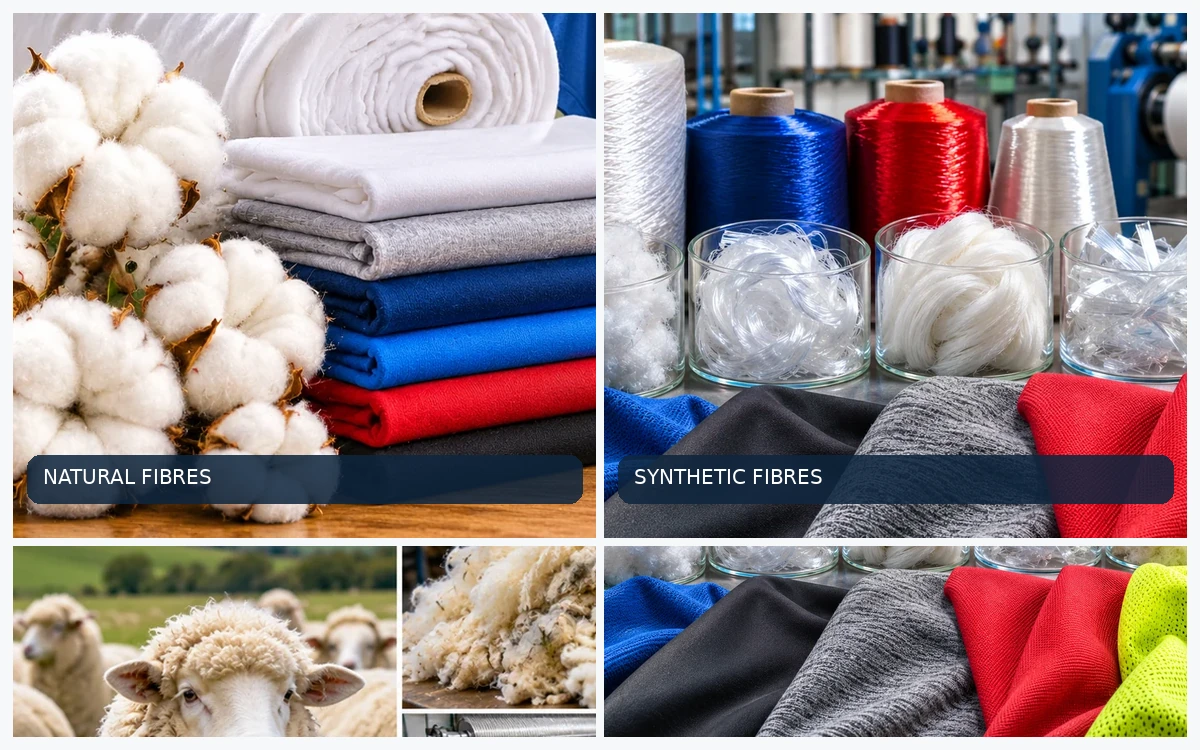
This guide explains the difference between natural fibre and synthetic fibre in plain language. You will see where each comes from, a list of examples, how they compare in comfort, strength, moisture, care, cost and environmental impact, how to tell them apart with a simple burn test, and why most fabrics today are blends. There is also a worked example that shows how mills calculate blend weights when the two fibre types hold different amounts of moisture. For a wider map of the fibre world, you can also read our overview of the classification of textile fibres.
The short answer
Natural fibres come from plants, animals or minerals. Examples are cotton, linen, jute, wool and silk. Synthetic fibres are made entirely from chemicals, usually from petroleum or natural gas, by forcing a polymer through tiny holes. Examples are polyester, nylon, acrylic and spandex.
In general, natural fibres feel softer and absorb more moisture, which makes them comfortable in many conditions. Synthetic fibres are stronger, dry faster, resist wrinkles and cost less, but they absorb little water and are made from fossil fuels. Neither group is better in every way, and blends try to get the best of both.
What is a natural fibre?
A natural fibre is one that is found in nature in fibre form, or that needs only simple processing to become one. There are three types.
Plant (vegetable) fibres
These are made mostly of cellulose.
- Seed fibres. Cotton, kapok.
- Bast fibres (from stems). Flax (linen), jute, hemp, ramie.
- Leaf fibres. Sisal, abaca, pineapple.
- Fruit and husk fibres. Coir from coconut.
For details on the cotton fibre, see our guide on the properties of cotton. Our pages on jute and coir cover two important fibres for Bangladesh and South Asia.
Animal (protein) fibres
These are made of proteins.
- Wool from sheep, and hair fibres such as cashmere, mohair, alpaca and angora.
- Silk from the cocoon of the silkworm.
To see how wool differs from cotton in practice, read why woolen clothes keep us warm in winter. Our page on silk fibre covers how silk is formed.
Mineral fibres
The only natural mineral fibre is asbestos, which is now banned in many countries because of health risks. Our article on mineral fibers explains this group.
What is a synthetic fibre?
A synthetic fibre is made by chemical reaction. Small molecules, called monomers, are joined into long chains, called polymers. The polymer is melted or dissolved and pushed through a spinneret, which is a plate with many tiny holes. The streams harden into filaments, which can be used as they are or cut into short staple fibres.
Common synthetic fibres include:
- Polyester. The most widely used fibre. See our guide to polyester fibre properties and uses.
- Nylon (polyamide). Strong and elastic. Our page on nylon 6 and nylon 66 compares the two types.
- Acrylic. Wool-like and soft. See our guide to acrylic fibre.
- Spandex (elastane). Highly stretchy. We explain it in our guide to spandex fibre.
- Polypropylene and polyethylene. Used in sportswear, ropes and nonwovens.
- Aramids such as Kevlar. Used in protective gear. Read what Kevlar is made of.
For a wider survey, see our guide to types of synthetic fibres.
The middle group: regenerated fibres
There is a third group that is often forgotten. Regenerated fibres, such as viscose (rayon), modal and lyocell, are made from natural raw material, usually wood pulp, which is dissolved and spun again into new fibres. They are man-made, but they are not synthetic in the strict sense, because their polymer is cellulose from plants and not a polymer built from chemicals.
In everyday talk, people put them in one of the two camps depending on the point they want to make. In textile science, they are listed under man-made (or manufactured) fibres, along with synthetics.
Natural fibre and synthetic fibre side by side
| Point | Natural fibres | Synthetic fibres |
|---|---|---|
| Source | Plants, animals, minerals | Chemicals, mainly from oil and gas |
| Examples | Cotton, linen, jute, wool, silk | Polyester, nylon, acrylic, spandex |
| Length | Short staple, except silk | Any length, filament or staple |
| Moisture regain | High (cotton about 8.5%, wool about 13.6%) | Low (polyester about 0.4%, nylon about 4%) |
| Comfort | Soft, breathable, absorbent | Can feel clammy if not designed well |
| Strength | Moderate, varies | Usually higher |
| Stretch and recovery | Wool good, cotton low | Nylon and polyester good, spandex excellent |
| Wrinkles | Cotton and linen wrinkle easily | Resist wrinkles |
| Drying | Slow | Fast |
| Heat | Burns, does not melt | Melts when heated |
| Static | Low | Builds static |
| Dyeing | Reactive, direct, vat, acid dyes | Disperse, acid or basic dyes |
| Shrinkage | Can shrink | Low shrinkage |
| Mildew and moths | Can be attacked | Resistant |
| Cost | Varies, often higher for quality fibre | Usually lower |
| Biodegradability | Yes, in the right conditions | Very slow |
| Renewability | Renewable | Fossil based |
The moisture figures are standard regain values. They are rough guides, and real values depend on temperature and humidity. For more fibre data, see our page on the properties of textile fibres.
What these differences mean in daily life
Comfort
Natural fibres such as cotton and linen absorb sweat, so they feel good in warm weather. Wool keeps you warm even when slightly damp. Synthetics do not soak up sweat, so they can feel sticky in the heat unless the fabric is light, open and designed to wick. See our guide on whether polyester is good for summer.
Durability
Synthetics resist wear, mildew and moths, so they last well in sportswear, uniforms and outerwear. Cotton gets a bit stronger when wet. Silk is strong for its weight but loses strength in sunlight. Wool is elastic but can felt.
Care
Synthetics wash easily and dry fast, and they do not shrink much. Natural fibres often need more care, such as lower heat for wool and ironing for linen. Always check the label. Our guide to care labels and wash symbols can help.
Safety
Natural fibres burn with an ash. Synthetic fibres melt and can stick to skin. For that reason, fire-resistant clothing for hazardous work is usually made from special flame-resistant fibres, not ordinary synthetics.
Price
Synthetics are usually cheap to make in large volume. Natural fibres vary. Prices of cotton, wool and silk change with weather, harvests and demand, so quality natural fibres can be costly.
How to tell them apart: the burn test
Textile technicians use a small burn test to give a first guess about fibre type. It is only a guide, and finishes and blends can change the result. Do this only in a safe place, using a small snip of fabric, tweezers and a bowl of water at hand. Never do it on finished goods you plan to sell.
| Fibre | How it burns | Smell | Ash or residue |
|---|---|---|---|
| Cotton, linen, viscose | Burns quickly with a yellow flame | Burning paper or leaves | Soft grey ash |
| Wool, silk | Burns slowly, self-extinguishes | Burning hair or feathers | Brittle black bead or crushable ash |
| Polyester | Melts, shrinks away from flame, sooty flame | Slightly sweet | Hard, round bead |
| Nylon | Melts and drips | Celery or chemical | Hard grey or tan bead |
| Acrylic | Burns with a bright flame, sputters | Acrid | Hard, black, irregular bead |
For a precise answer, labs use microscopy, solvent tests or infrared analysis.
Why blends are so common
Most clothing is a blend. Mixing fibres combines strengths and covers weaknesses.
- Polyester and cotton. The classic shirting blend. More crease resistance and easier care than pure cotton, with more comfort than pure polyester.
- Cotton and spandex. Comfort stretch in jeans and T-shirts.
- Wool and nylon. Strong socks and knitwear.
- Viscose and polyester. Smooth, drapey fabrics at a lower price.
Blends can make recycling harder, because the fibres must be separated. We discuss the state of the art in our article on fibre-to-fibre recycling.
A worked example: blending polyester and cotton by weight
Blend ratios in spinning are set by dry weight, but fibre is bought and weighed at its natural moisture level. Moisture differs between natural and synthetic fibres, so a mill must correct for it. This example shows how.
A spinner wants 1,000 kg of yarn with a 65 percent polyester and 35 percent cotton blend by dry weight. Standard moisture regain values used are:
- Polyester: 0.4 percent
- Cotton: 8.5 percent
Regain is the water weight as a percentage of dry weight. So the weight of fibre at standard condition is dry weight × (1 + regain ÷ 100).
Step 1: Dry weights needed.
- Polyester: 1,000 × 0.65 = 650 kg dry
- Cotton: 1,000 × 0.35 = 350 kg dry
Step 2: Weights as fed, at standard moisture.
- Polyester: 650 × 1.004 = 652.6 kg
- Cotton: 350 × 1.085 = 379.75 kg
Step 3: Total as-fed weight.
652.6 + 379.75 = 1,032.35 kg
Step 4: Blend percentages by as-fed weight.
- Polyester: 652.6 ÷ 1,032.35 = 63.2 percent
- Cotton: 379.75 ÷ 1,032.35 = 36.8 percent
So to hit a dry-weight blend of 65:35, the mill must feed about 63.2:36.8 by as-fed weight. If it simply used 65:35 on the scale, the final yarn would contain less cotton than planned (about 33.3 percent instead of 35), because part of the weighed cotton is water. The label would then be wrong, and the shirt might fail a fibre content test. This is a small but important correction in every blending room.
For legal fibre content labels, standards allow a small tolerance and use agreed moisture allowances. Check the rule used by your buyer or country.
Environmental points
Neither type is free of impact.
Natural fibres
- Cotton needs land, water and, in conventional farming, pesticides. Organic cotton reduces some of these, as we explain in our guide to organic cotton as a sustainable fabric.
- Wool and leather involve animal farming, with methane emissions and land use.
- Natural fibres are renewable and biodegradable when untreated, but dyes and finishes can slow this.
Synthetic fibres
- Made from fossil fuels, with high energy use in production.
- Shed microfibres in washing, which end up in water systems.
- Do not break down quickly. Recycled polyester made from bottles reduces new oil use but does not solve shedding.
A thoughtful approach is to buy fewer, better garments, wash less, use a filter or bag for synthetic items, and choose recycled or certified fibres where possible.
How to choose
- Hot, humid weather: Light cotton, linen or a good wicking synthetic knit.
- Cold weather: Wool or wool blends, or insulated synthetics for wet conditions.
- Sport and travel: Polyester or nylon knits that dry fast.
- Sensitive skin: Soft cotton, fine merino, silk or lyocell.
- Easy care and low budget: Polyester-cotton blends.
- Heavy wear: Nylon blends, polyester, strong cotton twills.
- Fashion drape: Viscose, silk, or soft polyester crepe.
Final thoughts
The difference between natural fibre and synthetic fibre starts with where each one comes from, and it shows up in nearly every property that matters: comfort, moisture, strength, care, cost and impact. Natural fibres feel good and breathe. Synthetics last and dry fast. Regenerated fibres sit in between, and blends mix them all.
Do not ask which type is best. Ask which one is best for the job, the climate, the budget and the way you plan to wash it. And if you work in a mill, remember to correct blend weights for moisture so that the label tells the truth.
Frequently asked questions
Natural fibres come from plants, animals or minerals. Synthetic fibres are made from chemicals, usually from oil or gas, by spinning a polymer into filaments.
Natural fibres: cotton and wool. Synthetic fibres: polyester and nylon.
Synthetic fibres are generally stronger and more resistant to abrasion and mildew. Some natural fibres, such as silk and flax, are also very strong for their weight.
Viscose is a regenerated fibre. It is made from natural cellulose, usually wood pulp, but is processed chemically, so it is man-made and not purely natural or synthetic.
Natural fibres are usually more comfortable in warm weather because they absorb sweat. Well-designed synthetic knits can also be comfortable for sport because they wick and dry quickly.
A small burn test gives a first guess. Natural cellulose fibres burn to soft ash, protein fibres smell like hair and synthetics melt into hard beads. Labs use microscopes and chemical tests for certainty.
Not always. Natural fibres are renewable and biodegradable, but cotton uses much water and land, and wool has farming emissions. Synthetics use fossil fuels and shed microfibres. The best choice depends on how the garment is made, used and cared for.


