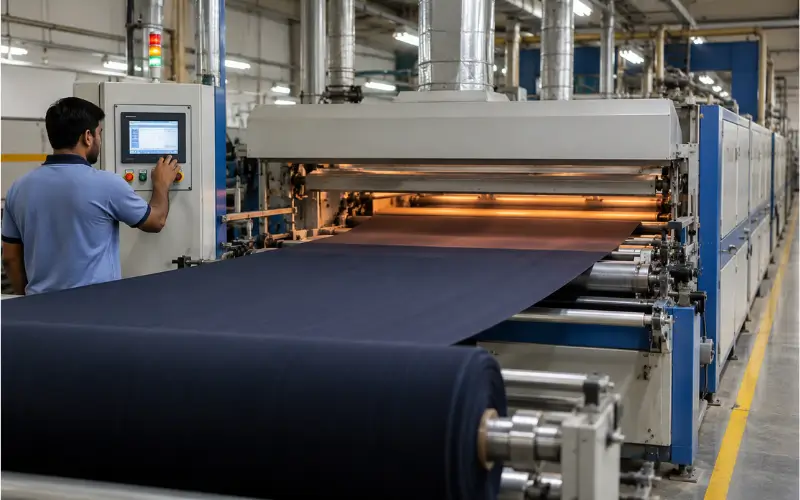
Think of a bright red wool jumper, a pair of nylon stockings or a silk scarf with a deep, glowing colour. Chances are that each of them was coloured with acid dyes. This family of dyes is the main choice for protein fibres like wool and silk, and for nylon, because it gives bright shades, good levelling and a wide range of fastness.
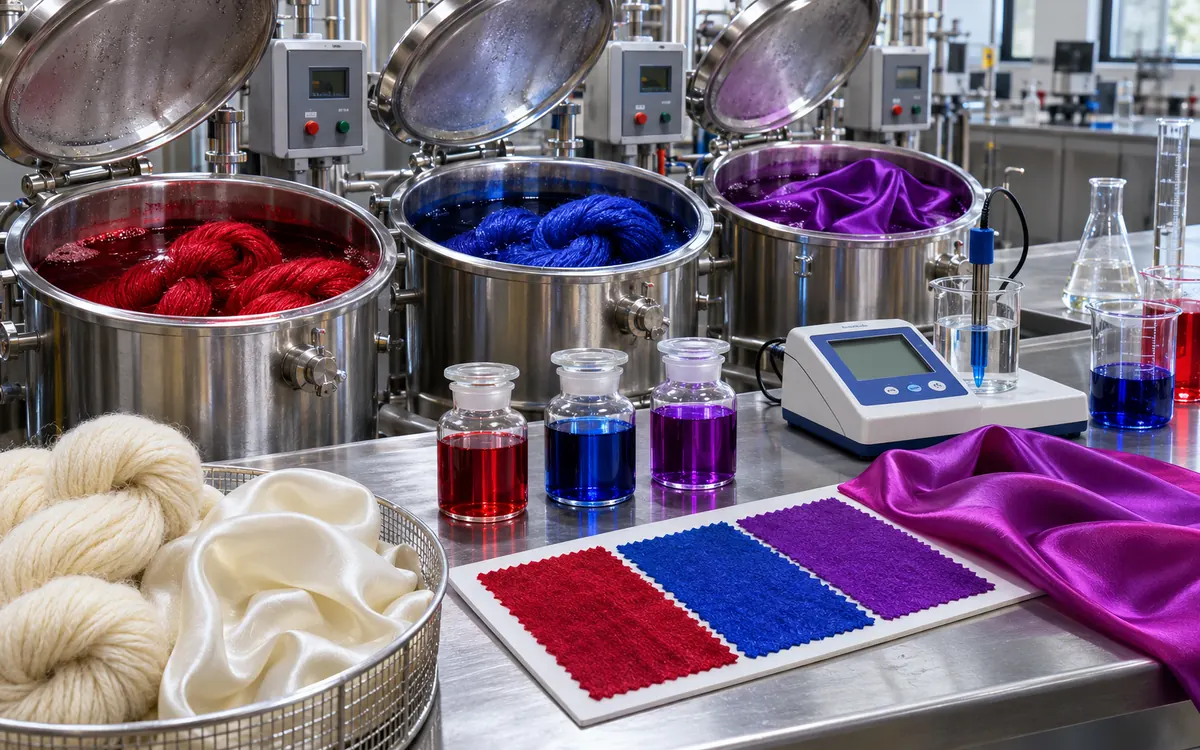
This guide explains what acid dyes are, why they have that name and how they bond to fibre. It covers the main types, with examples, the properties, the dyeing method, and a worked recipe with real quantities. It also looks at uses, problems and safety. For the full set of dye families, see our guides on the classification of dyes and on synthetic dyes.
What are acid dyes
Acid dyes are water-soluble dyes with a negative charge, carried on acid groups in the molecule, most often sulfonic acid groups (-SO₃Na). They are applied from a bath that contains acid. Because the dye carries a negative charge, it is called an anionic dye.
The name acid dyes does not mean the dye itself is a strong acid. It comes from the fact that the dyeing is done in an acid bath. The first acid dyes appeared in the 1860s and 1870s, and picric acid had been used to dye wool and silk yellow long before.
How acid dyes work
Wool, silk and nylon contain amino groups (-NH₂) in their structure. In an acid bath, these groups take up a hydrogen ion and become positively charged (-NH₃⁺). The negatively charged dye is then attracted to these sites by ionic bonds. In addition, weaker forces such as hydrogen bonds and van der Waals forces help to hold the dye.
Think of the fibre as a set of tiny magnets that turn on when the acid is added. The more acid there is, the more sites become charged, and the faster the dye rushes in. This is why the pH is the main control in acid dyeing.
| pH of bath | Effect |
|---|---|
| Strongly acid (pH 2 to 3) | Many charged sites, fast dye uptake, risk of uneven dyeing |
| Moderately acid (pH 4 to 5) | Slower uptake, easier to level |
| Weakly acid to neutral (pH 6 to 7) | Slowest uptake, best for dyes with high wet fastness |
Types of acid dyes
Acid dyes are grouped by how easily they migrate on the fibre and how well they stand up to washing. These two properties pull in opposite directions. Small molecules move easily and give level shades but wash out more. Big molecules stick strongly but may go on unevenly.
| Type | Molecule size | Dyeing pH | Levelling | Wet fastness | Typical use |
|---|---|---|---|---|---|
| Levelling (equalising) acid dyes | Small | 2 to 4, with sulfuric or formic acid and Glauber’s salt | Excellent | Fair | Bright shades on wool where levelness matters most |
| Milling acid dyes | Medium | 4.5 to 6, with acetic acid or ammonium acetate | Moderate | Good | Wool knits and fabrics washed often |
| Super-milling (neutral-dyeing) acid dyes | Large | 6 to 7, with ammonium acetate | Poor | Very good | Carpets, knitwear, nylon |
| 1:1 metal-complex dyes | Medium, with one metal atom per dye | Strongly acid, about pH 2 | Good | Very good | Deep shades on wool, but rarely used now due to metal in effluent |
| 1:2 metal-complex dyes | Large, with one metal atom for two dye molecules | Neutral to weakly acid, pH 5 to 7 | Fair | Excellent | Wool, nylon, leather, dark shades |
The name milling comes from the old fulling mill, where wool cloth was beaten in soap and water. A milling dye had to survive that treatment.
Examples of acid dyes
Dyes are named in the Colour Index (C.I.) by class, hue and number. Some well-known examples are:
| C.I. name | Common name or colour | Notes |
|---|---|---|
| Acid Orange 7 | Orange II | Bright orange, widely used on wool and nylon, also in teaching labs |
| Acid Red 1 | Azophloxine | Strong red |
| Acid Yellow 36 | Metanil yellow | Yellow, used for wool and paper. Not allowed in food in many countries |
| Acid Blue 25 | Blue anthraquinone type | Good light fastness |
| Acid Black 1 | Amido black 10B | Deep black, used for wool and as a protein stain in labs |
| Acid Violet 17 | Violet type | Bright violet |
| Acid Green 25 | Green anthraquinone type | Good fastness |
| Picric acid (Acid Yellow 1 family) | Early yellow dye | Explosive when dry, no longer used in textiles |
Many acid dyes are azo dyes, but anthraquinone and triphenylmethane types are also common, especially for blues and greens. Check the current safety and regulation status of any dye before use.
Properties of acid dyes
| Property | What it means |
|---|---|
| Charge | Negative (anionic) |
| Solubility | Good in water, usually dissolve in hot water |
| Affinity | Wool, silk, nylon and leather |
| Dyeing bath | Acid, at or near the boil for wool and nylon |
| Shade range | Wide and bright |
| Levelling | Good for small-molecule types, poorer for large ones |
| Light fastness | Fair to excellent depending on type |
| Wash fastness | Fair to excellent depending on type |
| Compatibility | Dyes of the same type mix well |
| Effect on fibre | Mild, if heat and pH are controlled |
| Cost | Moderate |
Dyeing wool with acid dyes: the method
Wool is delicate. It can felt if it is agitated hot, and it can be damaged in strong acid or alkali. A careful method is:
- Prepare the bath. Fill the machine with soft water at 40 degrees Celsius. Add a levelling agent and the acid (formic, acetic or sulfuric acid, depending on the dye class). Add salt such as Glauber’s salt (sodium sulfate) for levelling dyes.
- Load the wool. Run for 10 minutes to wet it out.
- Add the dye. Dissolve it in hot water and add it slowly through a strainer. Run 10 minutes.
- Heat slowly. Raise the temperature to 98 to 100 degrees Celsius at 1 to 1.5 degrees per minute. Heating too fast gives uneven colour.
- Hold at the boil for 45 to 60 minutes. During this time the dye moves into the fibre.
- Cool slowly to about 70 degrees before draining. Cooling fast can felt the wool.
- Rinse and after-treat. Rinse warm, then cool. Apply a fixing agent or soften if needed.
Dyeing nylon with acid dyes
Nylon is a synthetic polyamide with amino end groups, so it takes acid dyes too, though it has fewer sites than wool. Use a pH of about 4.5 to 6 and a temperature near 98 degrees Celsius. Level dyeing is hard because nylon can show barre (stripes) if the yarn varies. Use a levelling agent for nylon and control heating at 1 degree per minute through the critical range. See our guide on nylon fiber for fibre details.
Dyeing silk
Silk is dyed in a gentle acid bath, often with acetic acid, at 85 to 90 degrees Celsius to protect the lustre. Too much heat harms the fibre. See our guide on what silk is made of for the structure of the fibre.
Worked example: a recipe for 50 kg of wool
A dye house colours 50 kg of wool knit fabric with a levelling acid dye at 2 percent shade. The recipe, as a typical starting point, is:
- Liquor ratio: 1:15
- Dye: 2.0 percent owf
- Glauber’s salt: 10 percent owf
- Formic acid (85 percent): 2.0 percent owf
- Levelling agent: 1.0 percent owf
Quantities:
- Water = 50 × 15 = 750 litres
- Dye = 50 × 0.02 = 1.0 kg
- Glauber’s salt = 50 × 0.10 = 5.0 kg
- Formic acid = 50 × 0.02 = 1.0 kg
- Levelling agent = 50 × 0.01 = 0.5 kg
Bath pH check. The pH should come out near 3.5 to 4.5, but depends on the water, so test and adjust.
Time. Heating from 40 to 98 degrees at 1.5 degrees per minute takes 58 ÷ 1.5 = 39 minutes. With 10 minutes wetting, 10 minutes dye addition, 60 minutes at the boil and 30 minutes of slow cooling, one cycle takes about 150 minutes, plus rinsing and unloading.
Dye in effluent. If the exhaustion is 95 percent, 5 percent of the dye stays in the bath:
- Residual dye = 1.0 × 0.05 = 0.05 kg = 50 g in 750 litres, a concentration of 50 ÷ 750 = 0.067 g/L, or 67 mg/L
This colour goes to the effluent plant. A higher exhaustion lowers it. Adjusting pH, time and temperature can raise the exhaustion above 98 percent for many dyes. See our guide on the water treatment plant process in industry.
Why use acid dyes
- They give bright, strong colours on wool, silk and nylon.
- The range of shades is wide, including strong blacks and navies.
- Levelling types give very even dyeing.
- Milling and metal-complex types have good wash fastness.
- The process uses temperatures that wool and silk can handle.
- Equipment is simple and widely available.
Limitations of acid dyes
- They do not dye cotton, viscose or polyester well.
- Levelling dyes can have poor wet fastness.
- Some shades have fair light fastness.
- Metal-complex dyes put metals in the effluent.
- Strong acid baths harm some fibres and equipment.
- Dyeing must be controlled carefully to avoid unevenness.
- Some acid dyes have restricted use due to health concerns.
Uses of acid dyes
- Wool: Knitwear, suiting, blankets, carpets, yarn and hand knitting wool.
- Silk: Scarves, sarees, ties, dress fabrics.
- Nylon: Hosiery, activewear, swimwear, carpets, lingerie.
- Leather: Shoes, bags, upholstery.
- Paper and ink: Some acid dyes colour paper, ink and wood stains.
- Lab and biology: Some are used as stains, such as acid fuchsin.
- Food and cosmetics: A few related acid dyes are certified for food or cosmetic use, but these are separate, tested products.
- Hobby dyeing: Craft dyers use acid dyes on wool and silk at home with citric acid or vinegar. Use separate pots, gloves and a mask for powders.
Common problems and fixes
| Problem | Likely cause | Fix |
|---|---|---|
| Uneven dyeing | Heated too fast, too much acid early | Slow heating, add acid in steps, use a levelling agent |
| Poor depth of shade | Not enough dye or time, pH too high | Raise dye amount, check pH, hold longer |
| Dye spots | Undissolved dye | Dissolve dye completely and strain |
| Felted wool | Agitation at high heat, sudden cooling | Gentle movement, slow cooling |
| Poor wash fastness | Wrong dye class, no after-treatment | Select milling or metal-complex dye, use a fixing agent |
| Dull shade | Hard water or iron | Use soft water, add a sequestering agent. See sequestering agents |
| Barre on nylon | Yarn variation, fast heating | Use matched yarn, slow heating, levelling agent |
| Shade change between lots | Different pH or time | Standardise recipe and record every batch |
| Rubbing off | Unfixed dye on the surface | Wash off well |
Safety and environmental points
- Some azo acid dyes can release restricted aromatic amines under certain conditions. Check the dye’s data sheet and your buyer’s restricted substances list.
- Metal-complex dyes and mordant dyes carry chromium, cobalt or copper. Treat effluent and follow limits.
- Strong acids such as sulfuric acid are corrosive. Use gloves, goggles and safe handling.
- Dye powders can irritate lungs and eyes. Use dust control and masks.
- Keep dye pots and tools separate from food tools.
- Test finished goods for colour fastness. See our guide on colour fastness tests.
For the other dye families that work in similar baths, see our guides on basic dyes and the full dyeing process.
Final thoughts
Acid dyes are the standard answer for colouring wool, silk and nylon. Their power lies in the link between acid, charge and dye. Control the pH, heat slowly, choose the right type for the washing level you need and keep careful records. With those habits, you can get bright, level shades and keep waste down.
Frequently asked questions
Acid dyes are water-soluble, negatively charged dyes applied from an acid bath. They are used mainly on wool, silk and nylon.
Because the dyeing is done in an acid bath. The dye itself is not a strong acid.
Wool, silk, nylon and leather. They do not dye cotton or polyester well.
Levelling dyes are small and give very even dyeing but have lower wash fastness. Milling dyes are bigger, give better wash fastness and are harder to level.
Acid gives the fibre a positive charge, which attracts the negative dye. More acid means faster dye uptake.
Wool and nylon are usually dyed near the boil, at 95 to 100 degrees Celsius. Silk is dyed a little lower, at 85 to 90.
Many are safe when used properly, but some are restricted. Check the safety data sheet and the buyer’s rules.